Showing posts with label KM principles. Show all posts

Monday, 10 January 2022

Why "Top down vs bottom up" is a false dichotomy for knowledge management implementation

There is a bit of a philosophical divide in KM circles - those who take a top-down approach to implementation, and those who prefer bottom-up.  The truth is that neither are right.


Image from wikimedia commons
The bottom-up view is that if you provide people with the KM tools, then Knowledge Sharing will naturally emerge. They point to Wikipedia as a prime example of this - the wisdom of the crowds spontaneously emerging as documented knowledge. They point to Twitter, to Linked-In, to many of the global social networking tools. They believe that Knowledge is organic, and that too much management will kill it. This was certainly a very prevalent view a decade ago, particularly where communities of practice were concerned.

The top-down view is that knowledge is an asset to an organisation, and that assets cannot safely be left to manage themselves. They believe that if there is an area of knowledge which is important to the organisation, then there should be a community of practice that looks after that knowledge. They delegate a chain of accountabilities for KM, starting from the very top.

ConocoPhillips is a prime example of the structured knowledge company - they divide their business into areas of competence, and for each one they make sure there is a community of practice and a network leader, who is also the editor of the relevant wiki page. The network leaders are given training, and the communities are nurtured through a growth process until they become very effective knowledge-sharing mechanisms. Each network leader reports upwards through functional excellence teams into the functional leadership of the organisation.

However, maybe there is no dichotomy here: 

  • Nonaka and Takeuchi list "top down/bottom up" as one of the 7 Western polarisations which you should not get hung up about;
  • The top (management) and the bottom (knowledge workers) are both stakeholders for knowledge management, and to focus only on one is a common implementation trap;
  • Knowledge is an asset both for the organisation, and for the knowledge workers.
Knowledge Management therefore has to work both for the top and for the bottom. You can neither implement it from the top or from the bottom - nor, for that matter, as a middle-up-down approach.

Knowledge Management needs to be implemented holistically - including top, bottom and middle. All three layers have to be involved, and all three have to see value being delivered for them.

Because you cannot implement KM holistically for the whole organisation all at once, you need to take a piloting approach to Knowledge Management implementation, introducing it holistically for one practice area to solve one business problem. Once it is working here, delivering value to top, middle and bottom, then move to the next practice area, then the next, until the job is done and implementation is complete.

This is implementation not from the top, nor from the bottom, but from side to side; from wall to wall.

Monday, 29 November 2021

The top 7 tips for successful knowledge management programs

This is a blog post I repeat every 5 years or so, my summary of Top 7 success factors for implementing Knowledge Management. 

There are more than 7, of course (see the knowledge manager's handbook for details), but these are some of the most fundamental recommendations. Many if not all of these are now included within the ISO KM standard, and this blog post has been updated this year to reflect this.

"Tip of the Day" from Wikipedia


1. KM needs to be driven by operational needs.  


It is vital that KM efforts are clearly linked to operational outcomes, with a clear business objective. I have a quote from a survey from the early 00s, that reads as follows

“Most successful knowledge management applications addressed a ‘life or death’ business situation. Successful cases answered two questions at the outset - What business objective am I trying to achieve? How can I apply existing knowledge?”

Here's another quote

"We have been looking at the key processes of the business, testing them for their "knowledge intensity" to see if we would create some significant new change in the performance of that particular process if we managed knowledge in a more profound way. The concept has not been difficult to sell to the top executive team." 

See how this approach starts with the key business processes?

Tom Davenport and co-authors, in the paper "Building successful Knowledge Management projects", conclude that "Link to economic performance or industry value" is the number one success factor for successful KM. Mars, for example, implemented KM at a rate of two business issues per year

ISO 30401 (the ISO MSS standard for KM), in its first requirement clause, links KM to defined operational outcomes, so this first success factor is fundamentally woven into the ISO KM standard. 

2. KM needs to be introduced as a management framework. 


A Knowledge Management Framework is a a small defined set of technologies and processes, embedded into business activity, and a small defined set of roles embedded into the organisational structure, all under an umbrella of Governance.  Like other management systems, effective KM is a framework of roles, processes, technologies and governance which has been embedded into the business. Just as Financial Management is not a single tool - budgets for example, or invoicing - and is not a toolbox ("you can try writing budgets if you like - here's a guide"), but is a complete framework embedded into the business process, so Knowledge Management needs a framework. If there are holes in the framework, it will not deliver value.

A common mistake is to introduce one element of the Framework - a technology for example - and expect knowledge to start to flow. It won't. It might trickle, but it won't flow. 

Again, ISO 30401 requires KM to be implemented as a framework, including roles and accountabilities, processes, technology, governance, and culture (clause 4.4.4), covering the 4 main transitions or flow elements of knowledge (clause 4.4.3) and the lifecycle of knowledge (clause 4.4.2). Indeed, the whole concept of a "management system" as embodied in the KM standard equates to a management framework. 

3. KM needs to address Pull as well as Push and demand as well as supply.


I have blogged about this many times - Push creates supply, Pull creates demand and the two need to be in balance. Too many organisations focus on knowledge sharing, not on knowledge seeking and re-use. Pull, in the early stages, is more powerful than push. Creating demand for knowledge creates a market for knowledge.

We didn't manage to get this principle into the ISO standard, though the standard is careful to refer to the need for a culture of seeking as well as sharing. With hindsight, I wish this element had been much stronger in the standard.

4. KM is a culture change process. 


It is not a gradual change either - it is a step-change. It is a remodelling of the organisation; a make-over, a new way of thinking. It needs to be treated as a change process and measured as a change process. Don't go into KM thinking that it is about a new IT tool, or just "trying out communities" - you won't get far if you don't start to address the hearts and minds. This also means that KM implementation must be structured like a change program (including a piloting component), and must have a strong team of change agents to implement the change.

Again, ISO 30401 supports this principle, and clause 4.5 requires organisations to demonstrate that they are addressing the cultural issues within the organisation.

5. KM must be embedded in the business


If its not embedded, you risk "tipping back" to a pre-KM state. Many of the high profile failures of KM are due to a failure to embed. You can't rely on KM being driven by the efforts of a central team. A central team are needed, but their role is an assurance and support role. The drive must come from the business. 

ISO 30401 requires a chain of accountability for KM to be established within the organisation (clause 5.3) and KM objectives and plans to be developed at appropriate levels and functions (clause 6.2). These plans and accountabilities are the means by which KM is embedded.

6. KM needs not just high level support, but high level expectation


People do what they believe is expected of them. People are generally good workers, they want to do a good job, and if something is expected of them as part of the job, they generally do it. Expectation can be explicit or implicit - written or unwritten. Expectation comes from leadership, and from peers, and these two sources of expectation need to be aligned to be effective . For example there is no point in the boss saying "I expect you to have a work life balance" if all your peers are working to 10pm and expect you to be part of the team, or if your boss is emailing you on a Sunday afternoon and expecting a quick reply. 

Senior management in the organisation needs to make KM expectations clear by explicitly stating what needs to be done in Knowledge Management, and by whom. They need to write these expectations down, and keep reinforcing them by what they say and do. They also need to make sure these expectations do not get weakened by, or conflict with, other company structures and expectations.

ISO ensures this is done by requiring leadership to approve and endorse a KM policy (clause 5.1). It is this policy that sets the clear expectation that KM is a vital component of the organisational  management systems set. 

7. KM should be introduced first where the highest value decisions are made. 


This might be at operator level (the operator of a plant, the driller of an oil-well, the pilot of a passenger aircraft) or it might be at senior management level. Knowledge supports decisions, and decisions are made at all levels. In fact the most valuable and risky decisions are made at senior level. The default approach to supporting these senior management decisions is to hire a big-5 consultant firm to supply the knowledge, but there is no reason why KM can't help as well.  Delivering a high level KM pilot at senior level has three benefits.
  • It delivers massive value to the business
  • It engages senior managers in KM, and helps them understand the value KM can bring
  • It gets senior managers on-side, by solving their problems for them (see the thorn in the lions paw).
Although ISO 30401 states that the role of knowledge, and therefore KM, is to support and improve decision making, the standard makes no recommendations about which decisions to prioritise. That is because the standard is a standard for the final KM system, not for the way in which the system is introduced to the organisation. Therefore let's repeat this one again, as you wont get it just by applying the ISO standard - "Introduce KM first where the highest value decisions are made"


These 7 success factors should help you introduce and sustain successful KM. It's no surprise that most of them are embodied in the ISO KM standard.


Monday, 9 November 2020

8 demand-side principles for Knowledge Management

In 2008 David Snowden published a landmark article on 7 KM principle, mainly focusing on the supply side of knowledge management. The post below, upcycled from 2012, aims to present similar principles from the demand side. 


David's 2008 post is currently (Nov 2020) unavailable, but his principles are as follows:

  1. Knowledge can only be volunteered it cannot be conscripted. 
  2. We only know what we know when we need to know it.
  3. In the context of real need few people will withhold their knowledge.
  4. Everything is fragmented. We evolved to handle unstructured fragmented fine granularity information objects, not highly structured documents.
  5. Tolerated failure imprints learning better than success.
  6. The way we know things is not the way we report we know things.
  7. We always know more than we can say, and we will always say more than we can write down.
All except number 5 addresses the expression and presentation of knowledge.  There is of course another side - the demand side, or the user side - which represents the transition from expressed knowledge to conscious understanding and to unconscious knowing. Here I offer a set of principles which apply to the other side of the equation - the learning side

These principles are based on our own experience in Knoco, and there is some overlap with the established “principles of learning” used in the educational field.

Here are our principles
  1. People don’t pay attention to knowledge until they actually need it. People won’t  absorb knowledge until they are ready, and they won’t be ready until they feel the need.  I could give you detailed driving instructions of the quickest way to travel from Bath in Somerset to Woking in Surrey, but you wouldn’t retain them because they are of no immediate value to you. Then one day, you are at a garden party in Bath and your boss calls and says “can you get to Woking as quickly as possible, we have a potential big deal to close and I need you here right now”. THEN you will be highly receptive to the knowledge. The consequence of this "attention when needed" is that it is more effective to set up “just in time” knowledge sharing processes than “just in case” knowledge sharing processes (although these also have their place).
  1. People value knowledge that they request more highly than knowledge that is unsolicited.  I don’t know the psychology behind this, but it seems to be true.  The best way to get knowledge into people’s heads seems to be by answering their questions. The old fashioned “show and tell” is far less effective than “question and answer”, and the blog is less effective than the discussion forum.  The company where the most questions are asked, is often the company that learns the quickest.  This principle is behind the design of most effective knowledge management processes, the majority of which are based on dialogue, and the primary focus of communities of practice should be answering questions rather than publishing ideas.
  1. People won’t use knowledge, unless they trust its provenance.This is the “not invented here” principle, which is a very strong factor in knowledge management terms.  People won’t use knowledge they don’t trust, and they don’t trust knowledge if they don’t know where it has come from.  They need either to trust the individual who gave them the knowledge, or the organisational construct (such as the CoP) which provided the knowledge.  The source may be an expert, or a wiki (many people trust Wikipedia for example, despite its shortcomings), or a community of practice, and building credibility and trust has to be a key activity when building these constructs as part of the knowledge management initiative.
  1. Knowledge has to be reviewed in the user’s own context before it can be received.  One of the knowledge receiver’s first questions is “is this relevant to me?” Everybody always feels their own context is different (even though the difference is often less than assumed), and they need to test the knowledge for relevance before they really pay attention.  We were recently facilitating a peer assist, where people were bringing knowledge from Africa, from India, from China, to be used in an Indonesian context.  For each of the learning points, we needed about half an hour to an hour’s discussion around context, before we could even approach discussion of how imported knowledge might be used. This means that transferring knowledge in a written form is difficult, unless you can introduce a process by which people can interrogate this within their own context.
  1. One of the biggest barriers to accepting new knowledge is old knowledge.  This is the curse of prior knowledge. People have to unlearn, before they can learn.  Old assumptions, old habits, “the way we have always done it in the past” may all have to be challenged before people can absorb and make sense of new knowledge.  This can be hard work! As an example, see the story about the war of the hedgerows, where the U.S. Army completely missed the implication of the Normandy hedgerows, assuming they would not be a factor in tank and infantry warfare after the D day landings
  1. Knowledge has to be adapted before it can be adopted.  If people are provided with guidance, tips and hints, or even a “recipe to follow,” they will always tweak it and adjust it in order to “make it theirs”.  Sometimes this tweaking and adjusting is necessary to fit the knowledge to their own context; sometimes it is unnecessary in practical terms despite being necessary in emotional terms.  So when you are providing people with guidance, tips and hints or even a “recipe”, you have to give them some idea of where they can still adapt it, and where dangerous tinkering should be avoided. Otherwise they may "adapt" the wrong thing. We see this all the time in our Bird island exercise - they all want to tinker with the final design, and you have to let them tinker, but try to guide them to tinker in non-fatal ways!
  1. Knowledge will be more effective the more personal it is.  The more personal, emotional, and highly charged the learning situation, the more the knowledge will be easily adopted.  Discussion, story telling and coaching can be personal, and motional and highly charged, but it becomes difficult to translate this into the written word.  The use of stories is very helpful, the use of video even more so.  Obviously this has profound implications for knowledge transfer mechanisms.
  1. You won’t really KNOW it until you DO it.  We very often see in lessons learned meetings, teams that say  “we picked up this learning from the previous project, we tried it and it really did work!  That was a great learning for us”.  When they picked it up they knew it intellectually; after they had tried it they knew it practically and emotionally.  Seeing is believing, trying is trusting, doing is internalising.  This sort of positive reinforcement of learning is a massive boost for your knowledge management program; as people try things and find they work, this reinforces the belief that knowledge from others is of real practical value.


Monday, 13 July 2020

10 principles for managing knowledge, from Stephen Denning

In this article from Forbes Magazine in 2012, Steven Denning, once head of KM at the World Bank and a wise commentator on Knowledge Management topics, describes his ten principles for managing knowledge.


These are as follows


  1. The amount of money that could be spent on accumulating knowledge is infinite: Knowledge is in principle limitless. Accumulation of knowledge "just in case" is an endless task.
  2. However Knowledge has no value per se: Knowledge acquires value from use. 
  3. Spending on knowledge has negative value if organization doesn’t use it. Knowledge is only useful to those willing and able to learn.
  4. Institutional knowledge may serve as blinders to effective action (he cites this example where gaining more documented knowledge sometimes hindered performance). 
  5. The most valuable knowledge increasingly lies outside the organization. 
  6. Knowledge can require deep expertise to access it.
  7. The deep expertise needed to access knowledge can be lost.
  8. The value of knowledge lies in improved outcomes for external customers or stakeholders (I think we could include internal stakeholders as well). 
  9. What constitutes an improved outcome depends on the organization’s strategy.
  10. Outcomes need to be measured against the organizational strategy. Nothing can be managed unless and until it is measured. Knowledge has no value per se; it has to be measured in relation to the strategy it is intended to accomplish.

These principles are admirably focused on knowledge use, and the outcomes of knowledge use. This should be the focus for all KM programs. 

Thursday, 25 June 2020

The 10 principles behind successful KM strategies

I blogged last week about the 5 basic principles behind successful Knowledge Management. Let's take that one step further, into the principles behind a KM Strategy.


When Stephanie Barnes and I wrote our book "Designing a successful KM Strategy" we included a chapter on the ten principles behind KM strategies.  These are not just principles about KM, they are principles about how KM should be introduced, so they go beyond the 5 principles in last week's blog post.

Here are our 10 principles.


1. KM implementation needs to be organisation-led; tied to organisation strategy and to specific organisation issues. This is the fundamental behind KM implementation - the number one success factor (if present) and  a common reason for failure (if absent). 


2. KM needs to be delivered where the critical knowledge lies, and where the high value decisions are made. Knowledge Management needs to focus, and to focus on business-critical or business-strategic knowledge. This might be at operator level (the operator of a plant, the driller of a deepwater well, the pilot of a passenger aircraft) or it might be at senior management level.


3. KM implementation needs to be treated as a behaviour change program. Failure to
realise this is failure reason number one for KM programs.  


4. The endgame will be to introduce a complete management framework for KM. Unlike a KM toolbox, a Knowledge Management framework is a joined-up system of roles, technologies, processes and governance. The ISO standard for KM, ISO 30401:2018, describes the framework as a "Management System".


5. This framework will need to be embedded into the organisation structures. If you don't embed it in the business, KM wont survive. KM roles need to be embedded into the organigram, processes into the high level working process, technologies into the core technology set, and governance into the organisational governance structure. Without this, Km remains separate and optional. Many of the high profile failures of KM are due to a failure to embed.


6. The framework will need to include governance if it is to be sustainable. Governance is the combination of structure, expectation, support and monitoring that any management discipline requires if it is to be applied systematically.


7. The framework will be structured, rather than emergent. I explain this here.


8. A KM implementation should be a staged process, with regular decision points. Don't rush in and try to implement KM in one go. Take your time, stage the process, and learn as you go. Treat implementation as if you were launching a start-up, and make sure you have a viable business model.


9. A KM implementation should contain a piloting stage. This is crucial both to test the framework, and to create the social proof you will need for the culture change program. This also allows agile development of the KM framework, informed throughout by user feedback.


10. A KM implementation should be run by an implementation team, reporting to a cross-organisational steering group.  In other words, just like any other change program or project!  Choose the team wisely - they have a difficult job to do.

These are our 10 principles. Many of these are embedded within ISO 30401:2018; the ISO management systems standard for KM. Numbers 1 through 7 will be satisfied if you follow the guidance within the standard. 8, 9 and 10 address the structure of the implementation rocess itself which is outside the scope of the standard. 

Friday, 19 June 2020

5 universal principles for Knowledge Management

There is no universal solution for Knowledge Management in an Organisation, but there is a set of universal principles.


A Management Framework for KM is bespoke - not off-the-peg. Each organisation must find its own solution , and must design its own Framework. There is no template, no universal solution, no single toolbox of KM technologies, no "KM Ultimate Swiss Army Knife", no one magic system that does it all, no single KM Process set, no a single design for set of KM roles, no universally applicable KM policy that all companies can adopt.

However I believe there IS a universal set of 5 Knowledge Management principles that every successful Knowledge Management application adopts, and which form the foundation for a successful KM framework. 4 of these principles are embedded within ISO 30401:2018, the ISO management systems standard for KM.

Please note, these are the principles behind KM framework design, not the principles for KM strategy [which are about the vision and direction for introducing KM], or the principles for KM implementation [which is how the framework will be developed and rolled out].

These Principles are as follows.

1. Aligned. The KM framework must align with the needs and strategy of the organisation.

Knowledge Management should not be introduced for its own sake; it should be introduced because it solves business problems and helps the organisation perform better. ISO 30401:2018 supports this by,  in the first two requirements, asking for an understanding of how KM supports the organisational context, and for a mapping of the stakeholders and their needs. These two tasks form the foundation for the Management Framework.

The primary value of knowledge is helping people make better decisions, and so perform work better, faster and/or cheaper. There are secondary values as well (helping people fell more engaged, more connected, more supported) but all of these are also in service of a better organisation.  Knowledge management for its own sake can often destroy value, as this example of misplaced collaboration shows.

Your knowledge management framework therefore needs to focus preferentially on the knowledge of highest organisational value (ISO clause 4.3), and of providing the highest value and highest utility knowledge to the knowledge workers and other stakeholders at the place and the time that they need it (hence the concept of KM as a Knowledge Supply Chain).

Unfortunately business alignment is the second weakest of all the elements in our free online self-assessment survey, which suggests that this principle is not always followed.
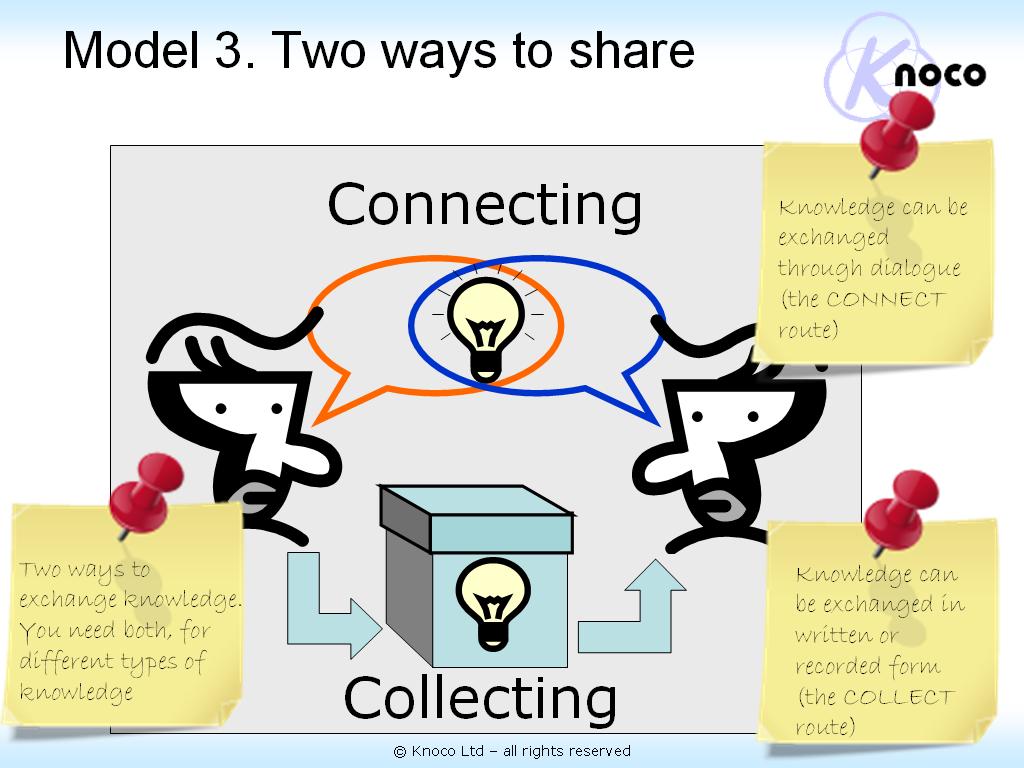

2.  Connect/Collect. The KM Framework must include Connect and Collect (aka Conversation and Content)


One of the earliest models in the history of Knowledge Management, and one that sometimes seems to get forgotten, is that there are two key dimensions in Knowledge Management, representing two routes between the knowledge suppler, and the knowledge user.

These are the Connect route, and the Collect route.

The Connect route supports knowledge transfer through connecting people and focuses on tacit knowledge.  The Collect route supports knowledge transfer through collecting knowledge into documents and focuses on codified knowledge.

Connect and Collect are not alternative strategies. They are two components of a single framework and a single strategy, which work in parallel.  Your organisation will contain critical knowledge of very many kinds; some of it managed as Content, and some as Conversations.  Conversations are a far richer medium than Content,  potentially 14 times richer, though Content can reach far more people, and has a longer life-span than a conversation.

Content and Conversation are the King and Queen of Knowledge Management - they rule together. Content is something to talk about, Conversation is where Content is born and where it is Tested.

In clause 4.3.3, the ISO standard requires organisations to address Connection through Human interation, and Collection through a) the representation of human knowledge in the form of documents, videos, and other artefacts: b) the combination and synthesis of documented knowledge, and c) the internalisation and reuse of knowledge.

3. Push and Pull. The framework must address Push and Pull (aka knowledge supply and knowledge demand)

I have blogged many times about push and pull in KM - push being the transfer of knowledge driven by supply (eg speculative publishing, or loading material to a database or wiki), and pull being the transfer of knowledge driven by demand (eg asking a question on a forum, or searching an Intranet).

 The ideal KM system runs push and pull in parallel - both supply and demand as valid ways of instigating the knowledge flow.

Push without pull (supply without demand) leads to knowledge over-supply and overload, and to ultimate destruction of knowledge value. Pull without push is better, but is ephemeral. Knowledge management, whether you view it as a market or as a supply chain, needs both supply and demand - both push and pull - if it is to function.

ISO 30401 does not address Supply and Demand, unfortunately.

4. The 4 legs. The KM framework must include Roles, Processes, Technologies and Governance

There are 4 enablers that support Knowledge Management, like 4 legs that support a table. These are

Like the 4 legs on a table, the 4 elements of KM are all equally important. No single element is dominant - they all support KM, and they support Knowledge Management in supporting the business.  Focus on all four enablers, to an equal extent, and your Knowledge Management table will stand firm and secure in support of the organisational strategy.

Clause 4.4.4 of ISO 30401:2018 contains the requirement to address these 4 enablers, plus the additional factor of culture. I do not include culture here, as I believe culture is an outcome of the management framework rather than part of the framework. The ISO standard goes on to include specific sections on three of these enablers:

  • 3 clauses addressing Roles (5.3, 7.1, 7.2)
  • 1 clause addressing Process (section 8)
  • 14 clauses on governance (5.1, 5.2, and all of sections 6, 7, 9 and 10)

5. Embedded. KM must be embedded into the structures of the organisation.

Lots of KM programs do not take root, because they have never been embedded in normal business. They are delivered by a strong team and a charismatic leader delivered as something separate - not fully rooted in the work structure and management framework of the company. They are like a tree in a pot - well tended, well watered, but separate - and when the tender care is removed, the organisation tips back. KM needs to be like a tree in a forest - rooted in the fabric of the business.

The goal is to embed a self-sustaining approach to KM in all elements of the business, with clear governance and good support, and clear evidence of sustainable culture change and sustainable business value.

Change the project requirements, to include KM. Change the minimum conditions of satisfaction for project delivery, to include effective lessons identification. Change the rules for project sanction, so a project gets no money if it hasn't done any learning. Change the job descriptions for the company experts, so that they are held acountable for stewardship of the company knowledge. Change the reporting requirements, the HR appraisal mechanism, change the incentive scheme to reward collaboration and discourage competition. Change the rules on timewriting. Notice the use of the word "change" there? Every such change is another KM root going down.


ISO 30401 requires these changes to be in place, and that top management ensures "the integration of the knowledge management system requirements into the organization’s business and project processes".

Using the 5 principles


Use these 5 principles to design your Knowledge Management Framework, with guidance from ISO 30401:2018. You will still need to decide

  • What the critical business knowledge is, that you need to align to
  • How to connect people and set up conversations
  • How to collect knowledge and manage content
  • How to create a demand for knowledge
  • How to create a supply of knowledge
  • Which roles to put in place
  • Which processes to adopt
  • Which technology to use
  • What governance to apply, and
  • How and where to embed the roles, processes, technology and governance.

However the principles will ensure that the framework you create works well, is stable, has no gaps, covers all relevant types of knowledge, and will not "tip back" to the previous pre-KM state.


Contact Knoco if you need any help in designing your KM framework.


Tuesday, 3 March 2020

10 principles for KM in product development

KM in product development has its own set of principles. Here they are.


The Exploratory Product Development Resolution Loop
by Petepetey via Wikimedia Commons
Kennedy, Harmon and Minnock's excellent book "Ready, Set , Dominate" takes a knowledge-centred view of product development, inspired by practices of Toyota Motor Company and refined through application to a wide variety of industries across the globe. Here are the ten principles that they list in the conclusion to the book (my explanation and commentary in italics).

1. Knowledge is both the raw material and the output of product development. This leads to the view of a knowledge workstream in parallel with the product workstream.  
2. Set-Based Knowledge is infinitely more valuable than Point-Based Knowledge (this means that generically applicable knowledge, for example "these combinations work in these circumstances" and often stored as trade-off curves, is more valuable than specific knowledge such as "this combination worked in this circumstance")  
3. Knowledge must be visible to be used and managed (which means it must be discussed, and must be a conscious issue and asset) 
4. The product development organization must be skilled at creating, capturing and using the knowledge (which means that you need a knowledge management framework for product development) 
5. The knowledge needed to be successful is a deep understanding of the interests of all the customers in the operational value stream, how decisions made in design affect them and how those design decisions interact with each other (this is some of the critical knowledge. Other core knowledge is "how to develop products effectively and efficiently" and "how does our technology work in practice").  
6. The knowledge needed to be successful needs to be available before the decision, not afterwards (which implies knowledge available at the point of need, knowledge for decision support, and that people will seek the knowledge in order to support the decision) 
7. The decisions should be delayed as long as possible to allow the maximum learning within time and budget (this is a principle specific to lean product development, and represents the principle that the early stages of product development should not be about fixing the design but about gathering knowledge to ensure the right design is fixed) 
8. Mechanisms must exist within the product development process to pull the reuse of existing knowledge and the creation of additional knowledge before the decision deadline (ie mechanisms to ensure knowledge is sought and used) 
9. That knowledge should enable and be systematically used to eliminate the weakest alternatives from the set of all feasible solutions allowing designs to converge to the optimum (Toyota run several prototype designs in parallel, eliminating the ones that dont work and combining the characteristics of those that do. This is iterative and parallel development). 
10. The organization must manage the process of creating, capturing and using the product development knowledge with the same diligence given to other corporate assets" (Yes, yes, and a thousand times yes. Knowledge is the core asset for product development. As the quote from Toyota goes - "we dont make cars, we make knowledge, and from that knowledge great cars emerge".  Knowledge is the asset that enables you to make great products. MANAGE THAT ASSET IF YOU WANT TO SURVIVE!!).
With the possible exception of numbers 5 and 9, which refer specifically to a design/manufacture context, these principles should be applicable in many other Knowledge Management initiatives (see for example the US Army KM principles).

However see the words of warning below from the authors.

"What is difficult is that some of the principles are opposite to today's practices and even seem counter-intuitive. Further, some roles in organizations may need to be created or modified for better knowledge management. And, as with any initiative, there is the need to lead the organizational change. As these principles and capabilities begin to fall in place, engineering productivity and schedule attainment increases rapidly".

If you are a KMer in a product organisation, apply these principles, especially number 10.

Friday, 3 November 2017

10 things best-in-class KM companies have in common

There are many things that the world leaders in KM have in common. Here are 10 of them.


Free image from Max Pixel
A focus on know-how, and providing know-how to the decision makers at all levels. The leaders in KM know that the end goal of KM is providing knowledge to people who need it to make decisions. A prime example here is the US Army hurricane story, but we can see this same principle in all KM leaders.

A focus on driving their performance through knowledge. Whether this is Shell drilling wells faster, NASA cutting cycle time, Severn trent improving their efficiency - all successful KM companies link KM activity to improved performance.

An understanding of the value of their knowledge. Leading KM companies know how much (in rough terms) KM means to them, and try to track the value through measuring the value of KM interactions like ConocoPhillips, or estimating the value of answered questions like Siemens. 

An understanding that knowledge is decentralised. Rather than centralising knowledge with experts or in centres of expertise, leading companies realise that knowledge is dispersed in the organisation and shared through communities of practice, as seen at Ericsson, World Vision, and Halliburton. Bringing together knowledge from many places yielded big benefits for Mars.

A complete framework for KM. Rather than just introducing one component of KM, Best in Class companies make sure they cover Roles, Processes, Technology and Governance. Bombardier is a great example,  with a framework of roles, processes, communities, technolgies and governance.

A balance of connecting and collecting. Connect and Collect are the two main pathways for knowledge transfer, and all the leaders in the field run both pathways in parallel - CoPs and wikis at Shell, CoPs and Wikis at Pfizer, Knowledge Assets and communities at Samsung, Siemens and others. They realise that both pathways complement each other, and are not mutually exclusive alternatives.

Embedded roles. All the leaders ensure there are embedded roles for KM. MicKinsey, for example, have 1800 knowledge professionals including knowledge owners, and the other big consultancies are amonst the world leaders in employing staff in knowledge roles together with the big technology firms like IBM and Hewlett Packard.

Embedded processes. KM processes are embedded in all the best-in-class KM companies. Processes such as After Action Review can be found in the oil majors, the emergency services and the military, while lesson learning processes and learning from experience has delivered value at Ford, the Canadian Air Force and Transport for London, and Peer Assist has be used to great effect at De Beers

Culture and behaviours, supported by governance. All the leaders recognise that culture is key, and address this through various governance processes such as the NASA KM policy, the knowledge policy for the Hong Kong Police, the Archimedes awards at Conoco, and the Oxfam "rightds and responsibilities" charter

Enough technology, and the right technology. Each of the leaders has a technology set that does everything needed in KM terms without going over teh top. This example from Schlumberger shows the ideal approach for KM technology, which is to select it based on need, and to eliminate any tehcnology which will cause confusion.

Wednesday, 6 September 2017

Knowledge Management principles from the US Navy

Another set of interesting KM principles to go in our limited collection.


These KM principles were presented by Michael Hill at KM Australia, and Michael (CKM and mentor for Tactical Training group, Pacific) was keen to point out that he was sharing his personal views, not those of the US Navy.

Whether they are Michael's person principles or are applied also within the Navy, these are a useful addition to our Principles collection, which at the moment includes:


Michael describes his principles (many of them from Nissen's book "Harnessing Knowledge Dynamics") as follows:

  • Knowledge is what enables action
  • Knowledge is not the same as data, or information
  • KM is about People, process, organisation and tools (the same as the four enablers we recognise at Knoco, except we refer to Governance rather than Organisation)
  • Tacit knowledge provides sustainable competitive advantage (explicit knowledge can be copied or stolen)
  • The dynamics of tacit knowledge are different from the dynamics of explicit knowledge, and rely on people talking to each other
  • Knowledge-enabled action determines performance, which provices competitive advantage (or mission success). Learning from action, performance and competitive advantage can create feedback loops
  • Taking action on feedback creates tighter human networks, which are more powerful than the written reports.

Tuesday, 25 July 2017

Example KM principles - US Army TRADOC

Here is a neat and concise set of KM Principles from the US Army.


These KM principles for the US Army Traning and Doctrine command are taken from the website for the TRADOC Chief Knowledge Office.  There are many KM principles here that could apply to any organisation.


People
  1. Train and educate KM leaders, managers, and champions.
  2. Reward knowledge sharing and make knowledge management career rewarding.
  3. Establish a doctrine of collaboration.
  4. Use every interaction, whether face-to-face or virtual, as an opportunity to acquire and share knowledge.
  5. Prevent knowledge loss.

Processes
  1. Protect and secure information and knowledge assets.
  2. Use legal and standard business rules and processes across the enterprise.
  3. Embed knowledge assets (e.g. links, podcasts, videos, documents, simulations, wikis) in standard business processes and provide access to those who need to know
Technology

  1. Use standardized collaborative tools sets.
  2. Use Open Architectures to permit access and searching across boundaries.
  3. Use a robust search capability to access contextual knowledge and store content for discovery.
  4. Use portals that permit single sign-on and authentication across the global enterprise including partners.
Content
  1. Use standardize repositories that tags content allowing enterprise discoverablity and sharing capabilities to capture, preserve and make available information essential for decisions, and actions.
  2. Document Management using common taxonomies.

Thursday, 1 December 2016

KM principles froim the US Army

I blogged last month about knowledge principles from the UK government. Here is another set from the US Army.


Here you can find a document by the United States Army, listing (and illustrating) their 12 Knowledge Management principles.

These principles are as follows:

1. Train and educate knowledge management leaders, managers and champions.

2. Reward knowledge sharing.

3. Establish a doctrine of collaboration (they explain the principles of collaboration as 1. Responsibility to Provide - 2. Empowered to Participate - 3. User-driven)

4. Use every interaction as an opportunity to acquire and share knowledge.

5. Prevent knowledge loss.

6. Protect and secure information and knowledge assets.

7. Embed knowledge assets (links, podcasts, videos, documents, simulations, wikis and others) in standard business processes and provide access to those who need to know.

8. Use legal and standard business rules and processes across the enterprise.

9. Use standardized collaborative toolsets.

10. Use open architectures to permit access and searching across boundaries.

11. Use a robust search capability to access contextual knowledge and store content for discovery.

12. Use portals that permit single sign-on and authentication across the global enterprise, including partners.

An interesting list, and also interesting to see what's missing - nothing there about institutionalising capture and reuse, nothing there about accountabilities and ownership for knowledge, nothing there about linking KM to the primary issues; presumably because these three are all now firmly embedded in the US Army structure and ethos.

Nothing about "learning before, during and after" - in fact nothing there about the processes of KM itself. I would not use this list as a generic list - it must work for the US Army, but I suggest that it would need modification to be used elsewhere.

But nevertheless, it is a very interesting and instructive set of principles.

Friday, 7 October 2016

Knowledge principles for government

Here is a really interesting document on Knowledge Principles for the UK Government.


One of the first hurdles to get across when dealing with KM is to help people understand that knowledge and information are different, and need to be treated differently. This step is needed to head off the common, and futile, tendency to try to deliver Knowledge Management through Information Management tools.

In my experience, the UK Public sector has not really grasped this distinction in past years. many of their strategies and approaches have involved lumping KM and IM together, for example developing a KIM profession.

That is why it is so interesting to see a governmental body going back to basics, and asking "What's different about knowledge." The writers intend that these Principles will be used by departments to inform discussions on Knowledge and form the central tenet of their Knowledge Strategies (a set of Information Principles exist already).

It is worth reading the whole document, but in summary the principles are these.

1. Knowledge is a valued asset. If knowledge is not valued, KM will not attract the level of resource required for success.  
2: Knowledge needs the right environment in order to thrive. Whereas Information Management has tangible items to manage, KM relates to the intangible substance of a person or organisation’s awareness. Managing knowledge, therefore, is about working with people to create an environment where their knowledge is given freely and where they are supported and encouraged to share with and learn from others. 
3: Knowledge is captured where necessary and possible. Large and geographically dispersed organisations are unlikely to consistently share knowledge face to face. In order for knowledge to be fully exploited and contribute to the benefit of the organisation, it must be nurtured and readily accessible. This involves structured knowledge elicitation techniques such as retention interviews.  
4: Knowledge is freely sought and shared. This requires techniques to socialise learning (eg through the concept of Communities of Practice); the application of social business software; and mentoring programmes. 
5: Knowledge increases in value through re-use. The advantage of making knowledge widely available is that organisations can exploit it to avoid re-work, avoid repetition of bad practice / mistakes, and improve processes / ways of working. In this sense, knowledge increases its value by delivering benefit through sharing and re-use.  
6: Knowledge underpins individual learning 
7: Knowledge underpins organisational learning.  Principles 6 and 7 build on the preceding ones as the foundation for individual and organisational learning, exploiting knowledge at both the individual and organisational level to become more effective and efficient, increase capability and achieve greater impact. 


I like these principles, and hope they will leads the government towards developing Knowledge Management strategies that are really about Knowledge Management, and not information Management under a different name.

Monday, 18 May 2015

Steven Denning's KM principles

In this article from Forbes Magazine in 2012, Steven Denning, once head of KM at the World Bank, and one of the wiser writers on Knowledge Management, describes his ten principles for Knowledge Management.


These are as follows


  1. The amount of money that could be spent on accumulating knowledge is infinite: Knowledge is in principle limitless. 
  2. However Knowledge has no value per se: Knowledge acquires value from use. 
  3. Spending on knowledge has negative value if organization doesn’t use it. 
  4. Institutional knowledge may serve as blinders to effective action (he cites this example where gaining more documented knowledge sometimes hindered performance). 
  5. The most valuable knowledge increasingly lies outside the organization. 
  6. Knowledge can require deep expertise to access it: 
  7. The deep expertise needed to access knowledge can be lost: 
  8. The value of knowledge lies in improved outcomes for external customers or stakeholders. 
  9. What constitutes an improved outcome depends on the organization’s strategy.
  10. Outcomes need to be measured against the organizational strategy.

These principles are admirably focused on knowledge use, and the outcomes of knowledge use. This should be the focus for all KM programs. 

Tuesday, 5 May 2015

The ten principles behind a KM strategy

I blogged last week about the 5 basic principles behind successful Knowledge Management. Let's take that one step further, into the principles behind a KM Strategy.


When Stephanie Barnes and I wrote our recent book "Designing a successful KM Strategy" we included a chapter on the ten principles behind KM strategies.  These are not just principles about KM, they are principles about how KM should be introduced, so they go beyond the 5 principles in last week's blog post.

Here are our ten principles.


1. KM implementation needs to be organisation-led; tied to organisation strategy and to specific organisation issues. This is the fundamental behind KM implementation - the number one success factor (if present) and  a common reason for failure (if absent). 


2. KM needs to be delivered where the critical knowledge lies, and where the high value decisions are made. Knowledge Management needs to focus, and to focus on business-critical or business-strategic knowledge. This might be at operator level (the operator of a plant, the driller of a deepwater well, the pilot of a passenger aircraft) or it might be at senior management level.


3. KM implementation needs to be treated as a behaviour change program. Failure to
realise this is failure reason number one for KM programs.  


4. The endgame will be to introduce a complete management framework for KM. Unlike a KM toolbox, a Knowledge Management framework is a joined-up system of roles, technologies, processes and governance.


5. This framework will need to be embedded into the organisation structures. If you don't embed it in the business, KM wont survive. KM roles need to be embedded into the organigram, processes into the high level working process, technologies into the core technology set, and governance into the organisational governance structure. Without this, Km remains separate and optional. Many of the high profile failures of KM are due to a failure to embed.


6. The framework will need to include governance if it is to be sustainable. Governance is the combination of structure, expectation, support and monitoring that any management discipline requires if it is to be applied systematically.


7. The framework will be structured, rather than emergent. I explain this here.


8. A KM implementation should be a staged process, with regular decision points. Don't rush in and try to implement KM in one go. Take your time, stage the process, and learn as you go.


9. A KM implementation should contain a piloting stage. This is crucial both to test the framework, and to create the social proof you will need for the culture change program.


10. A KM implementation should be run by an implementation team, reporting to a cross-organisational steering group.  In other words, just like any other change program!  Choose the team wisely - they have a difficult job to do.

Tuesday, 28 April 2015

The 5 basic principles of Knowledge Management

There is no universal solution for Knowledge Management in an Organisation, but there is a set of universal principles.


Each organisation must find its own solution for Knowledge Management, and must design its own Knowledge Management Framework.

There is no template, not universal solution, not one toolbox of Km technologies, no "KM Ultimate Swiss Army Knife", no one magic system that does it all, not single KM Process set, nor a single design for set of KM roles, nor a universally applicable KM policy that all companies can adopt.

A KM Framework is bespoke - not off-the-peg.

However there IS a universal set of Knowledge Management principles that every successful Knowledge Management application adopts, and which form the foundation for a successful KM framework. These are as follows. Please note, these are the principles behind KM framework design, not the principles for KM strategy [which are about the vision and direction for introducing KM), or the principles for KM implementation [which is how the framework will be developed and rolled out].

1. KM must align with the business.

Knowledge Management should not be introduced for its own sake; it should be introduced because it solves business problems and helps the organisation perform better.

The primary value of knowledge is helping people make better decisions, and so perform work better, faster and/or cheaper. There are secondary values as well (helping people fell more engaged, more connected, more supported) but all of these are also in service of a better organisation.  Knowledge management for its own sake can often destroy value, as this example of misplaced collaboration shows.

Your knowledge management framework therefore needs to focus preferentially on the knowledge of highest organisational value, and of providing the highest value and highest utility knowledge to the knowledge workers at the place and the time that they need it (hence the concept of KM as a Knowledge Supply Chain).

Unfortunately business alignment is the second weakest of all the elements in our free online self-assessment survey.


2. KM must include Connect and Collect (aka Conversation and Content)


One of the earliest models in the history of Knowledge Management, and one that sometimes seems to get forgotten, is that there are two key dimensions in Knowledge Management, representing two routes between the knowledge suppler, and the knowledge user.

These are the Connect route, and the Collect route.

The Connect route supports knowledge transfer through connecting people and focuses on tacit knowledge.  The Collect route supports knowledge transfer through collecting knowledge into documents and focuses on codified knowledge.

Connect and Collect are not alternative strategies. They are two components of a single framework and a single strategy, which work in parallel.  Your organisation will contain critical knowledge of very many kinds; some of it managed as Content, and some as Conversations.  Conversations are a far richer medium than Content,  potentially 14 times richer, though Content can reach far more people, and has a longer life-span than a conversation.

Content and Conversation are the King and Queen of Knowledge Management - they rule together. Content is something to talk about, Conversation is where Content is born and where it is Tested.

3. KM must address Push and Pull (aka supply and demand)

I have blogged many times about push and pull in KM - push being the transfer of knowledge driven by supply (eg speculative publishing, or loading material to a database or wiki), and pull being the transfer of knowledge driven by demand (eg asking a question on a forum, or searching an Intranet).

 The ideal KM system runs push and pull in parallel - both supply and demand as valid ways of instigating the knowledge flow.

Push without pull (supply without demand) leads to knowledge over-supply and overload, and to ultimate destruction of knowledge value. Pull without push is better, but is ephemeral. Knowledge management, whether you view it as a market or as a supply chain, needs both supply and demand - both push and pull - if it is to function. 

4. KM must address Roles, Processes, Technologies and Governance

There are 4 enablers that support Knowledge Management, like 4 legs that support a table. These are

Like the 4 legs on a table, the 4 elements of KM are all equally important. No single element is dominant - they all support KM, and they support Knowledge Management in supporting the business.

Focus on all four enablers, to an equal extent, and your Knowledge Management table will stand firm and secure in support of the business.

5. KM must be embedded into the business

Lots of KM programs do not take root, because they have never been embedded in normal business. They are delivered by a strong team and a charismatic leader delivered as something separate - not fully rooted in the work structure and management framework of the company. They are like a tree in a pot - well tended, well watered, but separate - and when the tender care is removed, the organisation tips back. KM needs to be like a tree in a forest - rooted in the fabric of the business.

The goal is to embed a self-sustaining approach to KM in all elements of the business, with clear governance and good support, and clear evidence of sustainable culture change and sustainable business value.

Change the project requirements, to include KM. Change the minimum conditions of satisfaction for project delivery, to include effective lessons identification. Change the rules for project sanction, so a project gets no money if it hasn't done any learning. Change the job descriptions for the company experts, so that they are held acountable for stewardship of the company knowledge. Change the reporting requirements, the HR appraisal mechanism, change the incentive scheme to reward collaboration and discourage competition. Change the rules on timewriting. Notice the use of the word "change" there? Every such change is another KM root going down.


Using the 5 principles


Use these 5 principles to design your Knowledge Management Framework. You will still need to decide

  • What the critical business knowledge is, that you need to align to
  • How to connect people and set up conversations
  • How to collect knowledge and manage content
  • How to create a demand for knowledge
  • How to create a supply of knowledge
  • Which roles to put in place
  • Which processes to adopt
  • Which technology to use
  • What governance to apply, and
  • How and where to embed the roles, processes, technology and governance.
However the principles will ensure that the framework you create works well, is stable, has no gaps, covers all relevant types of knowledge, and will not "tip back" to the previous pre-KM state.

Contact Knoco if you need any help in designing your KM framework.


Tuesday, 29 May 2012


8 demand-side KM principles


8 Ball Shifter I blogged recently about David Snowden's 7 KM principles, and it struck me as I did so, that they all relate to the supply side of knowledge management; to the transition from unconscious knowing, to conscious knowledge and to expressed knowledge. There is of course another side - the demand side, or the user side - which represents the transition from expressed knowledge to conscious understanding and to unconscious knowing. Here are a set of principles which apply to the other side of the equation - the learning side

These principles are based on our own experience in Knoco, and there is some overlap with the established “principles of learning” used in the educational field.

Here are our principles
  1. People don’t pay attention to knowledge until they actually need it. People won’t  absorb knowledge until they are ready, and they won’t be ready until they feel the need.  I could give you detailed driving instructions of the quickest way to travel from Cheddar in Somerset  to Woking in Surrey, but you wouldn’t retain them because they are of no immediate value to you. Then one day, you are at a garden party in Cheddar and your boss calls and says “can you get to Woking as quickly as possible, we have a potential big deal to close and I need you here right now”. THEN you will be highly receptive to the knowledge. The consequence of this "attention when needed" is that it is more effective to set up “just in time” knowledge sharing processes than “just in case” knowledge sharing processes (although these also have their place).
  2. People value knowledge that they request more highly than knowledge that is unsolicited.  I don’t know the psychology behind this, but it seems to be true.  The best way to get knowledge into people’s heads seems to be by answering their questions. The old fashioned “show and tell” is far less effective than “question and answer”, and the blog is less effective than the discussion forum.  The company where the most questions are asked, is often the company that learns the quickest.  This principle is behind the design of most effective knowledge management processes, the majority of which are based on dialogue, and the primary focus of communities of practice should be answering questions rather than publishing ideas.
  3. People won’t use knowledge, unless they trust its provenance.This is the “not invented here” principle, which is a very strong factor in knowledge management terms.  People won’t use knowledge they don’t trust, and they don’t trust knowledge if they don’t know where it has come from.  They need either to trust the individual who gave them the knowledge, or the organisational construct (such as the CoP) which provided the knowledge.  The source may be an expert, or a wiki (many people trust Wikipedia for example, despite its shortcomings), or a community of practice, and building credibility and trust has to be a key activity when building these constructs as part of the knowledge management initiative.
  4. Knowledge has to be reviewed in the user’s own context before it can be received.  One of the knowledge receiver’s first questions is “is this relevant to me?” Everybody always feels their own context is different (even though the difference is often less than assumed), and they need to test the knowledge for relevance before they really pay attention.  We were recently facilitating a peer assist, where people were bringing knowledge from Africa, from India, from China, to be used in an Indonesian context.  For each of the learning points, we needed about half an hour to an hour’s discussion around context, before we could even approach discussion of how imported knowledge might be used. This means that transferring knowledge in a written form is difficult, unless you can introduce a process by which people can interrogate this within their own context
  5. One of the biggest barriers to accepting new knowledge is old knowledge.  This is the curse of prior knowledge. People have to unlearn, before they can learn.  Old assumptions, old habits, “the way we have always done it in the past” may all have to be challenged before people can absorb and make sense of new knowledge.  This can be hard work! As an example, see the story about the war of the hedgerows, where the U.S. Army completely missed the implication of the Normandy hedgerows, assuming they would not be a factor in tank and infantry warfare after the D day landings
  6. Knowledge has to be adapted before it can be adopted.  If people are provided with guidance, tips and hints, or even a “recipe to follow,” they will always tweak it and adjust it in order to “make it theirs”.  Sometimes this tweaking and adjusting is necessary to fit the knowledge to their own context; sometimes it is unnecessary in practical terms despite being necessary in emotional terms.  So when you are providing people with guidance, tips and hints or even a “recipe”, you have to give them some idea of where they can still adapt it, and where dangerous tinkering should be avoided. Otherwise they may "adapt" the wrong thing. We see this all the time in our Bird island exercise - they all want to tinker with the final design, and you have to let them tinker, but try to guide them to tinker in non-fatal ways!
  7. Knowledge will be more effective the more personal it is.  The more personal, emotional, and highly charged the learning situation, the more the knowledge will be easily adopted.  Discussion, story telling and coaching can be personal, and motional and highly charged, but it becomes difficult to translate this into the written word.  The use of stories is very helpful, the use of video even more so.  Obviously this has profound implications for knowledge transfer mechanisms.
  8. You won’t really KNOW it until you DO it.  We very often see in lessons learned meetings, teams that say  “we picked up this learning from the previous project, we tried it and it really did work!  That was a great learning for us”.  When they picked it up they knew it intellectually; after they had tried it they knew it practically and emotionally.  Seeing is believing, trying is trusting, doing is internalising.  This sort of positive reinforcement of learning is a massive boost for your knowledge management program; as people try things and find they work, this reinforces the belief that knowledge from others is of real practical value.


Blog Archive