Showing posts with label innovation. Show all posts

Tuesday, 3 May 2022

Why warring personalities are crucial for innovation

Why were the Wright brothers the first to invent the aeroplane? Perhaps because there were two of them, and because they fought all the time.


Wilbur and Orville Wright, from wikimedia commons
Anyone who is interested in innovation should visit the Basadur Applied Creativity site. There you will find some very interesting models for the innovation cycle, but also a really useful model about the character traits required for innovation. They also offer an online (paid) service for assessing the creativity styles of your team.

Basadur recognise 4 main types of person needed for innovation:

  • The Generators are the big thinkers - the ones who spot a potential untapped area, a gap in the market, or a new innovation opportunity. They find problems.
  • The Conceptualisers are the ones who like to work with a problem until they fully understand the forces at work, and the possible ways in which the problem might be addressed. They understand problems.
  • The Optimisers are the people who like to look for solutions, and to fix things. They solve problems.
  • The Implementers are the people who like to get things done. They implement solutions.
You need all 4 types of people within the creativity cycle, if a problem-solving idea is to be created, understood, solved and implemented.

However these people are very different in outlook and working style, and friction between them is common. 

The Generators and Optimisers do not understand each other at all. Once is looking for problems, the other for solutions. They find each other frustrating to work with. The Conceptualisers and Implementers also are chalk and cheese. One is pressing for deadlines, the other saying "hang on, we don't understand what we are dealing with yet". Each is a source of huge exasperation for the other.

This is one of the reasons why lone creators are so rare; they tend to represent only one of the four types above, and therefore look at only one aspect of the innovation cycle. Innovation is a team activity, and to be successful you need a balanced and well managed team with LOADS of creative friction and tension.

And that may be why the Wright brothers won the race for powered flight. They were brothers, they had contrasting personalities, and they argued like anything.

According to Notable Biographies

"Their personalities were perfectly complementary; each provided what the other lacked. Orville was full of ideas and enthusiasms. Wilbur was more steady in his habits, more mature in his judgments, and more likely to see a project through".

And according to the Smithsonian National Air and Space museum

"Relying on each other's strengths and compensating for each other's weaknesses was crucial to their invention of the airplane. Neither probably could have achieved alone what they did as a team. “I like scrapping with Orv,” Wilbur said, “he’s such a good scrapper.” Heated discussions were a frequent and significant aspect of the Wrights’ creative process. Their ability to defend a position with genuine passion, while considering the other’s point of view, was essential to their inventive success".

Orville was a Conceptualiser, Wilbur was an Implementer, and they managed their creation tension through a brotherly bond, heated arguments, and passionate "scrapping".

The challenge for any innovation team leader is to create a team with similar diverse character traits,  to build a bond as strong as the Wright brothers', and to manage the heated arguments and scraps that will surely be necessary as part of the creative process.

If you can do this, maybe you too can match the same level of success the Wright brothers demonstrated.

Tuesday, 30 June 2020

Which is the winning strategy - copying or innovating?

The question of whether innovation or copying is a more effective social learning strategy was tested a few years ago in an online tournament. The result may surprise you. 


Day 187
Originally uploaded by pasukaru76
Over a decade ago, the European Commission sponsored a research project called Cultaptation, to study the success of social learning strategies. This involved researchers from four universities in three European countries: Sweden, Italy and Scotland. It was coordinated by Stockholm University, where researchers from several departments formed a multidisciplinary “Centre for Cultural Evolution”.

The project explored social learning strategies by setting up an online tournament, with a generous proize,  to test out which strategy would be successful. The competitors were software "agents" who developed a repertoire of actions to survive in a changing landscape, and the contest looked for agents whose chosen learning strategy gave them the greatest survival rate. The learning strategies were based on variables such as the choice between

  • exploiting (continuing with actions in the current repertoire),
  • observing (learning from the behaviour of others), 
  • and innovating (trying something new).


The competition had a clear and outright winner, as shown in the plot below and described in the competition results paper.


This winner was DiscountMachine, which used the following strategy:

"Our creature does three major things: First it estimates/calculates, what we believe to be all the pertinent parameters of the simulation as well as a few other quantities that we believe to be useful.... Second it uses some of these parameters to estimate the expected payoff for performing each action in its repertoire. Once it has a best exploit chosen from its repertoire it compares the value of Exploiting to the value of Observing...... Lastly a machine learned function, takes into account N_observe and the estimates on the reliability of observing and P_c to adjust the value of Observing accordingly. Our creature then chooses whichever action has the higher perceived value, Observing or Exploiting. As a side note our creature only Innovates when it has an empty repertoire and observe doesn't work, which typically is only on the first turn of a simulation".

In other words, Discount Machine analysed carefully, all the time, whether to Exploit  (using its current best approach) or to Observe and learn from others, but it almost never Innovated.

An Article on the competition in New Scientist Magazine made the following observations:
"It seems a successful strategy rests primarily on the amount of social learning involved, with the most successful agents spending almost all their learning time observing rather than innovating"

"Avoiding spending too much time learning either socially or individually was
just as important. Between a tenth and a fifth of their life seemed to be the
optimal range. If they did more learning than that it seemed that life was just
passing them by."

"Successful strategies were also good at spacing out learning throughout the agents' lives. The winning strategy, Discount Machine, stood out because it did just this. It seems packing all your learning into the early part of your life is not a great idea - we need to keep updating our knowledge as we go along".

"You don't need any clever copying rules. You can just copy anyone at random. Other individuals are doing the filtering for you. They will have tried out a number of behaviours and they will tend to perform the ones which are reaping the highest rewards."

"To become the winner of the tournament you .... have to weigh up the relative costs and benefits of sticking with the behaviour that you have, versus inventing a new behaviour, versus copying others. That requires assessing how quickly the environment is changing, as this gives you an idea of how quickly information will become outdated".

"In variable environments (the winner) placed a higher value on more recently
acquired information and discounted older information more readily".

"Another attribute of the most successful strategies is that they are parasitic. This is the essence of social learning - somebody has to do the hard graft to find out how to do things before other people can copy them, so it only pays to learn socially when there are some innovators around. Indeed, in contests where (the winning) agents were able to invade the entire population, they actually ended up with a lower average pay-off than they did in contests where the conditions allowed some agents with more innovative strategies to survive, so providing new behaviours to copy".

Implications for Knowledge Management


For the knowledge manager, this is really useful and interesting experimental input. Given the emphasis on innovation you often see, it is good to be reminded of the value of copying as an effective competitive strategy. I remember one senior engineering manager telling me that his principle was "No Versions 1.0". He never wanted to be the guinea pig for new technology - innovation is risky, and sometimes the best strategy is to let others take the risks, and copy the survivors.

The need to adjust strategy depending on the variability of the environment is also interesting, suggesting that the variability of the knowledge context can affect the strategy needed to deal with it.

The ideal learning percentage is also an interesting statistic, also the fact that learning seems to be something that needs to happen constantly, rather than just at the start of your career.

The final learning point for me from all of this is that if we are looking at internal practices rather than competitive practices, then an organisation needs a knowledge management strategy that is strong on internal copying, leavened with a proportion of innovation.  If a team in an organisation meets a challenge, then (if they follow the DiscountMachine approach) they would look at their existing practices and compare them with practices elsewhere in the organisation.

  1. If their existing practices are as good or better, they should use the "Exploit" approach, and follow these existing practices. 
  2. If another team has a better practice, they should use the "Observe" approach, and copy the other team's practice. 
  3. Only when there is no existing knowledge that will sufficiently meet the challenge, should they use an Innovate approach.

This was the winning strategy for DiscountMachine, and it may well be the winning strategy for teams within an organisation.


Thursday, 13 February 2020

The 10 myths of creativity

In his book "The myths of creativity" , David Burkus demystifies the creative process, and explodes what he calls the top ten myths about creativity, based on his research with highly creative individuals and firms.

The ten myths are listed and described below, and David introduces two of them in the following video.


His top myths are as follows:
  • The Eureka myth - that creativity strikes (as Terry Pratchett says) like particles of inspiration sleeting through the universe
  • The Breed myth - that some people are just more creative than others
  • The Originality myth - that creative ideas are original (as opposed to a combination of existing ideas)
  • The Expert myth - that creativity comes from creative experts
  • The Incentive myth - that you can incentivise people to be creative
  • The Lone Expert myth - that creativity comes from inidividuals working alone
  • The Brainstorming myth - that you can brainstorm creativity
  • The Cohesive myth - that you have to suspend conflict to be able to innovate
  • The Constraints myth - that creativity must be unconstrained
  • The Mousetrap myth - that once you have the creative idea, the world will beat a path to your door. It won't

Organisations need to unlearn these myths, and to see creativity not as an individual attribute, but as a team process ,ideally one that mixes many viewpoints and personality types, one that starts from a problem rather than an idea (usually a big out-of-the-box problem), that remixes existing knowledgedefers judgement, and operates under stress and time pressure. Like this process, for example

You can learn more about these myths in David's hour-long talk at Google, below.


Friday, 29 November 2019

The 6 stages through which a knowledge topic matures

Business in a world of change is a learning race. The winner is the organisation that can develop and mature knowledge more quickly than the competition, bringing new and improved products and processes into the market first, and so gaining First Learner Advantage.


Therefore one way of viewing Knowledge Management is to see it as a strategic approach to maturing critical and competitive knowledge domains in the most rapid and effective way. 

In this view, Knowledge passes through a series of stages, as shown and described below, and the task of Knowledge Management in each stage is to move as effectively as possible to the next stage. As the knowledge domain matures, so the management approach for that knowledge evolves.

The stages are shown in the plot below.

Stage 0. Innovation, or Knowledge Creation.

This step is where ideas are made. Knowledge Management helps innovation by creating proactive processes for generating new ideas in the areas of greatest business need, often incorporating networked innovation (Deep Dive, for example). 

Stage 1. Research

Research is Idea Testing - moving from an Idea to Knowledge through practical experimentation. Knowledge Management helps here by introducing roles, processes, technologies and governance for capturing that first knowledge, as well as by capturing what did NOT work (and why), and also the most promising research leads that there was no time to explore. The knowledge evolves rapidly, through the use of blogs and wikis (see this example). Once the main theoretical problems are solved, the knowledge needs to be passed to the Development team, and also retained for future Research programs.

Stage 2. Knowledge Development

The development stage involves taking the best research ideas and testing them further to develop a viable process or product which can be rolled out in the business, or delivered to a customer. Knowledge Management helps here by introducing a framework for learning during development, both to make the development process more effective and efficient, and to ensure the "knowledge workstream" is well managed (i.e. the creation of knowledge for the benefit of the users further along the value chain).  The techniques of After Action review, Retrospect, and Knowledge Asset development are important here. Once the main practical problems are solved, the knowledge is passed to sales, manufacturing or operations. 


Stage 3. Establishment of Best Practice

Even when the process or product is in use, the knowledge can be further perfected. The organisation can still improve the process or product, and can learn to improve its application. Because the product or process is now in use in many locations, Knowledge Management helps by introducing a framework of knowledge sharing and re-use, so that people all over the organisation can learn together. The techniques of Communities of Practice, Lesson-Learning and development of Knowledge Bases become important. 

Stage 4. Standardisation

Once the knowledge has been perfected through use, the next step is to standardise the knowledge, as further experimentation would now be wasteful "reinvention of the wheel".  The knowledge becomes codified in manuals, reference materials and training. Knowledge Management helps now by ensuring these "knowledge assets" are well constructed and easy to find. 

Stage 5. Reinvention.

However no knowledge lives for ever. There are often cycles of reinvention, where old knowledge is replaced by new ideas, and the cycle begins again with Innovation. Knowledge Management should promote constant challenge of the status quo, to test whether there could be a better way to do things, and to decide whether the maturity cycle needs to be restarted.

The most successful organisations will be those who can run this maturity cycle at optimum speed, and so out-learn their competitors.  


Monday, 14 October 2019

Creativity is a process

Creativity is a process

We often struggle with innovation and creativity in organisations; assuming you need a sprinkling of lone creative geniuses - a few "Steve Jobs-type" people - to make new breakthroughs.

This is not true. What you need is a deliberate creative process, as described in the embedded PBS video. I list some of the key points from the video later in this post.


  • You need "negative capability" - suspension of judgment until you have chased down a number of ideas
  • The creative impulse is one piece of the process, but at some point you need to sit down and do the work
  • Creativity is a spiral of excitement and despair and you have to keep working at it
  • "Inspiration is for amateurs, the rest of us just get to work"
  • Creativity proceeds through cognitive stages. There is a preparation stage, an incubation stage (where you let the task go for a while), an insight stage, and a verification stage.
  • Collaboration makes a creative process better. There is no "lone creator" - the members of the group makes up a single meta-creator. The conversations create more than the sum of the individual viewpoints
  • You have to believe that criticism of your ideas is not criticism of you, and you have to be willing to let go of your ideas as well
  • You have to work with people who are very different to you
  • When you work in a group, what you create is much grander
  • Additional perspectives make the result better, 
  • Nothing is original. There is no creation without being influenced. 
  • We create new ideas by remixing. You innovate by transforming on top of platforms that already exist. 
  • Anyone can be creative in the domain that best works for them. It could be a work of art, it could be making dinner. It could even be making process or product improvements in your own organisation.
In Knoco, the creative process we offer is the Deep Dive process, based on the principles of business-driven action learning. This is a structured collaborative process, put together to address a big audacious challenge by working through the cognitive stages mentioned above, using a disparate team with a mix of personality types. Contact us for more detail.

Thursday, 15 August 2019

Problem-focused innovation process at De Beers

Innovation should be focused on problems first, ideas second, and should follow a structured process. Here's an example from the mining sector

Image of the De Beers AUV from Sonardyne.com
A few years ago, my then colleague Ian Corbett published a really interesting case study entitled "Learning for the long view – A case study in enabling learning to deliver breakthrough innovation in the offshore diamond mining industry" (part of an Ark Group report on Organisational learning).

The context to the study was the need for the mining giant De Beers to radically improve their ability to map the seabed offshore Namibia, in order to understand where the offshore diamond-bearing deposits might lie. Use of a small submarine had already told them that the seabed morphology was highly variable, even over short distances, and that an order of magnitude improvement in mapping resolution was needed if they were to be able to predict where diamonds could be found.

They needed to, and eventually managed to, develop a highly innovative technology involving an Autonomous Underwater Vessel (pictured). This was done by setting up a diverse and motivated Innovation Team that was willing to challenge the barriers of what was currently known, using a structured Innovation process

The steps in the innovation process are listed by Ian, and illustrated with quotes from the innovation team themselves, as follows:

  • Setting the challenge - "The team felt the responsibility the company had given them to basically design their own future around a leading technology. They felt the gravity of it and responded in kind."
  • Enablement through leadership support - "Any organisation can do anything they put their minds to, the crucial thing is putting your mind to it in the first place. And the crucial thing about that is uniting as a group and saying ‘This is the thing we are going to do’. It’s the attitude and unity of vision that you create to do it."
  • Team leadership and the creative process to deliver deliberate innovation. "Once a team crosses the threshold and commits to action, their ability to manage the creative process then determines future success or failure".
  • Attention to team dynamics."We compared our (personal) profiles – it immediately became apparent why we were experiencing conflict. Once we were conscious of our different styles we could manage our relationship more effectively."
  • Designing and enabling creative networks for accelerated learning. Here De Beers built a deliberate innovation network of three types of actors - Users; Product developers; and Knowledge sources.
  • They also applied a structured Innovation process of divergence and convergence, similar to the one shown in this video
  • "Managing people down" at the end of the project was also key - "Few people can probably fully appreciate what this team has done –it has been brilliant, brilliant. And it’s all [been done] through the learning experience." 

Ian offers these lessons for building and managing a breakthrough innovation project.

  1. Make sure you really understand the challenge you are trying to solve;
  2. Build dynamic learning networks with the best people you can find who ‘fit’ the team culture; 
  3. Select the right team members and ensure there is a well-balanced mix of cognitive diversity;
  4. Make sure you have a committed sponsor with a facilitative, supporting outlook that understands the importance of helping to ensure progress;
  5. Make sure the team understands what is at stake and ensure they see the importance of the task they are being asked to do;
  6. Help the team to understand how work style influences the ability to deliver different phases of the creative process; 
  7. Create a high-trust environment that provides the team with freedom to determine how to do it and the autonomy to make it happen; and
  8. Most importantly, trust the team – and share in the joy of their success.

Monday, 15 July 2019

Knowledge Management and Innovation

What’s the link between Innovation and KM? Are they opposites? Are they the same? Are they two sides of the same coin? This post from the archives explores the relationship between the two.


 Here are some of our thoughts. As ever we would like to hear from you on whether you agree or disagree with our assertions on this topic.
  • Knowledge management takes over from Innovation at the point where an idea becomes knowledge, which is when you first test the idea, and first gain experience from which you can learn. 
  • New ideas can often spring from old knowledge combined in new ways - the Remix approach to innovation. 
  • Proactive innovation beats reactive innovation. Systems where employees volunteer innovative ideas are nowhere near as powerful as systems where planned conversations are held around work process. The Technical Limit process, for example, where work crews are led through a structured discussion seeking new approaches, often leads to step changes in performance. 
  • Networked innovation is a favoured model. Bringing together a series of fresh minds can lead to breakthrough solutions. The more diverse the network, the more radical the innovations can be, and we have experienced this ourselves at innovation-focused peer assists. Networked innovation forms the core of our Business Driven Action Learning approach. 
  • Both Innovation and KM need to sit within a single strategic umbrella, focused on organisational competence. This could be an Organizational Learning Strategy, for example. This strategy would map out the competence of the organisation, both current and desired, and map out its knowledge, both existing and missing. Missing knowledge, if it exists, can be learned or bought in, or created/innovated.
  • Innovation and KM are both driven by challenge. If people are not challenged, they will do what they have always done, using the knowledge they already have. The best way to get someone to actively seek for knowledge (either through innovation or re-use) is to give them a challenge they don’t know how to solve. We saw this when studying innovation in the Innovene (Chemicals) process, where innovation was driven by the sales force making promises that were beyond current technology. Ford drove incremental innovation by continually decreasing operating budgets. BP drives innovation by promising a continuous improvement in operating efficiency.  
  • Innovation and KM only come into conflict when used inappropriately. Reuse of old knowledge is inappropriate if it can’t do the job. This is known in English as "flogging a dead horse". Innovation is a waste of time if sufficient knowledge already exists. This is known as "reinventing the wheel". See the discussion here. 

Perhaps the greatest waste of all is when great ideas are lost because organisations fail to manage their knowledge holistically. Our South African colleague Ian remembers a classic example that demonstrates why it is important:
 ‘The importance of managing knowledge was highlighted during the 1990s in De Beers. Ilana, a young metallurgist, was given a project. Ilana found the solution in a visionary internal report written in 1971 – an idea that appeared before its time. The innovative solution radically improved diamond recoveries and cut costs – the new technology was rapidly deployed across the group’.

Tuesday, 25 June 2019

Why receptivity is so important to innovation

Innovation happens only when inspiration hits the receptive mind. You can't manage inspiration, but you can manage receptivity.


All knowledge creation activities are based around approaches to helping people to move outside their boxes, and open their minds; on helping them to be receptive, rather than judgmental, and on helping people to step outside the "known" - outside the box - and to be open to looking at things differently.

  • For example, the Deep Dive process  that we use in Knoco is based not only on a rigorous approach to problem analysis, but also on a series of exercises to de-limit the thinking of the team members. Deep Dive is used as a way to bring innovative thinking to the biggest business issue.
  • Similarly the Technical Limit process used by Shell involves challenging teams to deliver the best result possible, encouraging them to challenge the way things have always been done.  Technical limit is used in the project planning phase.

  • Even the humble After Action Review can include a knowledge creation step, when the team discusses "How will we do this differently next time".

Innovation and knowledge creation can be encouraged by any of these processes, and although you cannot manage inspiration, you can use processes such as these to encourage receptivity.

The main enemy of receptivity is prior knowledge. As Epictetus said, "you cannot teach someone something they think they already know". This means that if you give people problems they know how to solve, they will not look for additional knowledge, and they will not think outside the box. They will say - "We know how things work. These new ideas are not needed".

So the key cultural behaviours that drive Knowledge Creation are these

  • challenge to the way things are currently done,
  • continually looking for a better way, and
  • non-judgmentalism when faced by new ideas.

Innovation and knowledge creation therefore is an active combination of process and behaviour, rather than a passive waiting for inspiration to strike, because Inspiration, when it meets a closed mind, will be killed by judgment.

You can't manage inspiration. You can manage receptivity.

Wednesday, 17 October 2018

Driving innovation by setting out-of-the-box targets

If you want people to think outside the box, give them a problem that's outside the box.


Image by nicubunu on Public Domain Clipart
There is a game I often play with a class, when we are on an innovation retreat such as a Business Driven Action Learning exercise.

We put people in a large circle, and give them a Koosh ball. The rules of the game are simple -

  • All hold out your hands
  • The person with the ball throws it to someone holding out their hands
  • They remember who that someone is
  • Once you have thrown the ball, put your hands down
  • Continue until everyone has their hands down.
You, as facilitator, time how long this takes. Imagine it took 80 seconds.You say "Now do it again, passing the ball in the same order, but do it in 40 seconds".

You keep the exercise going, in several rounds, but you time each round, then cut this time in half to form the target for the next round. 20 seconds - 10 seconds - 5 seconds - 2 seconds.

What happens, is instructional.
  • Firstly, people take the same approach as before, but try to work faster.
  • Then, they tighten up the circle, reducing waste time
  • Then they reorganise - reforming the circle so they are standing in the correct order
  • Then when challenged even further, they start to think outside the box. They start to come up with radically creative solutions. Maybe we don't need to be in a circle? Maybe we lay our hands on the ground, and roll the ball over them? Maybe we form a tube with our hands (in the correct order), and drop the ball down the tube?

While the target can be achieved by working in the known way (working inside the box), creativity is limited to incremental innovations such as reorganisation or "working faster". 
When the target is outside the box - outside the realm of the known solution - people need to be radically creative. When they roughly know what to do, they use known solutions. When they don't know what to do to meet the target, they become radically innovative.

Impossible targets drive innovation. "Put a man on the moon and return him safely, before the end of the decade".  "Fly 500 people nonstop across the USA and be able to land at La Guardia". "A h-fi system you can put in your pocket". These were the impossible targets that resulted in the space program, the modern airliner, and the Sony Walkman.

If you want people to be innovative, set outrageous goals. If you want them to think outside the box, set them out-of-the-box targets.

Friday, 25 May 2018

Innovation starts with problems, not with ideas.

We often think of innovation as starting with an idea nobody has had before. More often it starts with a problem or opportunity nobody has noticed before. 

3D Problem Solving
3D problem solving, by Chris Potter, on Flickr
You want to become an innovative organisation?  If so, it is tempting to focus on the ideation process, and to create an innovation funnel to filter out ideas (even though this really doesn't work well at all).

However you may be starting at the wrong end.

In his blog "The 4 Types of Innovation and the Problems They Solve", Greg Satell states that
 "every innovation strategy fails eventually, because innovation is, at its core, about solving problems — and there are as many ways to innovate as there are types of problems to solve. There is no one “true” path to innovation."
The path to innovation is to find new problems and new opportunities which will really help the organisation.  And so long as it is really relevant to the business, the more difficult, scary, or audacious the problem the better. You cannot get people to step outside the box if you give them a problem they can solve inside the box. Or you find what Mukesh Gupta calls the "invisible problems" - the ones that nobody has noticed.

Once you have selected the correct problem, there is a crucial intermediary step, which is to fully explore the problem.

  • You can see this in the deep dive process shown in this video - where the team has 3 days to innovate and spends the first whole day exploring the problem. 
  • You can see this in the after action review process (often a trigger for incremental innovation), where the questioning process includes identifying the things that did not go to plan  and performing a root cause analysis of these problem areas before suggesting solutions.
  • You can see this in this blog post from Anita Campbell, who describes a structured process for creating a Problem Definition, after which innovation can begin. 

Only once you have started with a problem or an opportunity which you have fully explored, understanding the constraints and the complexities, can you start to create, combine and remix existing ideas to solve these problems.

You want to be innovative? Start with finding a new problem

Monday, 14 May 2018

How to innovate

Innovation has a recipe. Here is how it works


It's tempting to think of innovation as a "flash of inspiration" - a blinding idea - a lightbulb going off.  However - counterintuitively - many of the most innovative and imaginative teams and companies use a structured and deliberate process to innovate; a process that starts not with an idea, but with a problem.

We can see this structure below in the clip from IDEO, which shows their innovation DeepDive process applied to the problem of innovating the humble Shopping Trolley.


Notice how they go through several deliberate steps in their Deep Dive - a process similar to our Business Driven Action Learning Innovation process. The steps are

1) Identification of the problem
2) Data gathering around the problem
3) Sharing and consolidation of the findings and re-definition of the problem
4) Idea creation and mock-up
5) Idea combination
6) Solution testing

Note how they spend the enitre first day just working on the problem, long before any ideas are generated.

The ground rules are interesting;
  • Stay focused on topic
  • One conversation at a time
  • Encourage wild ideas
  • Build on the ideas of others
  • Defer judgment

Note also the deliberate time pressure, and listen to the summary at the end.

Innovation has a recipe. It can be deliberate. It can be structured. Don't wait for inspiration to strike - go out there and hunt it down.

Friday, 3 February 2017

The personality traits needed for innovation (example of the Wright brothers)

Why were the Wright brothers the first to invent the aeroplane? Perhaps because there were two of them!


Wilbur and Orville Wright, from wikimedia commons
Anyone who is interested in innovation should read the Basadur Applied Creativity site. They have some very interesting models for the innovation cycle, but also a really useful model about the character traits required for innovation. They also offer an online (paid) service for assessing the creativity styles of your team.

Basadur recognise 4 main types of person needed for innovation:

  • The Generators are the big thinkers - the ones who spot a potential untapped area, a gap in the market, or a new innovation opportunity. They find problems.
  • The Conceptualisers are the ones who like to work with a problem until they fully understand the forces at work, and the possible ways in which the problem might be addressed. They understand problems.
  • The Optimisers are the people who like to look for solutions, and to fix things. They solve problems.
  • The Implementers are the people who like to get things done. They implement solutions.
You need all 4 types of people within the creativity cycle, if an idea is to be created, understood, solved and implemented.

However these people are very different in outlook and working style. 

The Generators and Optimisers do not understand each other at all. Once is looking for problems, the other for solutions. They find each other frustrating to work with. The Conceptualisers and Implementers also are chalk and cheese. One is pressing for deadlines, the other saying "hang on, we don't understand what we are dealing with yet". Each is a source of huge exasperation for the other.

This is one of the reasons why lone creators are so rare; they tend to represent only one of the four types above, so look at only one aspect of teh innovation cycle. Innovation is a team activity, and an activity for  balanced and well managed team with LOADS of creative friction and tension.

And that may be why the Wright brothers won the race for powered flight. They were brothers, they had contrasting personalities, and they argued like anything.

According to Notable Biographies

"Their personalities were perfectly complementary (each provided what the other lacked). Orville was full of ideas and enthusiasms. Wilbur was more steady in his habits, more mature in his judgments, and more likely to see a project through".

And according to the Smithsonian National Air and Space museum

"Relying on each other's strengths and compensating for each other's weaknesses was crucial to their invention of the airplane. Neither probably could have achieved alone what they did as a team. “I like scrapping with Orv,” Wilbur said, “he’s such a good scrapper.” Heated discussions were a frequent and significant aspect of the Wrights’ creative process. Their ability to defend a position with genuine passion, while considering the other’s point of view, was essential to their inventive success".

Orville was a Conceptualiser, Wilbur was an Implementer, and they managed their creation tension through a brotherly bond and heated arguments.

The challenge for any innovation team leader is to create a team with similar diverse character traits,  to build a bond as strong as the Wright brothers', and to manage the heated arguments and scraps that will surely be necessary as part of the creative process.

If you can do this, maybe you too can match the same level of success the Wright brothers demonstrated.

Thursday, 29 September 2016

Better Ideas through Failure

 Here is a really interesting article from the Wall Street Journal entitled Better Ideas Through Failure

The article is about how leaders can remove fear of failure in order to encourage bolder innovation.

The article explains  as follows:

"Failure, and how companies deal with failure, is a very big part of innovation," says Judy Estrin of Menlo Park, Calif., a founder of seven high-tech companies and author of a book on innovation. Failures caused by sloppiness or laziness are bad. But "if employees try something that was worth trying and fail, and if they are open about it, and if they learn from that failure, that is a good thing."
Leaders can take many approaches to removing the fear of failure. Mr. Myhren of Grey Grey Group, New York, started handing out the "Heroic Failure" award because he was worried that fast growth at the agency, was making employees "a little more conservative, maybe a little slower." The award is for "The award is for ideas that are "edgier or riskier, or new and totally unproven,"

Michael Alter offers "Best New Mistake" awards at SurePayroll, a payroll-services company in Glenview, Ill. Only people who are trying to do a good job, make a mistake and learn from it are eligible for the $400 annual cash award.  Mr. Alter describes the fallout as "paying tuition. As opposed to saying, 'You screwed up,' or, 'You messed up,' we say, 'Let's talk about what we learned.' That drives a lot of innovation," he says.

Gary Shapiro, CEO of Consumer Electronics Association, tries to make it safe to fail by talking openly about screw-ups. In his eight-page manifesto called "Gary's Guidelines, he points out that "Mistakes are OK; hiding them is not."

The interesting thing here is that all these people are not rewarding mistakes, they are rewarding risk-taking and learning. It is not failure that is being celebrated, but the courage to take risks and to learn from failure.

Tuesday, 5 July 2016

3 questions that drive innovation

Three simple and open questions are at the heart of an innovation process.

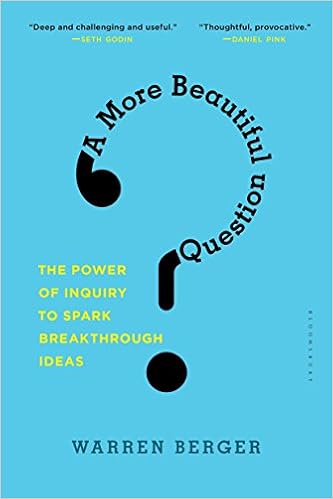
Berger's book
At Knoco, we believe innovation and creative problem solving is a process - a process that we call "Deep Dive."  Now via the Farnham Street blog we have some insight to the key questions that drive the process.

This Farnham street blog post references the book by Warren Berger called "A more beautiful question" where Berger describes three key questions as being vital to creative thinking and innovation.

The first question is Why. Why are things the way they are? Why can't they be different? (Why is closely allied to Why Not). This is a challenging question, that challenges the status quo and accepted wisdom, and opens the possibility of out-of-the-box thinking. It also ensures we fully understand the problem and the issues that create it. As Berger says:
Although we may think we have a brilliant idea in our heads for a new product, or a new answer to an old question, or a new way of doing an old thing, unless we understand why things are the way they are, we’re not yet on solid ground.
 Once we understand why things are the way they are, the next question is What If?  This is the question that opens new possibilities, not by concentrating on solutions, bit on vision. What If is a visionary leap. Berger tells us:

The What If stage is the blue-sky moment of questioning, when anything is possible. Those possibilities may not survive the more practical How stage; but it’s critical to innovation that there be time for wild, improbable ideas to surface and to inspire. If the word Why has penetrative power, enabling the questioner to get past assumptions and dig deep into problems, the words What if have a more expansive effect–allowing us to think without limits or constraints, firing the imagination.
The final question is the one that fills the gap between the understood current state and the blue sky future; it is the How question. How is the reality test, which Berger suggests we can best explore through trial and error, as we work our way towards the What If vision.

These simple questions, within a framework like Deep Dive, and accompanied by suspension of judgement, can form the basis of a solid innovation process. 

Thursday, 12 November 2015

Deferring judgement vs the innovation funnel

One of the most important elements in innovation is the deferral of judgement.  That's why innovation funnels are such a poor innovation tools


In the video below, the creativity guru Min Basadur talks about how deferral of judgement (your own judgement, and that of others) is a key principle behind the innovative/creative process. 


New ideas are both fragile and incomplete. They can be easily killed prematurely by judgement.  Deferral of judgement allows them to be explored, combined and modified, so that ideas converge into robust innovations.

The problem with innovation funnels is that they are predicated on judgment.

An idea enters the funnel, and is immediately judged.

The purpose of the funnel is to weed out the ideas that don't work, rather than to explore and modify them until they do. As this article points out:

The entire focus of the funnel and stage-gate process is to ‘whittle down’ a large number of ideas to a smaller number by ‘killing off’ weaker ones and ‘picking’ the winners, rather than being constructive and finding solutions to the problems each idea poses.
The funnel focuses on judgement, administration and evaluation, assuming that ideas are easy to come by, that the majority are bad, and that the good ideas emerge fully formed.

Here is another article with some scary figures:

In their 1997 article “3,000 raw ideas = 1 commercial success!”, published in the Research Technology Magazine, Stevens and Burley summarized a study based on project literature, patent literature, and venture capitalist experience, and concluded that “across most industries, it appears to require 3,000 raw ideas to produce one substantially new, commercially successful industrial product”. The funnel they described acts as follows: 
  • 3,000 raw ideas turn into 300 ideas for which minimal action is taken (such as simple experiments, patent filing, or management discussion); 
  • 125 of the 300 ideas become small projects; 
  • 9 out of the 125 become significant projects with a significant development effort; 
  • 4 out of the 9 become major development efforts; 
  • 1.7 out of the 4 is commercially launched; and 
  • 1 out of the 1.7 launched (59%) becomes commercially successful (this last success rate varied from 40% to 67%, depending on the source of information, industry, and geography).

This is a mechanical approach to innovation - a ruthless culling of ideas before they have had any gestation time, and a relatively low level of attention paid to any individual idea (you can't spend long on each idea of there are 3000 of them).  It counter-incentivises the contribution of ideas. Why bother to contribute an idea, if there is only a one in 3000 chance of it being taken through to commercial success?

In Knoco we recommend a different approach.


  • The funnel approach should be applied not to ideas, but to problems, to allow you to  find the problems most in need of an innovative solution.
  • Each problem then becomes the subject of an innovation Deep Dive process, involving a cycle of fact finding, problem definition, idea generation, idea combination, solution finding, solution testing and acceptance winning. 
  • The success rate for each problem should be 100%, not one in 300

Don't ask your staff to contribute ideas, just so you can kill them. Do away with the judgement-based innovation funnel, and be creative instead.

Monday, 9 November 2015

10-step creative process (video)

Here's a fantastic video about the creative process - really inspiring!


Friday, 4 September 2015

The innovation spectrum

Innovating and Knowledge Re-using form part of a spectrum. Each behaviour has it's place. Either behaviour is counterproductive in the wrong context. 

Innovation in the wrong context is "re-inventing the wheel". Re-using knowledge in the wrong context is "flogging a dead horse".

The graphic below shows the spectrum of innovative behaviour in different contexts linked to the maturity of the knowledge in question.

Innovation is the required behaviour when new knowledge is needed and no applicable knowledge exists to do the job. Here the risks and costs of innovation are entirely justified investments in future success. Here we are talking about breakthrough or step-out innovation (often identified through processes such as Deep Dive) and the development of new process or new product.

Improvement (small innovations to make existing process or product better) is the required behaviour when the current knowledge or design can be improved without being re-invented. The small innovations (often identified through processes such as After Action review, Kaizen or Retrospect, or in Community of Practice discussions) drive continuous improvement.

Tinkering is common behaviour when people are re-using knowledge but wish to "make it their own" through adapting before adopting. Provided they understand the risks of making changes (which means that the knowledge must come with documented "know-why" as well as "know-how"), tinkering has a neutral effect on performance while enhancing the user's willingness to apply the knowledge.

Meddling is common behaviour where there is a strong "Not Invented Here" culture, and where the knowledge is not documented well enough that people understand the risks of changing it. Here people adapt the existing knowledge so much that it no longer works. Meddling can have a negative effect on performance. 

Re-inventing is where people either are unaware that applicable knowledge exists, or cannot find it, or do not trust it when they do find it. Re-inventing is very costly to the organisation, and results in repeated mistakes, and repeated spend of money trying to re-solve problems where the answer is already known. 

Innovation is therefore not always desired behaviour. Innovation carries risk, and where an adequate solution exists, there is less risk in following this solution.


This is something to remember when tempted to promote a "culture of innovation". I remember a manager in a high-reliability, high-risk industry saying to me "I wish my people were not so innovative - then our projects would be cheaper and safer".

Make sure you focus your innovation efforts where they are needed the most, and not where they turn into meddling and re-inventing.


Tuesday, 12 May 2015

In a contest between copying and innovation, which would win?

The question of whether innovation or copying is a more effective social learning strategy was tested a few years ago in an online tournament. The result may surprise you. 


Day 187
Originally uploaded by pasukaru76
In 2010, New Scientist magazine published an article entitled "You are what you copy", with the tag line "Forget free thinking, a talent for imitation is what really makes us smart".

This describes an experiment (actually an online tournament) to test out various social learning strategies. It tested variables such as the choice between copying and innovation, whether to copy the expert vs following the crowd, or whether to rely on what you know. The contest looked for "agents" who's chosen learning strategy gave them the greatest survival rate.

You can read the online summary for yourself, but here are some quotes from the magazine article.

"It seems a successful strategy rests primarily on the amount of social learning involved, with the most successful agents spending almost all their learning time observing rather than innovating"

"Avoiding spending too much time learning either socially or individually was
just as important. Between a tenth and a fifth of their life seemed to be the
optimal range. If they did more learning than that it seemed that life was just
passing them by."

"Successful strategies were also good at spacing out learning throughout the agents' lives. The winning strategy, Discount Machine, submitted by PhD students Daniel Cownden and Timothy Lillicrap from Queen's University in Ontario, Canada, stood out because it did just this. It seems packing all your learning into the early part of your life is not a great idea - we need to keep updating our knowledge as we go along".

"You don't need any clever copying rules. You can just copy anyone at random. Other individuals are doing the filtering for you. They will have tried out a number of behaviours and they will tend to perform the ones which are reaping the highest rewards."

"To become the winner of the tournament you .... have to weigh up the relative costs and benefits of sticking with the behaviour that you have, versus inventing a new behaviour, versus copying others. That requires assessing how quickly the environment is changing, as this gives you an idea of how quickly information will become outdated".

"In variable environments (the winner) placed a higher value on more recently
acquired information and discounted older information more readily".

"Another attribute of the most successful strategies is that they are parasitic. This is the essence of social learning - somebody has to do the hard graft to find out how to do things before other people can copy them, so it only pays to learn socially when there are some innovators around. Indeed, in contests where (the winning) agents were able to invade the entire population, they actually ended up with a lower average pay-off than they did in contests where the conditions allowed some agents with more innovative strategies to survive, so providing new behaviours to copy".


For the knowledge manager, this is really useful and interesting experimental input. Given the emphasis on innovation you often see, it is good to be reminded of the value of copying as an effective competitive strategy. I remember a senior engineering guy telling me that his principle was "No Versions 1.0". He never wanted to be the guinea pig for new technology - innovation is risky, and sometimes the best strategy is to let others take the risks, and copy the survivors.

The need to adjust strategy depending on the variability of the environment is also interesting, suggesting that the variability of the knowledge context can affect the strategy needed to deal with it.

The ideal learning percentage is an interesting statistic, also the fact that learning seems to be something that needs to happen constantly, rather than just at the start of your career.

The final learning point for me from all of this is that if we are looking at internal practices rather than competitive practices, then an organisation needs a knowledge management strategy that is strong on internal copying, leavened with a proportion of innovation. You need both - neither all copiers nor all innovators, but a blend of both (and the blend weighted towards the copiers). Also you need to ensure that the innovators capture or share enough knowledge that they can be copied!

Monday, 29 December 2014

Where good ideas come from

An excellent illustrated video on creativity and innovation


Wednesday, 5 November 2014


The 6 steps on the knowledge maturity curve


Business in a world of change is a learning race (Tweet this). The winner is the organisation that can develop and mature knowledge more quickly than the competition, bringing new and improved products and processes into the market first, and so gaining First Learner Advantage.


Therefore one way of viewing Knowledge Management is to see it as a strategic approach to maturing critical and competitive knowledge in the most rapid and effective way. 

In this view, Knowledge passes through a series of stages, as shown and described below, and the task of Knowledge Management in each stage is to ass as effectively as possible to the next stage. however the KM approach in each stage is different.

Stage 0. Innovation, or Knowledge Creation.

This step is where ideas are made. Knowledge Management helps innovation by creating proactive processes for generating new ideas in the areas of greatest business need, often incorporating networked innovation (Deep Dive, for example). 

Stage 1. Research

Research is Idea Testing - moving from an Idea to Knowledge through practical experimentation Knowledge Management helps here by introducing roles, processes, technologies and governance for capturing that first knowledge, as well as by capturing what did NOT work (and why), and also the most promising research leads that there was no time to explore. This knowledge needs to be passed to the Development team, and also retained for future Research programs.

Stage 2. Knowledge Development

The development stage involves taking the best research ideas and testing them further to develop a viable process or product which can be rolled out in the business, or delivered to a customer. Knowledge Management helps here by introducing a framework for learning during development, both to make the development process more effective and efficient, and to ensure the "knowledge workstream" is well managed (i.e. the creation of knowledge for the benefit of the users further along the value chain).  The techniques of After Action review, Retrospect, and Knowledge Asset development are important here. 


Stage 3. Establishment of Best Practice

Even when the process or product is in use, the knowledge can be further perfected. the organisation can still improve the process or product, and can learn to improve its application. Because the product or process is now in use in many locations, Knowledge Management helps by introducing a framework of knowledge sharing and re-use, so that people all over the organisation can learn together. The techniques of Communities of Practice, Lesson-Learning and development of Knowledge Bases become important. 

Stage 4. Standardisation

Once the knowledge has been perfected through use, the next step is to standardise the knowledge, as further experimentation is now wasteful "reinvention of the wheel".  The knowledge becomes codified in manuals, reference materials and training. Knowledge Management helps now by ensuring these "knowledge assets" are well constructed and easy to find. 

Stage 5. Reinvention.

However no knowledge is mature for ever. There are often cycles of reinvention, where old knowledge is replaced by new ideas, and the cycle begins again with Innovation. Knowledge Management should promote constant challenge of the status quo, to test whether there could be a better way to do things. 


Blog Archive