Showing posts with label knowledge sharing. Show all posts

Tuesday, 20 September 2022

How organisational demographics affect Knowledge Management

The demographics of your organisation determine the distribution of knowledge, and therefore the details of the Knowledge Management Framework you need to deploy


Here's another factor that can affect the way you address KM in an organisation; the demographics of the workforce. 

Because the demographics are is linked to the distribution of knowledge across the staff, it determines how many sources of knowledge you have, how many net users, and the balance between the two.

For example:


  • A company with very many experienced staff will have many knowledge suppliers, each of whom is also a knowledge user, and will therefore have to find an efficient and effective way to allow these people to compare, combine and continuously improve the knowledge they have.
  • A company with very many junior staff and few experienced staff will have few knowledge suppliers and many knowledge users, and will therefore have to find an efficient and effective way to provide the knowledge of the few, to the many.
 Lets look at two examples. 

An organisation with many experienced staff. 

This is a profile you see in many Western engineering organisations. Here the economy is static, and the population growth is stable. Engineering is not a "sexy topic". The workforce is largely made up of baby boomers. A large proportion of the workforce is over 40, with many staff approaching retirement - the blue line in the graph above.

Experience is widespread in the organisation - this is an experienced company, and knowledge is dispersed. Communities of Practice are important, where people can ask each other for advice, and that advice is spread round the organisation. Experienced staff collaborate to create new knowledge out of their shared expertise. Knowledge can easily be kept largely tacit. The engineers know the basics, and a short call to their colleagues fills in any gaps. The biggest risk is knowledge loss, as so many of the workforce will retire soon, and a Knowledge Retention strategy would be a good investment.

An organisation with many inexperienced staff 

In many parts of the world, such as the BRIC countries, the economy is growing, the population is growing, there is a hunger for prosperity, and engineering (in contrast to the West) may be a growth area. The workforce in a growing organisation may be predominantly very young - many of them fewer than 2 years in post. There are only a handful of real experts, and a host of inexperienced staff - the red line in the chart above.

Experience is a rare commodity, and is centralised within the company, retained within the Centres of Excellence, and the small Expert groups. Here the issue is not Collaboration, but rapid onboarding and upskilling. The risk is not so much Retention of knowledge (although of course the knowledge of the few experts is vital and must be protected), but is more about deployment of knowledge. The reliance on a few experts means that they must be given a Knowledge Ownership role, rather than using them on projects.  Rather than keeping knowledge tacit, it makes sense to at least document the basics in explicit form (the experts will be too busy to answer basic questions), though there is of course a need to keep this documentation updated as the organisation learns.

The KM framework  

These two demographic profiles would lead you to take two different approaches to developing a KM framework. The first (experienced) company would introduce communities of practice, and use the dispersed knowledge to collaborate on building continuously improving practices, processes and products. Wikis could be used to harness the dispersed expertise. There would be huge potential for innovation, as people re-use and build on ideas from each other. Crowd sourcing, and "asking the audience" are excellent strategies for finding knowledge.

The second (largely inexperienced) company would focus on the development and deployment of standard practices and procedures, and on developing and deploying capability among the young workforce. The experts would build top-class training and educational material, and the focus would be on Communities of Learning rather than Communities of Practice. Innovation would be discouraged, until the staff had built enough experience to know which rules can be bent, and which must be adhered to. Crowdsourcing is not a good strategy, and the "wisdom of the experts" trumps the "wisdom of the crowd".

It would be a mistake for an organisation in the second category to copy a KM framework from an organisation in the first category, and vice versa.


This is one of the factors that KM must address, namely the amount of expertise in the company, and how widely it is dispersed.

Monday, 4 April 2022

Siloed organisations; knowledge in the hallways, knowledge in the walls.

There is a clear view than knowledge lies in the "walls" and the "hallways" between the "rooms" of an organisation.  Here are some of the implications of this view for Knowledge Management.


This blog post was inspired by a post from Nancy Dixon entitled  Where Is The Only Place Employees Share Their Knowledge? (The Hallways of Learning). If you haven't read Nancy's excellent post, please do so and then come back, as I want to expand on some of the ideas it raises. 

Nancy talks about knowledge and learning in an organisation using 3 metaphors:

  • Learning in "private rooms", and under this heading she talks about individuals learning for themselves, and creating their own understanding.
  • Learning in the hallways, where individuals get together and create shared understanding, and
  • Learning, or Knowledge, in the Storerooms of knowledge; the storerooms being the collections of knowledge created through the hallway conversations.
Nancy concludes as follows:
Hallways are the only space where it is possible for an organization to learn. It cannot learn in the Private Offices, although individual learning can certainly take place there. It cannot learn in the Storeroom, where it is only possible to affirm what is already known. If organizations are going to learn, they will need to construct Hallways in which the in-depth exploration of meaning can occur.

Nancy's blog post reminded me of something said by a one-time colleague of mine, Paul Whiffen, who was of the view that "Organisations are like a series of rooms, and knowledge lies within the walls". Paul was talking about teams at the time, and the rooms being "team spaces" (both metaphorical spaces and electronic spaces) while the walls represent the barriers to inter-team interaction. When those barriers are breached, knowledge flows.

Silos and hallways


We are talking here about silos, and silos in organisations exist at individual level, team level, and department level. Effective KM requires breaching some of the silo walls and creating the learning spaces ("hallways") in which knowledge can be shared. It is possible to learn within these silos - the Private Offices of the individual, and the Team Spaces - but the real value of KM - the challenge as well as the opportunity - comes when you break the silos. 

An illustration of the value of silo-breaking, and exchange of knowledge between individuals and teams, comes from the data from our classroom exercise "Bird Island" (reference here). This exercise has been rather like a controlled KM experiment which has run for over 20 years. We find that:

  • teams that learn only from their own experience, see potential performance gains of 40% on average;
  • when teams learn from experience of the other teams in the classroom, they see potential performance gains of 80% on average, and
  • when teams use all the historical knowledge from all past teams (the knowledge in Nancy's storeroom), they see actual performance gains of, on average, 220%.
The 80% and the 220% performance increase came from knowledge that was "in the walls and the halls" and that needed the teams to break their silos and enter a shared space - a hallway or storeroom as Nancy would say.

Where are the hallways in hybrid organisations?

Nancy's use of the term Hallways does not necessarily mean real hallways in a building (although it could; when I ran a local knowledge management system in a Norwegian office in the 90s, before online collaboration was common, we posted lessons learned on the hallway noticeboard opposite the coffee corner, and there was often a knot of people looking through these), she refers also to tools like After Action Review and storytelling circles. She says:

The real hallways of our organizations will not suffice for the level of organizational learning that is necessary. Rather, organizations to need to develop processes that have the positive characteristics of real hallways, yet are more focused and intentional.

Increasingly that focused intentional activity needs to happen in a hybrid world. And here we see an added challenge. As the Microsoft study showed, in an online or hybrid world, the silos are strengthened. Proportionately more interaction tends to happen within teams, in "Team Space" while proportionately less happens in the walls and hallways between the team spaces. I quote from the study;

Our results suggest that shifting to firm-wide remote work caused the collaboration network to become more heavily siloed—with fewer ties that cut across formal business units or bridge structural holes in Microsoft’s informal collaboration network—and that those silos became more densely connected. Furthermore, the network became more static, with fewer ties added and deleted per month. Previous research suggests that these changes in collaboration patterns may impede the transfer of knowledge and reduce the quality of workers’ output.

In other words, in a hybrid world the silos are strengthened and the hallways begin to disappear. This is a real risk for KM. 

So what can we do?

As Nancy suggests, we need to become intentional.

At the start of a project, the project leader needs to intentionally ask their team "who else can we learn from?" This question forces them to look outside team space, to look through the windows in the walls, to look into the hallways to see who else has valuable knowledge. And then they track those conversations to make sure the knowledge is brought into the team space, perhaps through Peer Assist or another process.

During a project, the project leader needs to intentionally ensure that team conversations are not just about task and activity, and that the question "what have we learned" is a regular topic of discussion. After Action Review is a great format for this discussion. 

At the end of a project, the project leader needs to intentionally ask the team "who else do we need to share our lessons with"? Again this forces the team to look through the walls and into the hallways. 

All of this intentionality can be built into a KM plan for the project.

The organisation also needs to intentionally build and support the required communities of practice which will act as the hallway monitors and the silo-breachers. In a hybrid world, these communities need their own communication channels, as well as their own roles, processes and governance. Each community lives in its own hallway.

The communities of practice can then act as the custodians of the storehouses of knowledge. 

None of the above is new. However in a hybrid world, it needs to become, in Nancy's words, more focused and more intentional if we are to open the hallways and release the knowledge trapped in the walls. 


Wednesday, 22 September 2021

Sharing knowledge is for everyone - inspiring story

 I read this story on Linked-In with real enjoyment, and have the author's permission to share it with you. 


This is the image Tabarak used to illustrate her story
It's an inspiring story of how anyone in an organisation, even those very new in their post, may have valuable knowledge to share with their colleagues. 

The story is told by Tabarak Ali Al-Lami, who very recently became a Reservoir Engineer at Schlumberger in Qatar (Schlumberger is one of the world's leading companies as far as Knowledge Management is concerned). Here is her story.


As I type this post, I’m reminded of a time when a part of me had thought that the act of sharing knowledge (be it lessons learned, newly developed models, continuous improvement techniques etc.) would be limited or cease to be of great importance upon entering the industry and after my years in academia. To my pleasant surprise however - at Schlumberger and through different shared forums uniting technical professionals, otherwise known as Special Interest Groups (SIGs) - I quickly came to the realization that what I had previously envisaged couldn’t be further from the truth.

Part of my training process within the #Digital and #Integration sub-entity is to review the material that I learn and communicate it with my team including my mentor - whom upon conducting such reflection with - encouraged me to internally share those learnings, despite it being my first month as a Reservoir Engineer!

As excited as I was about the prospect of sharing what I had learned with SLB’s technical community, I’d be lying if I said I wasn’t daunted by the proposition of having to speak to it intelligently at a venue that hosted members of substantially higher competency and expertise than what I’ve managed to acquire at this stage of my development – some with experience years that surpassed my age, let alone my time as a young professional! I remember how I kept thinking to myself: Why would such crowd listen to a junior RE? Surely, they must all know and be fully aware of what it is I’ll be presenting on.

But with a slight nudge from my mentor to see it from another angle and apply a perspective on things, I was able to develop appreciation towards the fact that it is not about the number of years, rather the richness of your experience 😊 and having heard a three-dimensional feedback from my webinar, it’s fair to say that it fully reaffirmed that thought in my mind and served as a true highlight of my first three months at D&I.

Suffice to say, it felt extremely fulfilling and enriching to present to our wider blue family!

The moral of the story is clear in the 4th paragraph - It's not about the number of years, rather the richness of your experience. And experience, when shared, enriches your colleagues as well. 

Wednesday, 16 September 2020

Maximising use of bandwidth in KM

We all suffer from bandwidth issues in KM - generally due to the deluge of information. Here's a good principle from the military for dealing with these issues.

The phrase - "Smart push, warrior pull" (described here). is a very useful military principle for maximising knowledge bandwidth. In the military case the bandwidth is often restricted by hardware rather than by attention, but the principle is a good one.

The US Department of Defence operates a global broadcast system (GBS) which acts as a knowledge and information transfer system to troops. Like any such communication system it suffers from bandwidth issues, so the transfer of knowledge and innovation must be strictly prioritised.  "Smart push, warrior pull", inevitably shortened to SP/WP, is a widely-applied principle to do this prioritisation. It represents the two following components;

  • Intelligent transfer, from central command to the troops on the ground, of the information and knowledge they need at that moment and nothing more.
  • The option for further requests for additional information and knowledge from the troops to the centre.
This is an excellent principle for a lean knowledge supply chain

It ensures that people get the right knowledge at the right time, with no waste. Send people what they must have, and let them pull what they might need.

The armed forces and intelligence units operate this way because of the bandwidth limitations of the GBS, but there is no reason why a similar principle cannot be used within organisations: "Smart Push, Front-line Pull" (SP/FLP) for example, where the customer facing staff, or staff conducting operations or projects, are provided centrally (or automatically) with the knowledge they need for that customer, or that operation, or that project, with the option to ask/search for more if needed. To do this effectively, the "senders" in the centre must anticipate the needs of the front line, so this "push" is probably best managed by the communities of practice and/or the domain experts.


Although organisations are less likely to have infrastructure bandwidth limitations, there is definitely an attention bandwidth issue, also known as "information overload". A principle such as SP/FLP would improve the efficiency of the KM system by reducing "knowledge waste" and minimising information overload.

Wednesday, 19 August 2020

Why bullet points don't work for knowledge sharing

The Curse of Knowledge is a real problem when it comes to knowledge sharing; trying to transfer knowledge to the Unknown User. It's also one of the reasons why lesson management systems are full of mushy motherhoods and useless bullet points.


The curse of prior knowledge refers to the fact that when we know something, it seems obvious to us, so we assume its obvious to everyone else. Therefore we underestimate the difficulty of transferring that knowledge to someone else; to whom it is not obvious.

Chip and Dan Heath, in their book "Made to Stick", describe an experiment where one person taps the rhythm of a popular song, and another person has to guess the song (it might be Happy Birthday to You, or The Star Spangled Banner, or something equally familiar). This is actually very difficult to do, and the success rate turns out to be about 2.5% for a successful guess. However the tappers estimated that the success rate would be 50%. They had the knowledge - they knew what tune it was - and they underestimated the difficulty of transferring that knowledge to someone else.

They underestimated it by a factor of 20!

When people put short lessons into databases, or write PowerPoints with bulleted "learnings", the curse of prio knowledge strikes again. They assume that the knowledge will be obvious to the reader, and write down little shorthand koans such as "get the right team in place from the start", "plan properly", or "do not underestimate the complexity of this task" (as if anyone ever sets out to put the wrong team in place, to plan improperly, or to underestimate the complexity). These bullet points are, to be frank, completely worthless.

They underestimate by at least a factor of 20 the difficulty of transferring to someone else what you have learned.

A lesson needs context, it needs explanation, and above all it needs concrete recommendations that others can follow, and can take action. A lesson needs to be a story, not a bullet point or a cryptic sentence. Bullet points are aides memoires; for communication (especially of contextual knowledge) you need a story.

Also, to avoid the curse of knowledge and get to a quality result, requires a facilitated process rather than relying on the expert to write the knowledge themselves. A facilitator, aware of the curse of knowledge, can challenge the expert and  can ask "will that really be obvious to the reader, who has no prior context"?

Without facilitation, without quality control of the lessons, and without awareness of the difficulty of transferring learning, the curse of prior knowledge will strike, and you will be "foiled again"

Thursday, 13 August 2020

Yokoten - the Japanese approach to best practice sharing

How do Japanese organisations approach best pratice sharing? Let's look at Yokoten

Workers exchanging knowledge (genchi gembutsu) 

Japan, exemplified by Toyota, has developed its own flavour of Knowledge Management.  Together with a local focus on knowledge development (Kaizen), knowledge documentation (A3) and the behaviours of Hansei we can add the knowledge sharing practice of Yokoten.

Yokoten literally translates as "across everywhere" and means the horizontal sharing of knowledge and experience and the horizontal deployment of practice improvements.  It is a process which avoids the development of pockets of excellence within and organisation, and results in the spreading of knowledge across the whole organisation.  The Ford Best Practice Replication system is a version of Yokoten, though Yokoten refers to the sharing of all knowledge rather than best practices per se.

There are several important aspects to Yokoten


  • The first is its horizontal nature. Knowledge sharing is peer to peer.  It’s not a vertical (top-down) requirement to copy, and it is not a case of the knowledge passing upwards in the organisation to be spread back downwards. It is truly peer-to-peer. The role of the managers is to make people aware of the existence of knowledge that should be shared and learned from. 
  • Secondly, as in the Ford example, the idea is that people to not blindly copy; they review the knowledge of others, learn from it, and add their own wisdom and context to the knowledge they gained.
  • A key point to this is that it is not just the result that is shared, but the process that led to the result.   It is not enough to copy a successful practice; Toyota realise you must also copy (or learn from) the thinking that resulted in the successful practice.
  • It is the responsibility of the team that generated the knowledge to identify others who could possibly benefit, and the responsibility of the others to make an effort to learn. They should not simply dismiss ideas that do not seem at first pass to be relevant. 
  • Yokoten is not just about sharing success, it involves sharing failures too, so that others can learn from them.
  • The expectation is that people should make an effort to go and see the idea or process improvement in practice first hand (this is called genchi gembutsu). This is what we call a learning visit, which can be as simple as a half hour trip to the other side of the factory, or a week long visit to the other side of the world. 
You can find a good western summary of Yokoten in this blog post by Jon Miller. In his post, Jon mentions the cultural background needed to enable Yokoten.

There is another Japanese phrase which is often associated with building a yokoten culture. It is kaze toushi which literally means “ventilation” or “wind blowing through” but refers to the openness or ease of communication within an organization. When this ventilation or information flow is poor, yokoten does not happen.

Remember Yokoten and Kaze Toushi in your KM programs, and ensure the wind of fresh knowledge and new ideas blows horizontally through your organisation.

Thursday, 23 July 2020

Free access to knowledge, or structured access to knowledge?

Here is another excellent article from Tom Davenport, one of the clearest writers on the topic of Knowledge Management, making the case for a structured "just-in-time" approach to the supply of knowledge. 

Tom starts his article as follows:
In the half-century since Peter Drucker coined the term “knowledge workers,” their share of the workforce has steadily grown—and so has the range of technology tools aimed at boosting their productivity. Yet there’s little evidence that massive spending on personal computing, productivity software, knowledge-management systems, and much else has moved the needle. What’s more, a wide variety of recent research has begun suggesting that always-on, multitasking work environments are so distracting that they are sapping productivity.
He goes on to contrast two approaches to the provision of knowledge

  • A "free access" approach where the organization provides free access to a wide variety of tools and information resources, assuming that the individual employees will do the selecting, prioritising and filtering and find the knowledge they need to conduct their work. 
  • A "structured" approach where knowledge is delivered in the context of tasks and delivereables, providing just in time knowledge at the point of need. In this case the prioritising has been done before the knowledge reaches the knowledge worker. 
Long-term readers of this blog will recognise these options as the "knowledge firehose and the knowledge faucet", or will recognise the second as the lean knowledge supply chain. The first rapidly overwhelms the knowledge worker, the second efficiently provides the knowledge they need with no additional waste. 

However Davenport adds a nuance. He suggests that the free access approach may be valid among the autonomous knowledge workers with high levels of expertise, who can invest the time and energy needed to filter the firehose and draw out the selected nuggets which may make a subtle difference. 

The problem with providing free and unstructured knowledge to all knowledge workers is the associated productivity loss. Here are some of Davenport' statistics.

  • One survey revealed that over a quarter of a typical knowledge worker’s time is spent searching for information.
  • Another found that only 16 percent of the content within typical businesses is posted to locations where other workers can access it.
  • Average knowledge workers access their e-mail more than 50 times, use instant messaging 77 times, and visit more than 40 Web sites a day.
  • A UK study suggests that social-media use by knowledge workers costs British companies £6.5 billion a year in lost productivity.
Davenport contrasts this with the structured supply of knowledge using workflow technologies. Here productivity is the major gain - by providing people with the knowledge they need without them even having to look for it, task-based productivity can rise by 50%. The downside of these systems is the lack of a personal touch - the lack of the social component. 

However there is always a combined approach. Through Connect and Collect we can provide a push-based supply chain of explicit knowledge to the knowledge workers, linked to their task workflow (or prompt them to pull structured knowledge from a structured knowledge base) and in parallel allow them to pull unstructured tacit knowledge from a community of practice.  A Knowledge Management Strategy can be used to determine the balance between these two approaches for different knowledge topics. 

 Davenport concludes his article as follows:

It’s time to think about how to make [the knowledge workers] more productive by imposing a bit more structure. This combination of technology and structure, along with a bit of managerial discretion in applying them to knowledge work, may well produce a revolution in the jobs that cost and matter the most to contemporary organizations

Wednesday, 1 July 2020

How G2 got knowledge sharing to work

Here is a very interesting article from G2 about how they finally made knowledge sharing work, after failing twice.


The article, by Deirdre O'Donoghue, is a very interesting read. They tried to introduce structured knowledge sharing three times, and only succeeded at the third attempt.  What was different about that lucky Third Time?  Please note, the article is only about knowledge sharing, which as we know is just one component of Knowledge Management.

Firstly - what failed?


Lunch and Learns failed. 
I am not a great supporter of lunch and learns (see my article "Lunch and Learn? No thanks, I am trying to give it up") and they did not work for G2. As Dierdre says,

"People wanted knowledge shares to be standardized – not random. They also didn’t like sacrificing their lunchtime for learning. Instead, employees wanted to see that G2 leadership valued knowledge sharing enough to take time out of the actual workday".

Friday afternoon "sharing time" failed.
"A few of these sessions were successful because people came eager to learn and share. But Friday afternoon is a difficult time to focus, and everyone, including me, shifted focus from sharing work knowledge to sharing what their weekend plans were".

Finally, what worked? 


The solution that worked for G2 was a regular schedule, within office hours, of  knowledge sharing sessions, and a site where the shared knowledge  (in the form of presentations) could be found and referred to later. According to Dierdre, this works because it is;

  • Consistent. A consistent timeslot, a consistent format, a consistent length of presentation. 
  • Relevant. "Ensure that you aren’t just trying to fill the knowledge share time. Instead, really focus on what would bring value to the team. "
  • Transparent. "After the presentation ends, the work doesn’t stop. Create a space using knowledge management software for employees to access the slides after the presentation. That way, if they need a refresher, they don’t have to wait on someone else for the information. They can easily click the link to re-learn pertinent knowledge".


Monday, 2 March 2020

How to select a methodology for a CoP event

You want to plan a face to face event for your Community of Practice in order to transfer knowledge, but which event style do you select?


This is a discussion I have been having recently, and it struck me that this might be a useful blog post.

Now there may be many reasons for a CoP event; to launch the CoP, to celebrate CoP achievement, or to agree on the CoP charter, work plan, objectives and knowledge focus areas. For these purposes you may use many styles of meeting - Open Space, World Cafe, Knowledge Market etc. 

However if we assume that the purpose of the CoP event is to transfer knowledge among the members on one or more topics of interest, then the primary driver of the choice of event style or methodology is driven by two factors:
  • The number of CoP members who have knowledge and experience on the topic ("knowledge holders", and
  • The number of CoP members who actively need to acquire the knowledge ("knowledge needers"). These are not just "interested parties" - these are people who will apply the knowledge they gain to improve the way they work. 
  • Please note that many people can be both holders and needers - they hold some knowledge but need to acquire more. 
The crossplot of these two factors above is used to suggest some methodologies or styles of knowledge transfer meetings, all of which should be based on positive dialogue between the knowledge holders and knowledge needers. Also note that if your CoP meeting addresses many topics, then you may need many styles of meeting at the same event - either one after the other, or in parallel in separate spaces. How do you find out the topics, and the number of holders and seekers within the CoP? You either conduct a survey, do some knowledge mapping, analyse the questions in the community forum, or hold a Knowledge Market

If you have a relatively small number of knowledge holders and a large number of knowledge needers, then you can hold a lessons learned discussion. This requires active moderation, and should be driven by questions from the knowledge needers. The discussion will create reference content for the CoP. Alternatively, a storytelling session may be appropriate. Or if the knowledge is very polarised, with one or two experts and everyone else in the CoP novices, then a training session may be the best approach, but try to drive the training by the questions of the needers as much as possible.

If you have one or two people with experience in the topic and a moderate number of knowledge needers, then in some cases a knowledge site visit may be appropriate. Here the CoP meeting is held at the premises of one of the knowledge holders (a factory, or a working office) who can demonstrate the knowledge in application.

If you have many knowledge holders and many knowledge needers, then a knowledge exchange may be appropriate. Here the CoP members discuss the topic, and all its subtopics, exchanging experience, answering questions, and discussing and co-creating best practice. The process is driven by the questions of the knowledge needers, and is suitable when there are one or more areas of practice applied by most of the CoP members, but where approaches differ. This process can develop good practice reference documents for future use by the CoP. 

If there are a moderate number of knowledge needers, then you can run a Peer Assist to enable knowledge transfer to the needers. Generally the process adds value to others as well.

If there is a topic where there are a few holders and a few needers, it may be best not to make this the focus of a CoP event, but to create a small action learning group, which will report back to the CoP through the online portal, or through short briefings.

Finally if there is a new topic which the CoP wants to explore, but currently has no experts or knowledge holders, then a more open process such as Open Space or World Cafe/Knowledge cafe.

However if transfer of knowledge is your aim, use one of the processes above to ensure effective dialogue between the knowledge holders and the knowledge needers. 


Wednesday, 26 February 2020

The fantastic example knowledge resource that is Radiopaedia

This reprised blog post is a reminder of that amazing example of free and open knowledge sharing that is Radiopaedia


X-ray published in ABC news, taken from Radiopaedia 
As described in this fascinating article,   Radiopaedia is an online wiki where Radiologists all over the globe share online X-rays that are interesting, unusual, or demonstrate particular aspects of patient cases that others might learn from. When I was a geologist, there was a saying that "the best geologist was the one what had seen the most rocks". Presumably the best radiologists are the ones that have seen the most X-rays, but no single radiologist can possible have seen a X-ray of every type of condition.

But now they can, thanks to this shared knowledge resource.


Radiopaedia was started in 2005 by Dr Frank Gaillard, as a way of storing online his digital radiographic images. Dr Gaillard had the inspiration to make this store an open resource, and in 2007 made it accessible to other radiologists. By 2015 Radiopedia had
  •  7 million hits a month 
  • 2 million unique users 
  • users in every country in the world 
  • more than 10,600 Twitter followers
  • 17,660 cases sorted into 7,636 articles. 

The vision of Radiopaedia is
"to create the best possible radiology reference and teaching site and make it available to everyone, for ever, for free..... By pooling our collective knowledge and experience we can make a real difference in how people all over the world are imaged and diagnosed".
The letters of thanks from radiologists all round the world show how useful this resource is in supporting correct diagnosis and thus saving lives.

So what can we learn from this?


I think the primary lesson is that a simple technology solution which serves a knowledge need for a large user base can grow quickly and organically. The barrier to entry is low, and the benefit for users is very high.

Secondly, the starting point for this was one person choosing to open his personal collection to the public. Despite the well-known behaviour of knowledge hoarding, Dr Galliard's decision to open his knowledge base not just resulted in value to other radiologists; he himself benefited from the massive outpouring of knowledge sharing.

The value is particularly great for radiologists, in that many of them work as lone specialists. A global community provides them with a very welcome link to other practitioners.

Also radiologists are visual workers. Their chief tool is images. The more images they can see, the greater their knowledge base. The best radiologist is the one who has seen the most Xrays.  A wiki is an ideal way to share visual imagery, and to make tens of thousands of Xrays available to view.

Also the wiki is not a standalone, but part of a KM Framework. This includes
For those of you working in knowledge management, this case history provides a model for how you can connect a large community of lone practitioners, for whom a shared library of images is a massively useful resources.

Are there lone practitioners like this in your company? If so, then Radiopaedia may give you some pointers in how to build a system to support them.


Wednesday, 12 February 2020

Do social media stifle knowledge sharing?

Do online social media drive a "spiral of silence" which can stifle proper debate?  It can, according to this techcrunch article, which points to this survey from Pew Research.


shhh
Shhh by Catherine on Flickr
I think everyone would agree that for knowledge to be shared effectively in organisations, people need to feel free to enter online debates and feel free to disagree with the opinions of others. Knowledge often comes through comparing and challenging conflicting "truths" in order that new truths and new knowledge can be born.

However the nature of online social media is such that we often create our own silos, and when addressing potentially contentious topics, are unwilling to discuss ideas which the rest of the group does not share (a structure called "polarised crowds" by this article, which I also explore in this blog post on groupthink in social media).  This has been referred to as "a spiral of silence" where people with dissenting views remain quiet.

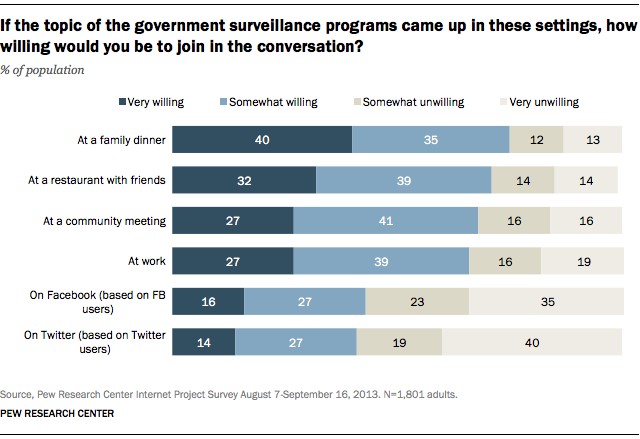
The Pew Research survey explored the willingness to debate online by choosing a contentious topic (in this case the topic of government surveillance) and exploring how openly people would be willing to discuss this in various settings.

As shown below, social media are at the bottom of the list, and people are nearly 4 times less willing to share their thoughts openly online than they are round the dinner table.

The study has the following conclusions

Overall, the findings indicate that in the (government surveillance) case, social media did not provide new forums for those who might otherwise remain silent to express their opinions and debate issues. Further, if people thought their friends and followers in social media disagreed with them, they were less likely to say they would state their views on the story online and in other contexts, such as gatherings of friends, neighbors, or co-workers. This suggests a spiral of silence might spill over from online contexts to in-person contexts, though our data cannot definitively demonstrate this causation. .

Does this spiral of silence apply in workplace social media?


I have seen this happen in the work setting, as in the example below.

A new community of practice for project managers was launched in an organisation. Over a couple of months, activity started to pick up nicely in the community forum, with many people asking questions and receiving answers. However when we followed up with the originators of the questions, we found an interesting pattern had developed. The first answer to the question set the tone, and from that point the only people contributing to the thread were those who agreed with the first answer. Anyone who disagreed found a private offline way to contact the questioner, such as a phone call or a personal email.

We were able over time to resolve this behaviour through strong facilitation, and the community now works well in publicly exploring multiple views on all topics.

For those of us seeking to foster knowledge sharing within an organisation, the research study quoted above is very important. If we do not address this tendency towards a spiral of silence, our in-house social media will either create a new set of silos - silos divided by opinions rather than by geography or by organisational hierarchy (the "polarised crowds" mentioned above) - or people with contrary opinions will just drop out of the conversation.

The lessons to the Knowledge Manager are clear

 To start with, we cannot afford plural communities of practice covering the same topic. There needs to be one community covering each main work topic, not two or more polarised ones.

Then within each topic, disagreement needs to be sought and explored, in service of finding the truth. This is part of the role of the community facilitator - the role of allowing a diversity of opinion, and promoting and facilitating the dialogue that allows this diversity to be explored and resolved.

Finally, for the really contentious topics, you need a face to face discussion, such as a Knowledge Exchange.

Monday, 3 February 2020

To share more knowledge, build bigger tribes

We are built to share knowledge within our tribes. To improve knowledge sharing, build bigger tribes.

Papua New Guinea - True North - Sepik
Papua New Guinea - True North -
on Flickr - source/credit: North Star Cruises.
Photograph by David Kirkland.
 Attribution-NoDerivs 2.0 Generic (CC BY-ND 2.0)
As humans, we have  always had the ability, through language to share what we know. It's just that, very often, we don't want to. share with everyone. Sometimes we would rather keep knowledge "within the tribe."

In New Scientist December 2012, Mark Pagel, the author of  "Wired for Culture: Origins of the Human Social Mind" wrote an article called "The War of Words" in which he argued that languages evolved in order to keep different tribes separate, just as much as to allow communication within the tribes.

He points out that that the greatest diversity of human societies and languages (and there are over 7000 languages on the planet) arises not where people are most spread out, but where they are most closely packed together. Papua New Guinea is a classic case. That relatively small land mass - only slightly larger than California - is home to between 800 and 1000 distinct languages, or around 15 per cent of all languages spoken on the planet. A different language is spoken every few kilometres, and Pagel suggests that these have evolved to keep the different tribes distinct, separate and competing. He says
"In support of this idea, I have found anthropological accounts of tribes deciding to change their language, with immediate effect, for no other reason than to distinguish themselves from neighbouring groups. For example, a group of Selepet speakers in Papua New Guinea changed its word for "no" from bia to bune to be distinct from other Selepet speakers in a nearby village. Another group reversed all its masculine and feminine nouns - the word for he became she, man became woman, mother became father, and so on. One can only sympathise with anyone who had been away hunting for a few days when the changes occurred".

The two features that drive this are, according to Pagel "groupishness" - affiliating with people with whom you share a distinct identity - and xenophobia, demonising those outside your group and holding parochial views towards them.

So language and knowledge sharing are linked, and both language and knowledge sharing are very much kept "within the tribe".  Sharing knowledge with other tribes is an unnatural act; something languages have evolved to deter.

We can recognise the same effects of groupishness and xenophobia at work. Organisational boundaries create teams and silos, they create groupishness, and they create "us and them" feelings, which may be reinforced by internal competition.  Knowledge sharing happens within the silos, but seldom between them.

So what can we, as KMers, do about this?


We need to create new tribes.

This is the idea behind Communities of practice - that we can build a new organisational structure along knowledge lines, that cross-cuts the existing silos. By creating these new tribes, we create a feeling of groupishness and a sense of identity which align with the needs for knowledge sharing. One community leader I know calls this "dual identification" - identification with the business silo, but also identification with the community of practice.

We need to create new vocabulary.

This is particularly important after a merger, when terminologies between the merged organisations will be different. Without finding a common terminology, the old divisions remain, reinforcing old groupings. I have argued before that a Community of Practice is united by a common jargon and where multiple jargons exist, you need to lead the attempt to merge them.

I read an article recently about how a national rugby team can be created from individuals from different and rival clubs - a process of creating groupishness from a selection of xenophobic competitors - and the first step was to create a common vocabulary for the patterns and techniques they would encounter on the field of play. To create a common group, they needed a common vocabulary.

We need to remove the influences that keep us most separate. 

The most pernicious of these influences is institutionalised internal competition; reinforced by awards like "factory of the month", "salesman of the year" and so on.  Anything that separates and divides, creating us (winners) and them (losers) will kill Knowledge Management stone dead and must be removed and replaced with awards that unite.  "Us" needs to be the company (plus key allies, stakeholders and supply chain) and "them" needs to be the competition - and then only where you are in a competitive context.

Create new tribes, create shared language, create shared groupishness, keep the xenophobia for the competition, and then Knowledge sharing will follow.


Friday, 17 January 2020

Forget knowledge sharing, let's encourage knowledge seeking instead

People often ask us "how do we incentivise  knowledge sharing?" I often answer "don't bother. Incentivise knowledge seeking and re-use instead".


I give this answer, because knowledge sharing in itself achieves nothing. Knowledge needs to be sought and re-used before any value has been added, and re-use is often a far bigger barrier than knowledge sharing. The Not Invented Here syndrome is far more prevalent than Knowledge Hoarding.

As an analogue, think of a driver in a car in a strange city, looking for a building which is not on the satnav.  They need knowledge, people on the sidewalk have the knowledge, but why doesn't the knowledge reach the driver? It's usually not because people won't share, but because the driver doesn't ask.

Knowledge needs supply and demand - sharing is the supply, seeking and re-use is the demand. Supply without demand devalues a commodity. Demand without supply increases a commodities value. Supply and demand need to be in balance, but the best way to kick off a market is to stimulate demand. 

Without an appetite for knowledge re-use, knowledge sharing can actually be counter-productive, resulting in the feeling of the "knowledge firehose".  Better to incentivise knowledge seeking first then knowledge sharing later, create the appetite for knowledge before you create the access, and create the demand before you create the supply.

There will naturally be SOME supply already, as there are people who naturally like to publish. They like to share, they like to write, they were given two ears, one mouth and ten fingers and use them in that proportion.  If you create the demand and create the channel, the supply will follow. As David Snowden pointed out,
"In the context of real need few people will withhold their knowledge. A genuine request for help is not often refused unless there is literally no time or a previous history of distrust. On the other hand ask people to codify all that they know in advance of a contextual enquiry and it will be refused (in practice its impossible anyway). Linking and connecting people is more important than storing their artifacts".
Create the need, connect the people, and the sharing will follow.

And how do you create the need for knowledge?  There are a number of ways;

So don't incentivise knowledge sharing - incentivise knowledge seeking first. The sharing will follow.


Monday, 18 November 2019

Why transferring knowledge through discussion is over 10 times more effective than written documents

Connecting people is far less efficient than Collecting while being far more effective - but how much more effective?

Knowledge can be transferred in two ways - by Connecting people so that they can discuss, and Collecting knowledge in written (explicit) form so others can find and read it (see blog posts on Connect and Collect). 

Connecting people is less efficient than transferring documented knowledge, but more effective.  We can never be sure about the absolute effectiveness of knowledge transfer without some good empirical studies, but there are 2 pointers towards the relative effectiveness of these two methods. These pointers are as follows;

First, the often repeated (and sometimes challenged) quote that “We Learn . .
  • 10% of what we read 
  • 20% of what we hear 
  • 30% of what we see 
  • 50% of what we see and hear 
  • 70% of what we discuss 
  • 80% of what we experience 
  • 95% of what we teach others.”
This is similar to Media Richness theory, which ranks media on the basis of it's richness, with unaddressed documents as least rich, and face-to-face as most rich.

Second, David Snowden's principle that

  • We always know more than we can say, and 
  • We will always say more than we can write down
Our assumptions

Let's make two assumptions here, firstly that the percentages in the first list are correct, and secondly that we equate the "more than" in Snowden's principle to "twice as much as." OK, the fist assumption is highly dubious and the second is entirely arbitrary, but I want to see what the consequences are.


With these assumptions, the effectiveness of the Connect route (knowledge transfer through discussion) is as follows
  • I know (100%)
  • I say (50%) 
  • You learn through discussion (70%)
The effectiveness of transmission of knowledge through Connecting is therefore 35% (100% x 50% x 70%) provided there is discussion involved.

If you connect people through video (seeing) the effectiveness drops to 15%. Through hearing only (eg podcasts) it drops to 10%. The most effective way to transfer knowledge would be to work together, so the knowledge donor does not need to tell or write, they just have to show, while the knowledge receiver learns by experience. That way you minimise the filters.

The effectiveness of the Collect route for knowledge transfer through documents is as follows
  • I know (100%)
  • I write (50% x 50% = 25%)
  • You learn through reading (10%)
The effectiveness of transmission of knowledge through Connecting is therefore 2.5% (100% x 25% x 10%)

Transfer through discussion is 35% effective, transfer through documents is 2.5% effective. In the first case you can transfer a third of what you know, and in the second case you transfer one fortieth.

Therefore transferring knowledge through Collecting is 14 times less effective than transferring knowledge through Connecting people.

If we change the proportions in Snowden's principle then we change this conclusion. If for example 
we always know 3 times more than we can say, and we will always say 3 times more than we can write down, Collecting becomes 21 times less effective, and so on.

I know all these figures are arbitrary and inexact, but what we are looking at here is some sort of estimate of relative efficiencies.

Note that this does not mean that Collecting knowledge has no place in Knowledge Management - quite the opposite. Despite being very ineffective, it is very efficient. Knowledge has only to be documented once, to be re-used one thousand times. Efficiency can trump effectiveness. However we can conclude the following
  • Because of these relative efficiencies, Knowledge should shared in explicit form (the Collect route) only when it is relatively simple and when it can be codified with minimum loss of context. 
  • Where efficiency is more important than effectiveness (i.e. broadcasting relatively straightforward knowledge to a large number of users), the Collect route is ideal.
  • The Collect route is also necessary when a Learner (a recipient for the knowledge) cannot be immediately identified, so no Connection is possible (see "speaking to the unknown user").
  • Even then, it is worth "keeping the names with the knowledge" so that readers who need to know more detail can call the originator of the knowledge and have a discussion.
  • Where knowledge is more complex or more contextual, it should be shared through discussion (the Connect route) - for example through conversational processes such as Peer Assist.

Given that transfer of knowledge through documents is so ineffective, choose your KM strategy carefully!

Tuesday, 24 September 2019

The two chambers of the KM heart

The heart of KM keeps knowledge flowing, and that heart has two chambers. 


Image from wikipedia
You can think of the organisation as a body, and knowledge flowing round the organisation like blood flows round a body.  But what is at the heart of KM? Is it knowledge sharing? Is it communities of practice? Is it knowledge creation?

The answer is that if there is a heart, it is not a single thing, but two chambers working together.  The two chambers are our old friends Connection and Collection; the Connect and Collect routes for knowledge transmission through Conversation and Content respectively. 


Connection


Connection refers to connecting people so that they can share knowledge between them; through discussion and conversation. 


Collection 


Collection supports knowledge transfer through collecting documented knowledge, synthesising it, sharing it and making it findable.
  • In the Collect route, Knowledge is transferred through documentation ("Knowledge capture"), through organisation and synthesis of that documentation, and through connecting the user with the documents, through search or through push.
  • It can be supported by processes such as Retrospect, Lesson Learning, Interview, creation of Knowledge Assets, and Knowledge Synthesis. 
  • It can be supported by technologies such as portals, lessons management systems, search, semantic search, blogs and wikis


You Need both routes!


In the past, Connect and Collect have been positioned as opposites, for example in the rival Personalisation vs Codification strategies described by HBR.

However they are not opposites; they are two sides of the same heart.  The two different approaches address different sorts of knowledge, both of which exist in your organisation. 
  • The Collect route is ideal for relatively simple non-contextual knowledge which needs to reach a large audience, for knowledge that needs shelf life, for knowledge where no immediate user is available, and for knowledge which needs compiling and processing (such as lessons). 
  • The Connect route is necessary for complex knowledge, advanced knowledge, deep skills, and highly contextual knowledge. 
  • Collection without connection results in bland knowledge bases which answer basic questions, but often lack nuance and context.
  • Connection without collection preserves no corporate memory, and runs the risk of overloading the experts with basic questions, and of loss of knowledge as the experts retire.
In reality, the two chambers of the heart work together. 

People can unite around collections of knowledge, connected people can collect what they collectively know. Conversation is where content is born, and content is something to talk about. In combination, both Connect and Collect drive the engine that makes knowledge flow. 

Keep the two chambers of Connection and Collection at the heart of your Knowledge Management strategy  if you want to succeed!


Thursday, 5 September 2019

The four contexts for Knowledge Transfer

There is no one-size-fits-all solution for knowledge transfer, because not every transfer context is the same.  However we can look at four main classes or types of knowledge transfer, by looking at the dimensions of TIME and LOCATION.

There are other dimensions as well, such as whether the transfer is Expert/Expert, Expert/Novice etc, but let's stick with 2 dimensions at a time, as that helps build a Boston Square, as shown here. 

This particular Boston Square, based on location and time, allows us to identify 4 contexts for knowledge transfer, described below. 

OTJ (On The Job) Transfer

The transfer of knowledge between people or teams who are co-located - doing the same sort of work at the same time in the same place - can be done on the job. This is the sort of context you see within a project team. The knowledge does not need to be documented in order to be transferred, and because everyone is working with the knowledge every day, then your focus should be more on conversations about knowledge rather than building knowledge bases. Knowledge can be transferred through embedding processes like mentoring, coaching, and particularly After Action Reviews, as well as through numerous informal conversations. 

Serial transfer

The transfer of knowledge within a series of projects in the same location, one after the other (and often with the same team) is called serial transfer. Much serial transfer can be accomplished by the transfer of project plans, designs, basis of design documents, and so on, as well as by transferring lessons learned, and transferring core team members. Project knowledge handover meetings can also be useful - sometimes known as baton-passing. The focus here is less on conversation, and more on transfer and continuous improvement of artefacts. This can results in excellent examples of steep learning curves.

Knowledge transfer between individuals working in the same place but at different times is accomplished by personal knowledge handover - a planned set of conversations, and compilation of a set of key documents, contacts, lessons and tips and hints. This can be part of a Knowledge Retention Strategy.

Parallel transfer

The transfer of knowledge between a series of projects running simultaneously but in different locations, or between many individuals doing the same work in different parts of the business, is called parallel transfer. This can rely heavily on face-to-face activities such as peer assist, and knowledge visits, as well as real-time transfer of knowledge through communities of practice, online forums and enterprise social media. Because operations are simultaneous and continuous, much knowledge can remain tacit, and the focus is on conversation rather than content.

Far Transfer

The transfer of knowledge between projects running in different times and different places, or from person to person separated by time and distance, is called far transfer (a term coined by Nancy Dixon). Far transfer cannot rely on real-time conversations, or on simply transferring project plans, as the next project may take place in a completely different country in several years time. Knowledge will need to be transferred in written form as a knowledge asset, or as a series of Lessons Learned. Far Transfer relies on captured knowledge, the development of knowledge assets, and careful attention to well written and easily findable advisory and instructional content.

There is no one-size-fits-all approach to Knowledge Transfer; it depends on the specific context, which may  be one of the four described here. 


Wednesday, 28 August 2019

Why "Knowledge Sharing" doesn't work as an alternative title for KM

Many people prefer to use the term "Knowledge Sharing" instead of "Knowledge Management". However as a synonym "Knowledge Sharing" is inadequate and misleading. 


Sharing is caring
I know lots of people prefer the term Knowledge Sharing, but sharing is only one element of KM. There are at least four other major elements of Knowledge Management in addition to sharing, and a focus only on sharing does not deliver the full potential of KM.

I think people prefer the team "knowledge sharing" for three reasons;

  1. Sharing is a softer word than management (it rhymes with Caring, after all), and people sometimes distrust the concept of management (unnecessarily, I believe) 
  2. Sharing is a concept that fits more neatly with social tools
  3. There is an oft-repeated opinion that because Knowledge is intangible, then it cannot be managed, and that the term "Knowledge Management is therefore an oxymoron.
I deal with the linguistic argument in my post  "why knowledge management is not an oxymoron"(there are plenty of management disciplines that cover intangibles, and if KM is an oxymoron, then so are risk management, safety management etc), and I defend the Management term here.

However even if the term "knowledge sharing" is easier on the ear, it still doesn't suffice. Knowledge sharing is only one component of KM, and there are at least four other main areas of Knowledge Management which need to be considered. These are as follows.

Knowledge Creation


Before Knowledge can be shared, it has to be created. Knowledge Management deals with the creation in three ways. The first is through Innovation. Process and roles for innovation need to be part of your Knowledge Management framework.

The second approach is team reflection. Processes such as After Action Review and Retrospect lead a team to reflect on performance, reflect on experience, and identify new knowledge. Processes such as these lead individuals to become conscious of their knowledge, and allow the team to collectively make sense of what has happened. These KM processes allow us to know what we know, and if we don't know what we know, we can't share it.

The third process is to use experts working with AI and/or with big data sets, to spot new correlations and to infer meaning and new knowledge from these.

If you focus only on Knowledge Sharing, you lose focus on Knowledge Creation.

Knowledge re-use


Knowledge doesn't add value until it leads to action. Therefore merely sharing knowledge is not enough - the knowledge needs to be applied (often it needs to be adapted before it becomes adopted).  Knowledge Management addresses re-use through promoting a culture of continuous performance challenge, through processes such as Peer Assist, and through the introduction of governance processes such as Knowledge Management plans.

If you focus only on Knowledge Sharing, you lose focus on Knowledge re-use.

Knowledge synthesis


Over time, more and more knowledge is created and shared. Some of it is duplicated, some of it is contradictory, some of it rapidly becomes out of date, and much of the time the knowledge consists of small pieces - observations, insights, lessons.  There eventually comes a time when the relevant community of practice comes together to make sense of all this knowledge, and to synthesise it into a single set of guidance; a wiki, a procedure, a guidance note or a knowledge asset. Sharing without synthesis rapidly leads to overload and "deknowledging".

Synthesis is a style of sense-making, and often is more like a co-creation of knowledge - creating new knowledge out of a compilation and combination of what is already known.

If you focus only on Knowledge Sharing, you lose focus on Knowledge synthesis and co-creation.

Knowledge seeking


Sharing is generally Knowledge Push. This needs to be balanced by Knowledge Seeking or Knowledge Pull. The need for Pull is a common theme in this blog, and readers requiring more background should go here.

Knowledge Push and Knowledge Pull equate to Knowledge Supply and Knowledge Demand, and more KM implementations fail through lack of demand than lack of supply.

When we look at Push and Pull, therefore, "Knowledge sharing" covers only half of the equation, and it covers the half which is less of a problem. In this circumstance, "Knowledge sharing" can even become a dangerous term. What is primarily needed is not Knowledge Sharing, but Knowledge seeking.  If you are looking for the 20% of KM that adds 80% of the value, then choose Knowledge Seeking. If you can generate a real demand for knowledge in your organisation, all else will be much easier.

If you focus only on Knowledge Sharing, you lose focus on Knowledge seeking, you focus on Push and not Pull, and your knowledge "market dynamics" are unbalanced.

So please a) don't feel you need to abandon the term "Knowledge Management", and b) if you do, don't replace it with "Knowledge Sharing"; a term that covers only 20% of the KM landscape, and not the 20% that adds the most value either. 

Friday, 5 July 2019

How knowledge can be "the thread through the labyrinth"

"The thread through the labyrinth" is a metaphor for allowing others to follow our steps safely. This is what Knowledge can do. 


When Theseus negotiated Daedelus' labyrinth in order to kill the Minotaur, he left a thread behind him (provided by Ariadne, daughter of Minos) so that the way through the Labyrinth would be clearly marked.

Cave divers do something similar, unreeling a line behind them as they explore the labyrinth of flooded passageways; both so they can find their own way out, and also so that others can follow the path without getting lost, or without having to explore the same dead ends and blind alleys that the first divers did. 

Sometimes, negotiating our projects feels like making our way through a labyrinth, especially when the project has to negotiate complex regulatory or bureaucratic hurdles, or technical difficulties.

When we successfully negotiate these hurdles, which sometimes can be long and taxing, we need to leave a thread behind us for the sake of the next project.

Imagine the first project of its type in a country - the first factory, or the first branch office. Imagine you have eventually worked your way through the maze of rules, regulations and red tape, contracts and logistics. The thread you leave behind is not string, but the collected knowledge (the "knowledge asset") that enables the second factory, or the second branch office, to successfully follow the path of the first.

That knowledge might include;
  • The list of activities you need to undertake
  • The order in which to undertake them
  • The people you must contact, and how to contact them
  • The letters you must send, and how to write them
  • The evidence you must collect, and how to best present it
Without leaving this trail of knowledge behind you, the second factory or the second branch office will approach the maze of logistics and legislation with the same ignorance as the first, and may get just as lost and confused.

If you are the first to try something, then leave a guideline of knowledge for others to lean from.


Blog Archive