Showing posts with label standards. Show all posts

Friday, 5 May 2023

Details of the Webinar next Wednesday on the BSI guide to Knowledge Management

You can find a link to the Webinar announcement here and a button to register for a place.

Date: 10 May 2023

Timing: 12.00 - 13.00 (BST)


This webinar will focus on the recently published BS 34401:2022 Knowledge management. Application of BS ISO 30401. Guide and Executive Briefing and explain how your business can use these documents to implement, review and improve a management system for KM (KMS).

Who should attend the Knowledge Management webinar?

All sizes and types of organization, including public and private sector bodies, non-governmental organizations, charities and other not for profit organizations.

What will participants gain?

  • Insights and guiding principles on what KM is, drawn from the principles of BS 34401
  • Knowledge of the key factors to consider when implementing a KMS
  • How to implement the standard including awareness of some common pitfalls
  • The chance to put your questions to experienced knowledge management professionals
  • A post-event copy of all presentations and a recording of the webinar for future reference


AGENDA

Welcome & Introduction

Helena Barrell, Standards Development Manager, BSI

Launch of BS 34401 and Executive Briefing

Helena Barrell, Standards Development Manager, BSI

What is Knowledge Management (and what is it not)?

Margaret Gair MA FCLIP, Head of Library & Information Services, Scottish Government

How to Implement the Standard, KM Enablers and Guiding Principles

Adrian Malone, Digital Engagement and Business Partnering Director, WSP UK

Challenges and Pitfalls

Adrian Malone, Digital Engagement and Business Partnering Director, WSP UK

Margaret Gair MA FCLIP, Head of Library & Information Services, Scottish Government

Q&A

How to Access the Executive Briefing and Guide

Helena Barrell, Standards Development Manager, BSI

Summary & Close

Wednesday, 13 April 2022

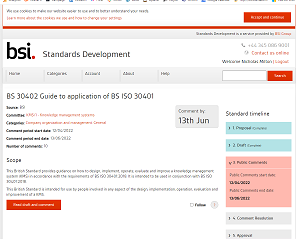
Please review and comment on the draft new guide to the KM standard

 Over the past several months, a drafting team from the British Standards Institute has been writing a guide to the ISO KM standard. This guide is now available in early draft form for public review and comment.


The guide will become British Standard BSI 30402, and it provides guidance on the application of BSI/ISO 30401:2018, the management systems standard for Knowledge Management. It is designed to help those for whom ISO standards are unfamiliar, and provides guidance, suggestions and examples addressing each of the critical clauses in ISO 30401. 

At this stage the guide is very much a draft.

It is a committee draft, and has been agreed by the BSI committee as suitable for public review, in order to gather early feedback and suggestions. This review version is available online until June 13 via the link below, after which we will consider all comments, and look to improve the guide as a result. 


Click on the link above. You will need to register with BSI before you can see the text, and once you have registered you can scroll the through the guide and add comments. Comments should be one of three types:
  • Editorial, related to spelling, grammar, and the way sentences and paragraphs are constructed:
  • Technical, related to the actual content itself and the points and suggestions that are made:
  • General, related to more general issues, such as missing material, or whether entire sections can be omitted.
Please use the comments function on the website, as this allows us to compare multiple comments on each paragraph. Sending us word documents with tracked changes will not help, as we don't have the resources to compile that sort of response. 

Please give us your views, and help improve the guide!


Tuesday, 7 January 2020

Doing KM "the right way around"

Say what you like about the ISO KM standard; at least it encourages you to address KM in the correct order!


There are many approaches adopted for introducing KM, and not all of them work well. For example the historically common approach of "Technology Push" - where an organisation seeks to buy a KM technology as their first step into KM - is usually a recipe for failure. It is still common today - I have many enquiries from organisations who say "we are starting up in KM - help us choose a technology".

Starting like this, from the KM tool, is starting KM the wrong way around.  There is no point in choosing a tool until you are clear what you are doing KM, for who, and with what objective; until you understand the stakeholders and objectives, and also the other elements of the KM Framework which need to be in place.

This is where the beginners in KM will find the new ISO standard - ISO 30401:2018 - particularly useful (contact us for a free white-paper introduction to the standard). In common with all other ISO management system standards, IOS 30401:2018 follows a defined structure (described here) which doubles as a logical sequence for building your KM Framework. ISO have standards for many management systems, they know how they work and how to introduce them, and the logical sequence is based on this experience.

This sequence is described in sections 4 through 10 of the standard as follows;


  • First you become clear on the organisational context for KM. Why do you need KM? What will it do for the organisation? What are the external and internal issues which make KM important to you?  This answers the WHY question - why do you need KM? It ties KM to the strategy of the organisation right at the start of the KM thought process; well before you  think about tools.
  • Secondly you become clear on the stakeholders for KM, and what they need from the KM framework. This is another way of looking at KM objectives. In the previous section you decided what KM would do for the organisation, in this section you think through, and document, what it will do for the stakeholders. 
  • Thirdly you look at the scope of KM. What is in scope, what is out of scope, what will KM focus in and what it will ignore, what part of the organisation will be involved and what parts will not. 
  • Only then do you define the Framework - the elements of roles, processes, technology and governance, and how these will affect the culture of the organisation. You look at an integrated framework that covers the lifecycle of knowledge, and covers knowledge in all its forms and transitions. 
  • Once this is in place, the standard requires you to look in more detail at the leadership elements that support the KM framework, including the assignment of accountability.
  • Then you look at planning and objective setting for KM.
  • Then you look at support resources for KM.
  • Then you look at how KM operation, KM monitoring and performance management, and finally continuous improvement of the KM Framework.

Now THAT is KM "the right way round"

Wednesday, 19 June 2019

New survey results on planned usage of the ISO KM standard

Last week I launched an online survey of planned uses for the new ISO KM standard: ISO 30401:2018. Here are the results of that survey. 


The survey was announced on this blog, on Twitter, and on LinkedIn (where it was shared by many people). 75 people answered the survey, which seems like a large enough dataset to be representative. The results are shown above, and in the table below.

Response Number
Buy a copy as a useful guide to KM development 20
Self-audit compliance against the standard 17
No plans to engage with it 14
I didn't even know there was an ISO KM standard 12
Seek external audit of compliance against the standard 5
Bought a copy to be able to advise clients aiming for it. 1
Bought a copy. Now thinking of how could I use THAT... 1
Hasn’t thought about it in a while but now thinking we should use! 1
If I can access through the library I would look at it but I can't afford to purchase a copy 1
Use it as a communications tool for senior stakeholders to get buy in for a "serious" approach to KM 1
Utilize audit group internally 1
Need to understand it better before I decide whether I need to consider it relevant in my market 1

Over half of the respondents (42 out of 45) plan to use the survey in some way or another, as a useful guide (27%), as a tool for self-audit (23%) or as a tool for external audit (7%).

14 respondents (19%) do not plan to engage with the standard at all. 

Almost as many (12 respondents, 16%) were unaware that it exists. 

The remaining individual responses vary
  • Three of them are effectively "don't know" responses
  • One is "I can't afford it", which you could say equates to not planning to engage with it, for reasons of expense. 
  • One is "utilise audit group" which I suspect is another vote for internal/self-audit
  • One is a KM consultant planning to use it with clients
  • And the final one is interesting - planning to use the standard as a mechanism to engage senior managers. 
If we eliminate the "Don't know" answers and the "Unaware" answers, and reassign "can't afford it" and "utilise audit group" as discussed above, then we have the following stats:

  • 60 people knew about the standard and had a view on its use
  • 45 of these (75%) planned to use the standard in some way (as a guide, for internal or external audit, for communication with stakeholders or for supporting clients)
  • 15 (25%) said they had no plans to use it


Thursday, 6 June 2019

How are you planning to use the new ISO KM Standard? Survey, and results

It looks like there is quite a lot of interest in ISO 30401, the ISO management systems standard for Knowledge Management. 

This blog post gives you the results of a recent poll, and the chance to submit your own views, concerning usage of the ISO KM standard.

On Tuesday, the organizers of the KMUK conference ran an online poll, after I had delivered the opening address discussing the standard, its genesis, its structure, and ways in which it can be used. The poll asked "How are you planning to use the new ISO KM Standard" and provided three options;
  • Buy a copy as a useful guide to KM development
  • No plans to engage with it
  • Applying for certification
I had already explained in the keynote that certification, in the sense that it is applied to ISO 9001, is not possible until the accreditation bodies accredit certification companies, so I suspect the last option was interpreted as "aiming to be audited against the standard."

The results of the 27 replies received are shown in the chart below. 


These results, albeit from a limited sample, suggest that over 60% intend to engage with the standard in some way, with 7% wishing to demonstrate compliance.

But how about you?

Use the poll below to give your views. Note I have used 5 options, so even if you voted at KMUK, please vote again

Friday, 2 November 2018

ISO KM standard now available for purchase

ISO 30401, the Management System standard for Knowledge Management, is now available for purchase

From the ISO store, for 118 Swiss Francs
From the BSI store, for £170, or member price of £85

More details on the standard


Friday, 12 October 2018

ISO KM standard - link to webinar recording

Please find copied below a communication from BSI about the webinar earlier this week where we introduced ISO Management Systems standard 30401 - Knowledge Management, with a request to pass it on to other interested parties.

You can find below links to the slides that were presented, and to a recording of the webinar


Email not displaying correctly?
View it in your browser.


Dear Nicholas,
Thank you for your interest in our Unlocking the value of knowledge - Introduction to BSI ISO 30401 Webinar. You can download the presented material below.  
 
Please feel free to pass these along to colleagues who may be interested. We hope that you find it interesting and helpful in understanding the new standard.

We look forward to welcoming you to other insightful discussions in the future.


Keep an eye:
BS ISO 30401 will be published soon and you can follow the project status here.


For all general enquiries call +44 345 086 9001 or visit the BSI Group website
Our mailing address is:
BSI Standards
389 Chiswick High Road
London, W4 4AL
United Kingdom
The British Standards Institution (BSI, a company incorporated by Royal Charter), performs the National Standards Body activity (NSB) in the UK. BSI, together with other BSI Group Companies, also offers a broad portfolio of business solutions other than the NSB activity that help businesses worldwide to improve results through Standards-based best practice (such as certification, self-assessment tools, software, product testing, information products and training).

Friday, 18 May 2018

The ISO KM standard - news and explanations

The ISO KM standard is due for publication in September. Here's the latest news, and what to expect when the standard is finally ready.


The international committee at work on the standard this week.
That's me on the far right. Photo by Avigdor Sharon 
This week, in Paris, the ISO working group finished work on the final draft of ISO Management Systems standard. Here are some facts about the standard,  a description of its development, and a discussion of some of the benefits.

First of all, some reassuring words about ISO standards in general and the KM standard in particular.

About the standard

The standard will not try to tell you how to do KM.  This would be crazy - every organisation has to do KM in a way that suits their purpose, objective and context. What the standard does is makes sure you have set up a good management system, to provide solid foundations on which to build your KM solution.


The standard is not just for big companies.  We have tried to make it flexible enough work for organisations of all types and of all sizes.

The standard will not require you to be externally audited.  It's primarily for your own guidance, with internal audit as a good practice if you so choose. Only a small proportion of the ISO standards are regularly audited  using external auditors, and 90% of audit work is against only 5 standards (9001, 14001, 18001, 27001, 45001); the other 22131 standards mostly never get audited. There would need to be a reason for external audit,for a KM standard and then a set of accredited auditors willing to do the work, and I can't see either of these being viable for KM, which is relatively niche when compared to topics such as health, safety and quality. The KM standard will be an aid for self-audit and self-examination rather than a requirement for accreditation.

The standard will not take ages to implement. There are 49 uses of the word "shall" in the standard, each of which marks a requirement, but many of those are sub-requirements to a larger requirement. There are maybe 25 or 30 things you need to be able to demonstrate in order to comply with the standard, and the chances are you do most or all of these already.

The standard does not mandate how you implement KM. Top-down, bottom-up, middle-in-out, guerrilla KM, agile KM, or KM as a change program - implement it as you see fit and at your own risk. The standard describes requirements for the final product, not how you get there.

The KM standard will look very much like other ISO standards. That's because all the ISO management systems standards use the same structure and much of the same text. You can see the mandatory generic text here. The introduction and annexes are unique to the KM standard, but these do not contain any requirements, but are instead explanatory.

The development of the standard

Work on the standard started in 2015 and was conducted by an international committee supported by mirror committees in the main involved countries. Several sessions through 2016 and 2017 created a  draft version of the standard, which was judged in late 2017 to be ready enough to open for public comment.  You can buy a copy of this draft standard here. It will cost you 58 Swiss francs.

The draft was made available for public review and comment over a 6 week period in Dec 2017 and Jan 2018. Hundreds of comments were received. The British site alone received about 350 comments - some of them one-liners pointing out spelling mistakes, others suggesting rewordings for entire sections. Many of the comments gave alternative views on the same points, and needed to be balanced and reconciled; others suggested alterations to the mandatory text which ISO requires to be used. The British working group went through each comment, identifying 270 suggestions to be referred on to the international committee.

This week the committee reviewed the referred comments from all 15 contributing countries - 420 comments in all - and discussed each one, making edits to the text as appropriate. We finished the job, and the standard now goes to ISO for proof-reading and for translation into French, German and Russian. We expect it to be ready for purchase in September, if all goes well.

You can "follow" the development of the standard here
You can read the draft introduction and see the draft table of contents here

Benefits of the standard.

I presented on the standard at KMUK this week, and in discussion afterwards we identified several benefits the standard will bring to knowledge managers:

  • It gives KM legitimacy as a profession. Several people said their management often look at KM as "not a real management discipline". Now it's real enough to have its own KM standard.
  • It gives the Knowledge Managers leverage in their organisation. You can say to your management "if we don't do X, Y and Z our KM won't be compliant with the ISO standard".
  • It can be used in bidding for work. If you are bidding based on your organisational expertise, it might be useful to say "Our KM approach is compliant with ISO standard 30401" (provided your internal audit shows this to be the case, of course).
  • And naturally it provides a benchmark for your KM management system; a yardstick for you to measure against, and a guide for those organisations who are newcomers to KM to stop them falling into the common pitfalls.


Wednesday, 17 January 2018

The new ISO KM Standard explained

The video webinar below is from Judy Payne, one of my co-members on the committee to develop the new ISO KM standard.


Judy delivered this last week for the Association of Project Managers, and explains the history of the standard, the thinking behind it, and some of the key messages it carries.


Thursday, 30 November 2017

The ISO KM draft standard is now available

After a couple of years of development, the ISO KM standard (ISO 30401) is now open for discussion of the first committee draft.


You can buy a copy of the draft standard from the ISO site for 58 swiss francs, or your own national standards body may allow you to view and comment on the standard online. The British site for review and comment is here, for example (you will need to register).

You have until January 16 to comment, after which the comments will be reviewed by the national standards bodies and passed on to the working group for ISO 30401 for review and revision.

All comments welcome!

My views on this standard can be found in the blog post below:


Friday, 12 May 2017

Knowledge management - mapping the elephant

Good quality positive dialogue helps us "map out the elephant"

KM working team - me third from left
I have just spent a really interesting couple of days on the working team for the ISO KM standard, and one of the most interesting things was the diversity of emphasis among the KM practitioners. It was not a diversity of overall view - we all shared the same view of KM, its components and the principles on which it was built - but it was a diversity of emphasis on the importance of various components.

You know the story of the blind people and the elephant, each intepreting the animal in different ways. The person holding a leg says "The Elephant is a sort of tree," the one holding the ear thinks it's a sheet, the tail holder says it is a snake.

I have worked on Knowledge Management for a long time and I thought I knew what the KM Elephant looks like, but it struck me in the detailed discussions with other experts that maybe I was looking at the Elephant out of proportion.

This came to a head when we were discussing KM Culture.
"Culture is everything in KM" was one view. "If you don't have the culture in place, then nothing else can happen. It's the most important thing". 
"Culture is an output" was the other view. "If you have the right processes and procedures in place, then the right culture will happen. Processes and procedures are the most important thing".
We had similar discussions about processes, and about technology infrastructure.

How could we have such different views?

We all saw each of the KM components as vital, but each person seemed to choose different elements as "primary".  We were not blind to the topic - we could all see the whole  KM Elephant, we could see it had 4 legs and a tail and a trunk - but different people favoured different legs, seeing them as a "primary" leg; more important than the other legs.

It was only through long and animated discussion and dialogue - through active listening and sharing with each other -  that we began to synthesise these diverse views, and paint a balanced picture of the elephant as a whole. It was a really interesting few days and a valuable learning experience for me.

There are still strong polarised views about KM which are still in circulation. You will have heard some of them:
  • "Knowledge Management is all about people"
  • "Social media is the new knowledge management" 
  • "Knowledge management is all about change"
  • "Web 2.0 will replace Knowledge Management"
Thats a bit like saying "The Elephant is all about the tail". "The trunk is the new Elephant".

Knowledge Management is holistic - it is all about People AND Processes AND Technology AND Governance AND culture AND change etc etc. All of these things are important. The key is to get them in the correct proportion.

Thank you to the ISO team members for helping me see the proportions a little better.


Thursday, 2 February 2017

5 external forces that may require your organisation to do Knowledge Management

There are increasingly a number of external factors that can drive the adoption of Knowledge Management in organisations. Here are the top 5.


Good Knowledge Management is increasingly becoming an expectation on organisations; from clients, from customers, from governments and from contracts.  If you cannot build enough support for Knowledge management inside your organisations, look out for these external factors.


KM in contracts.

I posted a while ago about how I was beginning to see KM appearing in tender documents for government and for major clients. Here some example clauses from real contracts;
"the contractor shall employ knowledge management systems and processes to promulgate knowledge and experience resulting from the service to the user community" 
"The contractor shall provide the following ... A knowledge management systenm to promulgate lessons learned, good practice and to facilitate improved maintenance and operation"

KM in supplier audits

We have also seen Knowledge Management beginning to be part of big-company suppler audits. In one example, the client fed back fed back to one supplier that
  • your company is formed into silos,
  • your silos are clearly not talking with each other, especially for identification and re-use of lessons learned,
  • your company needs effective Knowledge Management.


KM in pre-qualifications

Given the two trends above, we have been approached by service companies that wanted to demonstrate to clients that they were competent operators, and part of that would be to demonstrate a good KM system, because "our customers will expect us to do KM".

KM in external third party audit

In several cases, we have been approached by organisations as a direct result of audits by the big consulting companies, who have identified deficiencies in Knowledge Management, and made recommendations that these should be addressed. This is perhaps unsurprising, as the big consultancies are among the leaders in KM, and can recognise when it is not being applied.

KM as a government expectation

We can see this most clearly in the UAE (as described in this slideshare) where the government is pressing for the development of a Knowledge Economy, with KM playing a key supporting role. 

A problem to date, for all of these forces, is that there is no consistent definition of what Knowledge Management actually is. Therefore companies and government departments have had to work out for themselves (often with Knoco's support and help) what to do to comply with these external requirements. This will change once the ISO KM standard is published (hopefully in 2018), when all that these external bodies will need to do is say "you must demonstrate compliance with the ISO standard".

Once the KM standard is in place, expect these external forces to become stronger and more frequent.


Friday, 18 November 2016

The case for KM standards

The ISO Knowledge Management System Standard continues to be developed. but do we need an ISO standard for KM?

According to the ISO website, the ISO KM standard has reached the final step of the committee stage, and will soon be released for general review as a Draft International Standard. This does not guarantee that the standard will be published, but it opens the document for general review and comment.

However, do we need a KM standard at all? Is there any merit in people being able to qualify or accredit  themselves against a standard for KM?

There are certainly dissenting voices. Some people feel that Knowledge Management is more a philosophy than it is a management system, and that you cannot have philosophical standards. Others feel that the need for accreditation is unnecessary and would add administrative burden without adding value. Others think that KM is too broad a field for coverage by a standard.  And other feel that accreditation will be a tick-box exercise.

I certainly agree that a KM standard would not work if they tried to impose a uniform approach to KM on organisations, but a KM standard will work if it helps people avoid the common pitfalls that still plague the topic. I see the following three key arguments why a KM standard would be a really positive addition to the KM field.


Knowledge Management is a very poorly defined field, for which a standard would add clarity.  


It has been for a long time, and the main confusions have been with content management, information management, innovation management, training and development, and data management. One organisation can talk about a KM program, which to another organisation is not a KM program at all. 

When a client comes to Knoco and asks for help with a Knowledge Management program, we first have to ask "What do you mean by Knowledge Management?"  In some cases we find they want to put a corporate training program together, in other cases they want a whole lot of documents digitised, and in other cases they want to optimise the value of knowledge. To them, all of this may be knowledge management, even though to us much of it falls under already established alternative fields. 

There is no single body that talks for Knowledge Management, and which can help with establishing a definition. There are almost as many definitions as there are practitioners, which is unhelpful.

ISO, on the other hand, is a recognised international authority. It already has a set of published standards (or standards under development) for various disciplines, including Records Management, Information Management, Innovation management and so on, and still a "white space" remains into which Knowledge Management neatly fits. 

An ISO KM standard would at last provide a definition, from an international body, of the scope of the KM field. We may not all agree with this scope (and we will be able to comment during the review phase) but at least we will have an international definition to refer to. 

Knowledge Management is prone to common and persistent errors, which a standard would help avoid. 


I am sure we are all aware of the high failure rate of KM projects, and of the common reasons for failure. I list 7 common failure reasons here;

  1. KM is not introduced with a business focus
  2. KM is not introduced as a change program 
  3. Only parts of the KM solution are implemented (usually only the technology parts)
  4. There is no effective high-level sponsorship 
  5. The KM team does not have the right people to deliver change 
  6. The KM team engage only with the enthusiasts 
  7. KM is not embedded into the business 
These and other errors have persisted ever since KM was invented, and you can read warnings against them in the old classics such as "Working Knowledge" by Prusak and Davenport.  They persist to this day. We are constantly approached by clients who think that simply buying a KM technology will result in effective KM, for example, or who feel "KM is a good thing to do" but with no organisational rationale behind it.

The Knowledge Management standard should guard against all of these pitfalls. An organisation should not be able to certify, or self-certify, against the standard without a clear link between KM and the organisational objectives, a complete working solution (appropriate to the organisational scale and context), a change management plan, a high level sponsor, a skilled and accountable KM individual or team, etc.

A standard would give a way to ensure your outsource partners manage your outsourced knowledge


Sometimes organisations don't manage their knowledge themselves. Sometimes they outsource it to partners or contractors. Say you have an outsource partner managing your customer support, for example, or your tax preparation, or your website design. You want them not only to provide a good service, but to manage their knowledge about service provision, tax preparation and website design.  But how do you do this, without a standard to judge them against?

If the KM standard makes it through the review stage and is finally published, then the outsource partner can demonstrate, through certification (provided the certification is good), that they have a complete KM system and have not fallen into any of the common and persistent pitfalls.

To address the other objections:

  • Yes, Knowledge management is a philosophy as well as a management system, but so is Quality management, and the ISO quality standard has been hugely successful. The standard should explain how the philosophy can be defined, communicated and supported.
  • You do not need to apply for accreditation against the standard. You can use it as a guide, without the need for accreditation. The option for accreditation, however, becomes useful when an organisation needs to demonstrate to others that they manage their knowledge in a recognised manner. You can't just say "trust us - we manage our knowledge", especially with KM being such a poorly defined field; instead you ask for external accreditation against the standard.
  • KM is potentially a broad field for coverage by a standard, but not once you look at the coverage of all the other ISO standards.  The remaining white space is relatively well defined, and neatly addresses a coherent field.
  • Self-accreditation will be a tick-box exercise. Independent accreditation should not be. Thats the value of the ISO system. A third party comes and checks what you claim, and looks for evidence. 

All in all, I am very positive about the ISO KM standard.  There remains a huge amount of consultation and discussion before anything can be published, but the end result will be worth the work.

Thursday, 4 February 2016

Why KM "minimum standards" are vital

What are the minimum conditions of satisfaction in your company for KM?  If you have not set any, then the long term future of your KM activity may be at risk.

Knowledge Management becomes embedded in an organisation when everyone who needs to be is involved and engaged.  However not everyone wants to be engaged, and knowledge management is always in conflict with other less important but more urgent activity.

As a result, people may begin to "skimp" on KM - doing the bare minimum that they can get away with. Although this sounds bad, it's a fact of life at work. There is so much to do, there are so many competing pressures, that people will often focus on any one aspect (KM, quality, risk management) to the extent that they have to. They will follow the rules and the expectations, and very few people can go above and beyond the expectation in every aspect of their work.

If you have set minimum conditions of satisfaction for KM, at a level that still adds value to the organisation, then its no problem if people do the bare minimum that they can get away with. If you have not set any minimum conditions, then the bare minimum is effectively zero. People can refuse to engage with KM, and still get away with it.

If there are no minimum conditions of satisfaction, then effectively KM is optional; you can do as little of it as you want. If someone wants to do zero KM, that's up to them. Nobody cares, nobody minds. And if KM is optional, then generally it won't get done. Nobody has time for optional activity.

If there are minimum conditions of satisfaction, then people are clear about the acceptable standard. They know what is expected of them (at a minimum level, anyway). If they fall below the minimum, then people do mind and people do care. That's the point of minimum conditions of satisfaction - if you don't meet them, then your performance is not satisfactory.

So you need to ask yourself, what is the minimum standard that individuals and teams and projects need to do in tour organisation, to deliver a satisfactory level of KM?

Do they need to conduct lessons capture for each project? Do they need to ensure communities of practice are active for each key area of knowledge? Do they need to consult the company knowledge base at the start of each piece of work?  So they have a role in contributing to the knowledge base, and what is the minimum expected contribution?

Define these minimum standards, make sure they are not too onerous but still add value, and ask your management to help you embed these into policies, procedures and expectations. Make it part of a "rights and responsibilities" charter, perhaps, like Oxfam has. But define these minimum standards, otherwise the effective minimum is zero. 

Friday, 6 November 2015

Is Knowledge Management certification counter-productive?

Last month I posted about the planned ISO standards for KM, and received some positive feedback, and some negative feedback.

Christian De Neef, for example, posted this comment:
If we look at the history of ISO 900x quality standards, it appears that some organizations complied with the standard because they needed to (to be able to get business from government for example) whilst others did the effort because they actually “believe” in quality. The first category has never achieved anything more than administrative compliance. On the other hand, the companies that worked on quality management initiatives because it was part of their values, have achieved remarkable success. Possibly, they would have been successful even without the ISO standard. I'm afraid that a KM standard would go the same path: it's not about the standard, it's about believing KM is at the heart of managing your organization!

Certainly a standard can, in some cases, be treated as a compliance exercise. This is true of the ISO Quality standards - some companies "tick the box", others take them seriously.  If a company was immediately told "you must be compliant against KM standards" (for example in order to qualify for a big contract) there might be a tendency to just tick the boxes.

But not always.

To explore this issue, let us divide companies by the following two vectors, to create a Boston Square;

  • Whether or not the company planned to do KM anyway before a requirement for certification was identified, and
  • Whether or not the company will take KM seriously as a core management discipline

These two vectors give us four fields.


The 4 quadrants are as follows

Where the company plans to do KM and do it seriously, the KM Standard should be of great help in avoiding common pitfalls and delivering an effective KM program. This is the primary purpose of the standard - to help people who want to do KM, to get it right by applying the basic principles (It is surprising how few companies even get the basic principles in place)

Where the company is not already planning to do KM but will take it seriously the standard should be of great help in introducing a new company into good-quality KM.

Where the company was planning to do KM but was not going to take it seriously, at least the standard will give them some guidance on avoiding the common pitfalls (though there should be few companies in this quadrant - why want to do it, if you don't want to do it well)

 Where the company was not already planning to do KM, is forced into it (perhaps by a contract requirement) and will not take it seriously, the standard will add no value, and will be treated as a box-ticking exercise. Even then, the box-ticking compliance may surprise them when and if KM starts to add value.

In three out of the four cases above, the standard adds value.

A standard is not a substitute for a "wish to take KM seriously", it is an aid, if that wish exists, to getting it right and avoiding the common mistakes we see so frequently.

Friday, 9 October 2015

What the new ISO 9001really says about KM

I have mentioned here and here the inclusion of Knowledge within the 2015 revision of ISO 9001. The new version of this international quality standard has been published, and we can see the final wording of the Knowledge clause.

The inclusion of Knowledge Management within ISO 9001, 2015 edition marks a huge change within the world of KM. For the first time one of the global business standards makes an explicit mention of Knowledge as a resource, and specifies expectations for the management of that resource.

We can now see the final version of the standard, and the final wording of the relevant clauses.

The new clause (in the English Language version of the European standard) reads as follows:

 Clause 7.1.6. Knowledge 
  • Determine the knowledge necessary for the operation of its processes and to achieve conformity of products and services. 
  • This knowledge shall be maintained and made available to the extent necessary. 
  • When addressing changing needs and trends, the organization shall consider its current knowledge and determine how to acquire or access any necessary additional knowledge and required updates. 
  • NOTE 1: Organizational knowledge is knowledge specific to the organization; it is generally gained by experience. It is information that is used and shared to achieve the organization's objectives. 
  • NOTE 2: Organisational knowledge can be based on: a) Internal Sources (e.g., intellectual property, knowledge gained from experience, lessons learned from failures and successful projects, capturing and sharing undocumented knowledge and experience; the results of improvements in processes, products and services); b) External Sources (e.g., standards, academia, conferences, gathering knowledge from customers or external providers). 

 The new standard offers the following commentary, which gives a little more guidance on the sort of things that an auditor might be looking for:

In 7.1.6 the international standard addresses the need to determine and manage the knowledge maintained by the organization, to ensure the operation of its processes and that it can acheive conformity of products and services. Requirements regarding organizational knowledge were introduced for the purposes of:
a) safeguarding the organization from the loss of knowledge, e.g. - through staff turnover - failure to capture and share information
b) encouraging the organization to acquire knowledge, e.g. - learning from experience - mentoring - benchmarking". 

We can see from the text above and in the previous section, that many of the common elements of Knowledge Management are implied or specifically mentioned. These include:

  • an appropriate system for learning from experience, including the use of lesson learning; 
  • an appropriate approach to knowledge retention and reducing the risk of loss of knowledge, including mentoring, tacit knowledge capture, and knowledge sharing; 
  • some form of KM audit, benchmarking and/or KM strategy, sufficient to identify the critical knowledge needed to deliver quality products and services, and the main knowledge gaps which need to be filled; 
  • a framework (roles, processes and supporting technology) for maintaining knowledge and making it available to the extent necessary.

You can find more commentary on the implications of ISO 9001 for Knowledge Management in our most recent newsletter, available for free here.

Friday, 14 August 2015

More on KM and ISO 9001

I blogged last year on the inclusion of a new clause covering management of knowledge within the 2015 revision of ISO 9001. There is more commentary now, and the intent of this clause is becoming clearer.

Image from commons.wikimedia.org
The new clause, 7.1.6, is entirely new, and was not present in the 2008 version of ISO 9001. The inclusion of this clause comes from the recognition (at last!) of knowledge as a resource, and therefore the management of knowledge as good business practice.

New clause 7.1.6 is shown below (taken from Whittington Associates) within its context:

7. Support
7.1 Resources
7.1.6 Organizational Knowledge Requirements:
  • Determine the knowledge necessary for the operation of processes and to achieve conformity of products and services. 
  • Maintain this knowledge and make it available to the extent necessary. 
  • Consider current knowledge and determine how to acquire or access the necessary additional knowledge (when addressing changing needs and trends). 
  • NOTE 1: Organizational knowledge can include information such as intellectual property and lessons learned. 
  • NOTE 2: To obtain the knowledge required, consider: a) Internal Sources (e.g., learning from failures and successful projects, capturing undocumented knowledge and experience of topical experts within the organization); b) External Sources (e.g., standards, academia, conferences, gathering knowledge with customers or providers).
  • Changes: This clause on organizational knowledge is a new requirement. It should be an input to clause 7.2 on Competence.
  • “Knowledge” is defined in the terms section as the available collection of information being a justified belief and having a high certainty to be true
Here is some more commentary (my emphasis)

According to the ISO 9001 revision site,  - Knowledge management is the handling of knowledge which 'should not go home after work'. Knowledge should therefore remain available in-house at all times. For this, it should be shared among more than one person, if it cannot be stored in the documentation system. Always think of the situation if a key person doesn't show up for work unannounced...
According to a webinar by the ISO chairman Nigel H Croft,  - Remember Deming - “There is no substitute for profound knowledge of the business!”

The implications

There are some big implications for organisations. Now knowledge has to be managed as a resource. Lessons learned becomes a required component. So does capturing undocumented knowledge and experience from topic experts. So does accessing external knowledge. So does ensuring tacit knowledge is shared between many people.

These are all standard components of KM - learning from experience, knowledge retention, communities of practice. Hopefully this new clause will drive a deeper understanding of the need for KM as part of good business practice.


Wednesday, 15 October 2014

How to meet the Knowledge Management requirement within ISO 9001

In a new departure, clause 7.1.5 in the 2015 revision of ISO 9001, the world's leading quality management standard, addresses the importance of Knowledge in supporting quality. 


 The clause reads as follows
7.1.5 Knowledge The organization shall determine the knowledge necessary for the operation of the quality management system and its processes and to assure conformity of goods and services and customer satisfaction. This knowledge shall be maintained, protected and made available as necessary. Where addressing changing needs and trends the organization shall take into account its current knowledge base and determine how to acquire or access the necessary additional knowledge.
This clause would suggest that, to meet the new version of the standard, an organisation should have

  1. A definition of the critical organisational knowledge (knowledge about operation, process, goods and services)
  2. A system for maintaining, protecting and accessing that knowledge
  3. A system for acquiring or accessing (and potentially for creating) any new knowledge, as things change
There no doubt will be many different ways in which organisations meet these requirements, and there will of course be the perennial argument "does this apply to tacit knowledge, or just to documents".

However we would suggest that this requirement is met as follows

  1. As part of a Knowledge Management Strategy, you define your critical knowledge needs
  2. You create a Knowledge Management Framework for your organisation, that ensures knowledge is created, discussed, captured, synthesised, and re-used. This framework contains the four critical enablers; Roles, Processes, Technologies, Governance. The contents, scale and complexity of this framework will vary enormously - from very simple (in the case of a small company) to sophisticated and complex for major multinationals.
  3. You run a scan or audit of your critical knowledge topics, to ensure each of these is in an acceptably managed state
Contact Knoco for support in preparing for this new requirement.

Blog Archive