Showing posts with label best practice. Show all posts

Monday, 26 September 2022

How "Best Practice" works - the story of High Jump techniques

Best Practices are part of Knowledge Management, but sometimes misused. Here (from the archives) is an example of how they work in practice.


Picture originally from here
There is a lot of pushback in the KM world about the term "best practice". In the discussion groups, we hear people saying "we don't believe in best practice". Respected KM gurus say that "best practice harms effectiveness". There is a school of thought that says the concept is flawed, or even dangerous.

Certainly if best practice is used the wrong way - for example as a reason to avoid innovation and improvement ("we are already following best practice - no need to change") - then it can be a danger.

But let's look at Best Practice in the context of sport, let's look at the value the concept brings, and lets see how it develops over time. This will allow us to draw some conclusions for the world of KM.

Let's look at the high jump.


There was a time when there was no established technique for the high jump. People approached the bar front-on, often from a standing start. However as the high jump became an international field event, techniques and practices began to be developed.

One of the early successful practices was the Western Roll, introduced in 1912, leading to the world record of that time, and a step change in performance. This new practice rapidly became "best practice" of the time, and was predominant through the Berlin Olympics of 1936. You can see the introduction of best practice in the graph above, as an abrupt improvement in performance (labelled Western Roll), followed by a long flat period, as the new best practice becomes established.

The Western Roll was superseded by the Straddle technique in 1937. You can see on the graph how this new practice led to another step-change in performance, with record height rapidly increasing over a period of years as the technique was perfected and adopted around the world, and then a flat section where the new best practice becomes common practice.

Then in 1968, Dick Fosbury introduced a new technique, the "Fosbury flop", to win a gold method in Mexico City (a similar backwards style was being developed at the same time by Debbie Brill). As Wikipedia says, "After he used this Fosbury flop to win the 1968 Olympic gold medal, the technique began to spread around the world, and soon floppers were dominating international high jump competitions". The new practice had become Best Practice, and then became standard practice. Over the years since 1968 the details of the Flop have been perfected, but it still remains the basis of Best Practice in high jump techniques, until a new technique is discovered.

So what has all this got to do with Knowledge Management?


Basically, this is a metricated historical look at a single practice under controlled conditions, and allows us to draw the following conclusions.

1) Best Practice is what delivers Best Performance for a given context. In world competitive high jumping, this is easily defined - it's the technique allows you to jump higher, over standard Olympic apparatus, than any other technique. In the office, it is whatever approach gets your work done better, or faster, or cheaper, or best satisfies the customer (you need to define the metric before you can identify which practice is best).

2) People will follow Best Practice whenever they are highly incentivised to deliver the best performance. In an Olympic Games, people will adopt a new Best Practice when it allows them to jump higher than their old practice did, and when they have not yet found an even better practice (see number 1 above). Nobody would go back to the practice of the Western Roll nowadays. 

3) Best Practice is not static. Best is "Best for now, until something better is found". The existence of "current best" doesn't stop you looking for Better. In the history of the High Jump, Best Practice has changed three times - from no defined practice, to Western Roll, to Straddle Jump, to Fosbury Flop.

4) Best Practice is easiest to develop and copy in a relatively repeatable situation, where the parameters remain fairly constant, and where the metrics are clear (such as jumping over as high a bar as possible, on a flat field, with no springboard, no pole and no jetpack).

5) Under such circumstances, changes in Best Practice drive step changes in performance - the steps seen in the attached graph. Adoption of each new Best Practice gives a step change in performance, followed by a flatter performance graph where the new Best Practice is refined and perfected.

6) There will be personal variants of Best Practice, but the core of the practice - the fundamentals of the technique which differentiate it from other techniques -  remains the same. Tinker with the core, and the practice fails to deliver. Enhance the core, and you can still improve. High jump records are still being broken even though everyone uses a 

7) Changes in Best Practice are often driven by changes in context. The Fosbury Flop, which drove the biggest leap forward in high Jump achievement, was made possible by the change from sawdust landing pits to deep foam matting. Basically, you could land on your neck without killing yourself. So the new Best Practice - the flop -  was born.


Best Practice has a place in KM, so long as you see it as linked to performance, applying to a single context, and evolving over time.

Tuesday, 23 October 2018

Adopt, adapt, improve

Adopt, adapt, improve could be seen as a mantra for KM - but is it always the right approach?


"Adopt, Adapt, Improve" is the maxim of the British "Round Table" club - a non-political, non-sectarian association for young professional men, for social and professional ends. The maxim comes from a 1927 speech by Edward, Prince of Wales "The young business and professional men of this country must get together round the table, adopt methods that have proved so sound in the past, adapt them to the changing needs of the times and wherever possible, improve them."


The phrase was even mentioned in a Monty Python sketch.

Adopt, Adapt, Improve also works in KM terms, and is in some ways as good and as simple a KM mantra as "Learn Before, During and After", or "Ask Learn Share". You can look at Prince Edward's vision of the Round Table as a community of practice, developing and discussing best practices. In any task of undertaking we should adopt ideas and knowledge that have worked before elsewhere, adapt them to our current situation, and improve them by learning on the job; making sure we broadcast them to others for their adoption. This way, knowledge is used, improved and shared, and the collective knowledge grows in effectiveness and value.

But is this 3-word mantra always applicable?


  • There are times when adaptation is a risk (see the innovation spectrum, and where adaptation becomes tinkering or meddling) and where a better approach is "copy exactly" as in the Intel case study. People like to adapt - it gives them more ownership of the outcome, but where a context is unchanging, and a solution works and always works (and especially if we don't quite know why it works) then Adaptation may do more harm than good. In such a case, the Mantra would just be "Adopt".
  • There are times when there is nothing to Adopt; where no current solution meets your needs. In this case, the Matra is "innovate, test, improve".
 But in most other cases - where knowledge is evolving, and where knowledge exists that will help you in your work but may not quite fit your current context, then you could do a lot worse than to adopt these three words as your KM strapline:

Adopt, Adapt, Improve 

Tuesday, 9 October 2018

3 levels of knowledge authority; Must, Should, Could

Knowledge in an organisation often comes in 3 levels of authority - Must, Should and Could


Copyright Knoco 2018
I am often asked "Does knowledge management have to be top-down, command and control? Should the company be telling people what to do and how to do it? Why can't knowledge just emerge, from the bottom up?

The answer, as usual, is that it is a question of Horses for Courses. There is some knowledge which can and should "bubble up from the bottom", and there is some knowledge that needs a top-down validation (but even in this case, this tends to be top-down validation of bottom-up contribution).

Let's look at the second case, as this is the one that people tend to struggle with.

Here we are looking at knowledge that is mission critical, or related to safe operation. Knowledge like how to run a nuclear power plant, or an oil refinery, or how to fly a jumbo jet. We already know from incidents like the Longford Refinery disaster  that in such situations the company is legally obliged to ensure that operators have access to the knowledge they need to do their jobs, and that an organisation cannot use "operator error" as an excuse excuse if the knowledge is available. Nor, in a  Just Culture approach, can you blame the individual if the knowledge they use is wrong or absent.

Any organisation will (or should) put in place structures to make sure that people with mission-critical jobs have access to the best knowledge, compiled from the best sources, and will require validation that this is happening.

I recently presented about this, and mentioned the role of the "Practice Owner" - the person who acts as custodian or guardian of an area of knowledge. There were some immediate questions - "who gives this person the right to tell others what to do? What if they are wrong?". The answer is that the person speaks on behalf of the community of practice (and is often appointed by the community), and acts as a check and validator on the community process.

If the community members find a problem with company procedures then this is the person who checks that out, runs the management of change, and signs off (on behalf of the community and the company) on the new process.

People sometimes ask, why doesn't the community collectively sign off? The answer is, for company critical knowledge, you need checks and balances. Otherwise you can imagine the courtroom conversation
"What made you think that the procedure you provided Mr X, which resulted in the destruction of the laboratory, was safe?"
"Well your honour, it got 20 Likes in the company knowledge system"
When the company is responsible for providing correct knowledge, the company needs that validation process in place, which goes beyond star-ratings and Likes, and requires proper review and sign-off.

What you generally end up with, in high reliability organisations, is three levels of knowledge;

  • There is the "Must Follow" knowledge, which is enshrined in the company standards, and which has been signed off by the Practice Owners (on behalf of the Community) as being the only safe or effective approach, and is endorsed as such by management. Examples might be the operating procedures for the above-mentioned Nuclear plant, or the in-flight checklists for the Jumbo Jet. This is the top down knowledge - created and validated from below, and set as a requirement by management.
  • There is the "Should Follow" knowledge, which is represented by "Current Best Practice", and which the community collectively agrees that is the best way to do something, and which should be used as a default unless you have a good reason to do otherwise. These are the contents of the Community Wiki, or the community knowledge base, and there will be generally some form of validation procedure to determine that this really is the best knowledge available at the moment. This knowledge is created and validated by the community.
  • Finally there is the "Could Follow" knowledge, that represents the good ideas, good examples, tips and hints, and templates. This is generally the content of the community forums and the community Yammer streams, and has the Likes and the star ratings. This is the bottom up knowledge, bubbling up from below and attracting rating and commentary as it goes, until it passes a validation step to become "Should Follow". 

Monday, 21 May 2018

Becoming "One Organisation" - KM's role in integration of approaches

Many global organisations pass through a stage of global integration. Here is how KM helps.

image from wikimedia commons
Global organisations constantly draw a balance between global aspiration and local delivery. They need to balance agility and accountability in the local business units with the power and resources a global organisation can bring, and one of those resources is knowledge.

The managerial pendulum often swings between globalisation and localisation, and the swing to globalisation is often accompanied by the call to be "One Organisation". I have seen this at BP with "One BP", but also "One Rio Tinto", One BBC", "One Anglo-American" - and many others.  "One" can mean a uniform branding or a uniform strategy, but it can also mean "one way of working". And this is where KM comes in.

KM can help learn from different local approaches to operational activity, using a process such as Knowledge Exchange, and to come out with a global "current best approach" on which any future local variants can be based. The company experts and practitioners get together, compare approaches, share knowledge of how things are done in the different regions and why, and build a "best of the best". This then becomes the new standard way of working for the organisation, and the new baseline for continual improvement.


Immediately there is a step up in productivity and consistency. This is particularly important for global service companies, as their global clients now get a consistent standard of service worldwide.
This standardisation of approach is a Knowledge Management strategy, in that it results in pooling global knowledge into a "company best practice".

However as a long term approach, this "one way of working" faces several problems;

  • Best practice never stays Best for long. The "global way of working" is going to need to evolve over time if the company is to stay competitive. There needs to be a feedback and improvement mechanism, such as a lessons learned cycle.
  • This is a "central push" model for KM, where knowledge (the "standard way") is pushed out from the centre to the regions. However the regions are where The Way is applied, and unless knowledge comes back, and is shared between the regions, then that operational experience is lost. There needs to be an experience gathering approach, such as Knowledge Exchange.
  • All too often, the "global way of working" tells people what to do, but not how to do it, nor how to do it in the most effective way given the different operating contexts around the world. It provides the Standards and Rules, but not the tips and hints. The Tips and Hints come from the operators on the front line, and need to be shared with other operators. There needs to be a Community of Practice, allowing effective local application of the global ways.
In other words, a Knowledge Management Framework needs to be in place, supporting, refining and building upon the global ways of working. The first step of standardising needs to be followed by a second step of application and continuous improvement. Then the whole organisation, both global and local, form one learning organisation.

That way lies both local and global success.

Monday, 5 March 2018

What are the outputs of the KM workstream?

KM organisations need a Knowledge workstream as well as a Product/Project workstream. But what are the knowledge outputs?


I have blogged several times about the KM workstream you need in your organisation; the knowledge factory that runs alongside the product factory or the project factory.  But what are the outputs or  products of the knowledge factory?

The outputs of the product factory are clear - they are designed and manufactured products being sold to customers. The outputs of the project factory are also clear - the project deliverables which the internal or external client has ordered and paid for. 

We can look at the products of the KM workstream in a similar way. The clients and customers for these are knowledge workers in the organisation who need knowledge to do their work better; to deliver better projects and better products. It is they who define what knowledge is needed. Generally this knowledge comes in three forms:

  • Standard practices which experience has shown are the required way to work. These might be design standards, product standards, standard operating procedures, norms, standard templates, algorithms and so on. These are mandatory, they must be followed, and have been endorsed by senior technical management.
  • Best practices and best designs which lessons and experience have shown are currently the best way to work in a particular setting or context. These are advisory, they should be followed, and they have been endorsed by the community of practice as the current best approach.
  • Good practices and good options which lessons from one or two projects have shown to be a successful way to work. These might be examples of successful bids, plans, templates or designs, and they have been endorsed by the community of practice as "good examples" which might be copied in similar circumstances, but which are not yet robust enough to be recognised as "the best". 
  • More generic accumulated knowledge about specific tasks, materials, suppliers, customers, legal regimes, concepts etc.
The project/product workstream also creates outputs which act as inputs to the knowledge workstream; these are the knowledge deliverables, the lessons which capture hindsight, and the useful iterms which can be stored as good practices and good options. The link between lessons and best practices is described here, and shows how the two workstreams operate together to gather and deliver knowledge to optimise results. 

Tuesday, 8 August 2017

How Best Practices work - an example from Sport

Best Practices are part of Knowledge Management, but sometimes misused. Here is an example of how they really work.


Picture originally from here
There is a lot of pushback in the KM world about the term "best practice". In the discussion groups, we hear people saying "we don't believe in best practice". Respected KM gurus say that "best practice harms effectiveness". There is a school of thought that says the concept is flawed, or even dangerous.

Certainly if best practice is used the wrong way - for example as a reason to avoid innovation and improvement ("we are already following best practice - no need to change") - then it can be a danger.

But let's look at Best Practice in the context of sport, let's look at the value the concept brings, and lets see how it develops over time. This will allow us to draw some conclusions for the world of KM.

Let's look at the high jump.


There was a time when there was no established technique for the high jump. People approached the bar front-on, often from a standing start. However as the high jump became an international field event, techniques and practices began to be developed.

One of the early successful practices was the Western Roll, introduced in 1912, leading to the world record of that time, and a step change in performance. This new practice rapidly became "best practice" of the time, and was predominant through the Berlin Olympics of 1936. You can see the introduction of best practice in the graph above, as an abrupt improvement in performance (labelled Western Roll), followed by a long flat period, as the new best practice becomes established.

The Western Roll was superseded by the Straddle technique in 1937. You can see on the graph how this new practice led to another step-change in performance, with record height rapidly increasing over a period of years as the technique was perfected and adopted around the world, and then a flat section where the new best practice becomes common practice.

Then in 1968, Dick Fosbury introduced a new technique, the "Fosbury flop", to win a gold method in Mexico City. As Wikipedia says, "After he used this Fosbury flop to win the 1968 Olympic gold medal, the technique began to spread around the world, and soon floppers were dominating international high jump competitions". The new practice had become Best Practice, and then became standard practice. Over the years since 1968 the details of the Flop have been perfected, but it still remains the basis of Best Practice in high jump techniques, until a new technique is discovered.

So what has all this got to do with Knowledge Management?


Basically, this is a metricated historical look at Best Practice under controlled conditions, and allows us to draw the following conclusions.

1) Best Practice is what delivers Best Results. In high jumping, this is easily defined - it's the technique allows you to jump higher than any other technique. In the office, it is whatever approach gets your work done better, or faster, or cheaper, or best satisfies the customer.

2) People will follow Best Practice whenever they are highly incentivised to deliver the best performance. In an Olympic Games, people will adopt a new Best Practice when it allows them to jump higher than their old practice did, and when they have not yet found an even better practice (see number 1 above). Nobody would not go back to the practice of the Western Roll.

3) Best Practice is not static. Best is "Best for now, until something better is found". The existence of "current best" doesn't stop you looking for Better. In the history of the High Jump, Best Practice has changed three times - from no defined practice, to Western Roll, to Straddle Jump, to Fosbury Flop.

4) Best Practice is easiest to develop and copy in a relatively repeatable situation, where the parameters remain fairly constant, and where the metrics are clear (such as jumping over as high a bar as possible).

5) Under such circumstances, changes in Best Practice drive step changes in performance - the steps seen in the attached graph. Adoption of each new Best Practice gives a step change in performance, followed by a flatter performance graph where the new Best Practice is refined and perfected.

6) There will be personal variants of Best Practice, but the core of the practice - the fundamentals of the technique which differentiate it from other techniques -  remains the same. Tinker with the core, and the practice fails to deliver.

7) Changes in Best Practice are often driven by changes in context. The Fosbury Flop, which drove the biggest leap forward in high Jump achievement, was made possible by the change from sawdust landing pits to deep foam matting. Basically, you could land on your neck without killing yourself. So the new Best Practice - the flop -  was born.


Wednesday, 22 February 2017

The difference between lessons and best practice - another post from the archives

Here is another post from the archives - this time looking at the difference between Best Practice and Lessons Learned.


Someone last week asked me, what's the difference between Best Practice, and Lessons Learned.

 Now I know that some KM pundits don't like the term "Best Practice" as it can often be used defensively, but I think that there is nothing wrong with the term itself, and if used well, Best Practice can be a very useful concept within a company. So let's dodge the issue of whether Best Practice is a useful concept, and instead discuss it's relationship to lessons learned.

My reply to the questioner was that Best Practice is the amalgamation of many lessons, and it is through their incorporation into Best Practice that they become learned.

If we believe that learning must lead to action, that lessons are the identified improvements in practice, and that the actions associated with lessons are generally practice improvements, then it makes sense that as more and more lessons are accumulated, so practices become better and better.

A practice that represents the accumulation of all lessons is the best practice available at the time, and a practice that is adapted in teh light of new lessons will only get better.


Friday, 21 August 2015

Let's re-habilitate "Best Practice"

There is a lot of pushback in the KM world about the term "best practice", but is it a bad term, or is it just a term than needs rehabilitation?

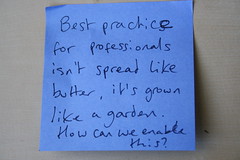
Best practice isn't spread like butter
Originally uploaded by sicamp

In the discussion groups, we hear people saying "we don't believe in best practice". Respected KM gurus say that "best practice harms effectiveness". There is a school of thought that says the concept is flawed, or even dangerous.

But is it?

In our recent survey we found that 62% of the knowledge managers who responded said that Best Practice was part of their KM program, and of that 62%, those who quoted a value delivery figure for KM delivered on average $175 million in value from Knowledge Management. Those who did not include Best Practice delivered on average $8.6 million from KM.

Certainly Best Practice is not a universal concept - David Snowden, in his complexity model, believes that best practice will apply only to simple repeatable non-complex problems.  However the world is full of simple repeatable non-complex problems, and there is a lot of value to be gained by finding good consistent ways to solve these.

Certainly I have seen the concept of best practice used negatively and destructively in organisations. I have seen people defend outmoded and inefficient ways of working by saying "we are following best practice". However I feel that as a concept, best practice can still be very useful, with the following caveats

1. Best is temporary. There may be a current "best way" to do something, but like "world champion" or "world record", it's not going to stay the best for long.

2. Best is therefore a starting point. We are always looking to improve on best, but without knowing the temporary best, we don't know what we have to beat. Like a world record, best is there to be beaten - its a minimum accepted threshold.

3. Best is contextual. There may be no universal "best way" to do something. The best way to deal with emergency decompression of a Jumbo Jet may not be the best way to deal with emergency decompression of a Harrier jump jet. However within that context, there is still a "best".

4. In a new context, you cannot blindly apply "best" from another context. However you can learn from other "bests" - no context is ever totally alien, and there may be approaches that can inform and advise, that you can build upon

5. Best practice does not have to be written down. It can live there in the community cloud of tacit knowledge. Usain Bolts "best way to run a sprint" is probably not even conscious - its in his muscle memory. However if it can be written down - in a wiki, or a document, or a manual - so much the better, so long as it is immediately updated every time its superseded and improved. The risk with documenting a best practice, is that it goes out of date, and there is no point in documenting without allowing for continual update. The risk with not documenting a best practice, is that people can't find it, can't refer to it, and so make up their own practice which is frequently far from best. The answer is to record and continually update, eg through a wiki, or through a constantly reviewed and updated reference (for example, army doctrine)

If you apply these 5 caveats, then there is little or no risk from the concept of best practice, and instead it can be part of the engine that drives continual improvement.

After all, the concept of best practice is simply the following thought process

"Here's a problem. Has anyone seen anything like this before? What's the best way they've found to deal with things like this? How can I build on/improve on that to tackle my problem? Hmm - that worked, I'd better let others know what I did".

Friday, 7 March 2014


How to build a business case for Knowledge Management


When we run our Bird Island Knowledge Management simulation, we put people into separate teams, working out of sight of each other, and we give them a task to build a construction; as tall as possible while passing simple tests.

At the end of 20 minutes they have finished their construction, they feel proud of what they have achieved, and think they have done pretty well. maybe they could have built a little higher, but not by much.

Then we open the doors and let them exchange knowledge with each other. Invariably they find that the others have got different designs, smarter approaches, and sometimes have built constructions to a height that others thought impossible. The teams begin to re-use each others' ideas, and their next construction is much higher as a result. Performance has increased through knowledge sharing.

This is "KM in a laboratory setting" but exactly the same can be true at work.

Let's assume you are working in a business with multiple operating or manufacturing sites. Operations cost or manufacturing cost will vary from site to site, and often each site will use different approaches, different designs, different management systems. They work in isolation, they don't know what good ideas the others are using.

Knowledge Management gives you the opportunity to reduce these costs, by sharing learnings and good practice from low cost sites, to improve the performance of high cost sites.

In order to be make to make a business case for your knowledge management intervention, you need to know what the performance difference between the sites currently is, and make an estimate of how much you can reduce this difference. You need
  • A good set of benchmark data on current operational costs, broken down as far as possible into the different factors
  • An estimate of how effective knowledge sharing and re-use could be in normalising those costs through reusing good practices
  • A desire across the business to improve. The high cost sites need to want to improve. The low cost sites need to want to help them.
As an example, in the 1990s we worked with the refineries in BP to help reduce the costs of planned shutdowns. Historical data showed that if all refineries could reach the level of top quartile, there was a prize of £30m available to the business. The business estimated that an improvement on the existing level of knowledge sharing could deliver $5m of this, while no knowledge sharing could lose $10m. This return more than justified an investment of $230,000 in a community of practice, an online knowledge asset, and a series of Retrospects and Peer Assists, and so a robust business case was constructed.

Another one of our clients looked at one of their major cost elements, water usage, and benchmarked this around their global sites. They set a target of top quartile, and assumed that KM, at the very least, would move each site 10% of the way towards this top quartile target. Even this modest estimate of improvement was worth $7m annually to the organisation, which would more than cover the costs of the Community of Practice required to facilitate the exchange of knowledge.

Simple calculations such as these can be used to help build a business case in any multi-site operation where performance varies between the sites, whether it is operational cost (as described above), sales results, time to market, customer satisfaction, cost of quality, or any other metric you care to mention.

And if you really want to convince the business that KM will improve these metrics, take the managers through the Bird Island exercise.

Thursday, 13 February 2014


Don't like Best practices? Try Best Principles! How the Navy could learn from the Army


Article Here
There is a common view in Knowledge Management that "Best Practices don't work".

I disagree; I think that there is nothing wrong with the concept of Best Practice, only with it's application. Best Practices, when they are seen as a) applying in a specific context, b) applying to a practice-based operation, and c) are open to continuous improvement, can be a mainstay of any practice-based Knowledge Management approach.

But what can you do when sharing knowledge between radically different contexts? Here Best Practices will fail, but what can you use?

Maybe you can use Best Principles.

This article is an interesting proposal to the US Navy, in a 2013 Essay, that they learn from the Army's success in dealing with IEDs (Improvised Explosive Devices).

Now hang on a minute, you might say.

IEDs are roadside devices, hidden under rubble and in civilian cars, and detonated by cellphones. The Navy operate at sea where there are no roads, no rubble and no cars, and cellphones and seawater do not mix. Practices related to IEDs surely cannot translate to the Naval context.

Yet if we avoid looking at detailed Practices and instead look at Principles, there is a big opportunity to learn.

The suicide attack on the USS Cole in Aden in October 2000, for example, showed that the Navy is under threat from explosive devices in civilian craft - a concept not that different from the car bomb. And the mining of supply routes is not that different to the bombing of transport corridors.

So what could the Navy learn from the Army? According to the essay -

  • They could learn about the use of remote operated vehicles in dealing with mines, much as the Army use robots in dealing with bombs.
  • They could learn about how counter-IED specialists have been integrated into normal operations Army operations prior to deployment, and do the same with counter-mine personnel and craft in the Navy.
  • They could learn from how the Army use each IED as an opportunity to gather intelligence thus fusing operations and intelligence together.
In each case the learning would not be blindly copying Best Practices, but looking at the Principles behind the Army success, and applying them within the Navy context.

As the author of the proposal, Commander Thomas Reynolds, says, 
"We can begin immediately to tap the valuable lessons we've learned from the military's decade-long experience and hard-won success in dealing with IEDs, and use them to restructure our naval mine countermeasures"
That's Knowledge Management!

Tuesday, 10 December 2013

KM case study - the Ford BPR system (Quantified success story #78)

73 Ford Mustang Mach I The Best Practice replication system was an early Knowledge Management approach, applied by Ford in the 90s, to share improvements around the 37 manufacturing and assembly plants in the Vehicle Operations division.

The interesting thing about this system is that it is rigorous, defined, quantified, all the things that we often think Knowledge Management should NOT be, but for a long time it worked extremely well at Ford.

  • Within this CoP are “Focal Points" responsible for best practice in specific areas
  • At each plant, innovations and improvements are identified and tagged as "Best Practices"
  • These have to be "proven practices" - ie they have to be shown to work, and to significantly improve things.
  • There is a validation step, to demonstrate that these practices really are good, and really are worth replicating
  • These validated practices are entered into an Intranet-based system. this is done through an  Intranet report page, which records things like where idea came from, how much time, money or manpower it saved, who to contact for details, images and video  
  • The system "pushes" the practice to the other focal points in the CoP
  • Between 5 or 8 practices per week come through the system
  • Each focal point who receives a practice needs to fill in a form saying what has been done with this knowledge in their local plant - adopted it (and if so, what value did it add), rejected it (and if so, why), improved it, put it on hold for further investigation.
  • Statistics of adoptions and value were captured and reported regularly
  • Plant management meetings were held on a regular basis to review levels of adoption
  • Engineers within the community would meet quarterly face to face, to build trust and relationships
  • Engineers have reciprocal site visits, to visit each others plants and to understand each others contexts.
  • All of this was within a context of a strong pressure on operating costs, which drove the management of each plant to be very receptive to any ideas that would cut cost.
Ford claim that the Best Practice replication system delivered $1billion in hard documented value from 1995 to 2002, for an annual investment of $500,000 (that's an ROI of nearly 300-fold).

The Best Practice Replication system itself has been licensed to many organisations, including Shell, Nabisco, Kraft, and the US Navy


Tuesday, 13 August 2013


Why great ideas don't always spread


_MG_0095 Here is a very interesting article from the New Yorker, by Atul Gwande, about why some ideas or best practices catch on and spread, while others don't. In today's connected world we expect good ideas to diffuse virally, but the fact is that many great ideas never spread.

For example, Gwande contrasts the histories of anaesthesia and asepsis in medicine - both important life-saving ideas, but the practice of anaesthesia spread like wildfire, while asepsis is still not properly adopted world wide. What was the difference between the two?

The difference was the immediacy and visibility of the problem to the practitioner. Anaesthesia solved an immediate and visible problem for the surgeon. Under ether, the patient was no longer screaming and thrashing about, and the operation could take place in peace and quiet. Asepsis, on the other hand, did not solve an immediate problem. The operation took place as normal, and nothing apparently changed. As far as the surgeon could see, there was no immediate improvement. OK, the long term patient survival rate improved with asepsis, but that was a longer term issue and more remote for the surgeon. Asepsis solved a big problem, but a problem that was largely invisible to the practitioner, at least in the short term.

Gawande concludes that with the big invisible problems, you cannot expect improved practices to spread virally. You need to work on them. You need to sell the solutions, and like sales reps, that requires frequent interactions (the "seven touches") between the trainer or knowledge holder and the user - person to person, door to door, talking. He gives an example of an interaction with a nurse who learned, from a visiting trainer, a new practice that improved the survival rate of newborn infants. This was a practice that addressed one of these "invisible problems", but had proved very difficult to spread. Gwande wanted to know why the nurse had adopted the practice in this case.

“She showed me how to get things done practically,” the nurse said. 
“Why did you listen to her?” I asked. “She had only a fraction of your experience.” 
In the beginning, she didn't, the nurse admitted. “The first day she came, I felt the workload on my head was increasing.” From the second time, however, the nurse began feeling better about the visits. She even began looking forward to them. 
“Why?” I asked. All the nurse could think to say was “She was nice.” 
“She was nice?” “She smiled a lot.” “That was it?” 
“It wasn't like talking to someone who was trying to find mistakes,” she said. “It was like talking to a friend.”
This was one of those big ideas that spread through repeated personal contact and influence, rather than virally, and the repeat contact and trust that developed between the trainer and the nurse was vital for adoption and re-use of the knowledge.

So what is the implication for Knowledge Management?

The implication comes through the strategies you need to employ for knowledge re-use. Where knowledge solves an immediate problem for the user, then you can rely on a viral approach. Where it solves a longer term problem for the organisation, but may be invisible to the user, then knowledge re-use needs to be promoted through training, coaching and frequent interaction.

Monday, 6 August 2012


Best Practices and Olympic High Jump techniques


Picture from here
This is Olympic Week 2, so let's look at some hard data on Best Practices and how they affect performance.

Let's look at the high jump.

There was a time when there was no established technique for the high jump. People approached the bar front-on, often from a standing start. However as the high jump became an international field event, techniques and practices began to be developed.

One of the early successful practices was the Western Roll, introduced in 1912, leading to the world record of that time, and a step change in performance (see picture above). This new practice rapidly became "best practice" of the time, and was predominant through the Berlin Olympics of 1936.

The Western Roll was superseded by the Straddle technique in 1937. You can see on the graph how this new practice led to another step-change in performance, with record height rapidly increasing over a period of years as the technique was perfected and adopted around the world.

Then in 1968, Dick Fosbury introduced a new technique, the "Fosbury flop", to win a gold method in Mexico City. As Wikipedia says, "After he used this Fosbury flop to win the 1968 Olympic gold medal, the technique began to spread around the world, and soon floppers were dominating international high jump competitions". The new practice had become Best Practice, and so standard practice. Over the years since 1968, the details of the Flop have been perfected, but it still remains the basis of Best Practice in high jump techniques, until a new technique is discovered.

So what has all this got to do with Knowledge Management?

Basically, this is a metricated historical look at Best Practice under controlled conditions, and allows us to draw the following conclusions.

1) Best Practice is not static. Best is "Best for now, until something better is found". The existence of "current best" doesn't stop you looking for Better.

2) Best Practice is what delivers Best Results. In high jumping, this is easily defined - it's the technique allows you to jump higher than any other technique.

3) People will follow Best Practice whenever they are highly incentivised to deliver the best performance, e.g. in an Olympic Games, where the new Best Practice is better than their old practice, and when they have not yet found an even better practice (see number 1 above).

4) Best Practice is easiest to develop and copy in a relatively repeatable situation, where the parameters remain fairly constant, and where the metrics are clear (such as jumping over as high a bar as possible).

5) Under such circumstances, changes in Best Practice drive step changes in performance - the steps seen in the attached graph

6) There will be personal variants of Best Practice, but the core of the practice - the fundamentals of the technique which differentiate it from other techniques -  remains the same. Tinker with the core, and the practice fails to deliver.

7) Changes in Best Practice are often driven by changes in context. The Fosbury Flop, which drove the biggest leap forward in high Jump achievement, was made possible by the change from sawdust landing pits to deep foam matting. Basically, you could land on your neck without killing yourself. So the new Best Practice - the flop -  was born.


Thursday, 24 May 2012


Quantified success stories #32, GM


CCM Rapide 32 Here's a good case study of the General Motors KM approach (and you can also find a more detailed description in Tom's book).

GM is a company with 327,000 employees that manufactures cars and trucks in 33 countries, and the driver for GM was standardisation of design and manufacturing approach, delivered through identifying, codifying and applying best practices.

 Steve Wieneke of GM used an existing taxonomy to charter 138 best practice teams across 33 centres of expertise to work with the identified subject matter experts, to populate and maintain "Technical Memory", a database of explicit knowledge and best practice. About one-third of the database is updated every year.

According to the article

" Early outcome metrics are already beginning to validate the product engineering initiatives. During the 36 months in service, for vehicles sold during 2000 through 2003, actual warranty costs dropped by almost 20 per cent below forecasts. The catalogue of engineering solutions, technical memory and the closed-loop learning are three of the current 10 activities identified as the engineering enablers driving the warranty cost down.
Although not solely a result of the initiative:
  • Product quality has dramatically improved;
  • Time to market has been accelerated;
  • Structural cost has been reduced;
  • The engineering culture is progressing from hoarding to sharing knowledge and from reinventing to adopting and adapting what is already known".

Thursday, 16 February 2012


Who signs off on Knowledge?


signing off I have an old video of Professor John Henderson, where he says "every Knowledge Management system I have seen, addresses the issue of Validation".

Validation means a process by which it can be said that "this is good quality knowledge. It's not opinion, or conjecture; it is justified and valid".

If Validation is important, and I believe it is important, then who validates? Who "signs off" on Knowledge?

The more we see Knowledge as being community property rather than the property of .any one individual, the more tricky this issue becomes. Here are some thoughts about how it may be addressed.

Firstly, there is the issue of the important of the knowledge itself. The more important it is, the more of a life-end-death issue it is, the more validation becomes a single person job. This is partly for purposes of accountability. Single-point accountability, in business and government, is the cornerstone of good governance and ultimately, good performance. Without single point accountability for processes, organisations have no means of ensuring that what have been determined as the goals for the organisation are likely to be met. So let's imagine knowledge of Nuclear Power Plant construction. If you want good performance in Nuclear Power Plant construction, then validation of the knowledge requires single point accountability. One person must sign off, generally using a Community of Practice or a smaller Community of Experts as an advisory board.

If the knowledge is of lesser importance, then the Community of Experts can take a collective accountability, and validate the knowledge themselves. If single-point accountability is not so important, then let the group decide.

But can we have a system of validation by the Community of Practice? Indeed we can - we could give the users of the knowledge some sort of "voting rights" on the knowledge, so they can vote on what is useful, and what is valid. You would end up with a CoP validation process. This may be possible when the Community Members are experienced enough to be able to validate. Take a community of amateur bakers, validating the best recipe for Victoria Sponge. A community voting process to define the best recipe would be very effective.  In other cases, the CoP members may be largely inexperienced, and lack the capability to make effective validation judgments. A poll of tabloid newspaper readers regarding the validity of newspaper horoscopes might not give an answer that was consistent with scientific study, for example.

So when you are addressing the validation issue, ask yourself who knows enough to validate, and whether there needs to be single point accountability.

Monday, 13 February 2012


The difference between best practice and lessons learned


Someone last week asked me, what's the difference between Best Practice, and Lessons Learned.

 Now I know that some KM pundits don't like the term "Best Practice" as it can often be used defensively, but I think that there is nothing wrong with the term itself, and if used well, Best Practice can be a very useful concept within a company. So let's dodge the issue of whether Best Practice is a useful concept, and instead discuss it's relationship to lessons learned.

My reply to the questioner was that Best Practice is the amalgamation of many lessons learned.

If we believe that learning must lead to action, that lessons are the identified improvements in practice, and that the actions associated with lessons are generally practice improvements, then it makes sense that as more and more lessons are accumulated, so practices become better and better. A practice that represents the accumulation of all lessons is the best practice available at the time.

See the diagram (though really instead of a steadily increasing arrow, it should go up in small incremental steps, but that's beyond my drawing ability).

Thursday, 26 January 2012


Tom Peters on Best Practices


As I said myself, (also here and here) - nothing wrong with the concept if it's used in the right way

Lots wrong with the concept if it's used in the wrong way

Tuesday, 4 January 2011


Real Men don't follow Procedures


What Real Men (or Real Women or Real Anyone) Don't Do
In my files, I have a copy of an article called "Should Real Men Use Procedures?" - largely repackaged here. It's a very interesting look at an unexciting topic, written by Dr David Embrey of Human Reliability Associates.

Nobody gets really excited about procedures. Or at least, they don't until things go wrong. Procedures are needed to comply with quality systenms, and procedures are needed to document safe and effective operation. In an ideal world, corporate knowledge of the safest and most effective way to conduct operations would be encoded into procedures which everyone would follow (until a better way is found).

Unfortunately, people don't always like to follow procedures.

As the article explains

In one project, a questionnaire was distributed to nearly 400 operators and managers. The first set of questions related to the extent that procedures were actually used for different categories of task. For tasks perceived to be safety or quality critical, the use of procedures was high (75% and 80% respectively) but by no means universal. For problem diagnosis (regardless of whether a system was safety critical or not) only 30% of the respondents used procedures. In the case of routine tasks, only 10% of the respondents said they used procedures. When a task is described as ‘proceduralised' there is an implicit assumption that the procedures will actually be referred to when performing a task. However, the results of the survey indicated that even in tasks where procedures were said to be used, only 58% of the respondents actually had them open in front of them when carrying out the task These figures imply that the actual average 'on-line' usage of procedures for safety/quality critical, problem diagnosis and routine tasks is quite low, i.e. 43%, 17% and 6% respectively
That's pretty low!  And even when the procedures were referred to, they were generally taken as being advisory guidelines
Another dimension assessed by the study was the extent to which procedures should be regarded as being guidelines, or needed to be followed 'to the letter'. Although there was considerable agreement that safety and quality instructions should be followed 'to the letter' (90% and 75% respectively) for most other categories of task about 50% of respondents believed that they were primarily guidelines. This came as a considerable surprise to the management of the companies included in the survey.
Now it might be assumed that for routine tasks, people did not refer to procedures because they could remember them perfectly. Alas this is not the case

The results indicated a very high usage of 'Black Books' by both operators and managers (56% and 51% respectively). Although there is no reason in principle why such informal job aids should not be compiled by individuals, their existence suggests that there may be considerable variation in the way that tasks are actually performed. There are obvious implications for quality critical operations if some of these variations in performance do not achieve the required objectives.
So people don't refer to company procedures, but they do refer to their own personal version in their own black book. Some of the reasons for this are shown below.


Procedures are not used because. (percentage agreeing)
Accuracy
  • they are inaccurate (21)
  • they are out of date (45) 
practicality
  • they are unworkable in practice (40)
  • they make it more difficult to do the work (42)
  • they are too restrictive (48)
  • too time consuming (44)
  • if they were followed 'to the letter' the job could not get done in time (62)
optimisation


  •  people usually find a better way to do the job (42) 
  • they do not describe the best way to carry out work (48)
Presentation
  • it is too difficult to know which is the right procedure (32)
  • they are too complex and difficult to use (42)
  • it is difficult to find the information you need within the procedure (48)
Accessibility
  • it is difficult to locate the right procedure (50)
  • people are not aware that a procedure exists for the job they are doing (57)
policy
  • people do not understand why they are necessary (40)
  • no clear policy on when they should be used (37)
Usage
  • experienced people don't need them (19)
  • people resent being told how to do their job (34) 
  • people prefer to rely on their own Skills and experience (72)
  • people assume they know what is in the procedure (70)

So the procedures are innacurate, are not the best way to do the job, are difficult to follow or find, and people don't understand why they are needed, son instead they follow their own noses.
The way around all of this is pretty obvious, namely to involve the workers themselves in the creation and update of the procedures, and then to make them as user-friendly as possible. In other words, work with the operators to create the procedures from the black books themselves, and then apply a system for continuous improvement.
The old story about the knowledge sharing system applied at Xerox arose from a situation exactly as described in the article. Here there was a company manual which everyone was supposed to follow. Unfortunately it was wrong, out of date, and ineffective. The technicians kept two sets of manuals - a clean set to show management, and a set full of their own scribbles and annotations which was effectively their own "Black Book". Eventually Xerox introduced communities of practice, who took ownership of developing, applying and continuously improving their own procedures.


REAL men and women WILL follow procedures, provided they are involved in creating and improving those procedures in the first place. That's when they know that they are REAL procedures!

Tuesday, 27 July 2010


"Best Practice" and KM


I know a lot of people are suspicious of the concept of Best Practice in KM, but I believe its a useful concept when handled properly. See the video below

Wednesday, 7 April 2010


5 rules to reinvent "best practice"


There is a lot of pushback in the KM world about the term "best practice". In the discussion groups, we hear people saying "we don't believe in best practice". Respected KM gurus say that "best practice harms effectiveness". David Snowden, in his complexity model, believes that best practice will apply only to simple repeatable non-complex problems.

Certainly I have seen the concept of best practice used negatively and destructively in organisations. I have seen people defend outmoded and inefficient ways of working by saying "we are following best practice". However I feel that as a concept, best practice can still be very useful, with the following caveats

1. Best is temporary. There may be a current "best way" to do something, but like "world champion" or "world record", it's not going to stay the best for long.

2. Best is therefore a starting point. We are always looking to improve on best, but without knowing the temporary best, we don't know what we have to beat. Like a world record, best is there to be beaten - its a minimum accepted threshold.

3. Best is contextual. There may be no universal "best way" to do something. The best way to deal with emergency decompression of a Jumbo Jet may not be the best way to deal with emergency decompression of a Harrier jump jet. However within that context, there is still a "best".

4. In a new context, you cannot blindly apply "best" from another context. However you can learn from other "bests" - no context is ever totally alien, and there may be approaches that can inform and advise, that you can build upon
5. Best practice does not have to be written down. It can live there in the community cloud of tacit knowledge. Usain Bolts "best way to run a sprint" is probably not even conscious - its in his muscle memory. However if it can be written down - in a wiki, or a document, or a manual - so much the better, so long as it is immediately updated every time its superseded and improved. The risk with documenting a best practice, is that it goes out of date, and there is no point in documenting without allowing for continual update. The risk with not documenting a best practice, is that people can't find it, can't refer to it, and so make up their own practice which is frequently far from best. The answer is to record and continually update, eg through a wiki, or through a constantly reviewed and updated reference (for example, army doctrine)

If you apply these 5 caveats, then there is little or no risk from the concept of best practice, and instead it can be part of the engine that drives continual improvement.

After all, the concept of best practice is simply the following thought process

"Here's a problem. Has anyone seen anything like this before? What's the best way they've found to deal with things like this? How can I build on/improve on that to tackle my problem? Hmm - that worked, I'd better let others know what I did".

Blog Archive