Showing posts with label cognitivie bias. Show all posts

Monday, 23 May 2022

Is that really tacit knowledge, or could it be cognitive bias?

Is that really Tacit Knowledge in your head, or is it just the Stories you like to tell yourself?


IMAGINATION by archanN on wikimedia commons
All Knowledge Managers know about the difference between tacit knowledge and explicit knowledge (or at least they think they do!), and they know the difference between the undocumented knowledge you hold in your head, and documented knowledge which can be stored.   We often assume that the "head knowledge" (whether tacit or explicit) is the Holy Grail of KM; richer, more nuanced, more contextual and more actionable than the documented knowledge.

However the more I read about (and experience) cognitive bias and the failures of memory, the more suspicious I become of what we hold in our heads.

These biases and failures are tendencies 1) to think in certain ways that can lead to systematic deviations from good judgement, and 2) to remember (and forget) selectively and not always in accordance with reality. We all create, to a greater or lesser extent, our own internal "subjective reality" from our selective and flawed perception and memory. Some of this might be real knowledge, some might not.

Cognitive and memory biases include:

  • Confirmation bias, which leads us to take on new "knowledge" only when it confirms what we already think;
  • Gamblers fallacy, which leads us to think that the most recently gained knowledge is more important;
  • Post-investment rationalisation, which leads us to think that any costly decisions we made in the past must have been correct ("we spent a lot to learn that, so the knowledge must be correct");
  • Observational selection bias, which leads us to think that things we notice are more common that they are (like when you buy a yellow car, and suddenly notice how common yellow cars are);
  • Attention bias, where there are some things we just don't notice (see the Gorilla Illusions);
  • Memory transience, which is the way we forget details very quickly, and then "fill in the gaps" based on what we think should have happened;
  • Misattribution, where we remember things that are wrong;
  • Suggestibility, which is where we create false memories.

So some of those things in your head that you "Know" may not be knowledge at all. Some may be opinions which you have reinforced selectively, or memories you have re-adjusted to fit what you would have liked to happen, or suggestions from elsewhere that feel like memories. Some of them may be more like a story you tell yourself, and less like actual knowledge.

Do these biases really affect tacit knowledge? 

Yes they really do, and they can affect the decisions we make on the basis of that knowledge.  Chapter 10 of the 2015 World development Report, for example, looks at cognitive biases among development professionals, and makes for interesting reading.

While you would expect experts in the World Bank to hold a reliable store of tacit knowledge about investment to alleviate poverty, in fact these experts are as prone to cognitive bias as the rest of us. Particularly telling, for me, was the graph that compared what the experts predicted poor people would think, against the actual views of the poor themselves. 

The report identifies and examines 4 "decision traps" that affect the development professionals and influence the judgements that they make:

  • the use of shortcuts (heuristics) in the face of complexity; 
  • confirmation bias and motivated reasoning; 
  • sunk cost bias; and 
  • the effects of context and the social environment on group decision making.

And if the professionals of the World Bank are subject to such traps and biases, then there is no guarantee that the rest of us are any different.

So what is the implication?

The implication of this study, and many others, is that one person's "tacit knowledge" may be unreliable, or at best a mish-mash of knowledge, opinion, bias and falsehood. There is a risk that knowledge from one person's is unreliable, unless tested somehow. As Knowledge Managers, there are a number of things we can do to counter this risk.

  1. We can test Individual Knowledge against the knowledge of the Community of Practice. The World Bank chapter suggests the following: "group deliberation among people who disagree but who have a common interest in the truth can harness confirmation bias to create an efficient division of cognitive labor. In these settings, people are motivated to produce the best argument for their own positions, as well as to critically evaluate the views of others. There is substantial laboratory evidence that groups make more consistent and rational decisions than individuals and are less likely to be influenced by biases, cognitive limitations, and social considerations. When asked to solve complex reasoning tasks, groups succeed 80 percent of the time, compared to 10 percent when individuals are asked to solve those tasks on their own. By contrast, efforts to debias people on an individual basis run up against several obstacles, and when individuals are asked to read studies whose conclusions go against their own views, they find so many flaws and counterarguments that their initial attitudes are sometimes strengthened, not weakened". Therefore community processes such as Knowledge ExchangePeer Assist and general community discussion can be ideal ways to counter individual biases.
  2. We can routinely test community knowledge against reality. Routine application of reflection processes such as After Action review and Retrospect require an organisation to continually ask the questions "What was expected to happen" vs "What actually happened".  With good enough facilitation, and then careful management of the lessons, reality can be a constant self-correction mechanism against group and individual bias.
  3. We can test the knowledge against other viewpoints. Peer Assist, for example, can be an excellent corrective to group-think in project teams, bringing in others with potentially very different views. 
  4. We can combine individual memories to create a team memory. Team reflection such as Retrospect is more powerful than individual reflection, as the team notices and remembers more things than any individual can.
  5. We can codify knowledge. Lean as codified knowledge is, it at least acts as an aide memoire, and counteracts the effects of memory transience, misattribution and suggestibility. 
But maybe the primary thing we can do is to stop seeing individual tacit knowledge as being safe and reliable, and instead start to concentrate on the shared knowledge held within communities of practice.  

Think of knowledge as Collective rather than Individual, and you will be on the right track.

Wednesday, 1 September 2021

3 cases where human brains are the best store for knowledge

I have long argued that the human brain is a poor long term store for Knowledge. Here are the three cases where it's the best store there is.


Ebbinghaus' forgetting curve, from wikimedia commons

The poor human brain gets a bit of a bad press at times. The cognitive biases that plague us all are becoming well known and popularised in many books, and we recognise the cognitive illusions that get in the way of effective use of knowledge, such as

With such illusions as these, and with the way memory decays over time (see graph to the right), can we trust the "knowledge" we hold in our heads?

However this book by Daniel Schacter makes the point that the human brain works marvellously well in getting us through life, by selecting automatically what we remember and what we don't.  Our brain has limitations, and with those limitations come trade-offs. One of the trade-offs our brain makes is to prioritize which knowledge to hold on to, and which to let go of. It must do this — we’d be overloaded with information without this ability. 

The brain has evolved to prioritize knowledge which is: 
  1. Used frequently 
  2. Used recently 
  3. Likely to be needed
These are the three cases where Knowledge Management can harness the brain as the most reliable store of knowledge. 
  1. Knowledge of tasks used regularly and frequently - part of your daily or weekly routine. If you conduct the task annually, maybe your brain is not the best store. For example, packing for a holiday. We do this once a year, but still forget to pack things, so a packing checklist can be a very useful aide-memoire.
  2. When something has happened recently, the knowledge in the brain is reliable. However peoples' memories fade within a matter of hours or days (the forgetting curve) so if the knowledge is important, then it makes sense to either repeat it to someone, or record it.
  3. When the knowledge is something we know we will need (and need soon) then we make an effort to remember, for example through spaced repetition or rehearsal.
This current and frequently used knowledge is best left in human brains, connected into Communities of Practice, where the knowledge can be shared, improved, discussed and kept fresh.  The community of practice can act as a super-brain, holding collective memories. 

Note that for critical or complicated knowledge, or under times of stress or lack of sleep, even these three criteria may not be sufficient. Aviation pilots, for example, may fly frequently, have flown recently, and know they will need to fly again, but will still use a checklist to augment their memory, as they know that the consequences of forgetting one detail may be catastrophic.

Also note that muscle memory may not have the same "forgetting curve". once you know how to ride a bike, for example, you never forget. You may feel "rusty" but you remember the basics.

The converse of the three cases above is that knowledge which is used infrequently, was used some time ago, and which we did not realise was likely to be needed, gets forgotten. This is exactly the knowledge which needs to be documented, lest we forget.

The occasional and infrequent knowledge should not be left in the human memory without augmenting this somehow through collecting, recording and structuring it in Knowledge Assets, so that it is given a shelf-life which the human brain cannot give. Again the community can play a role in building and maintaining these assets, and keeping them fresh and up to date.

Our responsibility as knowledge managers is to work out which knowledge to deal with through connection, and which through collection.

Thursday, 1 October 2020

The illusion of confidence - test your own overconfidence bias!

As humans, we are prone to unconsious bias, which can severely affect the way we work with knowledge. Follow the link in this post to see how biased YOU are!


Image from book review
"Thinking fast and slow"

Cognitive biases can seriously affect the way we work with knowledge. I have described three of them in this blog - 
The last two combine in a very powerful way. People who don't know very much can seriously overestimate their confidence in what they do know (this is known as the Dunning Kruger effect - incompetence shields our self-knowledge of incompetence). They then give their opinions very confidently, despite those opinions being based on very little knowledge. And because they speak confidently, others believe them. 

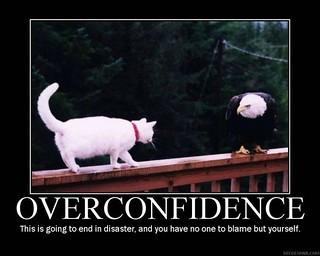
Result, disaster, especially in Knowledge Management terms. The greater the level of overconfidence, the greater the cost of the mistakes that follow.

Many of us think "I am not biased - I am completely confident that I am not overconfident, nor do I overestimate my knowledge or memory".  But you are wrong to say this. All humans are flawed. 

If you don't believe me - take this free test!

The test requires you to estimate ranges for ten numbers (the height of this, the age of that etc), and to put the ranges so that you are 90% confident the real answer lies within the range.

If you are not biased, then 9 out of 10 of the answers will lie within the ranges you gave. Any fewer than 9 out of 10 suggests an overconfidence bias.

I scored 5 out of 10. I am overconfident. I am a flawed human! How did you do?

The lesson is, just because someone gives you a confident answer, does not mean it is right. All people are overconfident, and overconfidence combined with an illusion of knowledge can result in big and expensive mistakes.


Monday, 9 September 2019

Watch confirmation bias in action

Confirmation Bias is one of the most pernicious cognitive biases, and is a major challenge to Knowledge Management. See it in action below.

Confirmation bias is a powerful cognitive bias, which means that people

  1. Tend to select evidence that supports what they already believe, and 
  2.  Set up tests that confirm their believe, rather than test it.
You can see how this would be a thorn in the side of KM. How do you know whether what you are dealing with is Real Knowledge, or Fake Knowledge - an opinion which has been reinforced through selective evidence and only confirmatory testing?

Below is a short video of a team exercise to expose confirmation bias, which is also an excellent example of confirmation bias in operation. I explore further later down the page. 


In the 5 rounds of the game, the facilitator provided a set of names that fit a rule, and the participants suggested other names, and then estimated their confidence that they knew what the rule was.


Round Names Provided Names Added (all deemed correct) Confidence level
1 John Adams, Thomas Jefferson, George Washington Alexander Hamilton, James Madison, Andrew Jackson, John Hancock 76%
2 Abraham Lincoln Ben Franklin, U Grant, T roosevelt, JFK 53%
3 Martin Luther King Columbus, Jesus, Nelson Mandela, Rosa Parks 56%
4 Ghandi Mother Teresa, Julius Caesar, Mohammed (PBUH), Saddam Hussein 64%
5 Philip Seymour Hoffman Golda Meir, Fidel Castro, Michael Jackson, Amy Winehouse 76%

For example, in round 1 the three names provided will be familiar to Americans as "Founding fathers", or signatories to the Declaration of Independence. All the names suggested/added by the participants were also founding fathers, and the group was 76% sure that the rule was "Founding Fathers"

As the facilitator added more names, it became clear that these were not all founding fathers. 
  • Maybe (round 2) they were "Famous American political figures (male)" 
  • Maybe (rounds 3 and 4) they were "Famous political/religious figures (male or female)"
  • Maybe (round 5) they were "Famous dead people"
However - notice one important thing

All (or almost all) the suggested names were confirmatory. They conformed to the rule that the participants thought was in operation.

In no case did anyone suggest a name that tested the rule, only names that fitted the rule. Each suggested name, each test of the rule, was already inside the set they had already defined.  Nobody said "Donald Trump" (to test whether the person had to be dead), or "My granny" (to test whether the person had to be human), or "Homer Simpson" (to test whether the person had to be real), or "Ming Ming the Panda" (to test whether the person had to be human).

The only example of a test I can see in this list, rather than a confirmation, is when someone suggested Rosa Parks, even though all other names to date had been male. This was a true test.

People prefer to confirm, rather than to test. 

Also note how confident the group were with their first guess at the rule, back at the time when the sample set was smallest and when they were most wrong. Then as new names were added, their confidence fell, then rose again. But maybe they are still wrong - maybe if we added Donald Trump, Homer Simpson and Ming Ming the Panda, these would be correct as well. Maybe the rule is "sentient beings, alive or dead."

The lessons for Knowledge Management are these;

  • If everything seems to conform with what you "know" - beware confirmation bias; especially when your sample set is small.
  • Just because you are confident of what you know does not mean you are right. 
  • If you want to test whether your knowledge is correct, don't seek for confirmatory examples, seek for counter-confirmatory examples. Test, don't just confirm,
  • The first valid counter-confirmatory example must result in a re-think of what you know.
  • All of this is difficult; as humans we are programmed to seek confirmation, not to test theories. 

Beware of confirmation bias - its more pernicious than you think 


Monday, 19 August 2019

The curse of knowledge (video)


When we have a lot of knowledge, we underestimate how hard it is to communicate this to people who don't know.  This is called the "Curse of Knowledge" - a cognitive bias that leads to people trying to convey knowledge in bullet points, or in fuzzy statements which are meaningless to others, or by writing knowledge assets which are incomprehensible to the unknowledgeable reader.

The video below by Jeff Walker, the Sales guru, illustrates this cognitive bias in more detail. As the YouTube caption says -
Ever have an “expert” try to explain something to you, only to be left more confused than when you started? They’d forgotten how to be a beginner… and lost most of the ability to teach along the way… here’s how to not make the same mistake yourself.
The video is aimed at sales staff, for whom the curse of knowledge is just as much a barrier to communication as it is in Knowledge Management, but the message is the same -

You cannot communicate knowledge properly unless you account for the Curse of Knowledge. 


Wednesday, 31 July 2019

Watch conformity bias in action

I blogged yesterday about groupthink. Would you like to see this in action?


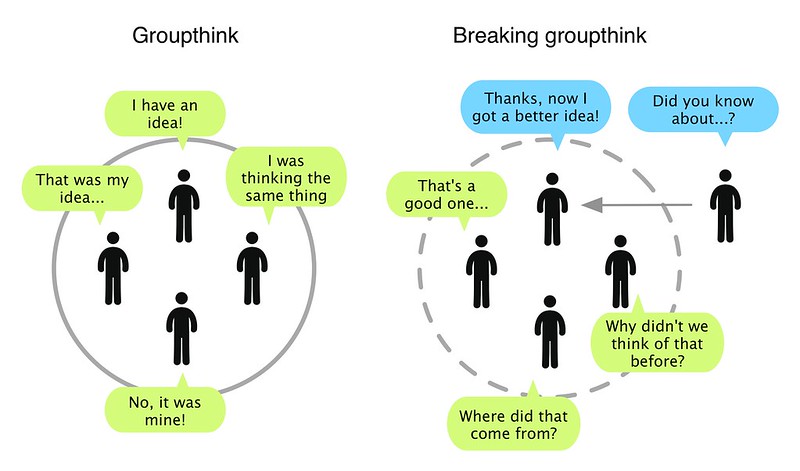
The video below is a startling example of how people will agree with a group even when they know the answer is wrong. This is known as Conformity Bias, the our tendency to take cues from the actions or judgments of others rather than exercise our own independent judgment. Conformity bias is a major enemy of Knowledge Management, as it means that group "knowledge" can remain unchallenged.

The video is of the "Asch conformity experiment" which placed a subject in a group of people primed to give obviously wrong answers. Much of the time, the subject agrees with the group even though he knows the answer is wrong, and you can see the consternation on his face has he does this (1 min 31) or the resignation as he "tells a lie" to fit in (2 min 12).

37% of the time the subject will give the wrong answer to fit in with the group, but this falls to 5% if there is a "partner" in the group who gives the right answer, thus destroying the group unanimity, and also if the subject is allowed to write their answer rather than say it.


So what's the lesson for Knowledge Management?

If you are facilitating a group KM session where knowledge is being exchanged, and they all seem to agree but you can see consternation, or discomfort, on some of the faces, then maybe there is groupthink at work. In this more extensive post on conformity bias I suggest some of the things you can do:


  1. Ask people to write down views then read them out, rather than "speaking out around the table"
  2. Press for the dissenting voice - "does anyone thing differently here? What about you Susan - you were looking concerned, do you have an alternative view?"
  3. Ask "who wants to be the devil's advocate here?
  4. Make dissent safe, both in groups and online
  5. Avoid using social responses as a form of crowdsourcing, unless you do this very carefully, as everyone is likely to agree with the first confident view. 

For a more modern version of this video, without the 1970s fashion sense, see here

Tuesday, 30 July 2019

Does KM need an official Devil's Advocate role?

KM is beset by cognitive biases such as Groupthink. Maybe the Devil's Advocate role is needed to help combat this?


The biggest impediments to learning in an organisation are mental impediments, driven by cognitive biases.  These include the confirmation bias (where we only accept evidence that confirms what we think), and GroupThink; aka conformity bias (where the desire for harmony or conformity leads group members to minimize conflict and reach a consensus decision without critical evaluation of alternative viewpoints).

If you combine these two, you end up with a powerful immovable force, whereby a group becomes entrenched in their thinking.  People inside the knowledge bubble are convinced they are correct, and immune to learning or to new knowledge that contradicts what they think. They cannot learn. They are stuck.  This results in a Knowledge Bubble -  the classic example being the Bush Administration who, convinced that Saddam Hussein was the primary threat, refused to countenance warnings about Osama Bin laden.

But if Group-think is such a potent threat to learning, and thus to KM, whose job is it to prick the Knowledge Bubbles?

This interesting post from Tech Crunch called "The VP of Devil's Advocacy" might just have the answer.

One solution (and here the Tech Cruch quotes from the movie World War Z) is
"The tenth man. If nine of us look at the same information and arrive at the exact same conclusion, it’s the duty of the tenth man to disagree. No matter how improbable it may seem, the tenth man has to start thinking with the assumption that the other nine are wrong".
The original scene is below.


This is an illustration from Hollywood, but it is based on a real group - the Devils Advocates Office in Israeli intelligence - described here as follows
The devils advocates office ensures intelligence assessments are creative and do not fall prey to group think. The office regularly criticises products coming from the analysis and production divisions, and writes opinion papers that counter these department's assessments. The staff in the devils advocate office is made up of extremely experienced and talented officers who are known to have a creative "out of the box" way of thinking".
The Devils Advocates Office is an excellent and systematic defence against the perils of group-think.

An alternative approach, taken by many project management organisations, is what they call "The Black Hat review" - a destructive review questioning the assumptions underlying a proposal or a planned project. Often the Project Management Office takes this Black Hat role, which can counter the wishful thinking that besets many projects.


In sports, Bill Simmons calls this role "The VP of common sense"

I'm becoming more and more convinced that every professional sports team needs to hire a Vice President of Common Sense, someone who cracks the inner circle of the decision-making process along with the GM, assistant GM, head scout, head coach, owner and whomever else. One catch: the VP of CS doesn't attend meetings, scout prospects, watch any film or listen to any inside information or opinions; he lives the life of a common fan. They just bring him in when they're ready to make a big decision, lay everything out and wait for his unbiased reaction.

When you think about some of the crazy decisions taken by companies, and the even crazier ones taken by governments, it makes you think that this sort of systematic challenge should be institutionalised more often.

Perhaps more organisations should have a VP of Devils Advocacy, a Chief Black Hat, or a VP of common sense, to act as "The Tenth Man"

Someone whose role and accountability is to be the Chief Pricker of the Knowledge Bubbles.

Friday, 22 March 2019

The human bias behind group-think

There is a real human bias that drives us to agree with each other, which can drive group think and false consensus 


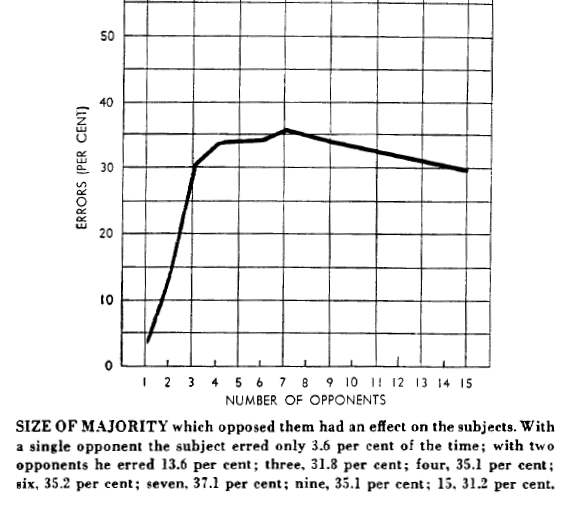
The power of social proof climbs rapidly
with the number of people involved.
From the Solomon Asch study
Why are "canned laughter" tracks so common on TV comedies?  We all hate them, we know they are false, and yet they keep putting them on the soundtrack.  The reason is that canned laughter is a form of Social Proof, and social proof is a massive factor in the way we think and behave.

Social Proof is the name for the assumption that "if everyone else thinks so, it must be correct". Canned Laughter is a subtle form of social proof; and it works - people judge comedy shows as funnier if there is canned laughter. Even though we know its false, we instinctively think "they are all laughing, so it's funny". The TV executives know we think this way, which is why canned laughter is so endemic.

The Solomon Asch study shows an even more radical form of social proof - how up to 74% of people (as part of a secret experiment) would say something they know is wrong, just to agree with everyone else. Asch concluded that it is difficult to maintain that you know something when everyone else knows the opposite. The group pressure ("Social Proof") implied by the expressed opinion of other people can lead to modification and distortion, effectively making you agree with almost anything.

The risk in Knowledge Management is very clear.

Consensus in a group may mean that everyone agrees because they all independently think the answer is correct, or it may mean that they all agree because everyone else agrees. This is particularly the case when the first person to speak is very confident; everyone else is likely to follow, and so social proof builds up (I talk about this in my blog post on the illusion of confidence, and point out that confidence is often an function of ignorance, especially ignorance in small groups. Real experts are rarely dogmatic).

I saw this for myself in a meeting in Sweden (a country where consensus is particularly valued). I asked everyone to judge the success of a project from their own perspective, to mark the level of success out of 10, and to write that number down in front of them. I was looking for outliers, and I could see that the person next to me had written a 6. We went round the table, the first person said "8 out of 10", and the marks followed - 8,8,8,8. We got to the person who had written down 6, and she said "8" as well.

Social proof is such a well known phenomenon now that it is widely used by marketers to convince us to buy things, and it can be a powerful took when marketing KM in an organisation. However when we are identifying knowledge, discussing knowledge, or trying to determine from a group what actually happened and why, then social proof can drive group-think and distort the truth.

In knowledge management we are not interested in consensus, we are not interested in knowledge as something to sell to others, and we are interested in truth, or as close to the truth as we can get. Social proof is not real proof, and just because everyone agrees with a statement, does not mean they all believe it to be correct.

So how do we avoid conformance and groupthink driven by social proof in KM?

1) When looking for individual objective input, we must avoid "speaking out around the table." In Sweden I could have collected votes on post-it notes, or I could have said clearly "read out what you have written, even if its not what everyone else said".

2) As facilitators of KM processes, we must always ask for the dissenting voice. "Does anyone disagree with this interpretation? Might there be other views here? What are the alternatives? Susan, you are looking concerned, do you have another view?"

3) As online facilitators, we must make dissent safe. I recall one community of practice where, in the first year, social proof was very strong. If anyone disagreed with the first post on a conversation they would not disagree online, but would reply privately. It took a lot of work from the facilitator to reverse this trend, and to develop a community where dissent was welcomed as being part of the search for the truth.

4) We must be careful to avoid using social responses as a form of crowdsourcing. Crowdsourcing works either with an expert crowd willing to share dissenting voices, or with a knowledgeable crowd able to contribute independently. It doesn't work with a small uncertain crowd building on each other's opinions, as that way you can end up with false agreement through social proof.

Social proof is real, groupthink is powerful, and it is one of the many human biases we need to beware of in KM. 

Thursday, 13 December 2018

The Gorilla illusions and the illusion of memory

Here is a reprise from the archives - a post primarily about the illusion of memory. The story here from Chabris and Simons raises some disturbing issues about the trustworthiness of tacit knowledge over a long timescale.


Gorilla 2
Originally uploaded by nailbender
I have just finished reading The Invisible Gorilla, by Christopher Chabris and Daniel Simons (an extremely interesting book). These are the guys who set up the famous "invisible gorilla" experiment (if you don't know it, go here). The subtitle of the book is "ways our intuition deceives us", and the authors talk about a number of human traits - they call them illusions -  which we need to be aware of in Knowledge Management, as each of them can affect the reliability and effectiveness of Knowledge Transfer.

The illusions which have most impact on KM are
 I would like to address these three illusions in a series of blog posts, as its a bit much to fit into a single one.

The illusion of memory has massive impact in KM terms, as it affects the reliability of any tacit knowledge that is held in human memory alone.

I have already posted about the weakness of the human brain as a long-term knowledge store. Chabris and Simons give some graphic examples of this, pointing our how even the most vivid memories can be completely unreliable. They describe how one person had a complete memory of meeting Patrick Stewart (Captain Picard of Star Trek) in a restaurant, which turned out not to have happened to him at all, but to be a story he has heard and incorporated into his own memory. They talk about two people with wildly differing memories of a traumatic event, which both turn out to be false when a videotape of the event is finally found. And they give this story of a university experiment into the reliability of memory.

 On the morning of January 28, 1986, the space shuttle Challenger exploded shortly after takeoff. The very next morning, psychologists Ulric Neisser and Nicole Harsch asked a class of Emory University undergraduates to write a description of how they heard about the explosion, and then to answer a set of detailed questions about the disaster: what time they heard about it, what they were doing, who told them, who else was there, how they felt about it, and so on.
Two and a half years later, Neisser and Harsch asked the same stu­dents to fill out a similar questionnaire about the Challenger explosion. 
The memories the students reported had changed dramatically over time, incorporating elements that plausibly fit with how they could have learned about the events, but that never actually happened. For example, one subject reported returning to his dormitory after class and hearing a commotion in the hall. Someone named X told him what happened and he turned on the television to watch replays of the explo­sion. He recalled the time as 11:30 a.m., the place as his dorm, the ac­tivity as returning to his room, and that nobody else was present. Yet the morning after the event, he reported having been told by an ac­quaintance from Switzerland named Y to turn on his TV. He reported that he heard about it at 1:10 p.m., that he worried about how he was going to start his car, and that his friend Z was present. That is, years after the event, some of them remembered hearing about it from differ­ent people, at a different time, and in different company.

Despite all these errors, subjects were strikingly confident in the ac­curacy of their memories years after the event, because their memories were so vivid—the illusion of memory at work again. During a final interview conducted after the subjects completed the questionnaire the second time, Neisser and Harsch showed the subjects their own hand­written answers to the questionnaire from the day after the Challenger explosion. Many were shocked at the discrepancy between their origi­nal reports and their memories of what happened. In fact, when con­fronted with their original reports, rather than suddenly realizing that they had misremembered, they often persisted in believing their current memory.
The authors conclude that those rich details you remember are quite often wrong—but they feel right. A memory can be so strong that even documentary evidence that it never happened doesn't change what we remember.

The implication for Knowledge Management


The implication for Knowledge Management is that if you will need to re-use tacit knowledge in the future, then you can't rely on people to remember it accurately. Even after a month, the memory will be unreliable. Details will have been added, details will have been forgotten, the facts will have been rewritten to be closer to "what feels right". The forgetting curve will have kicked in, and it kicks in quickly.  Tacit knowledge is fine for sharing knowledge on what's happening now, but for sharing knowledge with people in the future (ie transferring knowledge through time as well as space) then it needs to be written down quickly while memory is still reliable.

We saw the same with our memories of the Bird Island game in the link above. Without a written or photographic record, the tacit memory fades quickly, often retaining enough knowledge to be dangerous, but not enough to be successful. And as the authors say, the illusion of memory can be so strong that the written or photographic record can come as a shock, and can feel wrong, even if it's right. People may not only refuse to believe the explicit record, they may even edit it to fit their (by now false) memories.


Any KM approach that relies solely on tacit knowledge held in the human memory can therefore be very risky, thanks to the illusion of memory.

Wednesday, 5 December 2018

The curse of knowledge and the danger of fuzzy statements

Fuzzy statements in lessons learned are very common, and are the result of "the curse of knowledge"


Fuzzy Monster
Clip art courtesy of DailyClipArt.net

I blogged yesterday about Statements of the Blindingly Obvious, and how you often find these in explicit knowledge bases and lessons learned systems, as a by-product of the "curse of knowledge".

There is a second way in which this curse strikes, and that is what I call "fuzzy statements".

It's another example of how somebody writes something down as a way of passing on what they have learned, and writes it in such a way that it is obvious to them what it means, but which carries very little information to the reader.

A fuzzy statement is an unqualified adjective, for example
  • Set up a small, well qualified team...(How small? 2 people? 20 people? How well qualified? University professors? Company experts? Graduates?)
  • Start the study early....(How early? Day 1 of the project? Day 10? After the scope has been defined?)
  • A tighter approach to quality is needed.... (Tighter than what? How tight should it be?)
You can see, in each case, the writer has something to say about team size, schedule or quality, but hasn't really said enough for the reader to understand what to do, other than in a generic "fuzzy" way, using adjectives like "small, well, early, tighter" which need to be quantified.

In each case, the facilitator of the session or the validator of the knowledge base needs to ask additional questions. How small? How well qualified? How early? How tight?

Imagine if I tried to teach you how to bake a particular cake, and told you "Select the right ingredients, put them in a large enough bowl. Make sure the oven is hotter". You would need to ask more questions in order to be able to understand this recipe.

Again, it comes back to Quality Control.

Any lessons management system or knowledge base suffers from garbage In, Garbage Out, and the unfortunate effect of the Curse of Knowledge is that people's first attempt to communicate knowledge is often, as far as the reader is concerned, useless garbage.

Apply quality control to your lessons and de-fuzz the statements

Tuesday, 4 December 2018

The curse of knowledge, and stating the obvious

The curse of knowledge is the cognitive bias that leads to your Lesson Database being full of "statements of the obvious"


Obvious sign is obvious. There is an interesting exercise you can do, to show how difficult it is to transfer knowledge.

 This is the Newton tapper-listener exercise from 1990.

 Form participants into pairs. One member is the tapper; the other is the listener. The tapper picks out a song from a list of well-known songs and taps out the rhythm of that song to the listener. The tapper then predicts how likely it will be that the listener would correctly guess the song based on the tapping. Finally, the listener guesses the song.

Although tappers predicted that listeners would be right 50% of the time, listeners were actually right less than 3% of the time.

The difference between the two figures (50% and 3%) is that to the tapper, the answer is obvious. To the listener, it isn't.

This is the "curse of knowledge".

Once we know something—say, the melody of a song—we find it hard to imagine not knowing it. Our knowledge has “cursed” us. We have difficulty sharing it with others, because we can’t readily re-create their state of mind, and we assume that what is clear to us, is clear to them.

Transferring knowledge through the written word (for example in lessons learned, or in online knowledge bases) suffers from the same problem as transferring a song by tapping. People THINK that what they have written conveys knowledge, because they can't put themselves in the mind of people who don't already have that knowledge.

Just because they understand their own explanations, that does not mean those explanations are clear to he reader.

This effect can be seen in written knowledge bases and lessons databases, and often appears as Statements of the Blindingly Obvious (SOTBOs).

These are statements that nobody will disagree with, but which carry obviously carry some more subtle import to the writer which the reader cannot discern. These include statements like
  • "It takes time to build a relationship with the client" (Really? I thought it was instantaneous). 
  • "A task like this will require careful planning". (Really? I thought careless planning would suffice)
  • "Make sure you have the right people on the team." (Really? I thought we could get away with having the wrong people)
  • Ensure that communication and distribution of information is conducted effectively. (Really? I thought we would do it ineffectively instead)

The writer meant to convey something important through these messages, but failed completely. Why is this? Often because the writer had no help, no facilitation, and was not challenged on the emptiness of their statements.

In each case, any facilitator which had been involved in the capture of the knowledge, or any validator of the knowledge base, would ask supplementary questions:

  • How much time does it take? 
  • What would you need to do to make the planning careful enough? 
  • What are the right people for a job like this? 
  • What would ensure effective communication?
This further questioning is all part of the issue of knowledge quality assurance, to filter unhelpful material out of the knowledge base, or lessons management system, and to turn an unintelligible set of taps into a full tune.

Without this, people rapidly give up on the knowledge base as being "unhelpful", and full of SOTBOs.


Monday, 17 September 2018

How to curb overconfidence by considering the unknowns

Overconfidence is one of the most powerful cognitive biases that affects KM. Here is how to address it.


Cognitive biases are the plague of Knowledge Management. They cause people to neglect evidence, to fail to notice things, to reinvent their memory, and to be overconfident about their own knowledge.

Overconfidence in particular is an enemy of learning. People are more willing to accept knowledge from a confident person, but confidence is more often linked to a lack of knowledge - the "Dunning-Kruger effect". Overconfidence leads to wishful thinking, which leads to ignoring knowledge from others, and is one of the primary causes of project cost and time overruns.

Overconfidence is therefore what happens when you don't know what you don't know, and a recent Insead study shows that overconfidence can be significantly reduced just by considering your lack of knowledge. In this study they gave people general knowledge questions, and found (as is often the case) that people were overconfident about their answer (You can take a similar test, to test your own level of overconfidence). Then they tried again with two groups of people - with the first group they asked the people to list a couple of missing pieces of knowledge which would help them guess the answer better, and with the second group they asked them to consider reasons why their choice might be wrong (a "devil's advocate" approach).

The paper contains a very clear graph which shows that the approach of "considering the unknowns" has a major impact on overconfidence, while the devils advocate approach is far less powerful. The report concludes:

In our view, overconfidence often arises when people neglect to consider the information they lack. Our suggestion for managers is simple. When judging the likelihood of an event, take a pen and paper and ask yourself: “What is it that I don’t know?” Even if you don’t write out a list, the mere act of mulling the unknowns can be useful. And too few people do it. Often, they are afraid to appear ignorant and to be penalised for it. But any organisation that allows managerial overconfidence to run amok can expect to pay a hefty price, sooner or later.

In Knowledge Management, we have a simple and powerful process that allows exactly this process of  "Considering the unknowns". This is the Knowledge Gap Analysis, or its more elaborate version for larger projects - the Knowledge Management Plan. Both of these processes require a team to list the things they do not know (thus reducing overconfidence) and then set up learning actions to acquire the knowledge (thus reducing the number of unknowns).

These are two of many KM techniques that can help address cognitive bias.

Wednesday, 12 September 2018

Why self-assessment of KM maturity often fails

KM self-assessment often gives false results, as people frequently don't know what "good" looks like.


During knowledge management assessments for clients, we often run into something we call "overconfidence through ignorance", where someone will rank themselves good at something when they are really very poor, just because they have no knowledge of what "good" actually looks like.
When we run

"Yes, we are very good at sharing best practice" they might say; "We have a conference every second year where people present their best ideas". And because they have no experience of (for example) daily discussions in a community of practice, or projects routinely hosting peer assists, with the associated deep discussion of knowledge topics, they think that a show-and-tell conference is an effective way to transfer knowledge, and that every second year is an appropriate frequency.

Or they say "Yes, we capture knowledge when people leave the organisation - everyone has a 30-minute interview with HR before they leave". And because they have no idea of what a good Knowledge Retention and Transfer program looks like, they think that a 30-minute chat about "why are you leaving" is good enough.

This is one of the gorilla illusions - the cognitive biases that plague us all - known as the illusion of confidence.

So we find an interesting pattern;

  • A person who knows little about Knowledge Management, ranks themselves highly through false confidence
  • As they learn a little more about KM, their self-ranking drops dramatically, once they realise how poor they really are
  • Then as they actually start to implement good KM, their ranking begins to climb again

This is one of the primary reasons why any effective assessment of your Knowledge Management capability needs an experienced objective external view. One of the key pieces of knowledge any Knowledge Manager needs to know -

"What would things look like, if we were really very good at Knowledge Management, and how far are we now from that point".


Thursday, 8 February 2018

Wishful thinking - the inevitable outcome of "not knowing"?

The almost inevitable outcome of "now knowing what you don't know" is wishful thinking. Even the use of benchmarks may not help.


Wishful Thinking Wishful thinking is one of the curses of project management.  Any project team without a good knowledge of the challenges that they will face in a project, tend to underestimate them.  They assume things will work well, they assume the “best case scenario”, and they end up with an over-optimistic view of the project, an over-optimistic view of costs, and an over-optimistic view of schedule.

Daniel Kahneman gives a great example of this in his book “Thinking, Fast and Slow”.

He describes a project, many years ago, where he convened a team to design a new high-school curriculum and to write a textbook for it (ironically, it was about judgement and decision making).  They had had several team meetings to construct an outline of the syllabus, had written a couple of chapters, and even run a few sample lessons.  They decided to do some planning, and to create an estimate of how long it would take to submit the finished draft of the textbook. Kahneman knew that one of the most effective ways of estimating is not to start with discussion, but to get everybody to individually submit their judgment, so has asked everybody to write down their estimates, and then collected these in.  Estimates ranged from 1 ½ years to 2 ½ years with a median of two years, to finish and submit the first draft.

Then he had another bright idea. He asked one of the curriculum experts on the team whether he could think of any examples of similar projects in the past, and how long they had taken.

“He fell silent” Kahneman writes. “When he finally spoke, it seemed to me that he was blushing; embarrassed by his own answer: ‘You know, I never realized this before, but in fact not all the teams at a stage comparable to ours ever did complete their task. A substantial fraction of the teams ended up failing to finish the job’”.  That fraction was 40%.

Kahneman then asked how long it took those who actually had finished the job.
“I cannot think of any group that finished in less than seven years” he replied, “nor any that took more than 10”. 
(Note that this guy himself had, shortly before, estimated it would take about two years!).  Then Kahneman asked how the current team ranked compared to the others; perhaps they were much better and could finish much faster!  “We are below average” he replied “but not by much”.

So now the team had new knowledge, that comparable or better teams often fail at this job, and those that succeeded took four times longer than the group's estimate.

So what do you think the group did?

Kahneman tells us

“Our state of mind when we heard Seymour is not well described by stating what we “knew”.  Surely all of us now “knew” that a minimum of seven years and a 40 per cent chance of failure was a more plausible forecast than the numbers we had written on a slips of paper.  But we did not acknowledge what we knew.  The new forecast still seemed unreal, because we could not imagine how it could take so long to finish a project that looked so manageable.  All we could see was a reasonable plan that should produce a book in about two years. ……….  The statistics that Seymour provided were treated as base rates normally are – noted and promptly set aside.  We should have quit that day.  None of us were willing to invest six more years of work in a project with a 40 per cent chance of failure …..  After a few minutes of a desultory debate,  we gathered ourselves together and carried on as if nothing had happened”.

The book was eventually finished eight years later.  The initial enthusiasm for the idea in the ministry of education had waned by the time the text was delivered, and it was never used.

...

This is a very interesting story.  Not only did the group not know what they didn’t know, they were unable or unwilling to accept the new knowledge when it was presented.  They ignored it, and continued with the wishful hope that they would be finished in two years.

Kahneman concludes from this that there are two different approaches to forecasting; the inside view and the outside view.  The inside view is based on “what you know that you know”, and what the team knew was that they had made some good progress already, albeit completing some of the easiest chapters at a time when enthusiasm was at its peak, and they extrapolated from this good progress. 

But they didn't know what they didn't know, and they didn't foresee the bureaucracy, the distractions and the conflicts that would eventually arrive.  However because they were anchored to their inside view, they would not accept the outside view, even though the outside view was based on reliable baseline statistics.

The rest of Kahneman’s book, which I highly recommend, explores other aspects of the psychology of decision-making, and gives many examples of how people will make wrong decisions as a result of over confidence through limited data.

There are many are implications here for knowledge management; the need to access outside knowledge through activities such as peer assists, the need to collect baseline data on performance to act as a “reality check” for optimistic teams, and the need for continuous project learning to recognise when predictions are optimistic, and to renegotiate the prediction.

 Without effective knowledge management, and without effective knowledge-based decision making, project predictions will be, as Kanhneman’s project was, based largely on wishful thinking.

Tuesday, 26 September 2017

Knowledge and awareness - test your skills

Here is a great little test for you


I have blogged several times about Knowledge and Cognitive Bias, and how we need to acknowledge the deficiencies of the human brain within our Knowledge Management approaches.

Here is a great little test to see how well your brain works as a knowledge recording mechanism, and to test your Awareness Bias. See how well you do!


Friday, 5 May 2017

Why winners don't learn (the winner's curse)

Teams and individuals who are winning, are often the poorest at learning - a particular form of "winner's curse".


Who learned more about Tank Warfare from World War One? Was it the victorious Americans, British and French, or the losing Germans?

It was, of course, the Germans.

The story below is taken from a review of a book by Max Boot.

"The British military and government, before Churchill became Prime Minister, lost interest in tanks. In France, Captain Charles de Gaulle was interested in fast-moving mechanized warfare, but the French military favored defensive warfare and firepower.  The United States also devoted little interest in armored warfare. Writes Boot:
"The U.S. had deployed a Tank Corps in World War I, but it was disbanded in 1920 over the anguished objections of two of its leading officers -- Colonel George S. Patton and Major Dwight D. Eisenhower.
"It was the Germans who were most interested in fast-moving mechanized warfare. Writes Boot:
"Around 1934, Colonel Heinz Guderian, chief of staff of the Inspectorate of Motorized Troops, gave the Fuehrer [Adolf Hitler] a short tour d'horizon of tank warfare. "Hitler," Guderian wrote, "was much impressed by the speed and precision of movement of our units, and said repeatedly, "that's what I need! That's what I want!'"
"In 1939 Hitler had a three-hour parade of mechanized forces. Fuller was there, invited because of his fascist sympathies. Hitler said to him, "I hope you were pleased with your children." Fuller replied:
"Your Excellency, they have grown up so quickly that I no longer recognize   them". 
The Winners' curse is that the winner often fails to learn, and so is overtaken in the next competition by the loser. That's why Germany overtook the Allied powers in terms of tank warfare in 1939, and the loser became winner for a while.  Winners are complacent, and reluctant to change. Losers are eager not to lose again.

We often see this "Winner's Curse" in our Bird Island KM exercises, where the team that builds the tallest initial tower seems to learn the least from the others (and often from the Knowledge Asset as well).  Very often they are not the winning team at the end of the exercise.

The very fact that a team is ahead in the race, means that they have less incentive to learn. So the team with the tallest tower "relaxes" a bit. The best learners are often the teams with the second-tallest tower, as they know that with a little bit of learning effort, they can be in the lead. Also there seems to be a tendency to learn more readily from failure, than from success.

The story of the Wright Brothers is another example - having developed the first effective aeroplane, they failed to learn and optimise their design, and were eventually outcompeted. Their design became obsolete and the Wright Brithers went out of business.

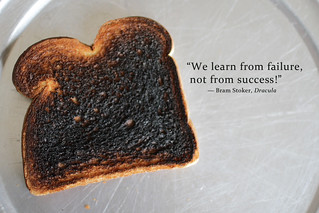
Beware of the Winner's Curse in your KM programs. Ensure the winning teams also continue to learn. Capture lessons from successes and failures, and encourage even the winners to keep pushing to do even better.  Learning from failure is psychologically easier, but learning from success allows success to be repeated and improved.

Learning from success is very difficult, but it is the most powerful learning you can do.


Monday, 20 March 2017

Tacit Knowledge and cognitive bias

Is that really Tacit Knowledge in your head, or is it just the Stories you like to tell yourself?


IMAGINATION by archanN on wikimedia commons
All Knowledge Managers know about the difference between tacit knowledge and explicit knowledge, and the difference between the undocumented knowledge you hold in your head, and documented knowledge which can be shared.  We often assume that the "head knowledge" (whether tacit or explicit) is the Holy Grail of KM; richer, more nuanced, more contextual and more actionable than the documented knowledge.

However the more I read about (and experience) cognitive bias and the failures of memory, the more suspicious I become of what we hold in our heads.

These biases and failures are tendencies to think in certain ways that can lead to systematic deviations from good judgement, and to remember (and forget) selectively and not always in accordance with reality. We all create, to a greater or lesser extent, our own internal "subjective social reality" from our selective and flawed perception and memory.

Cognitive and memory biases include

  • Confirmation bias, which leads us to take on new "knowledge" only when it confirms what we already think
  • Gamblers fallacy, which leads us to think that the most recent events are the more important 
  • Post-investment rationalisation, which leads us to think that any costly decisions we made in the past must have been correct
  • Sunk-cost fallacy, which makes us more willing to pour money into failed big projects than into failed small projects
  • Observational selection bias, which leads us to think that things we notice are more common that they are (like when you buy a yellow car, and suddenly notice how common yellow cars are)
  • Attention bias, where there are some things we just don't notice (see the Gorilla Illusions)
  • Memory transience, which is the way we forget details very quickly, and then "fill them in" based on what we think should have happened
  • Misattribution, where we remember things that are wrong
  • Suggestibility, which is where we create false memories

So some of those things in your head that you "Know" may not be knowledge at all. Some may be opinions which you have reinforced selectively, or memories you have re-adjusted to fit what you would have liked to happen, or suggestions from elsewhere that feel like memories. Some of them may be more like a story you tell yourself, and less like knowledge.

Do these biases really affect tacit knowledge? 

Yes they really do, and they can affect the decisions we make on the basis of that knowledge.  Chapter 10 of the 2015 World development Report, for example, looks at cognitive biases among development professionals, and makes for interesting reading.

While you would expect experts in the World Bank to hold a reliable store of tacit knowledge about investment to alleviate poverty, in fact these experts are as prone to cognitive bias as the rest of us. Particularly telling, for me, was the graph that compared what the experts predicted poor people would think, against the actual views of the poor themselves. 

The report identifies and examines 4 "decision traps" that affect the development professionals and influence the judgements that they make:

  • the use of shortcuts (heuristics) in the face of complexity; 
  • confirmation bias and motivated reasoning; 
  • sunk cost bias; and 
  • the effects of context and the social environment on group decision making.

And if the professionals of the World Bank are subject to such traps and biases, then there is no guarantee that the rest of us are any different.

So what is the implication?

The implication of this study, and many others, is that one person's "tacit knowledge" may be unreliable, or at best a mish-mash of knowledge, opinion, bias and falsehood. As Knowledge Managers, there are a number of things we can do to counter this risk.

  1. We can test Individual Knowledge against the knowledge of the Community of Practice. The World Bank chapter suggests that "group deliberation among people who disagree but who have a common interest in the truth can harness confirmation bias to create “an efficient division of cognitive labor”. In these settings, people are motivated to produce the best argument for their own positions, as well as to critically evaluate the views of others. There is substantial laboratory evidence that groups make more consistent and rational decisions than individuals and are less “likely to be influenced by biases, cognitive limitations, and social considerations”. When asked to solve complex reasoning tasks, groups succeed 80 percent of the time, compared to 10 percent when individuals are asked to solve those tasks on their own. By contrast, efforts to debias people on an individual basis run up against several obstacles (and) when individuals are asked to read studies whose conclusions go against their own views, they find so many flaws and counterarguments that their initial attitudes are sometimes strengthened, not weakened". Therefore community processes such as Knowledge Exchange and Peer Assist can be ideal ways to counter individual biases.
  2. We can routinely test community knowledge against reality. Routine application of reflection processes such as After Action review and Retrospect require an organisation to continually ask the questions "What was expected to happen" vs "What actually happened".  With good enough facilitation, and then careful management of the lessons, reality can be a constant self-correction mechanism against group and individual bias.
  3. We can bring in other viewpoints. Peer Assist, for example, can be an excellent corrective to group-think in project teams, bringing in others with potentially very different views. 
  4. We can combine individual memory to create team memory. Term reflection such as Retrospect is more powerful than individual reflection, as the team notices and remembers more things than any individual can.
  5. We can codify knowledge. Poor as codified knowledge is, it acts as an aide memoire, and counteracts the effects of transience, misattribution and suggestibility. 
But maybe the primary thing we can do is to stop seeing individual tacit knowledge as being safe and reliable, and instead start to concentrate on the shared knowledge held within communities of practice.  

Think of knowledge as Collective rather than Individual, and you will be on teh right track.

Friday, 26 August 2016

7 ways the brain loses or distorts knowledge

There are seven ways by which an individual forgets, doctors or otherwise overwrites their memories, and through which their knowledge gets lost.


Would you store your documents in a system that;
  • Begins to lose them as soon as they are filed
  • Never stores many of them properly in the first place
  • Often won't let you find them when you need them
  •  Returns results that are wrong
  •  Allows documents to be falsified, and 
  •  Gradually adjusts all the documents to fit what you currently believe?  

No you wouldn't, but that's how your memory works - the system in which you store tacit knowledge.


The human brain, despite its many remarkable features, is not great at retaining detail in the long term. A series of posts on the Farnham Street blog (posts one, two and three) reviews a book by Daniel Shachter called "the seven sins of memory - how the mind forgets and remembers".

For those of us in Knowledge Management, this is crucial stuff. We often assume that the majority of organisational knowledge is held in the minds of individuals, and there are many people who will argue that knowledge is ONLY in people's minds, and becomes information once recorded (an old but ultimately unresolvable argument).

But is it safe to store knowledge in brains? Here are 6 ways in which brains lose this knowledge.

  • Transience - the issue of the forgetting curve. As the blog says - 
"Soon after something happens, particularly something meaningful or impactful, we have a pretty accurate recollection of it. But the accuracy of that recollection declines on a curve over time — quickly at first, then slowing down. We go from remembering specifics to remembering the gist of what happened ... What we typically do later on is fill in specific details of a specific event with what typically would happen in that situation".
  • Absent-mindedness - the process whereby the memory is never properly encoded, or is simply overlooked at the point of recall, and never transferred from short-term to long-term memory.  When your attention is divided, you never store the memory in the first place.
  • Blocking - the process where you know you know something, but you can't recall it. "It's on the tip of my tongue" you say, but you still can't recall the knowledge you know that you know.
  • Misattribution - where you recall something that is actually wrong. For example, I prided myself in being able to remember word for word (in Norwegian) the introduction to a Norwegian Christmas TV serial from the 1990s.  Then I found it on Youtube, and discovered I was almost 100% wrong in what I remembered.  Misattribution is what causes eyewitness testimony to be so dangerous.
  • Suggestibility - the way in which someone or something can implant false memories in your mind (a very disturbing phenomenon).  As the blog says, "Suggestibility is such a difficult phenomenon because the memories we’ve pulled from outside sources seem as truly real as our own".
  • Bias - the way in which you gradually filter your memories to become consistent with your current worldview and with your personal "narrative".  There are in fact 4 biases that we are prone to when editing our memories: Consistency and change bias, hindsight bias, egocentric bias, and stereotyping bias.
  • The "seventh sin" on the list is Persistence - the way in which unpleasant memories can persist, despite our attempts to forget. Although this is not a failure of memory, the unpleasant and persistent memories may come, through persistence, to override other memories, thus giving a distorted picture. 

How can Knowledge Management help?

Knowledge management has to have solutions to these issues, as they are real and pervasive. Some of the solutions are as follows.

  • Team reflection processes, such as After Action review and Retrospect, are opportunities for a team to review and rehearse what happened in an activity or project. By talking together, they fill in the gaps caused by absent-mindedness, and help cement the memories deeply enough to combat some (but not all) of the transience.  AARs and Retrospects should become a habit in the organisation, and should be held as soon as possible after the activity in question, before transience sets in. 
  • Team logging - perhaps through the use of a project blog or similar, allows the blog posts to act as an aide-memoire, thus avoiding misattribution, suggestibility and bias.
  • Rehearsal through conversation - perhaps through conversations in a community of practice, keeps knowledge fresh and avoids many of the time-related aspects of knowledge loss. Ensure your community discussions are open to all, so all practitioners get constant exposure to discussion and exercise their memories on a daily basis.
  • Codification - imperfect as codification is, it is the only way to retain details in the long term and avoid all of the 7 issues mentioned above. 
 Make sure your Knowledge Management Framework includes team reflection, logging, conversation and codification in their appropriate places. Don't rely on the human memory as a long term knowledge store, given it's seven modes of failure. 

Monday, 25 July 2016

Making best use of the human brain in Knowledge Management

I have long argued that the human brain is a poor long term store for Knowledge. Here are the three cases where it's the best store there is.


Image from wikimedia commons
The poor human brain gets a bit of a bad press at times. The cognitive biases that plague us all are becoming well known and popularised in many books, and we recognise the cognitive illusions that get in the way of effective use of knowledge, such as

With such illusions as these, can we trust the memories in our heads?

However a recent post on the Farham Street blog, based on this book by Daniel Schacter makes the point that the human brain works marvellously well in getting us through life, by selecting automatically what we remember and what we don't.

It makes the point that

"Our brain has limitations, and with those limitations come trade-offs. One of the trade-offs our brain makes is to prioritize which information [knowledge] to hold on to, and which to let go of. It must do this — as stated above, we’d be overloaded with information without this ability. The brain has evolved to prioritize information which is: 
  • Used frequently 
  • Used recently 
  • Likely to be needed"

The converse of this is that knowledge which is used infrequently, was used some time ago, and which we did not realise was likely to be needed, gets forgotten.

This is exactly the knowledge which needs to be documented, lest we forget.

The current knowledge is best left in human brains, connected into Communities of Practice, where the knowledge can be shared, improved, discussed and kept fresh.  The occasional knowledge should not be left in the human memory without augmenting this somehow through collecting, recording and structuring it in Knowledge Assets, so that it is given a shelf-life which the human brain cannot give.

Our responsibility as knowledge managers is to work out which knowledge to deal with through connection, and which through collection.

Blog Archive