Showing posts with label survey. Show all posts

Friday, 3 November 2023

Knoco 2023 survey results are available

 The Knoco 2023 KM survey is now available, Follow the link below to order a free copy.

Knoco Ltd has conducted a global survey of Knowledge management every three years, starting in April 2014, with the latest in September 2023. Participation has been free, voluntary and confidential, and all participants received a copy of the Knowledge Management Survey report. 

Thank you to all who took part this year!

In total, nearly 1200 people have taken part in the 4 surveys; mostly individuals leading Knowledge Management activities or members of Knowledge Management teams. The survey looks at many elements of the way people are implementing KM in their organisations, such as the choice of technology, the size of teams, the annual budget, and the use of various KM approaches. 

The report contains not only the 2023 answers, but also the way these answers have changed over the course of the 4 surveys. See for example the plot below of answers to a question about the use and value of AI technology as part of KM (this particular plot only covers 3 surveys, as we did not ask about AI in 2014).


Here is the link again

https://www.knoco.com/knowledge-management-survey.htm 


Monday, 21 August 2023

Please take part in the global KM survey

 You are invited to take part in the 2023 Knoco global survey of KM. 

What is this survey?
This is a survey of what organisations around the world are doing under the heading of "Knowledge Management". 
This is the 4th survey in a series; the previous surveys were held in 2014, 2017 and 2020. The questions in each of the surveys are mostly identical, allowing us to track changes in the field of KM over time. 
Even if you have taken part in previous surveys, please consider taking the survey again so we can see what has changed.

Who should take part?
Anyone can take part, who can answer questions on behalf of a current KM program within an organisation. You will need to know this program well. Perhaps you lead KM in the organisation, perhaps you are on the KM team or perhaps you consult to the KM team. If you do not know a current KM program in detail, it's best if you sit this out. 

What does the survey cover?
The survey is quite comprehensive. It covers the maturity, aims and scope of the KM program, the budget and value delivery, the KM team size and skills, the processes, technologies and governance in use, plus optional sections on communities of practice, lessons learning, knowledge retention and AI. 

How long will it take?
we will be honest with you - this survey is a big survey and takes about an hour to complete. We know this is a significant investment of your time, but this ensures the richness of the data gathered. We hope you will feel this is time well invested.

What do I get  in return?
We will send you a copy of the survey report as soon as it is complete. This will not only contain the results of the 2023 survey, but also a comparison with the results of previous years, to show trends in the responses over time.

Will I be anonymous?
Your  name and email address, and the name of the organisation you are answering on behalf of, will not appear in the report,. nor will they be shared with any third parties. 

How do I take the survey?
The link is here, and the survey is open until 20 September.

Thank you in advance!


Monday, 31 January 2022

How long does Knowledge Management take to implement?

Introducing Knowledge Management is likely to take a decade before it is fully embedded. Here are some benchmark statistics 


Over the past few decades we have helped many organisations to benchmark their current status of Knowledge Management

They ask for this service for a number of reasons. Sometimes they want to see where they need to improve. Sometimes they need to see IF they need to improve. Sometimes they need to set a benchmark so they have something they can measure future improvement against.

There are a couple of trends in these benchmark figures. 

The first trend appears when you look at how the overall benchmark score varies with the length of time KM has been addressed by the organisation. The graph above shows the overall KM score (from 1 to 5) for about 50 organisations, plotted against how long they have been deliberately working with KM, in years. Bear in mind when you look at this that not all organisations want to score 5 out of 5, and that 4 out of 5 is a pretty fine score. However to reach a level 4 seems to take 10 years.  

Also note on the plot the two red points, which represent the same organisation measured at an interval of 2 years, showing good progress. Similarly the two green points represent a different organisation, measured twice, at a 3.5 year interval, showing a similar rate of progress.  Both of these organizations had an intensive KM program in place with support from the very top. These two companies improved at a much faster rate than the average. 


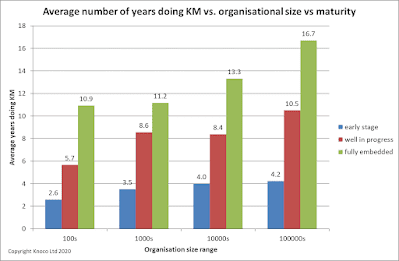
The second piece of evidence is from our three global KM surveys. The graph to the right is a combination of answers to three questions:

  • How big is your organisation?
  • How many years have you been doing KM?
  • How mature is KM at your organisation?
The three coloured bars therefore represent the average number of years organisations have been doing KM when they are at the three levels of maturity:
  • Early stage
  • Well in progress
  • Fully embedded.
So you can see that small companies at the "fully embedded" stage have been doing KM for 10 years or more, and large companies for significantly longer. Even companies that see themselves as "well in progress" with KM have been doing it for 6 to 10 years depending on size.

The sample size for this plot is 1039 responses. 


Conclusions from these two plots are as follows;

Firstly, changing the culture to become a knowledge-focused organisation is a long term process. You should be able to see significant progress within a few years, but it may take 10 years for KM to really become embedded in the culture as "the way we work".  

That doesn't mean you can't deliver value in the short term - in fact that should be your intent in the early years; delivering demonstrable value through short term pilots.  However you can't embed KM quickly.

Secondly, companies start from different places. There is a big range of scores in the top plot for organisations which are just starting KM implementation. If you already have a collaborative, open and supportive culture, you start at a higher point, and get good pretty quickly. If your culture is hierarchical, blaming and closed, it's going to be a much longer journey.

Thirdly it seems to vary considerably based on company size, As you might expect, smaller companies can change faster, and the lower plot suggests that the KM culture change in an organisation of more than 100,000 staff will take much longer than in organisations with hundreds of staff.

Fourthly you can transform much faster if you have the right conditions. The red points and green points on the upper plot transformed at more than twice the normal rate, thanks to a concerted KM push driven from the top of the organisation.

Please feel free to use these figures to benchmark your own organisational transformation, and help your management realise that a) KM is a long term culture change, and b) they can help you accelerate it if they give it strong backing. 


Tuesday, 4 May 2021

How Covid has affected KM in organisations

A month ago, I opened a survey to investigate how KM has fared during the pandemic and associated recession. Here are the results.

We conducted the last of our three triennial Knoco Global Surveys of Knowledge Management in 2020, and these reflect the state of KM in organisations prior to the pandemic. So we decided to conduct an additional survey in April/May 2021 to investigate how the pandemic affected the state of KM in organisations, and also how KM supported these organisations.

The 2021 Covid Survey was released through Twitter, Linked-In, this blog, and also direct emails to respondents to the 2020 global survey. A total of 83 responses were received. 

Not all respondents answered every question, as respondents who reported that their KM program had been closed down were not required to go on to answer questions investigating changes to the KM program. Please note that no demographic data were recorded from respondents. However 59 responses were previous respondents to the 2020 survey, where we had already recorded a suite of demographics. This will allow some further analysis at a future date.


Continued existence of the KM program


The first survey question covered the continued existence of KM programs during the Covid period. 6 options were offered, and the proportion of responses to each option is shown below. 


In the vast majority of cases, the KM program either remained the same, or expanded. Only in 6% of cases had the KM program had been cancelled or put on hold, and 5% reported a contracted program. 

Despite all the difficulties Covid has brought to various industries, organisations and businesses, KM has largely survived as a function, and often increased in scope.


KM budget.

Although KM continues, has the level of investment remained the same? The responses are shown below.


In the majority of cases (58%), the KM budget remains unchanged. There are roughly equal segments where the budget has increased (16%) and decreased (19%). Given that, in the previous pie chart, only 5% of respondents reported a contraction in the KM program, then in some cases the KM program must have continued with less money. Also the 46% who reported an expansion of the KM program is not matched by an expansion in budget. So although KM continues, it seems KM professionals are often being asked to contribute more. 

 Continuity of KM roles.

Given the continuity of KM programs, it is no surprise to see continuity of KM roles. Very few respondents have left their KM programs, and only 3 people out of the 83 surveyed reported losing their KM job during the pandemic. Although the loss of these three jobs will have been a huge issue to the people involved, it seems in general as if there has been a reassuring level of role continuity during Covid.


However it must be acknowledged that the survey sample set is biased in favour of people who remain in KM employment, are still answering email addresses linked to the 2020 survey, and are still following KM blogs and twitter feeds. The true percentage of people who have lost a KM job due to the pandemic and associated recession may well be higher than the 6% recorded here. 

Whether KM was easier or harder during the pandemic.


For those respondents whose KM programs continued during the pandemic, the next series of questions looked at how the programs changed. The first of these questions addressed whether KM had been easier or harder during Covid-induced lockdowns and remote working. The pie chart below shows that respondents were roughly even split between those who found it harder, those who found it easier, and those for whom there was no difference.


We asked respondents what had made KM easier/harder. 

There was a wide range of responses from people who had answered that it was harder. The most common theme was the relative difficulty of remote KM interaction compared to face-to-face. Other themes included a reduction in ad-hoc knowledge sharing, the general overloading of staff during the pandemic, and the need to learn new skills. 

 There was a smaller range of responses from people who had answered that it was easier. The most common theme was the fact that remote working exposed a need for KM and that there was therefore a wider recognition of its value. Other common themes were improved (remote) access to people across the organisation, and easier collaboration. 

 Changes in focus for KM


Respondents were asked whether the focus of their KM program had changed. Answers are shown below. About half said there was a slight change in focus, a quarter said a significant change, and a quarter reported no change in focus.


Participants were asked what new work items had been added to the KM scope. 31% reported no new work items. The most commonly reported new work items were collaboration, digital transformation, expansion within the organisation, and delivery/facilitation of online events. Other than these, there was a very wide range of new items, each mentioned by very few people.

Participants were asked what old work items had been removed from the KM scope. 77% reported no removal of old work items, which perhaps continues the theme of KM programs expanding and doing more, albeit not always with more budget. The most commonly reported removed work item was the facilitation of face to face events.

How else has KM changed?

Again there was a range of responses to this question, and the free-text responses from the respondents were grouped into themes as shown in the pie chart below. As you might expect, the most common theme reflected the move to online/virtual working, but other responses include an increase in demand for KM, a contraction of KM in those organisations where the budget reduced, and a reorganisation of KM.


The final question asked how KM has supported the organisations during the pandemic. 

Again, free-text responses from the respondents were grouped into themes as shown in the pie chart below. 


The most common benefits KM has provided to their organisations have been the provision of knowledge to staff working remotely - both generic knowledge, and knowledge of the Covid response itself - and support for new ways of working - remote working, use of collaborative tools, and collaborative behaviours. 

Summary

I think that the responses to the survey, as shown in the graphs here, demonstrate that Knowledge Management has stepped up and played a significant and valuable supporting role to organisations during the Covid pandemic. 

This supporting role has generated an increased understanding and demand for KM, which meant that KM programs generally have not suffered significantly but have often expanded in reach and scope, if not always in budget. KM has had its challenges (new ways of working, the difficulties of remote knowledge sharing, a loss of the ad-hoc opportunities for knowledge exchange), but has also found some things easier, like better access to staff, easier virtual collaboration, and a greater level of organisational support. 

The pandemic has been KM's time to step forward, show its value, and support people and organisations through an astonishingly difficult time. Let's hope we can continue to build on this role as we move towards a post-Covid world. 


Wednesday, 31 March 2021

Please take part in this new (short) survey - how Covid has affected KM

 Please take 5 minutes to reply to this short survey on how the Covid pandemic and accompanying recession has affected KM

Image from wikimedia commons


If you were involved in an organisational Knowledge Management program a year ago, at the start of the recession, please consider answering the short survey below, and let us know how things have changed in the interim.


  • Maybe KM found a stronger purpose during Covid, and has been busier than ever
  • Maybe the KM program was hit by the recession, and the budget was cut or completely eliminated
  • Maybe KM changed direction
  • Maybe you found things easier, or more difficult
It would be good to know!

The survey will take 5 or 6 minutes, it is between 4 and 11 questions depending on circumstance, and we will share the results in about  month time when we have collated all responses.

Your input would be very welcome.

Friday, 20 November 2020

How the management of documented knowledge changes with KM maturity

 Improved access to documents is the second-most common strategic approach to KM. How is this improved access delivered?

A question in our 2017 and 2020 surveys asked respondents how explicit or documented knowledge is managed.  The question was phrased as follows:

Which of the following most closely represents the organisation's current approach to the management of "documented knowledge" (documents from which others can gain knowledge, and which are stored as part of the KM approach)? 

The following options were provided; 

  •  Documented knowledge is scattered across many document stores (eg stored by department, team, individual or project) 
  • Documented knowledge is collected in one or more knowledge-related document stores, without tagging. 
  • Documented knowledge is collected in one or more document stores, and tagged 
  •  In addition to document collection, the store of documents is Curated (filtered, rated, prioritised etc) 
  •  In addition to document collection, the knowledge within the documents is Synthesised (combined into new documents such as, guidance, best practices or wiki content)

The figure below shows the survey results, for respondents in 3 categories:

  • Those who said their KM program was "in the early stages"
  • Those who said their KM program was "well under way",
  • Those who said KM was "embedded in the way we work".


The plot shows three main things:

  • As KM progresses, it becomes far less common to see documented knowledge scattered across many document stores, or collected without tagging;
  • As KM progresses it becomes far more common to see documented knowledge being curated and/or synthesised;
  • Curation and Synthesis are still minority activities. 


Friday, 9 October 2020

How organisations of different KM maturity plan to use the KM standard

The 2020 Knoco survey shows (among very many other interesting things) data on how organisations plan to use the ISO 30401 standard. I have further analysed the dataset to see how the planned usage varies with KM maturity. 


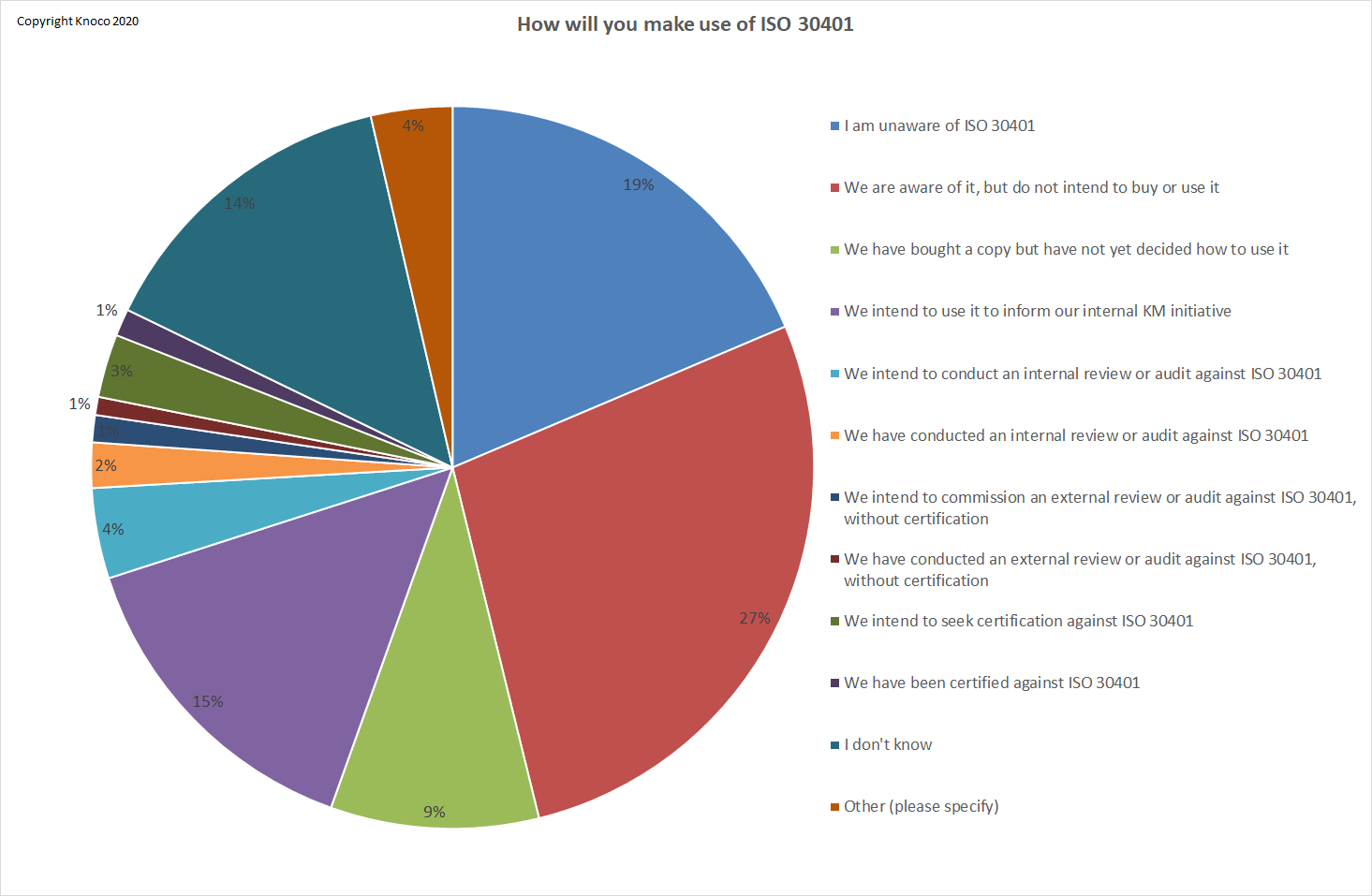
213 people answered the question, and the answers are shown in the pie chart below. Click on the picture for optimal resolution.


The various options on the chart represent escalating levels of involvement with ISO 30401:2018; the ISO management system standard for Knowledge Management, and the pie chart shows the percentage of respondents choosing each as the highest level of planned usage. 

19% of the respondents were unaware of the standard, and 27% know about it but will not buy or use it.

The remaining 54% will make use of the standard in some way, even if they have not quite yet decided how. Only a very small percentage(4%) are seeking, or have achieved, certification. “Other” options include the following: 

Balancing ISO against operational readiness needs. Champion is working to make the value connection: I am aware of it but not using it in (Organisation) as far as I know: I'm in the translation workgroup: organisation is not interested in using it: Probably will do it but not yet: Still early days to think of an ISO certification: Unfortunately seen as “a nice to have” and not top priority: We have a copy of it and would like to implement it within our firm, as a way of embedding KM but we are aware, from KM forums (in legal sector), that it only has one moderator at the moment and is struggling to be implemented in organisations, so we have no examples of where it has been successfully been implemented to demonstrate to our senior management - i would like to learn more about how this could be done.: While I am aware of ISO 30401, business is not. As KM is not openly identified as a business priority and under resourced the will to bring ISO 30401 to the table is not there.

The barchart below splits out these figures by the self-designated maturity of KM within the organisation. Again, click on the figure for better resolution.


We can see the following:

  • Organisations early in the journey are less likely to have heard of the ISO standard (bottom blue segment). This makes logical sense.
  • The percentage planning not to engage with the standard does not vary much with maturity (red segment). 
  • The percentage planning to use it to inform their KM program is greatest in the most mature KM organisations (purple segment), as is the percentage who have conducted an internal review or audit (orange segment).
  • The highest percentage planning certification, and the only organisations who have been certified, are in the "well in progress" category. When you think about it, that also makes sense. The standard adds most value as a check against your KM framework prior to finally embedding it into organisation process and structures. Once KM is embedded, its harder to change.
  • The "don't know" category is biggest when KM is new. Again - makes sense.
  • The "Other" category is biggest where KM is most mature. Again that sort of makes sense - if your organisation has KM fully embedded, the standard will have many more uses than seeking certification or as a yardstick - you can use it more creatively.


Monday, 10 August 2020

What does data tell us about the link between national culture and KM?

A few years ago I compared published cultural dimensions for various countries against a proxy measure of KM maturity. This blog post repeats that analysis with more recent, and more complete, data. 


One of the most famous (although controversial) studies of national culture was by Geert Hofstede. Hofstede looked at the culture of IBM employees of different nationalities, dividing that culture into 6 dimensions.

  • Power distance -  the extent to which the less powerful members of organizations and institutions accept and expect that power is distributed unequally.
  • Individualism - The degree to which individuals are integrated into groups
  • Uncertainty avoidance - a society's tolerance for uncertainty and ambiguity
  • Masculinity - The distribution of emotional roles between the genders
  • Long-term orientation - societies' time horizon.
  • Indulgence versus restraint - The extent to which members of a society try to control their desires and impulses.
There are published data for  these dimensions for a wide range of countries, and I used the dataset available here

There is no comparative study of the KM maturity of countries, but this blog post has a proxy measure, by looking at the number of knowledge managers listed on linked-in as a proportion of the total linked-in population from that country. So for example we can assume that KM in the Netherlands, with 249 knowledge managers per million people on Linkedin, is more mature than it is in Brazil, with 25 knowledge managers per million Linkedin users. 

We can therefore use the linked-in proportion in the blog post quoted above as a rough ranking of KM maturity, and cross-plot it with the Hofstede dimensions for a number of countries.  The resulting plots are shown below.

Each point on the following plots is a single country. A linear trendline has been calculated, and the correlation coefficient R2 is quoted for each plot.


There is a reasonable negative relationship between Power Distance and KM maturity ranking, with an R2 of 22%. Those countries where there are more knowledge managers (and therefore KM can be deemed to be established) tend to have lower Power Distance. We might expect this. Lower Power Distance means greater empowerment, which is a great enabler of KM.


There is a reasonable positive relationship between individuality and KM maturity, with an R2 of 21% (above). The countries with strong individuality tend to be more at the top of the KM ranking list in terms of KM people on linked-in.


There is no evidence of any significant relationship between uncertainty avoidance and KM maturity, and the trendline has an R2 of 0.02% (above)  


There is even less relationship between masculinity and KM maturity (above), with an R2 of 0.017%


There is potentially a very weak positive relationship between Long Term Orientation and KM maturity (measured in the proportion of poeple on LinkedIn with KM roles). R2 is 2.6% (above).


There is potentially a very weak positive relationship between Indugence/Restraint and KM maturity (measured in the proportion of poeple on LinkedIn with KM roles). R2 is 5% (above).

Conclusion


There must be many caveats to this blog post, but with the crude data we have it seems as if the countries with the highest KM maturity, measured by the percentage of KM post-holders on Linkedin, are potentially those with lower Power Distance and high Individuality.  Any correlation with the other 4 Hofstede dimensions is much weaker. 

The reason for this correlation is not clear, and correlation does not imply causation. However you could argue that KM is both more necessary and more powerful in  country of empowered individual knowledge workers.

If this is true, then we could use the Hofstede dimensions of Power Distance and Individuality as a rough indicator of the relative difficulty of establishing KM. 


Friday, 3 July 2020

What incentives work for Knowledge Management?

There are a number of ways to incentivise KM, but which ones work?


I blogged yesterday about an article which confirms that financial incentives for sharing knowledge can easily backfire, but which incentives actually work?

We can answer this question with data from the Knoco KM surveys in 2014, 2017 and 2020. One of the questions provided respondents with a list if possible incentives, and asked the participants to rank how powerful they have been in influencing behaviour. The graph below shows the answers (approx 700 people answered the question).


The chart shows these incentives in order of value from left to right, as a stacked bar chart, with the weighted value shown as a blue line (this line would be at 100% if all the participants that used this incentive said it was “very powerful" and at 0 they all claimed it was of no use). The top of the dark grey area represents the usage percentage for these incentives, as the light grey area above represents people who do not use this incentive. The top of the green area represents the percentage of people who said this incentive was "very powerful".

The most powerful incentives are clear management directive for KM, KM embedded within normal job descriptions, a centrally organised recognition shceme, and peer recognition schemes. Finanacial incentives are judged the least useful.

The usage of these incentives increases with KM maturity, as shown below.


Each of the incentives shows a greater level of application as KM matures, with the exception of financial incentives, where usage decreases slightly in the most mature organisations.

We can also look at the how the perceived value of these incentives changes with maturity.


Several of the incentives are judged to increase in power as KM matures, especially the clear management directive, embedding KM in job descriptions, adding KM to exected competences, and the use of peer recognition schemes. All of these represent the embedding of KM within the expected work behaviours.

Monetary incentives, gamification and the central recognition scheme, on the other hand - where KM is incentivised separately - are judged to decrease in power as KM matures, even though the previous figure shows they increase in usage.

The message seems to be clear - incentivise KM as part of the job, rather than incentivise it separately.


Tuesday, 23 June 2020

Which are the most commonly-used elements of KM governance?

As part of our three global surveys of Knowledge Management professionals in 2014, 2017 and 2020, we asked the participants to select from a list the Knowledge Management governance elements that had in place in their organisation. 

The results are shown here.  

Most of the survey respondents reported at least one element of Knowledge Management governance, with the most common being the Knowledge Management Strategy  (reported by 62% of the people who responded to this question).


Having a defined KM approach was second highest, followed by KM reference materials, to allow this approach to be followed.

It is also interesting to see a Knowledge Management policy being applied in 35% of the cases.  KM policies are quite hard to find online - but there must be a few of them out there.

Please do not think that because a governance element is low in the list, that it is not important!

 We would suggest that all these elements are important, with the exception of having a separate KM incentive system (see here for more on KM incentives). It's just that some are more commonly applied than others, often because people do not realise the value these elements bring.

The diagram below shows how the usage of these KM governance elements varies as the KM program matures from the early stages (blue), through "well in progress" (red) to fully embedded (green).


Firstly it is seems that the big difference - the biggest jump - is between the early stagers and those who are well in progress. This represents either the adoption of KM governance needed for progression, or the lack of progress of those who do not have those elements.

Those organisations where KM is embedded have an even greater application of all of the KM governance elements, the top 4 being KM strategy, Knowledge Management framework, KM training and KM reference materials. The biggest proportional difference in usage is the KM success stories, which tend to be collected as the KM initiative progresses.

At Knoco we would suggest that some of these governance elements should be developed within the first year of your KM journey, notably the strategy, the framework, the business case, the vision and the high level champion. Others such as the success stories and the network of champions in the business should be the next target, while the KM policy, training, metrics and reference are late-stage governance items.

Wednesday, 3 June 2020

Why "Finding Better Knowledge" is 100 x more valuable than "Finding Knowledge Better"

2 years ago I posted an article where I suggested that a KM strategy based on "finding better knowledge" was more valuable than a strategy based on "better ability to find knowledge". Now we have a figure for how much more valuable. 


In the 2018 post I suggested that there are two basic ways in which Knowledge Management can add value to an organisation:
  1. Finding Knowledge Better;
  2. Finding Better Knowledge.
The first approach focuses on better search, better content management, tagging, taxonomy, portal structure, and so on. The intent is to have "documented knowledge at your fingertips", and the result is faster and better access to documents and documented knowledge.  The value of this approach is that it saves people time in searching for relevant material, and so drives operational efficiency.

The second approach focuses on learning from experience, on capturing lessons, on connecting people into networks and communities of practice, on collaboration, and on synthesising knowledge into current "best" practices. The intent is to create learning loops and channels in the organisation, for improvement of practice, so that knowledge is continually improved. The value of the second approach is in delivering better decisions, and delivering better results, not just faster decisions. The value comes through improved operational effectiveness.

Often the choice between these two is a clear choice, and the two options are mutually exclusive. To get good knowledge requires time and conversation; good knowledge is rarely fast, and fast knowledge is rarely good.

In my 2018 article I suggested that the value of the second approach, is at least an order of magnitude greater than the first; maybe 2 orders of magnitude. I did not have the statistics to test this estimate at the time.

Now I do.

In the three Knoco KM surveys in 2014, 2017 and 2020 we asked people to tell us (among other things) their business drivers for KM, in order of priority. Business drivers included operational efficiency and operational effectiveness, as discussed above. We also asked them, where they could, to tell us how much value in $USD their KM program has delivered. So we now have the data to test the value of these two approaches.

The graph below shows the average value for the organisations grouped by their priority business driver.


  • Organisations whose primary driver was to increase organisational efficiency, delivered on average $1 million from KM. For these organisations, the most common KM strategy was to improve access to documents.
  • Organisations whose primary driver was to increase organisational effectiveness, delivered on average $106 million. For these organisations, the primary KM strategy was divided between improved access to documents, connecting people through communities and networks, and better lesson learning.
  • The business driver of "providing a better service to customers and clients" is also a type of operational effectiveness driver.
So we can see that in this dataset, operational effectiveness, which comes from finding better knowledge, is actually 100 times more valuable than operational efficiency, which comes from finding knowledge better/more easily. Thats 2 orders of magnitude better.


Bear this in mind when you set out your KM strategy and business case. If the business case is based on saving people time through better access to knowledge, you may be underselling the value by a factor of 100. 


Tuesday, 26 May 2020

Are communities of practice losing popularity as a KM mechanism?

Results from the Knoco 2020 global survey of Knowledge Management seem to show that the use of Communities of Practice is in decline.

Every three years since 2014, knoco has conducted a global survey of Knowledge Management. The latest survey is completed, and the final report written (go here to order a free copy).

One of the intriguing results from one of the graphs was that the usage of Communities of Practice seems to be in decline. So I did a bit more digging in the dataset, and came up with some more evidence.

Firstly, CoPs seem to have slipped down the list of priority approaches. 

The plot below is based on a question that asks respondents to prioritise various approaches within their KM strategy. This question has been asked in all three surveys, and the graph below shows the percentage of people who have chosen each of the options as their highest priority.


You can see that "connecting people through communities or networks" was the most popular "first choice" option in 2014 but has decreased significantly over the 6 years, and is now in 4th place.

Secondly, fewer organisations seem to be using CoPs as part of their KM Framework. 

Participants were asked whether they applied Best Practice, Lesson Learning, Communities of Practice, and (in the 2020 survey only)  Knowledge Retention. The percentages anwering Yes to this question for these four (largely tacit knowledge) approaches are shown below for the three surveys.


You can see that 62% used CoPs in 2014, 57% in 2017 and 55% in 2020. A steady decline.

Finally the organisations in 2020 which ARE using CoPs, are applying fewer of the components, and getting lower levels of satisfaction. 

This last one is a bit more subtle. Out of 13 potential component elements to a CoP framework, respondents in 2020 are using fewer (an average of 5.3 in 2020 compared to 5.4 in 2017 and 5.9 in 2020), and recording lower levels of satisfaction (3.04 out of 5 in 2020 compared to 3.16 and 3.2 in 2017 and 2014).  The prevalence of community sponsors, comunity business cases and community wikis is significantly less in the most recent survey.

These three pieces of data suggest that the use of Communities of Practice is in a slow decline.

But why?

I have to admit that I really do not know why this should be the case. Communities of Practice have been a mainstay of KM from the beginning; they are a powerful mechanism for peer to peer knowledge transfer, and they are the nearest thing to a KM silver bullet. So why are they not still top of the list as a KM priority?

Could it be that the survey datasets have changed - that the types of organisations answering the most recent survey are different? They are no smaller - if anything the average size is bigger in 2020 - but they are less multinational. One explanation might be that the 2020 respondent organisations contain a much higher proportion of government admin departments, and a smaller proportion of professional services firms. So maybe its not that CoPs are in decline, but that KM is being applied more in areas where CoPs are not a common mechanism. Maybe the government admin people need to discover the power of communities?


Tuesday, 21 April 2020

First preliminary results from the Knoco 2020 survey of KM

The Knoco 2020 Survey of KM is about half way through its open period for accepting contributions. We have some early findings, and your own contribution is still very welcome.

The Knoco 2020 survey of knowledge management is the third in a triennial series of surveys of the global status of KM. It seeks to find out what is going on in the KM World, and identify any trends in KM over the 9-year period. One of the trends is shown at the bottom of this article.

The survey is still open for the next 2 weeks. If you would like to take part, please click on one of the links below.

We have an open link for everyone, a spanish-language version, and also specific links for certain countries, These links are below - choose one that fits!

Open survey, English language
Open survey, Spanish language
Survey for S Africa-based organisations
Survey for China-based organisations
Survey for Indonesia organisations
Survey for Russia-based organisations

The survey takes between 30 minutes to an hour to complete. It is very comprehensive, but creates a very comprehesive set of data and allows you to benchmark against a wide range of parameters. The survey has been visited by nearly 250 people, of which about 180 have left substantial data.

It's too early to draw any firm conclusions from the data as it comes in, but here is one interesting snippet.  We asked all respondents to describe the trend in importance of KM in their organisation. The answers are shown below.


In each of the three years we have held the survey, the majority have said that the importance of KMis increasing, a substantial minority say it is neither decreasing nor increasing, and a small minority say the importance is decreasing.  Furthermore these results seem to be swinging more in the favour of increasing importance over the period from 2014 to 2019.

The view that "KM is dead or dying" is not supported by these results. Instead it seems that KM is still very much "on the up", or at the very least, "steady as she goes".

The final survey report will contain many more such plots (the 2017 report contained 61 figures and 29 tables).

However for these figures and tables to be fully representative, we need your data! If you have not already participated, please find an hour in the next 2 weeks to take part.

Thank you in advance!


Friday, 3 April 2020

Invitation to take part in the Knoco survey of global knowledge management, 2020

You are invited to take part in the 2020 global KM survey - the latest in a triennial series of surveys of knowledge management practices and results.


As a thank-you we will give you a free copy of the results from the last survey in 2017, as well as a copy of the 2020 results when they are available.

The 2020 survey is a re-run of surveys we did in 2014 and 2017 which gave some really interesting results, many of which I have covered in my blog.

Just a few of the results are:
and many many more.

This year we are running the survey again, to see what has changed in the last 3 years and 6 years, and also to extend the survey into countries and industries that were under-represented last time. Anyone who takes part will be rewarded with a link to a free copy of the 2017 results, as well as being sent a set of 2020 results when the survey closes.

Note that survey reports can also be ordered here.


Would you like to take part?


If you can answer on behalf of an organisation that does KM, or has done KM, or plans to introduce KM, then please follow this link and take the survey. Bear in mind that the comprehensive nature of the survey means it may take up to an hour to complete, but this also means the results are equally comprehensive and rich, so your time is well worth investing.

Feel free to take the survey now, and/or forward this blog post to any of your colleagues or contacts in other companies.


Tuesday, 24 March 2020

What measurable benefits can you get from Knowledge Management?

What are the business metrics where Knowledge Management has delivered value? This is one of the questions we addressed in our recent survey of Knowledge Management, and the results are very interesting. 


527 of our respondents (Knowledge Managers from a wide range of industries, company sizes and geographies) answered the question "What tangible benefits have you seen so far from Knowledge management? Choose all that apply".

The results are shown below in a number of ways, and may be useful to you when discussing the benefits of KM with your stakeholders. 


 First let's look at the overall results, in the figure above. The most common benefit, identified by over 3/4 of those who replied, is a reduction in time to find information. Although this is a relatively small and tatical benefit - perhaps an order of magnitude or two less in value than the other benefits - it should be common to all KM programs. 

However this is not really a benefit that will engage senior managers, none of whow will lie awake at night worrying that their staff can't find information fast enough. 

This is followed by four benefits quoted by over 100 respondents, which are more likely to gain management attention:

  • Reduced time to competence for new staff
  • Reduced project or operational costs
  • Reduced project or activity cycle time
  • Improved customer satisfaction
Each of these should be measurable, and provided you have a good pre-KM benchmark, you should be able to measure the impact of your KM program.

Now let's look at how soon, in a KM program, these benefits are recognised.


In the plot above we show the benefits, as a percentage of respondents, for 3 categories of respondent:

  • Those from organisations just starting in KM
  • Those from organisations well in progress with KM
  • Those from organisations with KM fully embedded.
Note that the benefit of finding information faster is recognised at all stages of KM maturity. Some of the other benefits however, such as improved bid success, improved customer satisfaction and reduced project cost, only become significant when KM is fully embedded. For these more strategic benefits, you may need to be more patient.

Finally let's look a benefits by industry sector. This is a more difficult plot to read, but contains a lot of information. I have removed all sectors where I had fewer then 10 respondents answer this question, and used dashed lines for some of the minor benefits so you can see which line is which.


You can see how "reduced time to find information" is a generic benefit, and the most commonly cited benefit for almost all sectors.

Also "reduced time to competence" is a common benefit for all sectors other than military and emergency services. 

After these generic benefits, things get more complex. 

  • Improves customer satisfaction is a major beneft for IT and telecoms companies, and for legal firms
  • Faster projects are a major benefit for oil and gas
  • Cheaper projects are a major benefit for oil and gas, utilities and construction/engineering
  • Bid Success benefits apply to legal, construction and the professional services
You can probably see other results in this plot. 

Hopefully these results will help you craft a benefits statement for your own organisation.


Friday, 13 March 2020

Cultural barriers to KM - updated

Which are the most common cultural barriers to KM? How do these barriers change with KM maturity? Which parts of the world have the most cultural barriers?  

These are some of the questions we addressed in our recent surveys of Knowledge Management. The results from the 2014 survey are presented in a previous blog post, and this post includes results from the 2017 survey as well.


 First we provided the respondents with a list of the top ten elements of an Organisational Learning culture, and asked them to identify which of these elements was currently a barrier to the implementation of Knowledge Management. The graph above shows the results, with the numbers being the number of people who identified this element as a barrier to their KM program. A total of 473 people answered the question.

The greatest cultural barrier to KM is short-term thinking - hurrying on with work rather than taking the time to learn before, during and after.  The second most common barrier is a lack of openness - a lack of willingness for people to be open to knowledge sharing and to analysis of what they have learned.  These two barriers are significantly more common that the others, and the same two were in top and second place in the 2014 survey.

Respondents could choose multiple cultural barriers, and to an extent, the number of barriers chosen is a measure of how supportive or unsupportive the culture is.

The number of cultural barriers identified by the respondents is on average fewest (and the culture therefore most supportive) for those companies where Knowledge Management is fully embedded.


This graph may be interpreted in three ways; either KM is easy to embed where the culture is most supportive, that embedding KM requires culture change, or that embedded KM acts to change the culture.


This issue is further explored in the third graph, which shows the average number of cultural barriers identified from respondents from different regions (note that the numbers of respondents are small in some cases).


The most supportive cultures for Knowledge Management seem to be in Australasia and the Indian sub-continent, with the least supportive cultures in Africa and China. The USA and Western Europe sit somewhere in the middle.


Thursday, 12 March 2020

CKO skills, revisited

In 2015 I published a post showing that a significant proportion of CKOs know very little about Knowledge Management, at least according to their Linked-in profiles. This year I revisited these stats.


It seems things have improved a little, but there are still a lot of CKOs out there with few or no KM skills.

I looked at the profiles of 50 CKOs in Linked in - people with "Chief Knowledge Officer" in their current job title - and I counted how far down the list of skills you had to go before you found "Knowledge Management".  The results are shown in the pie chart here. (Note however that this job title seems disproportionately popular at the moment in the military and legal fields, so these fields are over-represented in the sample).

Note how 34% of CKOs have KM as their top skill - as you might expect.

But note also how 14% of CKOs have KM way down their list of skills - lower than 10th place - and how 26% of the CKO profiles I reviewed DO NOT HAVE KM ON THE LIST OF SKILLS AT ALL!

I said in my 2015 post that there seems to be two types of CKOs out there, with a fairly even split between the two.

  • One type, who are reasonably well versed in Knowledge Management, and see this as the CKO's domain. KM is top of their list of skills, or high in the list (and half of the the profiles I reviewed had KM in the top 3 skills).
  • Another type, for whom the CKO role is held by a person with few or no KM skills at all.

It's the second type that puzzles me. Perhaps the job was titled "CKO" because it sounded good and important rather than because it had anything to do with the management of knowledge, or perhaps they appointed someone with information skills in a knowledge role, or perhaps the CKO plays purely an oversight and coordination role, and leaves the KM aspects to Knowledge Managers (managing the initiative rather than the knowledge)?

Whatever the reason, the results are surprising. 40% of CKOs have few if any KM skills.

Would you see this in any other discipline? Imagine

  • a CFO with no financial skills
  • a Chief Lawyer with no legal skills
  • a Chief Engineer with no engineering skills
So why do 40% of CKOs have few if any KM skills?


What is heartening though is that things seem to be getting better. Bearing in mind the caveats that

  • these are two different samples, and that 
  • 50 many not be a representative number, and that 
  • the profiles I can see on LinkedIn are related to my own personal network;
the plot below seems to show that the situation is improving. 


In the 2015 sample, only 24% had KM at the top of the skills list - now it is 34%.
In the 2015 sample, 32% had no KM skills on their skills list - now it is 26%.

Perhaps this is evidence that KM is becoming more respected and more established as a discipline, and that CKO is less likely to be used as a random job title.

The trend is heartening, but we still have a long way to go.


Wednesday, 12 February 2020

Do social media stifle knowledge sharing?

Do online social media drive a "spiral of silence" which can stifle proper debate?  It can, according to this techcrunch article, which points to this survey from Pew Research.


shhh
Shhh by Catherine on Flickr
I think everyone would agree that for knowledge to be shared effectively in organisations, people need to feel free to enter online debates and feel free to disagree with the opinions of others. Knowledge often comes through comparing and challenging conflicting "truths" in order that new truths and new knowledge can be born.

However the nature of online social media is such that we often create our own silos, and when addressing potentially contentious topics, are unwilling to discuss ideas which the rest of the group does not share (a structure called "polarised crowds" by this article, which I also explore in this blog post on groupthink in social media).  This has been referred to as "a spiral of silence" where people with dissenting views remain quiet.

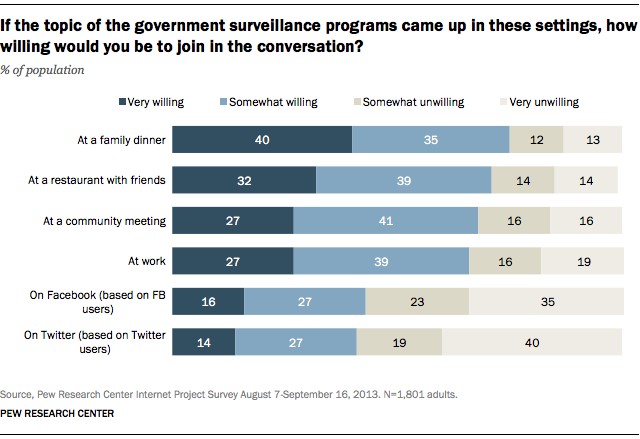
The Pew Research survey explored the willingness to debate online by choosing a contentious topic (in this case the topic of government surveillance) and exploring how openly people would be willing to discuss this in various settings.

As shown below, social media are at the bottom of the list, and people are nearly 4 times less willing to share their thoughts openly online than they are round the dinner table.

The study has the following conclusions

Overall, the findings indicate that in the (government surveillance) case, social media did not provide new forums for those who might otherwise remain silent to express their opinions and debate issues. Further, if people thought their friends and followers in social media disagreed with them, they were less likely to say they would state their views on the story online and in other contexts, such as gatherings of friends, neighbors, or co-workers. This suggests a spiral of silence might spill over from online contexts to in-person contexts, though our data cannot definitively demonstrate this causation. .

Does this spiral of silence apply in workplace social media?


I have seen this happen in the work setting, as in the example below.

A new community of practice for project managers was launched in an organisation. Over a couple of months, activity started to pick up nicely in the community forum, with many people asking questions and receiving answers. However when we followed up with the originators of the questions, we found an interesting pattern had developed. The first answer to the question set the tone, and from that point the only people contributing to the thread were those who agreed with the first answer. Anyone who disagreed found a private offline way to contact the questioner, such as a phone call or a personal email.

We were able over time to resolve this behaviour through strong facilitation, and the community now works well in publicly exploring multiple views on all topics.

For those of us seeking to foster knowledge sharing within an organisation, the research study quoted above is very important. If we do not address this tendency towards a spiral of silence, our in-house social media will either create a new set of silos - silos divided by opinions rather than by geography or by organisational hierarchy (the "polarised crowds" mentioned above) - or people with contrary opinions will just drop out of the conversation.

The lessons to the Knowledge Manager are clear

 To start with, we cannot afford plural communities of practice covering the same topic. There needs to be one community covering each main work topic, not two or more polarised ones.

Then within each topic, disagreement needs to be sought and explored, in service of finding the truth. This is part of the role of the community facilitator - the role of allowing a diversity of opinion, and promoting and facilitating the dialogue that allows this diversity to be explored and resolved.

Finally, for the really contentious topics, you need a face to face discussion, such as a Knowledge Exchange.

Thursday, 6 February 2020

How mature is KM in your industry sector? An interesting plot

The plot below is based on data presented in this blog post from last May. 


The data come from our Knowledge management surveys in 2014 and 2017, responded to by over 700 knowledge managers world wide. in this survey we asked (among many other things) about KM maturity, in two ways: the maturity level of the KM initiative, and the number of years the organisation has been doing KM. These two variables are cross-plotted below, and each data point is the average for each of the industry sectors used in the survey. More explanation of the way the data were created can be found below. If you want a copy of the complete survey report, please fill in the form on this page


Cross plot of the average maturity vs the average duration of  KM initiatives within  number of industry sectors
Image copyright Knoco Ltd


More detail on the data

The plot is based on answers to three questions: 
  1. A question "how long has your organisation been doing KM - please select the closest option" with the following options: 
    • 05 years
    • 1 year
    • 2 years
    • 4 years
    • 8 years
    • 16 years
    • 32 years
    • don't know
  2. A question "how mature is your KM program", with the following answers;
    • we do not intend to start KM
    • we are investigating KM but have not started (0 points)
    • we are in the early stages of introducing KM (1 point)
    • we are well in progress with KM (2 points)
    • KM is embedded in the way we work (3 points)
    • we tried KM and have given up
The weighted average was based on the points score above. A sector which was fully mature in KM would therefore score 3 on the vertical axis, while a sector which was fully immature would score zero. Please note that the survey was answered by people with some interest in, or connection with, KM. Therefore this maturity is the maturity of the KM initiatives within the sector, rather than a measure of the take-up of KM within the sector as a whole. 

We also asked the respondents to identify which industry sector their organisation worked in. The list of sectors can be derived from the data labels. Any sector with fewer than 10 respondents has been omitted.

Conclusions

The graph shows those sectors which are more mature in KM terms, and have been doing it the longest. There is a reasonable straight-line relationship, as you might expect. The longer a sector has been doing KM, the more mature and embedded it becomes.

There are no fully mature sectors, and no fully immature sectors.

There is no flattening off at the top of the graph. There are no sectors which have been doing KM long enough that they have reached full maturity.

Blog Archive