Here's a great video from NATO about their lesson learned capability
Source here

1a) Ad-hoc documentation of lessons by the project leader, documenting them and storing them in project files with no quality control or validation step. Lessons must therefore be sought by reading project reports, or browsing project file structures
1b)Structured capture of lessons, through scheduled lessons identification meetings such as retrospects, documenting and storing the lessons in project files with no quality control or validation step.
1c) Structured capture of lessons, through sheduled lessons identification meetings such as retrospects, documenting and storing the lessons in a company-wide system such as a lessons database or a wiki. This often includes a validation step.
1d) Structured capture of lessons, through lessons identification meetings such as retrospects, documenting and storing the lessons in a company-wide system with auto-notification, so that people can self-nominate to receive specific lessons.
2a) Lessons are forwarded (ideally automatically, by a lesson management system) to the relevant expert for information, with the expectation that they will review them and incorporate them into practice, procedure guidance or training;
2b) Lessons include assigned actions for the relevant expert, and are auto-forwarded to the expert for action;
2c) As 2b, with the addition that the actions are tracked and reported.
3a) Senior managers can identify priority learning areas for the organisation. Some projects are given learning objectives; objectives for gathering knowledge and lessons on behalf of the organisation. These may be written into project knowledge management plans.
3b) Learning teams may analyse lessons over a period of months or years to look for the common themes and the underlying trends - the weak signals that operational lessons may mask.
3c) Organisations may deploy specific learning resources (Learning Engineers, Project Historians, etc) into projects or activity, in order to pick up specific learning for the organisation. See this example from the Australian emergency services.
"The key is to ‘hunt’ not ‘gather’ lessons, apply them rigorously—and only when you have made a change have you really learned a lesson. And it applies to everyone … It is Whole Army business".
1. The senior people need to be involved in, and have ownership of, the lesson learning system. Their roles need to be well defined, and they should have been consulted during the design of the system.
2. The lesson learning system needs to be applied rigorously, so that the senior people can expect to see a flow of escalated lessons as part of normal business.
3. The lesson learning system needs to be quality-controlled and validated, perhaps by the technical experts, so that the senior people know that lessons represent real knowledge rather than opinion. This implies that the documented lessons should show the evidence and the root cause analysis behind the request for change.
4. The lessons must have some measure or description of impact, so the senior people can realise the importance of making the change
5. The lessons must be associated with an author, so the senior people know who to contact for more details
6. The senior people must not be able to reject a lesson without both registering that they are rejecting it, and giving a reason for rejection.
7. The lesson learning system must be monitored and reported to a senior level, so that the organisation knows whether lessons are being consistently ignored or rejected by certain individuals or groups.
8. Through their involvement, management must collectively accept accountability for the operation of the lesson learned system.
"We work with a two step implementation process. First the technical experts assure the quality of the knowledge and, when it needs further actions to implement, it is passed on to the senior leaders who should tell how, when and by who it will be implemented or why it is not going to create changes on the company. The senior leaders are then accountable for the knowledge they didn't implement. It empowers the employees and create a system to fight the knowledge bubble".
 |
| A screen sub-panel from the lessons management hub showing value assigned to lessons |
 |
| Hansei, by Jim O'Neil, on Flickr |
"Even if a task is completed successfully, Toyota recognises the need for a hansei-kai, or reflection meeting; a process that helps to identify failures experienced along the way and create clear plans for future efforts. An inability to identify issues is usually seen as an indication that you did not stretch to meet or exceed expectations, that you were not sufficiently critical or objective in your analysis, or that you lack modesty and humility. Within the Hansei process, no problem is itself a problem".
 |
| Image from wikimedia commons |


 |
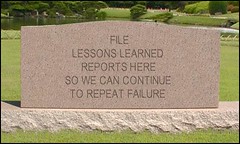
| Tombstone created using http://tombgen.appspot.com/ |
 |
| Native American Storytelling. Photo By: Johnny Saldivar |
"It all hangs on the central Context, Action, Result (CAR) structure. It starts with the Subject, Treasure, and Obstacle, and concludes with the Right lesson and link back to why it’s being told".When we transfer Knowledge, story is one of the best formats. That is equally true of lesson-learning as it is of the other elements of KM. Yet all too often, lessons fail to meet the test of a good story.
1) Context. Here we explain what was expected to happen, but didn't. This is the "What did we want" step of the story. It is amazing how many project teams or facilitators skip this step. Because "what was expected to happen" is so obvious to them, they expect it to be obvious to the reader, but of course it seldom is.
2) Outcome. Here we explain what actually happened - the Action step of the story. What went wrong? What actually happened?
3) Root cause. Here we explain WHY it happened - what the Obstacles were, what was missing that should have been there, or (in a success story) what was done to achieve the result.
4) Impact. Here we explain or try to quantify the result, either negative or positive.
5) Lesson. Based on the root cause, what is the learning for future projects? This is the "Right Lesson" part of the story.
6) Action to Embed.What action do we take to embed that lesson into business process, so mistakes are never repeated, and successes always copied.A lesson with a story-based structure such as this takes about a page to write down or a couple of minutes to tell, compared to typical bullet-point one-liner lessons - told in seconds, forgotten almost as quickly.

“This time is different” could be the 4 most costly words ever spoken.
It’s not the words that are costly so much as the conclusions they encourage us to draw. We incorrectly think that differences are more valuable than similarities. After all, anyone can see what’s the same but it takes true insight to see what’s different, right? We’re all so busy trying to find differences that we forget to pay attention to what is the same.Different is exciting and new, same is old hat. People focus on the differences and neglect the similarities. In projects, this becomes the "my project is different" fallacy that I described here. People look at their projects, see the unique situations, find the differences, overlook the similarities to all similar projects on the past, and assume that "this time it will be different".
If you catch yourself reasoning based on “this time is different” remember that you are probably speculating. While you may be right, odds are, this time is not different. You just haven’t looked for the similarities.A great antidote to the "This time it's different" fallacy is that good old, tried and tested mainstay of Knowledge Management, the Peer Assist. Once a project team gets into a room with a bunch of people with experience, the conversation automatically focuses on the similarities. "Yes, we've seen that, we've been there, here's what we learned" and it becomes increasingly difficult to maintain that "This time it will be different".

"We are a people who do not want to keep much of the past in our heads. It is considered unhealthy in America to remember mistakes, neurotic to think about them, psychotic to dwell on them".Knowledge Management, however, requires that organisations, and the people within them, learn from experience, and 50% of experience comes from Mistakes. KM, if it is balanced, must allow learning equally from failures and from successes. Somehow this very powerful driving force of cognitive dissonance, present in every culture and every human, must be allowed for, sidestepped and redressed.
A young worker had made a mistake that lost IBM $1 million in business. She was called in to the President’s office and as she walked in said, “Well, I guess you have called me here to fire me.” “Fire you?” Mr. Watson replied, “I just spent $1 million on your education!”That is a very powerful story that sets up a counter-dissonance.
We ordered a set of number 6 widgets, and when they arrived, they were very poor quality. We had to send them all back, which delayed construction by a week. The lesson is not to use that supplier again".So the fault was with the supplier.
"Few organisations welcome outside supervision and correction. If those in power prefer to maintain their blind spots at all costs, then impartial review must improve their vision ....... If we as human beings are inevitably afflicted with tunnel vision, at least our errors are more likely to be reduced or corrected if the tunnel is made of glass".This goes for teams and individuals as well as organisations - impartial assistance is vital.
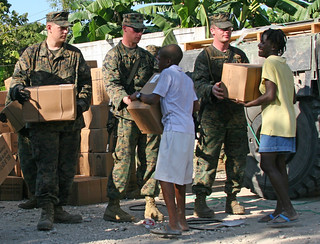
"We took advantage of a lot of lessons learned from previous deployments. We didn't do these types of things early on in Operation Iraqi Freedom or Operation Enduring Freedom. However, we learned those lessons and brought these capabilities to Haiti early on," said Brig. Gen. Joe Bass, commander, Expeditionary Contracting Command. "We were very proactive from the beginning, deploying the right personnel mix needed to provide quality assurance, legal, policy and other areas where we could address issues on the front end rather than after they've been done.Lessons included
"Learning from the past helped us deploy quicker and smarter," Bass said. "Just as we gathered lessons learned from previous deployments, we have gathered some from the Haiti deployment that should help us the next time we have to deploy. Moving forward means reviewing what we've done and how we have done it in the past, then reviewing it again and constantly using those lesson to better ourselves with each new challenge"
 |
| Kizar [Public domain], from Wikimedia Commons |
The Coast Guard routinely captures lessons learned as a way to improve its operations, but the CG_Ideas@Work challenge offers one distinct advantage: “Our crowdsourcing platform not only provides a place to submit ideas, but also to collaborate on them,” (Cmdr. Thomas “Andy”) Howell said. “Everyone from non-rates to admirals can discuss ideas.” Speed is also an advantage. “Catching the ideas when they’re fresh and raw preserves their integrity,” Howell said.
“The Commandant’s Direction says we need to become an organization capable of continuous learning, so it’s important that the innovations and adaptations that made this response successful are institutionalized,” Howell said. Ideas shared through the Hurricane Lessons Learned challenge are immediately shared with the responsible program. Many will be considered as potential projects for next year’s Research, Development, Test and Evaluation Project Portfolio.
“We’ve heard from pilots, inspectors, commanding officers, district command staffs, reservists, Auxiliary personnel – the entire gamut of responders,” Howell said. “It’s a very user-friendly way to collect information, and comes with the benefit of collaboration,” he said.

 Posts
All Comments
Posts
All Comments