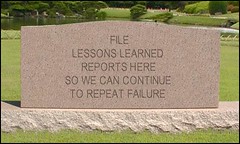
There's a lot of fuzziness about the topic, and this can really hamper the delivery of value through lessons identification, sharing and re-use. Let's start with the question - "What is a lesson learned". Here are a few definitions, many taken from the web, many of them (as we will see) flawed.
- "A Lesson Learned is knowledge or understanding gained by experience that has a significant impact for an organisation. The experience may be either positive or negative. Successes are also sources of Lessons Learned. Lessons Learned Systems tend to be more organisation-specific than Alert Systems".
- "A Lesson Learned documents the experience gained during a project. These lessons come from working with or solving real-world problems. Collecting and disseminating lessons learned helps to eliminate the occurrence of the same problems in future projects".
- “a potential mode of failure (a risk) and the possible actions to mitigate that risk”.
- A lesson learned is an experience or outcome of a particular course of action -- either positive or negative -- that is important enough to be communicated to one's peers.
- "The knowledge acquired from an innovation or an adverse experience that causes a worker or an organization to improve a process or activity to work safer, more efficiently, or with higher quality"
- Knowledge derived from the reflection, analysis and,conceptualisation of experience that has potential to improvefuture action
We can conclude from this that lessons are knowledge, and that they come from experience, and that they can help, or impact, the work of others. But does that make them "Learned"?
There is a very valuable distinction to be made between Lesson Learned and Lessons Identified, and anyone who has worked in this field for a while will have met companies which keep identifying the same lesson over and over, but never learning it (see excellent picture above). I would suggest that many of the definitions above are for Lessons Identified rather than Lessons Learned. Look at the language in the definitions; "collecting and disseminating lessons learned helps" - yes, disseminating lessons may help, but what about applying them? "Important enough to be communicated to one's peers" - what about "important enough to be re-applied by one's peers"?
Let's look at the steps a lesson has to go through before it can be considered to be "Learned".
1. Reflect on Experience. Think back (and discuss as a team)what happened.
2. Identify learning points. Where was there a difference between what was planned, and what actually happened? Either a positive or a negative difference.
3. Analyse. Why was there a difference? What were the root causes?
4. Generalise. What is the learning point? What should be done in future activity to avoid the pitfall, or repeat the success? At this stage we have a Lesson Identified. It will be a useful lesson, if others can learn from it, and for others to learn from it, it needs to be instructional.
At this stage, let me have a short digression on "What makes a good Lesson". We tend to use the phrase "Specific Actionable Recommendation to describe a good lesson.
- A lesson needs to be specific enough that you can learn from it. Let's have none of the "Well, Duh!" lessons, please. I read a Lesson last week that said "To do X properly will require time, resources and effort". Well, Duh! And there was me, thinking it could be done in no time, with no resources or effort!
- It needs to be actionable - people need to be able to take action. So none of the woolly waffles such as "A better system for Y needs to be in place". How Better? What sort of Better? What elements need to be Better? Who needs to put it in place?
- Finally it needs to be a recommendation, rather than an observation. I went through some documents recently which were purported to be lessons learned documents from an absolutely crucial project, and half of the "lessons" were observations. They had not got past step 2 above. They were statements such as "The team encountered great difficulty in Z, blah blah". Well, why did they encounter difficulty? What was the root cause behind that diffIculty? And what would their recommendation be for other teams, to avoid that difficulty? There has been no analysis, so there can be no specific actionable recommendation.
My conclusion is that a Lesson Identified needs to be "A recommendation, based on analysed experience, from which others can learn in order to improve their performance". We are still not at a "Lesson Learned" as there needs to be one more step - step 5.
5. Take action. As I explained here, a lesson needs to be accompanied by an action if it is to be considered Learned. A document, a procedure, a policy, a structure, a budget, or an order, needs to be changed. Then this change needs to be communicated, so working practices can be changed as a result. If nothing changes, nothing has been learned.
So I would like to propose this definition. A Lesson Learned, is a change in personal or operational behaviour as a result of experience. Ideally this will be a permanent, institutionalised change, but we know that lessons can be unlearned as well as learned, so I will leave the work "institutionalised" out of the definition for the moment.
Photo from Flickr Creative Commons - Lessons Learned. Sure
Originally uploaded by Mike Licht, NotionsCapital.com



 Posts
Posts


14 comments:
WOW ! I do agree with most insights.
My Doctorial research (now in progress) is on Learning from lessons and from experience.
a. Lessons may be recomendations- not only yes / no's.
b. Experience is also a source. I speak about lessons as the results of active debriefing, and experiences, as drived by experiencing (by doing the job, also if no active session took place).
c. Learning indeed is not guaranteed. It requires change in behavior/ performance.That is why a full life cycle of handling the lessons is the right way to achieve the shift in performance, i.e. in order to turn the lesson into a lesson learned.
Moria Levy
moria@kmrom.com
http://www.kmrom.com/Site-En/Custom/Site-en/Homepage/Homepage.aspx
Thanks Moria
I would be most interested in the results of your Doctorial research, when you are ready to share them
Hi Nick and Moria, I am with you both.
Just found this post. I plan on continuing the research here.
http://www.invictaprojects.com.au/pmlessonslearnedblog/
Nick, I like your article on 'Long Tail of Experience' and 'Lessons Learnt'.My doctoral research is on Business Disruptions and Learning the Lessons". One question: Why organizations consistently fail to learn the lesson? Nalin
Nick,
I like your views on 'Long Tail of Experience' and 'Lessons Learnt'. My doctoral dissertation is on related field - Business Disruptions and Lessons Learnt. One questions: Why do organizations consistently fail to learn the lesson? Nalin
Generally because nothing changes as a result of the "lesson". They have not taken step 5 above. The lesson is too often just documented and stored, and nothing changes.
See my book "the lessons learned handbook" for a full exposition.
I would very much appreciate seeing a copy of your dissertaion, if it is finiahsed!
I would like to add to Nicks response. Nalin's question.. "Why do organizations CONSISTENTLY fail to learn the lesson?" Two other contributing factors in my opinion are attitude and culture. Organizations based in certain parts of the world "where majority of individuals or employees have a certain cultural orientation and attitude to work" are capable of learning the lessons much easier and faster than others elsewhere. This definitely can be a good area to research on... "the contribution of culture and attitude to learning the lesson.. or?.." Documenting and storing in most cases is a well thought strategy.
P.M.
your cynicism is very cynical, one would even say cyncically so, unfortunately not necessarily wrong
Nalin, is your dissertation now available?
Nalin, I am working in this area as well. I think that one reason that some organisations are slow to or maybe unable to change is because they lack a strong enough catalyst or driver to change. In the book I am collaborating on at the moment, I have noted that two of the biggest drivers of change are 'blood and treasure'. If an organisation or an individual is hurting them they are far more motivated to change. A number of large corporates probably fall into this category.
Simon
Nick
I don't agree with your definition but your discussion getting to that point was really useful. I think that you are artificially constraining the process in proposing a definition that is limited to "...change in personal or operational behaviour...". I think that you were closer to the mark in your paragraph 5 where you include a broader range of change. Surely a lesson can be implemented by changing, for example, an item of equipment which, while still being a change, might actually reinforce current/extant behaviours that might have been adversely affected e.g. work-arounds, etc by equipment that was in some way unsuitable for the task at hand?
Simon
I agree Simon, you are right that in fact ANY change driven by experience is a lesson learned. That lesson can be embedded in many forms - behaviour, process, structure, equipment etc etc.
Stumbled across this blog which expresses exactly what i have been trying to say for a while - so thank you! And I absolutely agree with the definition. I got a bit frustrated when reflection processes in one organisation i worked with kept identifying the same "lessons learned". For example, the truism that working in partnership requires good communication. I wasn't very popular when I pointed out that this is a lesson that has already been widely identified but that the team had failed to learn.
I agree totally with the article.But in the real world there are givens, assumptions etc that we work with each and every day. We assume that the effort will have adequate/sufficient communications, resources, budget, time... The reality is that more often than not especially in the area of dedicated resources this is not the case, something occurs and our originally dedicated resource for a specified amount of time is not so dedicated. Regarding the communication aspect, it may not a lack of communication it might well be misguided communication, i.e., the right communication targeted to the wrong audience. I've seen it a thousand times as we progress through the process we touch base to address/document lessons learned. Basically everything that appears on the white board could very well apply to most projects. It is really of matter of learning the lessons, institutionalizing the learnings, but all too often most organizations just move on to 'rediscover' the same lessons learned in subsequent projects.
Post a Comment