Thursday, 30 June 2011

KM failure stories number 8


FAILThis is a new failure mode for a knowledge management project, which I had not heard before.

The KM team leader decided to take a technology-led approach to KM (already a mistake in my view). They commissioned a technology company to build a bespoke integrated technology suite including wikis, blogs and other community technology.

The technology company did a very poor job and the results were very disappointing. The KM team leader lost their job shortly afterwards.

Wednesday, 29 June 2011


Implementing KM at a rate of 2 issues a year


Last week at KMUK, Linda Davies of Mars told us the story of her Knowledge Management Strategy. Initially she wrote a good comprehensive strategy, put it on about 20 slides, and presented it, in late December 2003, to one of the company presidents.

"I didn't get past Slide 1" she reported. "He would not let me get past slide 1 until I could show him how KM would add value to the bottom line".

Linda told us that, in KM terms, "this was the best Christmas present" she had received.

She went away and re crafted her Knowledge Management Strategy to be entirely business focused.

Instead of rolling out KM tool by tool (blogs this quarter, improved search next quarter) she rolled out KM business issue by business issue, at a rate of no more than two business issues per year.

Two issues a year, but two BIG issues, two THORNY issues which needed good KM to solve.

That was a completely different strategy to almost every other strategy we heard at KMUK. It was a business led strategy, focused on solving business issues, and driven from the very top of the company. It made her some powerful friends in high places, and to data has delivered knowledge-enabled value in excess of £1 billion.

I know I often write about being business-led in KM, and Linda's story was one of the most complete examples of this that I have seen, as well as delivering huge value to Mars. It stands as an example to all KM initiatives, and it won the award for "Best KM Implementation" at KMUK.

Tuesday, 28 June 2011


You never told me - You never asked


This is a conversation that tells you that Knowledge Management is broken in your organisation. It is a primary symptom of a lack of KM.

The culture of KM is a culture of asking for knowledge, and a culture of offering your own knowledge in response to being asked. As a result, you find out that it won't work, before you start.

"Knowledge is a treasure house; questions are the key"

Monday, 27 June 2011


Jon's dangerous year in KM


Danger de mort Jon Harman is the head of Knowledge Management at Syngenta. I know him quite well, and admire the work has has been doing. He has been in post for many years, making steady though slow progress. Then, last year, he had a breakthough - he had the most productive year in KM that he has ever had.

The reason? He had lost his job.

Or perhaps to be more exact, he was under notice that his KM post was closing.

For Jon, this was liberating. Released from the fear that he might lose his job (because he knew the axe had already fell),  Jon decided to live dangerously. Instead of waiting for permission, he acted. Instead of working through is boss, he went direct to the CEO. Things started to happen, the CEO liked what he saw, and the KM train started to accelerate. Not only that, but Jon was offered another KM post within Syngenta.

So what's the lesson, ladies and gentlemen?

If you are going to make Knowledge Management work, you have to be bold. You have to live dangerously, because (as I said in the post "KM, simple but not easy"), "it needs courage and it needs dedication and it needs perseverence and a thick skin, and it needs you to work at some very difficult conversations".

Jon learned the lesson through the risk of losing his job. If you learn the lesson, rather than making your job more risky, it may actually make your job safer.

Sunday, 26 June 2011


"Knowledge is a comforting friend" (quote)


Comforting Brother
“Knowledge is a comforting friend in times of loneliness, it is the best companion during travels, and it is the inner friend who speaks to you in your privacy. Knowledge is the discerning proof of what is right and what is wrong, and it is the positive force that will help you surmount the trials of comfort, as well as those of hardships. Knowledge is your most powerful sword against your enemy, and finally, it is your most dignifying raiment in the company of your close companions".
Mu’adh bin Jabal, reported in Al-Hilyah by Abu Nu’aym

Friday, 24 June 2011


"Capturing" tacit knowledge


capture
We have always known that a lot of tacit knowledge cannot be captured, and some other tacit knowledge should not be captured, but should be left in the full richness of tacit form. That's why I always bristle when I see KM "Loop models" which start with "Capture".

However I had a good discussion in KMUK this week with a guy who applied just that model to tacit knowledge (Alan Knott, Technical Leader – Knowledge Management, Parsons Brinckerhoff Ltd).

He made the good point that tacit knowledge is to some extent "captured" when the knowledge holder joins a network or a community of practice. Up to this point, the tacit knowledge is siloed; inaccessible. Once the person is connected into a network, their tacit knowledge is linked into a system.

Much as a piece of explicit knowledge joins the company knowledge based when linked, accessible and searchable, so a piece of tacit knowledge joins the company knowledge based when the knowledge-holder is linked, accessible and findable though a network or community of practice.

Wednesday, 22 June 2011


KM, simple but not easy


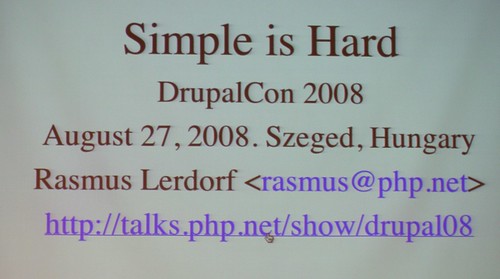
Rasmus Lerdorf - Simple is HardThe KMUK 2011 conference this week reinforced for me that Knowledge Management is actually really quite simple, but simple does not equate to easy.

For all the tools and all the strategies and all the nuances and all the things that we to do complicate knowledge management, at it's heart it is about making sure that the decision makers in the organisation have access to the crucial knowledge they need to make decisions. Then its about making sure that the right conversations happen to identify capture and transfer that knowledge. Then it's about change management - changing to a world where knowledge is important.

It's the change management aspect that's the hard aspect. There is enough technology out there, there are well-defined processes that work extremely well, there is an understanding of the roles and skillsets needed, and nowadays there's a pretty good understanding of the governance elements as well. All of that is easy enough. It's the change that's hard.

I think that's where poeple often go wrong with their KM programs. They do the easy stuff, not the hard stuff. They buy the technologies. They print the booklets. They work with the enthusiasts and sing with the choir.

What they don't do so often, is have the really hard discussion with the CEO and the senior management team about the value KM can deliver to the organisation, and the few focus areas they need to address. They don't gain those high level sponsors. They don't go and tussle with the hard-pressed team leaders and work out what you can do to help them, and what they can do to help you. They don't get out and work in detail with the pilot projects, to deliver the spectacular successes that act as a beacon to the rest of the organisation.

Knowledge Management is not complicated. It really isn't, despite the complicated models people sometimes build. But it needs courage and it needs dedication and it  needs perseverence and a thick skin, and it needs you to work at some very difficult conversations.


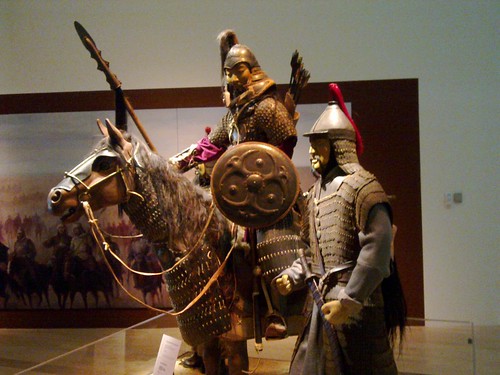
Genghis Khan and the strategic importance of knowledge


Genghis Khan Exhibition @ ArtScience Museum
"At the military level, Mongol doctrine relied for success almost entirely on learning exactly where their enemies were, while keeping their own whereabouts a secret until they attacked. This enabled them, despite a chronic inferiority in numbers, to overthrow the finest, largest armies of imperial China, Islam, and Christendom... In one of their greatest campaigns, against the mighty Muslim empire of Khwarizm (located approximately on the territory of today's Iran, Iraq, and portions of the central Asian republics of the former Soviet Union), a Mongol army of some 125,000 toppled a foe whose standing armies amounted to nearly half a million troops, with a similar number of reserves. How could this happen? The answer is that the Mongols identified the linear, forward dispositions of their foes and avoided them. Instead, they worked around the defenders, making a point of waylaying messengers moving between the capital and the front.
"
Muhammad Ali Shah, the ruler of Khwarizm, took the silence from the front as a good sign, until one day a messenger, having narrowly escaped a Mongol patrol, made his way to the capital, Samakand. Muhammad inquired about the news from his army and was told that the frontier was holding. The messenger went on to add however, that he had observed a large Mongol army but a day's march from the capital. The shah fled and his capital fell swiftly. This news, when given to the frontier armies, led to a general's capitulation".

J. Arqulla and D. Ronfeldt
Comparative Strategy, Volume 12, "Cyberwar is Coming," 1993

Tuesday, 21 June 2011

People or Portals?


The Portal.
I am spending the next couple of days at the KMUK conference.

I hope to hear lots of interesting stories, ideas and models. What I hope NOT to hear too much of, is the sort of presentation that seems to haunt KM conferences.

This is the presentation where at slide 2, the presenter says “Knowledge is all about people” or “Introducing KM is a culture change process – it’s all about culture”. And then at the next slide says “and let me show you our portal/wiki/website/networking page”. Then the rest of the presentation is all screenshots.

If KM is all about people, I don’t want to see lots of screenshots of technology. I want to hear from people.

If KM is all about culture and culture change, I don’t want to see lots of screenshots of technology. I want to hear about how people are engaging with knowledge, and about the changes in behaviour that this prompts.

If it’s a choice between People and Portals, I’d rather hear about People.

Hopefully there will be lots of People-talk at KMUK! Looking forward to it.

Monday, 20 June 2011


Stop adding and start updating


thanks for the addLearning is a lifetime process, but there comes a time when we must stop adding and start updating. Robert Brault,

The earliest Knowledge Management framework I helped build was in Norway. We built a project management system based around knowledge; knowledge of the client requirements, knowledge from previous projects, knowledge captured at the end of each project.

At the end of each project we would conduct a Retrospect, draw out the lessons learned, and put them as sheets into a ring-binder that acted as our database (this was before file sharing and web interfaces and wikis).

What happened was that over time, the folder got bigger and bigger, and thicker and thicker, until it became too daunting to open. People knew that there was so much in there, it would be difficult to find what they wanted, so they skipped the process entirely.

That’s because I was focused only on adding, and not on updating.

I was adding lots of lessons on (for example) geophysical reprocessing (some of which were repetitions, some of which were contradictions) instead of updating the geophysical reprocessing guidelines.

As a result, when I left Norway, the system was shelved for about a year, then someone was given the task of weeding through th lessons file and reducing it to a smaller file of guidelines.

Somewhere in one of Larry Prusak’s books he talks about how too much volume of content is unhelpful, and how knowledge can be “de-knowledged” through too much volume.

Sooner or later we have to stop adding, and start updating.


The knowledge-bubble trap worsens


Bubbly bubble
I posted a while back about the way we tend to create knowledge silos in social media, giving the example below of knowledge related to BP during the oil spill.
I looked at the BP corporate site and the Boycott BP site. Two more polarised communities it would be impossible to find, although conversations within the communities on both sites were focused on the same topic. Both sites were full of conversation about the Gulf of Mexico Oil Spill, and BP’s role in the spill and the clean-up. While the BP America community were talking about the technical details of the clean-up and the unprecedented resources and skills being deployed by BP, the Boycott BP community (more than 30 times larger than the community on the BP America site) were sharing horror stories about alleged breaches of safety and responsibility  ...... There was no dialogue - just a parallel separate pair of incompatible group monologues; loads of opinionated people agreeing with each other.
I went on to talk about how this development (largely driven by comfort and self-esteem) creates group-think, which is a kind of knowledge bubble. As I pointed out in my blog post on bursting the knowledge bubbles, this is a very dangerous situation. It has been argued that knowledge bubbles may have been behind many disasters, such as the lack of recognition of the imminence of Bin Laden's plans to attack the USA, for example.

Now it seems these bubbles are getting worse. In the UK Sunday Times yesterday, Bryan Appleyard (one of my favourite journalists - very perceptive, very articulate) reviewed The Filter Bubble - what the Internet is hiding from you. This book talks bout how search engines and social network sites increasingly send you results and notifications which are tailored to their view of what interests you. This is driven by your search history and by the groups you already belong to, so increasingly these results are becoming less and less objectives. The author gives this example (to me - strikingly familiar);
"While the BP Oil Spill was in progress last year has asked two friends to type "BP" into Google. One got investment information on the front page; the other news of the spill"
There were other filters mentioned, such as the way Facebook sent him news from his liberal friends (having identified him as a liberal" while filtering out news of conservative friends.  To some extent, it may be useful to be fed information that interests us. The danger comes when it reinforces the knowledge bubble, and we are fed only messages that we are expected to agree with. As Jaron Lanier, author of " You are not a gadget
says
"People tend to get into this echo chamber where more and more of what they see conforms to the idea of who some software thinks they are".
So not only do people create silos and knowledge bubbles on social media, the personalisation capability of software may reinforce those bubbles.

As knowledge managers in business, we need to recognise the risk of knowledge bubbles and echo chambers, specifically of making wrong decisions because we don't have a balanced view (see Deadly Decisions - how false knowledge sunk the titanic ... for scary examples). I reiterate what I said below in the group think post
"We cannot afford plural communities covering the same topic. There needs to be one community covering knowledge management, not 100. There needs to be one community covering oil-spill recovery, not two highly polarised ones. Then within each topic, disagreement needs to be sought and explored, in service of finding the truth. This is part of the role of the community facilitator - the role of allowing a diversity of opinion, and promoting and facilitating the dialogue that allows this diversity to be explored and resolved".
And to this I would add
"We need to be very careful of personalised search results which verge towards subjectivity. Wherever possible, a person should receive all search results relevant to a topic, whether they support the current viewpoint of the searcher, or are diametrically opposed".
It is only by seeing all sides of a question, that we can hope to come to knowledge of the truth.

Sunday, 19 June 2011


Answering questions at Shell


Shell logoIt's the easiest thing in the world to get people to answer a question at Shell; the trick is to get people asking those questions


Andy Boyd, of Shell

Friday, 17 June 2011


Safe in the Knowledge


Safe Handle
I was following a van down the motorway yesterday, and on the back it had the strapline "Safe in the knowledge"

What a great strapline for someone promoting Knowledge Management!

The van was owned by the Health Commission, and it is this message they are promoting - "you are safe in the health service, because we have the knowledge" - but it could be used by anyone promoting the value of knowledge, and therefore the importance of knowledge management.

(For our non-native speaking English readers, if you do something safe in the knowledge that something else is the case, you do the first thing confidently because you are sure of the second thing.)

Knowledge allows you to act confidently and safely.

Knowledge management is therefore a management approach to esuring that people have the access to the knowledge they need, in order to be able to act confidently and safely.

If your company has effective knowledge management, then it can remain "safe in the knowledge".

If it hasn't, then maybe that safety is illusory.

Wednesday, 15 June 2011

Taking a risk can pay off in a Knowledge Management career

Sometimes playing it safe in a Knowledge Management role is the worst thing you can do, and you need to take a risk, and live dangerously.

Danger de mort
Jon Harman is the head of Knowledge Management at Syngenta crop protection. I know him quite well, and admire the work he has been doing. In 2010 John had been in post for many years, making steady though slow progress. Then, in 2011 he had a breakthough - he had the most productive year in KM that he has ever had.

The reason? He had lost his job.

Or perhaps to be more exact, he was under notice that his KM post was closing.

For Jon, this was liberating. Released from the fear that he might lose his job (because he knew the axe had already fallen),  Jon decided to live dangerously. Instead of waiting for permission, he acted. Instead of working through is boss, he went direct to the CEO. Things started to happen, the CEO liked what he saw, and the KM train started to accelerate. Not only that, but Jon was offered another KM post within Syngenta.

So what's the lesson, ladies and gentlemen?

If you are going to make Knowledge Management work, you have to be bold. You have to live dangerously, because (as I said in the post "KM, simple but not easy"), "it needs courage and it needs dedication and it needs perseverence and a thick skin, and it needs you to work at some very difficult conversations".

Jon learned the lesson through the risk of losing his job. If you learn the lesson, rather than making your job more risky, it may actually make your job safer.


KM governance in 5 letters

FF DIN Round: ‘Round Pieces’When your KM framework is complete and in place, you need to operate a level of governance to ensure the framework becomes fully embedded.

So what does governance entail?

Let's think about it in terms of 5 letters

  • E is for Expectations. Everyone should know the corporate expectations for Knowledge Management; whatever they may be. They might be "Ask, Learn, Share", they might be "Learn Before, During and After", they might be "Every project should have a KM plan, and hold a post-project Retrospect". Whatever they are, everyone should know them.
  • A is for Accountability. Everyone should know their personal accountability within the KM framework. Whether they are accountable for making sure a project fulfils its KM expectations, or accountable for maintaining an area of corporate knowledge, or accountable for building and facilitating a community of practice, they should be clear on what this accountability is.
  • M is for Metrics. People should, to some extent, be measured against their accountabilities. Did the project follow the KM expectations? Is their area of corporate knowledge being maintained (complete, up to date, accessible, user-friendly)? Is the community of practice healthy and delivering value?
  • I is for Incentives. If people meet their accountabilities, this needs to be reflected in their remuneration and recognition. Like any other component of work, "good performance in KM" should get reflected in pay and promotion? ALso "poor performance in KM" should impact pay and promotion.
  • S is for Support. People need to be supported in KM. They need to get the training, they need to have the tools, and they need to have the reference material to be able to deliver against their accountabilities and expectations.
If you get E, A, M, I and S correct, knowledge management will become as embedded as any other component of your management system. You get one of these wrong, and KM may become unsustainable.

Tuesday, 14 June 2011


The three levels of Km training

When we are working with a client to introduce Knowledge Management, we generally recognise three levels where KM training is needed.

I am talking now about the later stages of KM implementation, when the tools and processes and technologies and roles (in fact the entire KM framework) for that company has been decided and agreed upon, and the implementation has reached the roll-out or the deployment stage. I am not talking about the early-stage awareness or engagement training.

Here are the three levels;

  • KM for managers. Here the managers need to understand the value of knowledge management, and they need to understand the basics of the M framework. They need to know what expectations to set for their staff, they need to know what sort of KM activity they should be seeing and what sort of activity they should be encouraging and rewarding, and they should understand their role in setting the KM behaviours. We have had a lot of success with the Bird Island exercise at this level.
  • KM for general staff. The staff in the projects and the departments need to know what is expected of them in terms of KM, they need to understand how the processes work, how the technologies work, and what the value will be to them and to the company. At this stage we generally give them hands-on experience of any technology they will be expected to use (community tools, yellow pages, lessons databases, wikis, RSS feeds, Yammer etc).
  • KM for the specialist KM roles. This is for the knowledge managers, the subject matter experts and the community leaders and facilitators. As well as the details of their roles and accountabilities, they need to know the details of how the technology works, how to facilitate the processes, how to address the culture barriers, and how to deliver the benefits. This last training may require tailored training and coaching for the individual roles - community facilitator require a different set of skills to the project knowledge managers, for example.

Monday, 13 June 2011


BT metaphor for social networking

I have yet to find a better metaphor for connectivity within communities of practice and social networks


8 steps to KM culture change


You can't change the culture all at once.

We most of us realise that introducing Knowledge Management is a culture change process, and we generally also realise that culture change is not something that happens all at once. We know that culture is changed one heart and one mind at a time, but we also need to realise that each individual heart and mind does not change all at once either.

There are a number of steps to successful KM culture change, and it is worth understanding these, as you cannot move an individual or a team more than two or three steps in any one interaction.

The steps are these
  1. First Contact - the first time that the individual or team hears the term "knowledge management"
  2. Awareness - the individual or team becomes aware of knowledge management as something that may be an issue in the organisation
  3. Understanding - the individual or team understands what knowledge management means (in basic terms)
  4. Acceptance - the individual or team accepts that there may be value in knowledge management, either a WIIFM for themselves, or a value proposition for the company
  5. Trial - the individual or team agrees to try knowledge management. This leads to the first commitment threshold - the commitment to act
  6. Adoption - assuming the trial has gone well and delivered more value than it cost, this is when the individual or team agrees to adopt knowledge management processes or technologies
  7. Embedding into work process - this is where the individual, team and eventually company embeds knowledge management into work process
  8. Embedding into culture - this is where the individual, team and eventually company Internalises knowledge management  as "something we just do." At this stage it becomes a core value.
You can see there are a lot of steps, and it is easy to neglect them. Many KM programs never go beyond the trial stage, or perhaps they adopt KM but never embed it, at which stage it can easily become unadopted again - re-orphaned. It is only when you get to step 7 that KM is relatively safe, and even then you want to take care of the final step, the Internalisation step, so that the culture becomes pervasive and unconscious.


Saturday, 11 June 2011


Ambition without Knowledge quote

Karate kidAmbition without knowledge is like a boat on dry land.


Sgt. Kesuke Miyagi - the Karate Kid

Friday, 10 June 2011


Complexity, collectivity and Knowledge Management

The world is becoming an increasingly complex place.

This came through to me very strongly when reading a recent article in New Scientist, entitled "we've made a world we cannot control". Here the authors talk about three levels of complexity.

  • Level 1 is a piece of technology, or any other autonomous system, in isolation. Take a Nuclear Power Plant for example. It can be designed, it works, you can map out cause and effect, and you can predict what will happen if you change certain variables. You can "know" it fully.
  • Level 2 is that piece of technology set within a network. Like a Nuclear Power Plant connected to an electrical grid, which is connected to domestic appliances and factories. Here you have feedback effects, which can lead to unexpected consequences, to which the Level 1 system needs to react. You can't really know the system fully, but you can derive some models.
  • Level 3 is that technology, in that network, integrated into all the other factors that effect it - the climate, the way humans behave en masse, global politics, the tectonic plates that cause earthquakes and tsunamis. This is chaos. This is unpredictable.
Level 3 is the world we live in. Level 3 is entirely unpredictable. It is too complex, and too uncertain. We are surrounded by Level 3 systems which we cannot hope to understand - financial, technological, social.

Also, the world is becoming an increasingly collective place. The decisions we make, affect people on the other side of the world. Our friendship networks and our business networks are becoming global, and we are connected to them full-time, through the phones in our pockets. we do not work in isolation, and we do not make decisions in isolation.

That's where the Boston Square on this page comes into the picture (based on Blackler, 1995).

In a Level 1 world, without connectivity, then we could rely on experts. Level 1 is the rational "knowledge society" based on Enlightenment notions of rationality. And if we need to work collectively, we can develop robust transferable procedures to help transfer that expertise.

In a Level 3 world, we need to be creative and to be reactive and to be innovative. If we were not connected - if collectivity were low - then we could rely on creative individuals to respond to unexpected problems. But we are connected, and that's where knowledge management comes in. The authors of the New Scientist article, Braden R Allenbury and Daniel Sarewitz, call our Level 3 world "the ignorance society" because the world is too complex to understand and too unpredictable to fully know. Ironically we cannot survive in a collective, complex, level 3 "ignorance society" without knowledge management.

We need to be innovative, we need to be agile, we need to learn very fast, and we need to pool and build on what knowledge we have. That's why Knowledge management is a crucial tool for survival in a Level 3, Collective world; whether you are in the Nuclear industry, the sales and marketing business, government, or any other sector. Knowledge is in short supply, so we need to make the most of what little knowledge we have, and be prepared to think and learn and innovate on our feet, collectively.

Thursday, 9 June 2011


New KM franchise


Knoco welcomes it's newest franchise holder - Javier Martinez, who will look after our business interests in Chile.

Welcome Javier to the Knoco family!

(Read more about Javier at the Knoco Chile page)

Wednesday, 8 June 2011


Approaching the knowledge supply chain from the wrong end


Chain
This week I met another client, another keen KM team looking for help, and another set of KM models. And yet again, their primary KM model was a diagram of a Loop, representing the movement of knowledge through the company. As seems so often to be the case, it was a clockwise loop, and the first or second step was "Capture".

Now there is nothing wrong with this as one model among many, but for so many of my clients it seems to be the primary model. It's a PUSH model, representing the push of knowledge into the organisation, and its an EXPLICIT model, as the first step is to capture explicit knowledge. And we know that Explicit Push is only one quadrant of KM, and we also know that it is the most difficult of the quadrants for delivery of value.

As a thought experiment, I often ask my clients to draw the Loop the other way, driven by Pull. Instead of running clockwise with the first step being the identification of learning, I ask them to draw it anticlockwise, with the frst step being the recognition of a knowledge need.

It is very useful to think of KM as being an internal Knowledge Supply Chain for an organisation, and nobody ever approaches the supply chain from the supply end. You never say "I can make all this product - what shall I do with it? Where shall I store it?". Instead you start from the market end. You think "where is the market? how big is the market? How can I stimulate the market? What products does the market need? Whats the most efficient way to get those products to the market?"

That's how you should approach the Knowledge Supply chain. Ask yourself

"Whats the market for knowledge in my organisation?"
"How can I stimulate that market?"
"What knowledge does the market need?"
"Whats the most efficient way to get that knowledge to the point of need?"

That's approaching the knowledge supply chain from the right end.

Tuesday, 7 June 2011


Learning before doing, on the rugby pitch


Business can learn a lot from Sport.


In Knowledge Management terms, one of the things it can learn about is the practice of "Learning before Doing".

No rugby team would take the field without spending a massive amount of time reviewing their own performance, reviewing the playing styles of the opposing team, and reviewing the preferences and biases of the referee. Much of this review is done through video, and through extensive video analysis of tactics and strategies; see here for a discussion of how Bath Rugby use video throughout their training week. There is an entire industry building up around video analysis software, and video analysis services, all with the aim of understanding your own team and your opponents. This can be an exposing affair - the statistics on individual players can show up the weak links as well as the star performers (see example) - but in today's intensive industry it makes the difference between success and failure.

So what can business learn from this?

I think there are a couple of points.

Firstly the more you "learn before doing", the better your results will be. You need to learn about yourselves to improve your methods and tactics, you need to learn about your competitors and their products and approaches, and you need to learn about your customers and clients. Get data - get as much data as you can. understand it, analyse it, look for the root causes, and look for the learning. Do this early enopugh that when you get into the client office, you have already done your learning.

Secondly you need ruthless self-analysis. As a team, you need to know how you perform, and where your weak spots are, so you can work on them. Business is a ruthless game, but the purpose of a team is to draw out the best from all its members, and you need to know how to do this. So don't be worried if this self-analysis identifies weaknesses, so long as you have a plan to work on those weaknesses.

Monday, 6 June 2011


Quantified success story 18 - Project ECHO


An excellent post from Mary Abrahams describes Project ECHO - an approach to spreading knowledge of specialist healthcare through learning networks and virtual case presentations (rather like virtual peer assists). Here specialist clinicians work virtually with health-care workers in rural or prison settings, sharing their knowledge of, and best practices for, treatment for Hepatitis C.

You have to dig into the literature a bit to find the success measures but project ECHO delivered rates of successful treatement of the HCV infection comparable to those at a University clinic, (58.2 percent vs. 57.5 percent), and significantly greater than the 20% to 34% success rate previously delivered in similar settings. And the only factor that can explain the difference between 20% /34% and 58%, is added knowledge.

If we assume that ECHO improves the results for 28500 people (the story mentions 30,000 Mexicans with HCV, of which 95% do not have access to specialist treatment), then this improved treatment rate represents between 6840 to 10830 people cured thanks to ECHO, than would otherwise be the case. I don't know if every successful treatment represents a life saved, but if it does, thats a lot of lives saved through managed knowledge transfer and re-use.

Sunday, 5 June 2011


Quote - your own life is your teacher


Student and Teacher
"Everything that happens to you is your teacher. The secret is to learn to sit at the feet of your own life and be taught by it."

---Polly B. Berends

Friday, 3 June 2011


Survey - the size of KM teams


I have been running a survey on Linked In on the size of central KM teams vs the size of the organisation they serve, just as a way of benchmarking team size for some of our clients.

I had been expecting to find a linear relationship, based on experience to date, or possibly a linear relationship with a minimum and a maximum.

The results from 41 datapoints are shown below, followed by analysis.
A couple of disclaimers before I get into analysis. Firstly the names of the companies has to remain anonymous. Secondly there are some very small teams, such as the lone guy in the 100,000-strong organisation, who is just starting on the KM journey and is not yet up to strength. Therefore the graph does not consist only of mature, full-strength teams. Thirdly the definition of "Knowledge Management" varies considerably - from companies that focus on learning from experience and communities of practice, to companies for whom KM means content management and librarianship. Finally there is FAR MORE to success in KM than just the size (or even the make-up or the leadership) of the team.

My expectation of a linear relationship was not met. Instead you can make a case for two linear relationships.

There is certainly a set of data which form a linear trend (blue in the diagram) representing one KM team member for every 5000 staff. The companies that I know on this trend have KM teams that I would call Catalytic teams; focusing on change management, on introducing the elements of KM into the business, and on change management. All of these are western companies.

There is another set of data which form a far steeper and less defined trend (red in the diagram), representing one KM team member per 500 staff. I am less familiar with many of these companies, but from the replies I have received, these teams act as Support teams, in that the members provide KM support services to the business, rather than expecting the business to support itself. Often these services seem to revolve around content management. The KM teams play the Knowledge Manager role, rather than supporting the Knowledge Managers in the business, and in addition may contain web developers, eLearning specialists, and others who create, format or package content. When I was in BP Norway as Knowledge Managers, I played this role, spending one third of my time on it for 100 staff.

So my conclusion from this is that the ideal size of your KM team depends on the role it will play. If it is a change management team, expecting the business to "do" KM, then 1 team member per few thousand employees is a good ration. If the team will "do" KM services or content management services themselves, then the ratio needs to be greater by a factor of 10.

If anyone has more datapoints to add, please comment here, or email me, so I can continue to build the dataset.

Thank you.

Thursday, 2 June 2011


Capturing knowledge - separating observation from analysis


Observation Post OulletteThe identification of new knowledge, or new lessons, involves a few steps. These are

 
  1. Making an observation. Something unexpected or unwanted has happened, and the first step is to make this observation.
  2. Analysis. You analyse the observation, look for the root causes behind it.
  3. Generic learning. You decide the learning point - what the recommendation would be for the future, to repeat the unexpected success, or avoid the unwanted problem.
  4. Decide the action. Here you decide what to change in the organisation, to ensure the generic learning is embedded in process.
 
Think of the 4 or 5 questions of the After Action Review. The first two ("what was supposed to happen? What actually happened?") cover the observation. The third ("why was there a difference?") is the analysis. The fourth (""what have we learned?") is the generic learning. The optional fifth ("What action do we take") is the action.

Who carries out these steps, and using what process, varies from organisation to organisation.
  • In the NATO system, observations come from the troops, and all the other steps are carried out by JALLC (the joint analysis and lessons learned centre). NATO therefore separate observation from analysis and identification of learning points.
  • In a major engineering company we work with, the observations, analysis and generic learnings are identified by the project teams, using the Retrospect process. The actions are decided by a central group of senior functional managers (in another company, a central lessons coordination team decides the actions). These companies combine observation, analysis and lessons identification into one process, but separate the step of identifying the actions.
  • In another company, the project teams conduct all the steps, including suggesting the actions.
You will need to decide, for your organisation, who does what in this process of indentiyfing the learning from activity, and whether you separate observation from analysis, or lessons from actions.

Blog Archive