Thursday, 31 March 2011


Measuring Knowledge Flow


Rate of Flow
There is no absolute scale for measuring the amount of knowledge held by a person, or held by an organisation.

There is no "milliknow, centiknow, kiloknow, megaknow" metric scale for know-how. No scales, no tape measure.

What you can measure, is a change in knowledge - "Yes, I know more now than I did before this meeting, or this conversation".

You can also measure the effect of this knowledge - "Now that I know more, I can perform this task faster, or more cheaply, or to a better quality".

It is therefore far easier to measure the FLOW of knowledge, than it is to measure the STOCK, and through Flow, to measure VALUE.


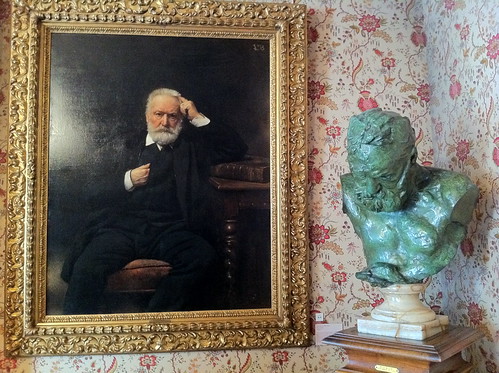
Invasion of ideas (quote)


Victor Hugo
"One can resist the invasion of an army but one cannot resist the invasion of ideas."
Victor Hugo

Tuesday, 29 March 2011


Knowledge Management leads to a boring life


Boring!

Knowledge management, if done well, leads to a boring life.

If you ensure that teams and individuals in your organisation always have the knowledge they need to make the right decisions, and to anticipate and meet the challenges they face, then you remove all the excitement, danger and uncertainty that makes life interesting. Instead, people can just quietly and effectively get on with work, and deliver excellent results without any of the fuss. Efficient, but boring.

We saw this again last week in our Bird island game, where the teams building the winning towers saw it as unexciting. It was much more fun when they didn't know what to do - when they could be creative and chaotic - even though their performance was far far worse. Ineffective, but exciting.

I remember a drilling manager in BP saying "my goal is for drilling wells to become boring" (no pun intended). He wanted no danger, no excitement, no unpredictability, because (as the Macondo well showed us) the hazards are too great to work in any other way.

Just be aware of this, and think how people are incentivised.

Does your organisation reward the people who single-handedly pull their project out of trouble and disaster?

Or do you reward the ones who quietly and effectively learn, so that their project never gets into disaster in the first place?

Do you reward the troubleshooters, or the trouble-avoiders?

Saturday, 26 March 2011


Frederick the Great on Failure


Fredirick the Great
"It is pardonable to be defeated, but never to be surprised"

Frederick the Great

If I understand the Late Great Fred correctly, he is addressing the same point I made in this blog post - failure in service of an audacious goal may be excusable, but failure because you are too dumb or too lazy or too proud to learn before you try, is not excusable.

Friday, 25 March 2011


KM plans on the increase


Recently we have found increasing interest from clients for KM Plans and KM Planning workshops. 
 KM plans are a way of focusing a project team on the KM activities associated with their project. This concept has been taken up enthusiastically by a number of our clients, and the Planning Workshops have evolved as a means of creating the plan. These workshops last half a day to a day, and involve the whole team in a discussion of the critical knowledge needed by the project or the business, and of the actions that need to be taken to ensure this knowledge is managed. The process is a simple one, and the main benefit of these workshops really is to provide an opportunity and a structure for a team conversation about learning, in the very early stages of the activity, when learning is of most value. As one of our clients reported recently

Various small projects and studies have starting up and every one is undergoing a K Planning workshop to create a Knowledge Plan. Of course, once you have done this, then it becomes easier to get Peer Assists done to. It helps to link in various KM activities of course, and we are starting to get a sense that the K Plan is being seen as something normal and routine”


I think what appeals to people about KM plans is that they are new, and they help you think through your project "through a knowledge lens". Project folk are used to planning, and knowledge-focused planning is a new way of looking at things, that often creates new insights (even if it is "Good grief, we have a lot to learn"!)


Dilbert on lesson learning


Dilbert.com

from the Dilbert site

Thursday, 24 March 2011


KM by stealth? How about KM with passion instead.


Stealthy!
There's another discussion on Linked-In about "Stealth Knowledge Management". I must admit, I don't understand this "Stealth" approach.

It would be hard to imagine successfully introducing any other management discipline by stealth, so why KM? "Knowledge Management by stealth" makes no more sense to me than "Risk Management by stealth", "Safety management by stealth" or "Financial management by stealth". If KM is viewed with scepticism, then address the scepticism, don't hide from it.

I agree that there can be an early stage where KM activities have not yet reached management attention, and I have heard this referred to as Guerilla KM, but the point of Guerrilla activity is to make a big impact so that everyone sits up and takes notice. The use of stealth is only in preparing for the Big Bang. Think of the stealth bomber - it's stealthy only until something large explodes - then everyone knows about it.

I don't see the need to be apologetic about KM, or to avoid using the terminology. There are plenty of success cases of big value added, and the need to apply systematic management disciplines to maximise the value of your core assets (and knowledge is surely a core asset) is at the heart of all management theory.

Ladies and Gents, we believe in the value of Knowledge Management.  We can show the huge value it can add. We stand by KM as the management discipline that drives continuous performance improvement, and that addresses the last untapped wealth of organisations - the wealth of knowledge. We are passionate about the topic.

Let's be proud of KM, not apologetic. Lets introduce KM with passion, not stealth. Let's stop hiding under the covers.

Wednesday, 23 March 2011


KM and national culture 4 - USA and middle east


A fourth installment in this mini-series on KM and national culture


North America

In the USA, analysing successful projects is not a problem: everyone wants to do it! Also the North Americans take very easily to online communities – so easily, in fact, that it can be harder to introduce some of the other knowledge management activities. The pioneering individual spirit frequently seen in the USA is a powerful driver in communities which take a bottom-up approach, and can result in excellent sharing and collaboration. Contributions to wikis and knowledge bases are likely to be generous. The same creative and collaborative attitude needs to be fostered in more structured activities such as knowledge capture sessions and KM plans. US knowledge management tends to concentrate on technology, and the US knowledge manager should look at introducing face to face processes for knowledge sharing as a way of complementing and building on sharing through technology.


Middle East

A strong oral culture, knowledge sharing is embedded into normal life in the Gulf, for example in the Kuwaiti Dewaniya’s, or talking circles, seen in many people’s home (known as Majlis in other countries in the region). This type of peer-based informal exchange within a trusted circle is likely to be far more productive than a more formal approach, where corporate hierarchy can get in the way. Middle Eastern cultures thrive on relationships, and relationship-building will be very important as a basis for knowledge- sharing. Communities of practice work well where they are based on peer relationships and where they operate face to face. Online communities may be less effective until the relationships are secure and solid, and knowledge management systems based on voluntary submission of material to an online knowledge base may prove to be hard work.

Tuesday, 22 March 2011


KM and national culture 3 - Scandinavia and S America

Part three of this small series of KM and national culture.

Swedish Invasion in Munich FIFA2006

Scandinavia

Northern Europeans are very open to knowledge management, and the Scandinavians are no exception. Scandinavian society is very egalitarian, with very little “Power Distance” (the King of Norway used to travel on public buses during the war, for example). In knowledge management terms, this is manifest is a strong team spirit, which lends itself on the one hand to very generous sharing of knowledge, and on the other hand to a tendency to consensus. It can at times be difficult to find a “dissenting voice” in a strong team, and knowledge which challenges the accepted welcome may sometimes be difficult to uncover. Knowledge Management processes such as After Action Review, Peer Assist and Retrospect will need good facilitation, to uncover all useful knowledge. It may be worth using mechanisms that deliver the individual voice, such as asking for comments and learning points on post-it notes


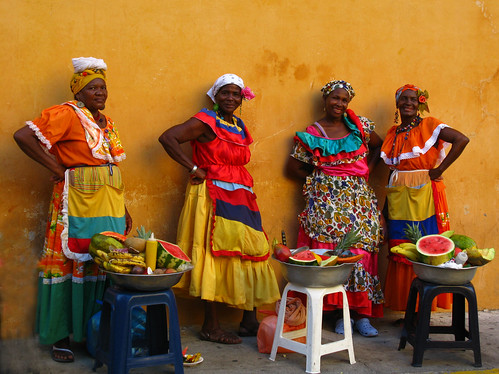
Colombia, the only risk is wanting to stay
South America

In the South American countries where we have worked (Colombia, Argentina, and a little work in Chile), there is a great respect for Knowledge, and for the company experts. The knowledge held by these experts can be used as a real resource, and the role of the expert can be subtly altered so that they become the custodians of corporate knowledge, rather than the providers of personal knowledge. People who are not experts need to be reassured that their knowledge is also of value to the community, so that the knowledge base is not entirely expert-dominated. Community dynamics may need to be carefully managed so that the experts do not dominate, as there can be a reluctance to challenge the expert. The issues of knowledge sharing up and down the hierarchy can be addressed using techniques such as those described here by Nancy Dixon.

Monday, 21 March 2011


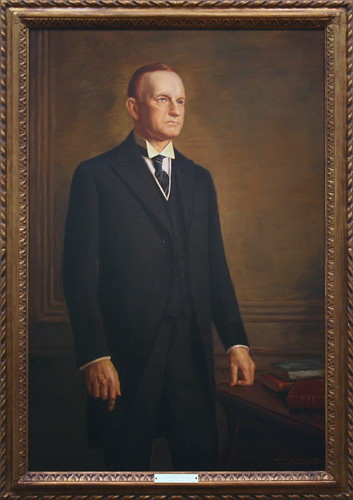
Listened out of a job (quote)


Calvin Coolidge, Thirtieth President (1923-1929)
No man ever listened himself out of a job.

- Calvin Coolidge


KM and national culture 2 - Australia, Africa

Continuing the series of blog posts on KM and national culture


self portrait 6Australia
The Australians are very open to knowledge sharing, and to learning lessons from past performance; good or bad. They have a very open culture and are happy to challenge authority and orthodoxy. The tendency to avoid appearing to ‘show off’ may make an Australian unwilling to volunteer a success or an innovation, and your Knowledge Management program should ensure that learnings from success and innovation are actively and proactively sought (eg through AARs) rather than waiting for them to be volunteered. The storytelling tradition is strong in Australia, and storytelling will be a key component in any effective Australian KM system. Communities of practice based on sharing stories will thrive, perhaps more effectively than more formal programs.


South African SmilesSouth Africa
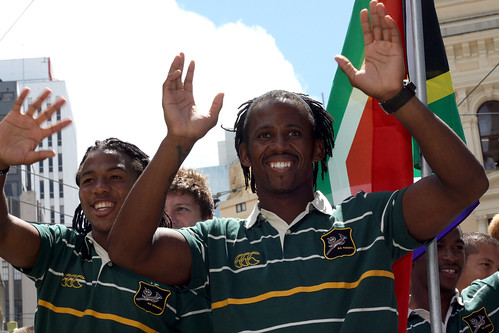
Africa is a continent of very many cultures. In many African countries, the culture of oral story-telling is very ancient, and can easily be used in support of KM. South African society is an interesting mixture of ubuntu (which values the collective whole ‘I am because we are’) with a strongly competitive spirit, which all rugby fans will recognise. Together these attributes create an interesting environment in which KM should flourish, provided that competition is turned externally. Internal competition can too easily thrive in tough Afrikaaner organisations, which will very effectively derail Knowledge Management, and this needs to be treated with great care. The political drive for employment equity introduces a real need for knowledge management, with knowledge needing to be passed to previously politically disadvantaged groups, on a large scale.

Saturday, 19 March 2011


Oscar on truth


truth
The truth is rarely pure and never simple.


- Oscar Wilde

Friday, 18 March 2011


KM and national culture 1 - UK and Thailand/Malaysia


I want to run a mini-series of blog posts on KM and national culture, based on some of the places we have worked. Obviously these are stereotyped, but are based on real experience. Your comments welcome! More national KM cultures to follow over the next few days.


Double decker bus in London
The United Kingdom

Northern Europeans are very open to knowledge management, and the UK is no exception. The British are very willing to learn from experience, but somehow more willing to analyse failures than successes. There is a British unwillingness to “show off”, and a national tendency to explore things that have gone wrong.

Knowledge Management and learning from experience will, if you are not careful, tend to focus on problems and challenges, and the knowledge manager will need to work quite hard at times to get people to recognise success, and learn from it.

However the northern European fondness for process is a good supporter of the Lessons Learned process, and other project-based KM activities. Communities of practice work well in the Bristish culture as a mechanism for problem-solving, as people are very open to asking other for help, and open to sharing their problems and challenges. The “not invented here” syndrome can be strong, and the knowledge manager needs to be very aware of this, and how it may be addressed.


Work
The Far East - Thailand and Malaysia

The Far East is a big place, with multiple cultures. The following analysis is based on our experiences in Thailand, Indonesia and Malaysia, and will not necessarily be true for Japan, China, Singapore, Hong Kong and elsewhere.

The far eastern companies that we have worked with have been very much oral culture, and knowledge is most easily transferred through face-to face conversation, often between peers. Online communities are frequently less successful here than in the US, for example.

Care must be taken that experts do not dominate the conversations, because of the healthy respect for expertise seen in SE Asia. There is a risk that people will not speak up in the presence of authority, making it difficult to identify knowledge that challenges the status quo. Standard western tools like the After Action Review may need to be readjusted for Asia audiences (as for example in the Singapore Army version).

Peer Assists and peer-level Knowledge Exchanges are likely to be a very effective KM intervention, if well facilitated. Corporate recognition is a good incentive in these cultures, with events such as “Best Practice awards” being very effective motivators, and these can be used as early ways to start to introduce a knowledge sharing culture, which later will move to face-to-face communities, to Peer Assist, and to lessons-learned systems.

Thursday, 17 March 2011


KMUK


The details on KMUK have now been published

This is a Twitter friendly conference, the hash tag for the event is #kmuk11 and you can follow it on @ArkKMUK


KM and innovation


Innovation
Again, another lively discussion, this time in Houston Texas. What’s the link between Innovation and KM? Are they opposites? Are they the same? Are they two sides of the same coin? Here are some thoughts from the discussion.
  • Knowledge management takes over from Innovation at the point where an idea becomes knowledge, and that point is where you first test the idea, and first gain experience.
  • Innovation takes over from knowledge management when there is no knowledge to fit your business need, and you need new ideas. New ideas can often spring from old knowledge combined in new ways.
  • Proactive innovation beats reactive innovation. Systems where employees volunteer innovative ideas are nowhere near as powerful as systems where planned conversations are held around work process. The Technical Limit process, for example, where work crews are led through a structured discussion seeking new approaches, often leads to step changes in performance.
  • Networked innovation is a favoured model. Bringing together a series of fresh minds can lead to breakthrough solutions. The more diverse the network, the more radical the innovations can be, and we have experienced this ourselves at innovation-focused peer assists. Networked innovation forms the core of our Business driven Action Learning approach.
  • Both Innovation and KM need to sit within a single strategic umbrella, focused on organisational competence. This could be an Organizational Learning Strategy or a Knowledge Strategy, for example. This strategy would map out the competence of the organisation, both current and desired, and map out its knowledge, both existing and missing. Missing knowledge, if it exists, can be learned or bought in.
  • Innovation and KM are both driven by challenge. If people are not challenged, they will do what they have always done, using the knowledge they already have. The best way to get someone to actively seek for knowledge (either through innovation or re-use) is to give them a challenge they don’t know how to solve. We saw this when studying innovation in the Innovene (Chemicals) process, where innovation was driven by the sales force making promises that were beyond current technology. Ford drove incremental innovation by continually decreasing operating budgets. BP drives innovation by promising a continuous improvement in operating efficiency.
  • Innovation and KM only come into conflict when used inappropriately. Re-use of old Knowledge is inappropriate, if the old knowledge can’t do the job. Innovation is a waste of time if sufficient knowledge already exists. Why reinvent the wheel? Perhaps the greatest waste of all is when great ideas are lost because organisations fail to manage their knowledge holistically. Knoco's Ian Corbett remembers a classic example that demonstrates why it is important:
“The importance of managing knowledge was highlighted during the 1990s in De Beers. Ilana Myburgh, a young metallurgist, was given a project. Ilana found the solution in an visionary internal report written in 1971 - an idea that appeared before it’s time. The innovative solution radically improved diamond recoveries and cut costs - the new technology was rapidly deployed across the group".

Wednesday, 16 March 2011


Four archetypes in KM


In this recent post I talked about four roles that a KM team can play - the publishing house, the library, the tour promoter and the help desk; all related to the four components of this KM Boston Square (explicit
push, explicit pull, tacit push, tacit pull).

Let's look at the four archetypes that play those four roles.


Mini J Jonah JamesonMeet Eddie the Editor.

Eddie works to the Publishing House model, concerned with explicit push. To Eddie, success is a knowledge base full of material. He is happiest when people are producing content, and his biggest worry is an empty Intranet. He lies awake at night thinking "How can I incentivise people to contribute to the wiki, the knowledge base, the best practice library". Eddie has a Knowledge Management Cycle on his wall, and the first step on the cycle is "Capture". If only people would capture more material, Eddie would be happy. But they don't, and he is a worried man.


librarian action figureMeet Connie the Librarian.

Connie works in the "explicit pull" sector of the Boston Square. She believes that the knowledge is in there, in the system, and what we need to be able to do, is find it more easily. Connie is investigating better search engines, and has a massive internal debate going on at the moment over taxonomies and ontologies. "Which would be best for my readers" she sighs, as she sips her latte. "If only they would tag better, then we could develop emergent folksonomies". Connie's wallchart is a high level taxonomy that she would dearly love to apply to the company SharePoint, which she knows at the moment is a complete mess, and people are unable to find what they need. Connie is an organised soul, and this mess is something she finds hard to bear.


Storyteller in the Mediterranean Biome. Fantastic! #EdenProjectMeet Gabby the Story Circle Man.

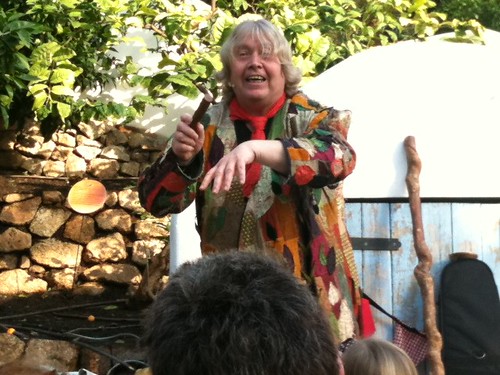
Gabby loves mess, and loves telling stories (tacit push). Gabby is never happier than sat in a pub somewhere, hosting a company storytelling circle. Gabby believes in the healing power of stories, and in the power of stories to change cultures as well as to carry knowledge. "If only we were better at conversation in this organisation" he says (to anyone who will listen); "then our knowledge would flow without stopping". Gabby has an aboriginal painting on his wall, painted personally for him by a Storyteller. He lives in the "tacit push" sector, and  wishes everyone would share their story. However lots of people are too busy doing their job to listen to Gabby, and he does tend to talk rather a lot.


kiwanja_kenya_calling_16Meet Tweet the Connector.

Tweet is one of the world's natural networkers. She loves everyone, and everyone loves her, because she likes to help. If you have problem, go to Tweet, and although she won't know the answer, she will put you in touch with someone who does. She is a one-woman help desk - all questions find an answer through Tweet (tacit pull). Tweet lives on her smart phone, juggling twitter, yammer, Facebook and Linked-In. She wishes everyone would be always online, just like her. "If only we could give everyone a smartphone" she dreams; "we would be like one big connected happy family, sharing knowledge whenever asked". It puzzles her when people say they can't see the value in tweeting - to her it would be like not seeing the value in breathing.


There are other KM archetypes, but these are the four end-members of the Push/Pull, Tacit/Explicit breakdown.

Do you recognise yourself in any of these?

Tuesday, 15 March 2011


Questioning the question


Question EverythingSomeone said something very important at a meeting last week in Washington, that got me really thinking.

We were talking about knowledge transfer between two people, and the power of questions in eliciting knowledge. And she said "as a librarian, I have been taught, and made it a habit over many years, never to accept the first question".

She went on to explain that when someone came to her asking for reference on birds, for example, she always asked for clarification. Why do you want to know about birds? Are you a chicken owner, looking for advice on keeping chickens? Do you want to identify a bird on your garden? Are you writing a study paper on bird biology? The choice of books that she recommeded, depended completely on understanding what the person was looking for, and that was seldom apparent in the initial question.

The questioner needs knowledge in a particular context, and if you don't understand the context, you can't answer their question effectively.

Also sometimes the questioner doesn't know what they don't know, and you need some dialogue to help both of you clarify what is needed.

The lesson is clear - always question the question, so you both have a better idea of what knowledge to seek for or to share.

But how common is this as a habit? How often do even the experienced KM people question the question?

I had a quick look through some of the Linked-in question-led discussions in the Knowledge Management groups (KM Experts, CKO forum etc). In what percentage of these discussions do you think anyone questioned the question?

Well, out of the 30 discussions I checked, in 26 cases nobody questioned the question. They just dived in and assumed they knew what the questioner wanted.

In 3 cases, the first reply to the initial question was a return question for clarification. In one more case, the second reply was a question. That's 13% of the examples I looked at. In the remaining 87% nobody questioned the question.

I think this is a habit we are all going to have to learn, if we want effective knowledge transfer to be a more common ocurrence.

Monday, 14 March 2011


Quotes add richness to knowledge transfer


I have been experimenting with different ways of packaging captured lessons for a client, and the format he liked best was rich with quotes, in little text boxes.

You know why? Quotes are engaging. Just be aware, next time you read a newspaper, how the quotes in a story jump out at you.

Quotes give context, they give credibility, they give immediacy.

He also preferred the version where the quote came with a little thumbnail picture of the person who gave the quote. This made it more human, somehow.

The inference for the person facilitating the meeting and taking the notes, is therefore

1) You need to record verbatim quotes.
2) You need to record who said what
3) You need pictures of the people who were present

If you do this, then you can add the quotes and pictures that make your text come alive.

Friday, 11 March 2011


Customer focus in Knowledge Management


committed to excellence and customer satisfaction - 030620091716Every transfer of knowledge requires a supplier and a customer.

I am focusing on transfer now; not the creative act of innovation that comes from people combining their knowledge to make something new.

In knowledge transfer, there is someone who knows something (the supplier) who interacts with someone who needs knowledge (the customer), so that the customer can learn something new.

In any transactional organisation, you need to focus on the customer. The needs of the customer are paramount.

We all know about the importance of the customer - "the customer comes first" - "the customer is always right" - "committed to excellence and customer satisfaction".

But how customer-centric is your KM program?

By customer-centric, I mean the following

1. Driven by the knowledge needs of the customer - by Knowledge Pull (see here)
2. Transferring knowledge the way the customer needs it to be transferred (see here)
3. Transferring knowledge in a medium that works for the customer (see yesterday's post).

Too many KM programs focus on the supplier and neglect the customer, and struggle to make a difference as a result.

Don't be one of them!

Thursday, 10 March 2011


Can video make a difference in Knowledge Transfer?


video

According to a 2009 article in New Scientist magazine, Britain’s leading popular science weekly, it can make a huge difference.

New Scientist was reporting on a study in Benin, in the International Journal of Agricultural Sustainability. The study described how a team from the West Africa Rice Centre was attempting to transfer knowledge to women farmers in West Africa, on the topic of “how to parboil rice”.

They tried a variety of ways to transfer the knowledge, including workshop demonstrations, and video demonstrations. They found that firstly the video attracted more watchers than the conventional workshops (74% of women in the villages, as opposed to 22%), and secondly that the reuse of the knowledge by those who attended was much higher (72% as opposed to 19%).

The author of the study suggests a few reasons why the video was a more effective way of transferring knowledge than a workshop demonstration.

 The people telling the story in the video were women rice farmers from Africa, not western scientists. This delivered a level of trust in the knowledge, as it was being demonstrated by peers.

 The videos were designed with the user in mind, making the steps of the process obvious and also the principles behind the process.

 Local farmers were then able to adapt the process to their local conditions,

and to create local version of the equipment that worked for them.

This video has been a huge success, and the team are now translating it into other languages for use elsewhere in Africa

Wednesday, 9 March 2011


Four roles for the KM team


I presented this Boston Square in a recent blog post, to talk about the different polarised attitudes companies can take to knowledge transfer.

 This differentiation into different types of knowledge transfer carries over into the role that the KM support team can take, and suggests 4 potential endmember roles.

I ask all KM professionals reading this, to identify which role(s) they are currently focusing on, and which role(s) they are neglecting.

A KM team that focuses on Explicit Push, or Share, takes the role of a publishing house. They are forever seeking contributors and publishers, to make sure that the flow of explicit knowledge is pushed out to the organisation. If your biggest worry is how to incentivise explicit  content, you are taking this role.

A KM team that focuses on Explicit Pull, or Search/Find, is taking the role of a Library team. They are concerned with taxonomies, ontologies, findability, cross-linking, structures, and owners, to ensure that people can find what they need in the explicit knowledge base.

A KM team that focuses on Tacit Push is taking the role of an events promoter (think of a promoter of lecture tours or concerts).  They are concerned with getting the experts to tell what they know and tell their stories, and with arranging venues and events and spaces where people can hear the stories.

A KM team that focuses on Tacit Pull takes the role of a help center and contact broker. This is the role taken by the US Army Centre for Lessons Learned in the famous story. They are concerned with getting questions answered, and putting people in touch with others, and with documents, that can help.

Everyone will have their preferred role (and my preferred role is the last of the 4, because I think it is the most effective in the short term, is easiest to get off the ground, and changes the culture faster than any other approach), but the key for any KM program is that you need to fulfil all 4 roles.

You need to fufil all 4 roles, as different knowledge needs to be transferred in different ways, and to focus on only one quadrant of the diagram is to miss 75% of the possibilities KM can deliver.

So tell me, what role(s) are you taking, and what role(s) are you neglecting?

Tuesday, 8 March 2011


KM and fish


Fishes
Give a man a fish, feed him for a day

Teach him to fish, feed him for life

Help him set up a community of practice for fisherman, create a thriving industry that will feed a nation.


In other words

Helping someone is good
Teaching someone to help himself is better
Helping someone to teach himself and others is best

Monday, 7 March 2011


KM in the gulf states, new Knoco franchise


We are very pleased to welcome to the worldwide Knoco family, Dr. Abdulhameed Alhosani, the director of Knowledge Consultants; Knoco’s franchisee in the Gulf States (GCC countries). Abdulhameed has over 25 years of experience on various fields spanning from quality assurance to training programs and lately change management and knowledge management. He holds a PhD in chemistry from the University of Glasgow, has research experience and published scientific papers and authored two books.

Abdulhameed has also conducted numerous training workshops and has taught in universities and colleges as a visiting lecturer. His main interest now is helping organizations around the Gulf States to establish knowledge management programs and assist in spreading education on this vital field

Sunday, 6 March 2011


Knoco Spring 2011 newsletter


Our latest free newsletter, on the topic of Communities of Practice, can be found here


Ask Learn Share, KM video from Shell


SHELL ASK LEARN SHARE from studionx on Vimeo.


If the video doesnt work from within this blog post, follow the link above.

For more KM video, see here or here

Friday, 4 March 2011


Global interest levels in KM


This plot is one potential proxy measure of global interest levels in KM

It takes the number of visits to our website, http://www.knoco.com/, for each country over the past year, and divides this number by the country population. So although visits are dominated by the US in pure number terms, this plot takes account of the fact that the US is a very big place.

Denmark is highest, though this (and Hungary) may be an artefact of the recent franchise in these countries.

Second to Denmark is Australia. This doesnt really surprise me, as there is so much coming from Australia in terms of KM. Then the US, the Uk and so on.

For your interest only, but it would be good to compare data with others, so we could build up a wider more robust picture

Thursday, 3 March 2011


My three KM wishes


Flower fairy
If a kindly fairy offered me three wishes for Knowledge Management, here's what I would wish today (tomorrow I might wish for something different!)

1. I wish that Knowledge Management could start to be seen for the strategic business tool that it really is. This means that directors, CEOs and senior managers would realise that knowledge is their key competitive asset and their primary means of survival in this changing age, and that Knowledge Management is the way to draw competitive advantage from that asset.

2. I wish that we could come to a clear understanding, collectively, as an industry, of what Knowledge Management really is. This is a tough wish - the fairy might prefer to grant something simpler instead, but there is still massive confusion over KM/IM/content management/records management and so on. For me, its simple - if you focus information its information management, if you focus on content, its content management -  for knowledge management the focus needs to be on people, and what they know, and how they can access better knowledge to make better decisions. This confusion is so deep that the first thing I say to poeple, when they ask me about KM, is "what do you understand the term to mean".

3. Sticking with the people theme, I wish we could finally all agree that KM is not a technology solution, no matter how appealing the technology. In the 90s, we were promised that Intranets would deliver good knowledge management. Then that good search engines would deliver knowledge management. Then that SharePoint would deliver knowledge management. In each case the old promise failed, in each case the new technology said "this time it's different". Now, "web2.0 and social software will deliver knowledge management" - "this time it's different". This is a very pervasive mindset, and seduces many people; you see that at conferences, where people stand up and say "Knowledge Management, it's all about people and culture, and not about technology" and then spend 20 minutes showing screenshots of their wiki. Guys - thats the wrong emphasis.

Tomorrow I might want 3 more wishes, but that will do for today. What are your three wishes?

Wednesday, 2 March 2011


Lessons meetings - where do you stand? Or sit?


.Mac for the Enterprise
I got some interesting feedback last week at a lessons identification/capture meeting.

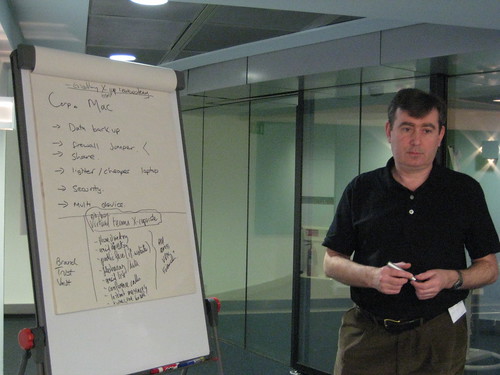
They said "it was great that, instead of standing up the front with a flipchart, you sat down at the table with us and took notes. It felt like a conversation, that you were part of".

I have been reflecting on this, and I am increasingly thinking that standing up the front with a flpchart is counterproductive.

When you are up front

  • you are the focus
  • it's about you
  • you are separate
  • people look at you
  • people listen to you
  • people read what you write
  • people analyse and judge what you write
When you are at the table with the team
  • the team is the focus
  • its about the team
  • you are part of the team*
  • people look at each other
  • people listen to each other
  • people don't read, analyse or judge, they converse
So if you find your knowledge capture meetings or lessons identification meetings are stilted, are not flowing, and are not producing the results you hoped for, then put down your marker**, and go sit at the table.

Join the team, and join the conversation.

* I use "we language" in the meeting - "So what have we learned"- "if we were going to do this again, what would we do" and so on.


** The other benefit is that you can take proper notes. Voluminous notes. Which you can't do on a flipchart. Which means that the stories, the context and the knowledge gets lost.

Tuesday, 1 March 2011


The curse of the little black book


books is power
Many operators and technicians carry a little black book.

This is where they keep their notes of how to do things - their checklists and workarounds and tips and hints. It's their means of personal knowledge management.

However the little black is both a risk to knowledge management, and a symptom of poor knowledge management.

The risk is that the knowledge in the little black book can be better (more accurate, more up to date, more useful) than the "company knowledge," wherever that is stored. And that means that the company knowledge is out of date.

The symptom would be that the knowledge in the little black book is worse (less accurate, less up to date, less useful) than the "company knowledge," wherever that is stored.  And that means that the operator or technician is not getting the access to the knowledge they need.

A well known  "little black book" story is the Xerox technicians case history, which I am sure most of you have heard at some time. The Xerox technicians all kept their own personal knowledge base; an annotated copy of the official manual, and each annotated version was different from all the other annotated versions. The manual itself, despite being seen by management, was woefully out of date, and the plethora of little black books was a symptom that KM was not happening in Xerox. The rest of the sotry is well known; the creation of Communities of Practice, the opening of communicaiton between the technicians around the globe, and the creation of the Eureka knowledge base; owned, maintained and kept live by the technocians themselves. Eureka became a shared "black book" - a Big Black Book that all the tecnicians used and trusted.

SO watch out for the little black books (or their equivalent) in your organisation. They are a symptom that KM is not working, a risk to effective operation, and also an opportunity, if you can help the operators and technicians to open their books so that the knowledge can be shared, and held in common.

Blog Archive