Wednesday, 30 June 2010


New KM educational/reference site


I don't think I have announced this here yet; we've just put together a reference site for Knowledge Management at the Knoco website. This site presents some of the basics around the KM processes, roles, technologies and governance, and contains the following sections;


We hope this is useful! Please let us know if we've missed anything important!!

Tuesday, 29 June 2010


Lessons Learned are like bridges burned


Lessons learned are like
Bridges burned
You only need to cross them but once.
Is the knowledge gained
Worth the price of the pain?

Lyrics, Dan Fogelberg


Fail better


fail better
Originally uploaded by Pretty/Ugly Design


What are the symptoms of KM failure?


Fail Road
Originally uploaded by fireflythegreat

I was prompted to write this post by various discussions about whether the Deepwater Horizon/MC252 well blowout represented a failure of KM at BP.

The more I think about this, the more I think it is important to identify what the symptoms are of failed knowledge management. We can't tell if knowledge management is failed in a specific situation, if we don't know what failure looks like.

Making a mistake, is not necessarily or failure of knowledge management. As I said in this post, anyone can make an honest mistake. Making mistakes is part of exploring, of innovating, and of pushing the boundaries. Nobody who ever made a breakthrough, never made a mistake. And I am not alone in this belief; no less a person than Albert Einstein said "Anyone who has never made a mistake has never tried anything new".

Making repeat mistakes is definitely a failure of knowledge management. In this case, the company should have had the knowledge to avoid the mistake a second time, and yet somehow they didn't act on it. You can see this in our failure story number two, where repeat mistakes in successive projects showed that the knowledge management system was broken somehow.

Losing capability is a very obvious symptom of failed knowledge management. This is where a company used to know how to do something, but lost that knowledge. Here is a very good example, where the loss of knowledge about making nuclear weapons cost £69 million to replace.
In safety management, they talk about "lost time incidents" (LTI), where through the failure of the safety mangement system, somebody sustains an injury which causes them to lose time at work, either through treatment or through convalescence. In knowledge management, we could talk about "lost knowledge incidents" (LKIs). This is where the knowledge is or was once available to the organisation, but failed to reach the person who needed to act upon it. Unfortunately a lost knowledge incident is far less visible than a lost time incident. An LTI is visible because a person is not available for work. An LKI is only visible when a mistake is repeated or a capability lost, as described above. Probably the majority of LKIs go undetected.

So how does an LKI happen?

  • It can happen when somebody has knowledge, but doesn't want to pass it on. This is a cultural failure.
  • It can happen when somebody has knowledge, but has no mechanism to pass it on. This is a failure of the KM framework (and by Knowledge Management framework, I mean the combination of people, process, technology and governance).
  • It can happen when somebody has knowledge and has passed it on, but that knowledge cannot be found. This is also a failure of the framework.
  • It can happen when somebody needs knowledge, and has the mechanism to find it, but doesn't know that they should look. This I would suggest is also a failure of the framework, because there should be processes for knowledge seeking built into activity.
  • It can happen when somebody needs knowledge, and has the mechanism to find it, but they don't want to look for it or don't want to consider it. This is a cultural failure, often known as "not invented here".


What if somebody needs knowledge, has the mechanism to find it, looks for it, finds it, considers it, and then decides that it's not applicable for their situation? I would say that this is not a failure of the knowledge management system, and there must be many many cases when this is the right thing to do. And in the cases where this is the wrong thing to do, it still isn't a knowledge management failure. It's a failure of priorities, or strategy. Knowledge management can only provide the knowledge to the person who needs it, at the time and place of need. It cannot force people to use it, because there may be many external reasons for not using it.

Whether any of these things happened on the MC252 well, we don't know yet. It's certainly not a single repeat mistake; there's been nothing like this happen anywhere, ever before. As the investigation into the cause of the blow out continues and concludes, we can see whether there was an unprecedented combination of repeat mistakes which should have been avoided, or whether the knowledge to avoid this was available to BP, Transocean or Halliburton. Only then will we know if this is a knowledge management failure.

The greatest failure of knowledge management will be if this ever happens again.

Monday, 28 June 2010


Free lessons report, suitable for PRINCE2 projects, available now


A free Lessons Report template, suitable for PRINCE2 projects, is new available via the Knoco downloads page

This report template focuses on the content of the lessons to a greater degree than other available templates, and is based on lessons formats from successful learning and Knowledge management organisations.

We hope you find this useful


Don't steal with pride - don't steal knowledge.


You often come across the phrase "Steal with Pride" in a Knowledge Management context. Try googling it and you will see what I mean.

Personally, I don't like the phrase, because there IS such a thing as knowledge theft, and it's a KM crime.

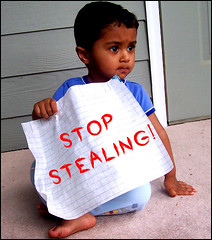
Knowledge theft is when someone else's takes your material, or your idea, or your knowledge, or your practice, and passes it off as their own. People hate that - they hate seeing their knowledge or their material being used and someone else getting all the credit (for example, follow the link under the picture to the right - reproduced with acknowledgement).

As Terry Pratchett says in "Unseen Academicals", its a short step from Adopt, Adapt, Improve to Steal, Use, and Look Innocent.

Knowledge sharing and reuse is great, provided due credit and acknowledgement is given. This is not theft, this is intellectual recycling. In all the knowledge assets and knowledge bases and lessons learned systems I am involved with, we make sure that the name of the orginator stays with the knowledge, and that they get credit for sharing.

So ladies and gentlemen, please don't steal with pride. Please don't steal, in fact, and don't encourage knowledge theft either.

Reuse with pride; yes. Reuse with acknowledgment. But don't steal.

Sunday, 27 June 2010


Every experience is an opportunity for learning


“Every experience in life offers an opportunity for learning. The smartest people are those who can transform the smallest event or situation into breakthroughs in thinking and action.”
Gary Ryan Blair

Saturday, 26 June 2010


I am defeated if I cannot learn (quote)


Defeat II
Originally uploaded by cameronkiselphoto


I am defeated, and know it, if I meet any human being from whom I find myself unable to learn anything.

George Herbert Palmer

Friday, 25 June 2010


Did KM fail at BP?


Given the high profile environmental disaster in the Gulf Region, BPs role in that disaster, and BP's reputation for KM, there are a lot of people questioning what went wrong. Comments seem to be along the lines of

"If BP are so good at KM, how come the Deepwater Horizon exploded"?

These are my personal thoughts.

.................................................................

Knowledge Management does not make you invincible, not does good KM make you immune from disasters.

BP has very good KM systems (in my view as an external consultant, still doing work for BP). They were good in the 90s, and they are good now. BP is IMO not the leader in oil-sector KM (that prize would go to ConocoPhillips) but they are not far behind the leaders. Their standing in the global MAKE awards is valid.

We do not yet know what caused the Deepwater Horizon accident. We don't know whether it was caused by a failure to manage existing knowledge, or a lack of knowledge, or was nothing to do with KM at all. We don't know the relative roles played by BP, by Transocean and Halliburton. There's a lot of blamestorming going on, a lot of media and political hype, but we do not yet know the root causes behind the well kick, and the failure of the Blow-out presenter. So it is far too early to say that BP Knowledge Management failed.

As Tony Hayward himself said in his testimony to Congress, "this is a complex accident, caused by an unprecedented combination of failures. A number of companies are involved, including BP, and it is simply too early to understand the cause. There is still extensive work to do".

There seem to have been up to 7 potential contributory factors to the accident, listed by Hayward as follows

1. The cement that seals the reservoir from the well;
2. The casing system, which seals the well bore;
3. The pressure tests to confirm the well is sealed;
4. The execution of procedures to detect and control hydrocarbons in the
well, including the use of the blowout preventer (BOP) and the maintenance of that BOP;
5. The BOP Emergency Disconnect System, which can be activated by pushing a button at multiple locations on the rig;
6. The automatic closure of the BOP after its connection is lost with the rig; and;
7. Features in the BOP to allow ROVs to close the BOP and thereby seal the well at the seabed after a blowout.

4,5,6 and 7 all represent the Failure of the Failsafe - the failure of the BOP, which was supposed to be failure-proof. At first sight, this looks like a Black Swan - an event that is outside current experience. Knowledge Management cannot deal with Black Swans.

I know Hayward has become a media target, but one of the more positive things you can see in his testimony is his commitment to Lessons Learned arising from this disaster.

Ultimately we are going to have to wait and find out what went wrong, before we know whether Knowledge Management failed for BP during the drilling of the MC252 well with the Deepwater Horizon. A goal for Knowledge Management will be to make sure that watever it was, it never ever happens again, to anyone, anywhere, and I am pleased to see in Haywards transcript that this is also BPs goal.


You wont use it if you can't find it - findability in KM


About a year ago, I took over the role of treasurer for my little local church. This is a tiny church, dating back to the 1100s, but still active and still requiring funding, so when the current treasurer moved away, someone had to take over. He gave me a good handover, but this is a new job for me and I have had a number of headaches already, where i have been scratching my head wondering how to do some arcane component of the role.

This week, I have been working with the diocesan offices, helping them with plans to set up some Communities of Practice, and we were discussing the role of the treasurer. My contact mentioned that there is a Treasurer's handbook on the diocesan website.

Well, this was news to me. I wish I had known about this before - it could have been very useful. I went to the website, browsed around, searched under "Treasurer", and still couldn't find the handbook (I have since been told where it is, and it's a gold-mine of information).

I wonder how often this happens? Someone creates a great knowledge resource, but others don't know about it, and even if they do suspect it's there, they can't find it.

That's where we, as KM professionals, need to consider two things


* KNOWLEDGE AWARENESS

Somehow we need to be able to alert people that knowledge resources exist. We need something or someone who says "there are experts in this field, and there are resources available to you. You do not need to make this up for yourself. There is knowledge out there, which you can acquire". In your organisation, you need to bring this awareness in during induction, and you need to point people to the key tools - the search engine, the community index, the yellow pages. I wish someone had done this for me when I inducted as a treasurer.

* FINDABILITY

We need to ensure that knowledge resources are findable. As Peter Morville, the author of Ambient Findability says

Findability precedes usability
in the Alphabet and on the Web
You can't use what you can't find.


Your knowledge assets MUST be findable. They must be ambiently findable (which means that by their very nature, they pop up when you start looking). As knowledge managers, sometimes we spend far too much time creating usable knowledge assets, without thinking about creating findable knowledge assets (actually, we often spend too much time on capture, and ignore both usability and findability). I wish the Diocese had made their resources more findable.

In conclusion, I would like to add to Peter Morville's three-line poem.

Awareness preceds findability which precedes usability
in the Alphabet and on the Web.
You can't use what you can't find,
and you won't find what you don't look for.

Thursday, 24 June 2010

Wednesday, 23 June 2010


KM in irregular activity - an example


There are plenty of regular, sometimes daily, activities in the oil sector where knowledge can be reused for process improvement, such as drilling or construction. These are activities that go on all the time.

There is also irregular activity; activity that occurs in bursts, and then there is a long gap until the next burst. It is activity such as this where KM delivers perhaps the greatest value for both process improvement and strategic advantage, as you cannot rely on the human memory to remember the details of the previous burst of activity, which may have been 3 or 4 years before. (These are the cases which Nancy Dixon refers to as "Far Transfer"). On example of irregular activity might include mergers and acquisitions. Another is licensing rounds.

Most countries divide their territory (onshore and offshore) into licence areas or licence blocks, and periodically issue licences for companies to explore these areas. The licences are issued via licensing rounds, and blocks are awarded on the basis of the work programme bid by the participants. Non-active licences have to be relinquished and are rebid. Because licence rounds are highly competitive, and because they are the only way for the companies to access new reserves, then it is highly important in strategic terms to prepare good and competitve bids, without overbidding on acreage that later turns out to contain nothing. Bidding in licence rounds therefore requires huge application of knowledge and judgment.

When I was working as Knowledge Manager in BP Norway in the mid 90s, we had a highly successful 14th Norwegian round, including the award of a share in the "Golden Block", which turned out to contain the Kvitebjorn field. After the round was over, we conducted several retrospects with the core team and subteams to identify and record the knowledge of why things had gone so well. As a result, we put together a guidance document of tips and hints and successful practices, which was our "codified knowledge" of executing licence rounds successfully. Shortly afterwards, BP Australia got in touch with us, as they were about to go through their own licence round. Norway sent them the guy who had been the bid document coordinator for the Norwegian round, plus a copy of the good practice report, so they could "Learn Before" and reapply the knowledge in their own context.

Tuesday, 22 June 2010


Who guards the memory?


Core Memory
Originally uploaded by jurvetson

In this post I made the case that organisational structures, operating procedures and processes form a core component of organisational memory.

Processes and procedures are built up over time, and they represent the company view of “how we do things”. Employees follow the processes, and repeat “how things are done”. The processes hold and propagate the patterns for behaviour, and for the way work is conducted. If the organisation is to learn, these processes must evolve over time.

Another key element here is that they must be owned. Someone or some group must be the custodian or custodians of the processes. We need clear process ownership.

Process ownership is a key component of many management approaches such as Business Process Improvement, Six Sigma, and Lean Manufacturing, and there are many definitions available in the literature. The definition below is a simplified version

A process owner can be defined as the person accountable for maintaining the definition, and the quality of a particular process. They don’t have to operate the process themselves, but they need to make sure that the people who do operate the process have access to the documentation they need to operate the process in the (currently identified) best possible way.

In KM terms, some of the specific responsibilities of the process owner are as follows-

• Monitoring the development of knowledge within their specific area of expertise
• Ensuring that new lessons are collected and shared from significant pieces of work,
• Promoting peer assists and personal connections between the projects to share tacit knowledge of the process,
• Developing and publicising process guidance documents relating to their specific process
• Developing, and agreeing with management, corporate standards for their specific process
• Updating guidance documents, Best Practices and standards for the process as required
• Ensuring that guidance documentation is made available to all users
• Publicising and rolling out new lessons, and updated process documentation
• Monitoring use of any relevant documentation, and acting on feedback to improve this.
• Liaising with the leader or coordinator of any community of practice which covers the process
• Monitoring the organizational performance in the application of the process

This is a role that can be done by Community coordinators, by Subject Matter Experts, or by Technical Authorities, depending on the maturity of the knowledge in question.

With no process owner, the processes fall out of date, and no longer become a reliable memory store. You end up with a sort of Corporate Alzheimers, where big holes develop in the long term memory of the company. We can't afford that to happen.

Make sure your core processes are owned, so that the corporate memory is guarded and continually refreshed.

Monday, 21 June 2010


Lessons Learned video


Here's a better quality version of my previous video about Lessons learned

More Knowledge Management video here.

Sunday, 20 June 2010


Bertrand Russell quote


eccentric concentric
Originally uploaded by istolethetv
Do not fear to be eccentric in opinion, for every opinion now accepted was once eccentric.
- Bertrand Russell

Saturday, 19 June 2010


Cosby quote


Bill Cosby
Originally uploaded by fuzzcat
"a word to the wise ain't necessary, it's the stupid ones that need the advice." bill cosby

Thursday, 17 June 2010


Incentivising Community contribution


Hey - look what I won!
Originally uploaded by foxypar4

I blogged recently about the difficult of incentives within Knowledge Management, and how most incentives can be "gamed" by astute people. However, in the context of Communities of Practice, there do seem to be some incetivization methods or principles that are generally robust. These principles are listed below.

Incentivise people on quality, not quantity. Don't give people awards for being the most prolific contributor, but for being the most valuable contributor. Shell publish the criteria for their community awards, including quality, quantity and commitment.

The incentive should not be monetary. Give a certificate, or a quality give-away. Syngenta, for example, give a crystal cube with a tree embedded in it - very nice, very good quality, and prized by the people who receive it.

The award should be given "by the community". When Shell introduced “entry of the month” and “top 3 contributors” awards (non monetary, of course), the candidates for the award were nominated by a retired expert, and the winners were picked by the community facilitators.

Link it to personal assessment. These awards need to be communicated to the relevant line managers, so they can take this into account during annual assessments. It's not a KPI; its something that is taken into account. So community contribution is seen as part of "doing a good job".

Wednesday, 16 June 2010


Outlawing Not Invented Here


"Not invented here" is one of the most difficult barriers to overcome in knowledge management. Basically "not invented here" is a symptom of an unwillingness to learn, and there is absolutely no point in creating the best knowledge sharing system if your organization has a learning problem.

Now there are various ways of discouraging "not invented here", or subtly encouraging the reuse of knowledge, but if you are looking for a lasting and sustained culture change, then ultimately "not invented here" has to be outlawed.

It has to become unacceptable behaviour.

It has to become as unacceptable as risky behaviour in a safety-conscious organisation, or is unacceptable as discriminatory behaviour in a diversity-focused organisation.

One way to address this, is to refuse to sanction any project or investment which has been "only invented here." As an example, BP Exploration would not sanction any project if it had not held a Peer Assist to bring in knowledge from other parts of the organisation. They are now taking this further, by verifying that the knowledge shared at the peer assist is been acted upon.

Another leader refused to accept "only invented here", by introducing what he calls "no single source solutions". It is a stated point of principle within his part of the organisation to have no single source solutions, solutions which have been worked up by one person with no input from other parts of the business. Single-source solutions represent "only invented here", and by refusing to accept these, he gives the message that solutions have to be based on multiple input and external knowledge. "There were no single source solutions. We did not allow that" he reports.

These are two examples where "not invented here" is a recipe for failure within your own organisation; failing to acquire funding, and looking stupid in front of the manager.

Two examples where "not invented here" has been outlawed.

Friday, 11 June 2010


The purpose of learning is growth (quote)


The purpose of learning is growth, and our minds, unlike our bodies, can continue growing as we continue to live. Mortimer Adler


Playing games with KM incentives


chess
Originally uploaded by gabork

Incentivising KM is a tricky thing. It is very tempting to define the behaviour you would like to see, and give people incentives to demonstrate that behaviour. But however you set up incentives, someone will find a way round them.

Take the company who set each business unit a target number of Best Practices to be submitted every year, in an attempt to overcome intra-company rivalry. And saw a burst of Best Practices, most of them very poor, submitted immediately before the annual deadline (the business units having held them back for the previous months, in case they give away any internal competitive advantage).

Or the company that decided to give a monetary award to the person who's contributions to a knowledge base were most highly rated, which sparked various lobbying campaigns as people mobilised their friends to "vote for them".

Or the company that decided to give a substantial monetary award to anyone who's "best practice" was re-used by another business unit, which prompted a number of cases where the supplier of the best practice colluded with someone who would claim to have reused it, and would subsequently split the award between the two of them.

There are ways to play games with most incentive schemes, and even the egalitarian ones such as Siemens' "ShareMiles" scheme have their drawback, as Siemens found when they withdrew the incentives when they thought the sharing habit had been embedded, only to find that sharing instantly fell away. In a future post I will explain one or two of the schemes that really do work, but most of the others can be "gamed" by intelligent players.

Wednesday, 9 June 2010


The problem with the Viral model for KM


I had a nasty virus a couple of weeks ago. I caught it from my wife, who had brought it back from New York. For about a week I hd no voice, and was awake all night coughing. But with the help of Lemsip and Strepsils, I fought it off after a while, and am now back to normal.

The problem with the viral introduction of knowledge management, is that most organisations have very good immune systems. They are very good at overcoming and rejecting new ideas, and generally fight them off after a while. As a body overcomes and destroys an infection, so the habits, routines, dogmas, and "not invented here"s can overcome and destroy even the best innovation. This explains why so many KM initiatives start well, flare up like a fever, then 6 months later have disappeared completely, and the company is "back to normal". (see also Victor Newman's post about Sticky organisations where by Sticky he means Resistant to change.)

We need a way of reducing the barriers, of reducing the rejection rate, of making KM more like a transplant to be incorporated, than an infection to be fought. That's where management need to be involved. They need to welcome the initiative, and to dampen down the resistance. The immune system needs to be suppressed long enough for KM to become embedded into the fabric of an organisation like a transplant is assimilated into the body.

Think Transplant, not Virus.

Tuesday, 8 June 2010


Knowledge Management in mergers and acquisitions


Knowledge management delivers maximum value when applied to high value knowledge, to support high value decisions, and in areas where that knowledge is otherwise at risk of being lost. A typical high value area is Mergers and Acquisitions. These are high cost, complex operations, where crucial decisions need to be made very well, and yet happen relatively rarely, so it is easy for tacit knowledge to be lost. People caught up in the high pressure activity can easily forget the detail of how the decisions were made, and fail to pass the knowledge on to future mergers and acquisitions teams. This combination of high value decisions made relatively infrequently, so that human memory alone cannot be relied on as a knowledge store, means that there is great value on documenting the learning for use in future mergers, acquisitions and divestments

The approach to KM for Mergers, Acquisitions and Divestments would be as follows;

Learning Before. Through Peer assists, the M&A team would seek to acquire lessons, guidance, success factors and pitfalls from previous Mergers, Acquisitions and Divestments.

Learning During. If possible, and for high value Mergers, Acquisitions and Divestments only,a Learning Historian would be seconded to the M&A team to capture lessons, practices and key documents as the exercise progressed, perhaps through a series of After Action reviews.

Learning After. Interviews and Retrospects of the key players would be held to determine the success factors to repeat, and the pitfalls to avoid. The focus will be on capturing tacit knowledge and experience; the 'golden rules', 'top tips', recommendations and advice that will allow success to be repeated routinely. This might include interviewing any external consultants who had been an integral part of the team.

Knowledge Asset. Output from the interviews and the Retrospect will be packaged into a knowledge asset; a web-based package or secure wiki that provides helpful accessible advice for future re-use. This advice will be at varying levels of detail; from the managerial overview of the "top 10" bullet points, down to operational advice.

Case History

The learning approach outlined above was applied by Company A to their merger with Company B, and again with Company C two years later. In the latter case, 14 of the core acquisition team were interviewed, and lessons were derived on leadership, the team and team processes, the role of the investment bank, the transaction process, communication, and staff issues. One year after acquisition, 31 staff were interviewed to gather lessons on the Integration process. Interviewees included the Chief Counsel, one of the Country unit Presidents, and several other very senior staff. Learnings were captured on topics such as managing the Integration project, dealing with delay, and getting ready for Day 1 of the integrated company.
Lessons from the first merger were used to guide the process for for the second, and lessons from the second acquisition and integration were used to guide the process for several further acquisitions. The value of the knowledge management approach was seen in the reduced involvement of external consultants in successive mergers. Initially the bill to Big 5 consultants had been very high, but this reduced from one acquisition to the next as Company A internalized the knowledge.

Monday, 7 June 2010


Learning with Impact


One of my neighbours has a really interesting job. He lost an arm as a young man in a motorcycle accident, and now often does work for Amputees in Action, adding realism to training simulations for the Army, Police and Fire Service. Here is a story about the value he adds.

Imagine a group of soldiers on exercises, on Salisbury plain. They come across a downed helicopter, on fire. Inside they find my neighbour, apparently seriously injured, with a very realistic fake arm lying semi-detached on the floor, and fake blood pumping from a concealed tube. It looks extremely realistic, and my neighbour is a great actor, with a fine line in "resisting aid"! Sometimes the soldiers turn green, sometimes they grit their teeth and carry on, but it gives them a taste of what they may need to deal with in action.

He has also got a wicked streak. Recently he was playing the role of an injured insurgent, fake blood, detached limb and all. The soldiers did a really good job of patching him up and loading him into a helicopter for evacuation. Except one of the soldiers made the mistake of leaning a rifle against the wall of the helicopter cabin. So, still in his insurgent role, he grabbed the rifle and took over the helicopter, causing complete consternation. That soldier will never, ever, make that mistake again! That lesson has been well and truly learned, and maybe one day it will save someone's life..

Why try so hard to make the training realistic? Because that's the best way to learn. We learn by doing, and if we can "do in advance", then so much the better. And its those emotional shocks that can really cement the learning.

So when we are trying to transfer knowledge and learning to an audience, can we turn it into an experience? Not necessarily with fake blood, but something better than PowerPoint? Something they will remember? Something with impact?

(For a YouTube video of Amputees in Action, see here, but be warned, it contains realistic-looking footage)

Sunday, 6 June 2010


Disraeli on Knowledge management


"The more extensive a man's knowledge of what has been done, the greater will be his power of knowing what to do." Benjamin Disraeli

Saturday, 5 June 2010


KM at the Olympic games


Did you know that KM has gone Olympic? This article from the vancouver post describes the KM program undertaken by the International Olympic Committee. I quote


In the summer of 2006, chief executive Cesare Vaciago (Turin Olympic committee) and a number of his staff came to Vancouver to deliver their views on what they did right and wrong at the 2006 Olympic Games. The debriefing was part of the IOC's relatively new program to transfer knowledge to future Games organizers from those who have been through the process. Now it's Vancouver's turn to pass on advice on best practices ... and what not to do.

The debriefing program was created in response to Olympic organizers making costly and repetitive mistakes. Each country, wanting to put its own nationalistic stamp on the Games, often repeated decisions that didn't work at previous Games, only to discover they worked just as poorly for them. The IOC wanted to put an end to "white elephant" venues, of wasting money on extravagant and unnecessary programs and of leaving taxpayers fatigued with debt.


Their approach?

They created an internal website accessible to all future Games organizers and bidders, and required that an official debriefing follow every Olympics.


A good mix of process and technology (and roles as well). And some of the lessons learned?


Ticketing and volunteers were two bright spots; Vanoc tried to eliminate the empty-seat syndrome that plagued the Turin Games. Vaciago four years ago also told Vanoc that the Italians had too many untrained volunteers doing menial
tasks. Vanoc clamped down on scalpers and created a resale site for its
customers. And it created a volunteer program, populated by Furlong's 25,000 "Blue Jackets" who were widely credited with creating a festive and relaxed atmosphere.

Ticketing and volunteers are also two problems facing Sochi. The culture of volunteerism is almost non-existent in Russia, and the lure of vast profits from reselling domestic tickets will be an intoxicant for Russians, whose average monthly wage is about $650.

And this is what the IOC chairman says about it all.


"Such transfers of knowledge are of paramount importance ... Sochi and Rio already know that they do not have to reinvent the wheel each step of the way, and the dialogue with Vancouver and the IOC will go a long way to engage and inspire them," he said. "At a time when the world is struggling to come out of recession, staging the biggest sporting event in the world can sometimes feel daunting. This is natural. To be supplied with firsthand knowledge from those who have been there before them, however, allows future host cities to make their own projects as economically efficient and effective as possible and to gain a great deal of perspective."

Brilliant. KM as it should be!


Plenty of KM bottle, not enough suck


Remember how I talked about Push and Pull in KM, how seeking is a better initial strategy than sharing, and how supply has to be met with demand?

I heard a great quote recently from someone in a company who is struggling with Pull - who has an abundance of knowledge and experience, but can't get people interested in learning. He said

"You can put the bottle in the baby's mouth, but the baby has to want to suck".

That's the trouble with many KM initiatives - too much bottle, not enough suck. Too much push, not enough pull. Too much supply, not enough demand.

Friday, 4 June 2010


The Knowledge Gratuity Index


I've come up with an index for the gratuitous use of the word knowledge, which you can use to analyse a definition or a document.

You count the number of times the words information, data, and knowledge are used, and exclude the title of the document, the name of the thing being described, or the word being defined. Then you look at the percentage of those words which are "information" or "data", as opposed to "knowledge".

Lets look at the definition I gave you in the Cats and Dogs post

"Knowledge management is a way of deliberate compilation, transfer, preservation and management of information within companies, in addition to systems designed to extract the most from that information. It refers specifically to utilities and methods made to preserve data and information held by individuals who make up the establishment. It is at once a software bazaar and a section of consultancy work related to fields such as competitive intelligence. A major point of knowledge management has to do with information that isn’t effortless to digitally codify, such as individual experiences.

So if we exclude the phrase being defined, we see four references to information, one to data, and none to knowledge. The gratuity index is 100% - all of the references are to data and information.

Or take a PowerPoint I read recently. The title of the Powerpoint was "knowledge and information management" and this title was repeated three times on three slides. "Information" was then mentioned 88 times in the PowerPoint, and "data" 60 times. Knowledge was not mentioned at all, except as part of the title. So the gratuity index is 100%, and the use of the word Knowledge in the title was 100% gratuitous.


Watch this video, and count the number of times they mention data, information and knowledge. I counted 5 references to "data", one to "information", and all references to "knowledge" were as part of the title. It's a great video and a fantastic piece of work - all credit to them - but why call it a knowledge base, if what it contains is information and data? It seems to me to be a 100% gratuitous use of the K-word.


see here to find out what is knowledge

Thursday, 3 June 2010


Share more and share faster - quote


"Every day that a better idea goes unused is a lost opportunity. We have to share more, and we have to share faster. I tell employees that sharing and using best practices is the single most important thing they can do".

Ken Derr, chairman and CEO, Chevron Corporation

Professor Wikipedia


Have you seen this video? Hilarious

Wednesday, 2 June 2010


Just Like Riding a Bike


There's another great article in this week's New Scientist, where Harry Collins talks about three types of Tacit Knowledge (where he describes Tacit as "knowledge that is not and sometimes cannot be made explicit").

He describes Somatic Tacit Knowledge, which is the knowledge stored in the muscles, nerve pathways and synaptic connections. This is describable - "in principle, if not in practice, science could describe all of this. We still wouldn't be able to use it to guide our actions, because we aren't built for that". in other words, you can read a book that gives you the basic tango steps, but you can't learn tango from a book.

He describes Relational Tacit Knowledge, which is about logistics and social interaction. Basically its the things you could explain, but don't, for one reason or another. It includes secrets, the things you don't know that you know, and the things you can't explain because you don't know what the other party needs to know.

Finally, there is collective tacit knowledge. This is about the way WE work. Its about knowledge held socially and collectively. He gives the example of riding a bike. The mechanics of riding a bike are all about somatic tacit knowledge, but the knowledge of riding a bike in London traffic are collective and tacit; you need to understand the unspoken social conventions, otherwise the taxis and buses will get you.

Blog Archive