Showing posts sorted by relevance for query synthesis. Sort by date Show all posts

Monday, 28 November 2016

Curation v Synthesis in Knowledge Management

There are two approaches to managing a body of knowledge within a community of practice - curation, and synthesis.


One of the functions of a community of practice is to provide a means for developing and co-owning a "body of knowledge" on behalf of the community (the other function is to provide a means for dialogue and discussion, particularly question-led discussion). Members of the community can offer pieces of knowledge, and the community as a whole (or the Subject Matter Experts within the community) builds this into a collected set of community knowledge. 

There are two ways to do this - through curation and through synthesis, and many of the most effective communities do both. 

Curation is the organisation of a set of artifacts or assets on behalf of the users. A Librarian curates a collection of books in a library, a museum archivist curates a collection of fossils, or paintings, or historical objects.  Similarly a community can curate a set of documents. 

Curation involves bringing together and organising documents

  • In one place (in “community space”) 
  • Tagged 
  • Prioritised 
  • Structured in a useful way (by practice or activity, not by document type, project, date, author etc)
  • Maintained, with obsolete material removed
We can see an example of curation with the NASA spaceport "body of knowledge" - a curation set of documents on spaceport operations.


Synthesis is the summarisation and documentation of knowledge, creating new content based on existing documents. So it is more than curating documents, it is combining, summarising, snynthesising them, removing duplication and contradiction,

Synthesis involves bringing together and summarising knowledge

  • In one document or group of documents
  • Organised 
  • Structured in a useful way 
  • Updated 
  • No duplication 
  • Validated by an expert or a community of practice.
We can see an example of Synthesis - a page from the Aviation Skybrary wiki which contains a synthesis of knowledge, followed by a list of source documents.  Wikis are often the preferred technology to support knowledge synthesis.


Why synthesise knowledge?


The benefit of synthesising knowledge is to make the knowledge far easier to consume and assimilate by the reader/user. Instead of having to wade through a curated list of source documents, resolving contradictions and removing duplications as they go, the work has already been done for the my the CoP or by SMEs within the community. There is an investment of work in creating the synthesis, but it saves every user from having to redo the synthesis themselves. 

Once the synthesised knowledge exists, then updating is is fairly simple. New knowledge, new CoP discussions, new lessons can all be added to the synthesised knowledge, for example as wiki edits. 

Many communities of practice combine synthesis and curation, with a wiki (containing synthesised knowledge) supported by a community library. 

Monday, 17 January 2022

The difference between curated knowledge and synthesised knowledge, and why this is important

There are two approaches to managing a body of knowledge within a community of practice - curation, and synthesis.


One of the functions of a community of practice is to provide a means for developing and co-owning a documented "body of knowledge" on behalf of the community (the other function is to provide a means for dialogue and discussion, particularly question-led discussion, which allows access to the undocumented body of knowledge). 

Members of the community can offer pieces of knowledge such as lessons experiences and good practices, and the community as a whole (or the Subject Matter Experts within the community) builds this into a collected set of community knowledge. 

There are two ways to do this - through curation and through synthesis, and many of the most effective communities do both. 

Curation is the organisation of a set of artefacts or assets on behalf of the users. A Librarian curates a collection of books in a library, a museum archivist curates a collection of fossils, or paintings, or historical objects.  Similarly a community can curate a set of documents. 

Curation involves bringing together and organising documents
  • In one place (a common folder or common register in “community space”) 
  • Tagged 
  • Prioritised 
  • Structured in a useful way (by practice or activity, not by document type, project, date, author etc)
  • Maintained, with obsolete material removed
As an example of curation, see the NASA spaceport "body of knowledge" - a curated set of documents on spaceport operations. For example, you can see all the documents related to SpacePort operations, such as all the annual reports from Cape Canaveral and New Mexico.


Synthesis is the summarisation and documentation of knowledge, creating new content based on existing documents. So it is more than curating documents, it is combining, summarising, snynthesising them, removing duplication and contradiction,

Synthesis involves bringing together and summarising knowledge

  • In one document or group of documents
  • Organised 
  • Structured in a useful way 
  • Updated 
  • No duplication 
  • Validated by an expert or a community of practice.
We can see an example of Synthesis - a page on Airspace Infringement from the Aviation Skybrary wiki which contains a synthesis of knowledge, followed by a list of source documents and further reading, and links to key tools such as the Airspace Infringement Prevention Toolkit.  Wikis are often the preferred technology to support knowledge synthesis.


Why synthesise knowledge?


The benefit of synthesising knowledge is to make the knowledge far easier to consume and assimilate by the reader/user. Instead of having to wade through a curated list of source documents, resolving contradictions and removing duplications as they go, the work has already been done on behalf of the user by the CoP or by SMEs within the community. There is an investment of work in creating the synthesis, but it saves every user from having to redo the synthesis themselves. So a Pilot or Air Controller can access best practice in Airspace Infringement Prevention directly from the synthesised source, while a SpacePort operator still needs to read though multiple annual reports looking for best practices to follow.

Once the synthesised knowledge exists, then updating is is fairly simple. New knowledge, new CoP discussions, new lessons can all be added to the synthesised knowledge, for example as wiki edits. 

Many communities of practice combine synthesis and curation, with a wiki (containing synthesised knowledge) supported by a community library. 

Monday, 20 May 2019

The Synthesis step in KM

Individual bits of learned knowledge need to be synthesised into a common understanding.


Synthesis [critical thinking skills] by Enokson, on Flickr
Knowledge is incremental - it arrives as discrete learnings from experience.

These increments of knowledge may be documented as lessons identified, best practices, blog posts, wiki pages and answers in forums, some of which contain knowledge which could be of value if re-used by staff. Or else the knowledge may remain undocumented, and be individual tacit learnings within a community of practice.

However keeping these increments of knowledge separate, as new ideas in individual heads, in individual documents or as individual lessons, leads to a whole series of inefficiencies:
  • Good practices may be documented many times 
  • Individual documents may contradict each other 
  • Individual people's experiences may be contradictory;
  • It is very difficult to find the knowledge you need among the many tens of thousands of documents, and hundreds of people;
  • Each individual user (and the ones who need the knowledge are often the more junior staff) is required to figure out their own answer, and make their own sense, from this mass of evidence. 
This is what Larry Prusak called "deknowledging through oversupply". To be really useful, this mass of raw knowledge needs to be synthesised into something useful and usable.

Knowledge Synthesis is the summary, collation, sense-making and integration of multiple sources of knowledge into a common view and (i many cases) a single set of guidance material, which people can use to help guide their business decisions and business activity.

Many or most of the best practice companies in Knowledge Management employ a step of Knowledge Synthesis within their Knowledge Management Framework. For example
  • Shell collate their Best Practices (“Practices Worth Replicating”), their lessons learned, and the results of discussions in Communities of Practice, into synthesised guidance within the Shell Wiki.
  • ConocoPhillips take the same approach with their Community Wiki sites.
  • Many organisations hold community discussions areound key topics, to develop a common understanding;
  • The US and UK Militaries collate all lessons and observations from the field into guidance documents on all military processes. These are called “Doctrine”, which represents synthesised knowledge on these processes. 
  • BP collates all its technical guidance into a set of Technical Practices and Guidance Documents
  • Samsung create Knowledge Assets - validated knowledge on value-adding Business processes, including practice guides, methodologies, business frameworks, examples, checklists, case studies, templates, architectures ;
  • Similar stores of validated, synthesised knowledge are provided by many other organisations such as the Pfizerpedia at Pfizer, the Capability Intranet at Rolls Royce, Knowledge Online at Fluor and the In-Touch system at Schlumberger.
Synthesis can be done collectively, through the use of self-organising systems like wikis, it can be done by experts working on behalf of communities of practice, or it can be done by task forces or working groups. Synthesis is not a one-off process - synthesis is the way that each increment of new knowledge is integrated into the body of existing knowledge. Synthesis requires time, resource, skill and training, but adds massive value to your Knowledge Management framework.

Knowledge synthesis will ensure that
  • The business staff know where to go to find most of the knowledge they need (though they will need to look more widely to find the most recent emergent knowledge which has not yet been synthesised)
  • They know that any documented knowledge they find within the synthesised collection will have been validated by a community of practitioners, that there will be no duplication, and that any contradictions will have already been resolved. 
  • They know that, apart from the most recent lessons, best practices and discussions, this knowledge will be up to date, and 
  • The knowledge will have been presented in the most useful and helpful way. 
When synthesis is working well, new knowledge is not buried within overloaded databases or online forums, but is proactively and systematically reviewed and integrated into the synthesised knowledge base.

The business result should be a faster learning organisation, with better decisions made on the basis of new knowledge, and an enhanced corporate memory through the rapid and frequent update and improvement of processes. This in turn leads to enhanced performance, with fewer repeat errors.

Friday, 2 May 2014


Synthesizing knowledge - a crucial KM step


Synthesis [critical thinking skills] by Enokson, on Flickr
Knowledge is incremental - it arrives as discrete learnings from experience.

These increments of knowledge may be documented as lessons identified, best practices, blog posts, wiki pages and answers in forums, some of which contain knowledge which could be of value if re-used by staff.

However the sheer volume of incoming material means that
  • Good practices may be documented many times 
  • Individual documents may contradict each other 
  • It is very difficult to find the knowledge you need among the many tens of thousands of documents, and 
  • Each individual user (and the ones who need the knowledge are often the more junior staff) is required to figure out their own answer, and make their own sense, from this mass of evidence. 
This is what Larry Prusak called "deknowledging through oversupply". To be really useful, this mass of raw knowledge needs to be synthesised into something useful and usable.

Knowledge Synthesis is the summary, collation, sense-making and integration of multiple sources of knowledge into a single set of guidance material, which people can use to help guide their business decisions and business activity.

Many or most of the best practice companies in Knowledge Management employ a step of Knowledge Synthesis within their Knowledge Management Framework. For example
  • Shell collate their Best Practices (“Practices Worth Replicating”), their lessons learned, and the results of discussions in Communities of Practice, into synthesised guidance within the Shell Wiki.
  • ConocoPhillips take the same approach with their Community Wiki sites.
  • The US and UK Militaries collate all lessons and observations from the field into guidance documents on all military processes. These are called “Doctrine”, which represents synthesised knowledge on these processes. 
  • BP collates all its technical guidance into a set of Technical Practices and Guidance Documents
  • Samsung create Knowledge Assets - validated knowledge on value-adding Business processes, including practice guides, methodologies, business frameworks, examples, checklists, case studies, templates, architectures ;
  • Similar stores of validated, synthesised knowledge are provided by many other organisations such as the Pfizerpedia at Pfizer, the Capability Intranet at Rolls Royce, Knowledge Online at Fluor and the In-Touch system at Schlumberger.
Synthesis can be done collectively, through the use of self-organising systems like wikis, it can be done by experts working on behalf of communities of practice, or it can be done by task forces or working groups. Synthesis is not a one-off process - synthesis is the way that each increment of new knowledge is integrated into the body of existing knowledge. Synthesis requires time, resource, skill and training, but adds massive value to your Knowledge Management framework.

Knowledge synthesis will ensure that
  • The business staff know where to go to find most of the knowledge they need (though they will need to look more widely to find the most recent emergent knowledge which has not yet been synthesised)
  • They know that the knowledge they find within the synthesised collection will have been validated by a community of practitioners, that there will be no duplication, and that any contradictions will have already been resolved. 
  • They know that, apart from the most recent lessons, best practices and discussions, this knowledge will be up to date, and 
  • The knowledge will have been presented in the most useful and helpful way. 
When synthesis is working well, new knowledge is not buried within overloaded databases or online forums, but is proactively and systematically reviewed and integrated into the synthesised knowledge base.

The business result should be a faster learning organisation, with better decisions made on the basis of new knowledge, and an enhanced corporate memory through the rapid and frequent update and improvement of processes. This in turn leads to enhanced performance, with fewer repeat errors.

Wednesday, 28 August 2019

Why "Knowledge Sharing" doesn't work as an alternative title for KM

Many people prefer to use the term "Knowledge Sharing" instead of "Knowledge Management". However as a synonym "Knowledge Sharing" is inadequate and misleading. 


Sharing is caring
I know lots of people prefer the term Knowledge Sharing, but sharing is only one element of KM. There are at least four other major elements of Knowledge Management in addition to sharing, and a focus only on sharing does not deliver the full potential of KM.

I think people prefer the team "knowledge sharing" for three reasons;

  1. Sharing is a softer word than management (it rhymes with Caring, after all), and people sometimes distrust the concept of management (unnecessarily, I believe) 
  2. Sharing is a concept that fits more neatly with social tools
  3. There is an oft-repeated opinion that because Knowledge is intangible, then it cannot be managed, and that the term "Knowledge Management is therefore an oxymoron.
I deal with the linguistic argument in my post  "why knowledge management is not an oxymoron"(there are plenty of management disciplines that cover intangibles, and if KM is an oxymoron, then so are risk management, safety management etc), and I defend the Management term here.

However even if the term "knowledge sharing" is easier on the ear, it still doesn't suffice. Knowledge sharing is only one component of KM, and there are at least four other main areas of Knowledge Management which need to be considered. These are as follows.

Knowledge Creation


Before Knowledge can be shared, it has to be created. Knowledge Management deals with the creation in three ways. The first is through Innovation. Process and roles for innovation need to be part of your Knowledge Management framework.

The second approach is team reflection. Processes such as After Action Review and Retrospect lead a team to reflect on performance, reflect on experience, and identify new knowledge. Processes such as these lead individuals to become conscious of their knowledge, and allow the team to collectively make sense of what has happened. These KM processes allow us to know what we know, and if we don't know what we know, we can't share it.

The third process is to use experts working with AI and/or with big data sets, to spot new correlations and to infer meaning and new knowledge from these.

If you focus only on Knowledge Sharing, you lose focus on Knowledge Creation.

Knowledge re-use


Knowledge doesn't add value until it leads to action. Therefore merely sharing knowledge is not enough - the knowledge needs to be applied (often it needs to be adapted before it becomes adopted).  Knowledge Management addresses re-use through promoting a culture of continuous performance challenge, through processes such as Peer Assist, and through the introduction of governance processes such as Knowledge Management plans.

If you focus only on Knowledge Sharing, you lose focus on Knowledge re-use.

Knowledge synthesis


Over time, more and more knowledge is created and shared. Some of it is duplicated, some of it is contradictory, some of it rapidly becomes out of date, and much of the time the knowledge consists of small pieces - observations, insights, lessons.  There eventually comes a time when the relevant community of practice comes together to make sense of all this knowledge, and to synthesise it into a single set of guidance; a wiki, a procedure, a guidance note or a knowledge asset. Sharing without synthesis rapidly leads to overload and "deknowledging".

Synthesis is a style of sense-making, and often is more like a co-creation of knowledge - creating new knowledge out of a compilation and combination of what is already known.

If you focus only on Knowledge Sharing, you lose focus on Knowledge synthesis and co-creation.

Knowledge seeking


Sharing is generally Knowledge Push. This needs to be balanced by Knowledge Seeking or Knowledge Pull. The need for Pull is a common theme in this blog, and readers requiring more background should go here.

Knowledge Push and Knowledge Pull equate to Knowledge Supply and Knowledge Demand, and more KM implementations fail through lack of demand than lack of supply.

When we look at Push and Pull, therefore, "Knowledge sharing" covers only half of the equation, and it covers the half which is less of a problem. In this circumstance, "Knowledge sharing" can even become a dangerous term. What is primarily needed is not Knowledge Sharing, but Knowledge seeking.  If you are looking for the 20% of KM that adds 80% of the value, then choose Knowledge Seeking. If you can generate a real demand for knowledge in your organisation, all else will be much easier.

If you focus only on Knowledge Sharing, you lose focus on Knowledge seeking, you focus on Push and not Pull, and your knowledge "market dynamics" are unbalanced.

So please a) don't feel you need to abandon the term "Knowledge Management", and b) if you do, don't replace it with "Knowledge Sharing"; a term that covers only 20% of the KM landscape, and not the 20% that adds the most value either. 

Friday, 26 January 2018

Why "knowledge sharing" cannot replace "knowledge management"

Can we use the term "knowledge sharing" as better replacement for the term "Knowledge Management? There are two good reasons not to do so.


image from Wikimedia Commons
The terminology debate continues to rumble on in the KM world, with many people preferring the term "knowledge sharing" over the term "knowledge management". This is partly due to a distrust of the concept of management, or use of the "management" term especially when used in conjunction with the word Knowledge.

As Tom Davenport wrote in his article "Does Management mean Command and Control?"

"I have a problem with overly simplistic characterizations of knowledge management, and management more generally. .... The term "management" is apparently a synonym for "command and control," and we know that's bad. "Command and control" is top-down, mean and nasty, and headed for extinction; "sharing" is bottom-up, nice and friendly, and the wave of the future. Maybe the Yale School of Management, for example, should become the Yale School of Sharing". (However)...if your organization really cares about creating, distributing (I'm sorry--"sharing"), and applying knowledge, you need to manage it".
But irrespective of whether you think Management equates to Command and Control or not, there are still 2 good reasons why you cannot replace "Knowledge Management" with "Knowledge Sharing".

Firstly, sharing is not the end of the process of knowledge transfer and application.

There is a common misconception that sharing is the be-all and end-all; that people should first Capture and then Share their knowledge (and Sharing is often taken as meaning posting a document into a repository), and that this constitutes an effective transfer of knowledge.

However KM does not work like that. KM is not about one person with knowledge making it available to others; transferring knowledge as if you were transferring a can of beans from one person to another as in the image above. Knowledge is not transferred, it is co-created.

Once knowledge is shared, as a post on a discussion forum, a lesson in a lesson management system or a comment on a wiki, then it can be questioned, tested, combined with knowledge from other sources, and synthesised into new and better knowledge through discussion and dialogue. After sharing comes synthesis.

And after synthesis comes re-use. Even if knowledge is captured, and shared, and synthesised into up-to-date, valuable reference material, it still adds no value unless someone looks for it, finds it, and re-uses it.

All to often a "knowledge sharing" approach is strong on capture of knowledge, strong on some form of sharing (usually by publishing in a public repository), but weak or absent on synthesis and re-use.

Secondly, sharing deals only with supply and not with demand.

The common approached to knowledge sharing, and to the development of a "knowledge sharing culture" tend to focus only on the supply of knowledge. They assume knowledge will be captured and shared, creating a constant supply of new knowledge, and that this is enough.

But it is not enough.

To make any exchange work, you need demand as well as supply.  In parallel with knowledge sharing you need knowledge seeking, and in parallel with a knowledge sharing culture you need a knowledge seeking and re-use culture. A constant supply of new knowledge is a waste of time unless there is a constant demand for new knowledge.

In fact knowledge seeking is actually a better place to start than knowledge sharing (even though both are needed as part of a Knowledge Management Framework). Seeking stimulates sharing, and as McKinsey found, "direct requests for help between colleagues drive 75 to 90 percent of all the help exchanged within organizations".

You could draw the whole knowledge cycle from a seeking point of view if you want - starting with seeking, then finding, reviewing, synthesising with existing knowledge, and applying, rather than starting with capture and sharing - which can give you a different way to look at KM.

Knowledge Management is therefore much more than knowledge sharing.

Knowledge Management includes Knowledge Sharing, as well as Knowledge Creation, Knowledge Capture, Knowledge Synthesis, Knowledge re-use, Knowledge seeking, Knowledge finding, and so on. To focus only on Knowledge Sharing is to underestimate the topic, and runs the risk of creating only a partial solution.

Beware of a focus only Knowledge Sharing. Focus on Knowledge Management instead.


Tuesday, 7 February 2023

3 reasons why "Knowledge Management" is a better term than "Knowledge Sharing"

Can we use the term "knowledge sharing" as better replacement for the term "Knowledge Management? There are three good reasons not to.

image from Wikimedia Commons
The terminology debate continues to rumble on in the KM world, and many people prefer to use the term "knowledge sharing" rather than the term "knowledge management". This is partly due to a distrust of the concept of management, or use of the "management" term especially when used in conjunction with the word Knowledge. After all (people argue) knowledge cannot be directly managed, but it can be shared.

But irrespective of whether you trust or distrust the concept of management, there are still 3 good reasons why you cannot replace "Knowledge Management" with "Knowledge Sharing".

Firstly, sharing is not the end of the process of knowledge transfer and application.

There is a common misconception that sharing is the be-all and end-all; that people should first Capture and then Share their knowledge (and Sharing is often taken as meaning posting a document into a repository), and that this constitutes an effective transfer of knowledge (however see my criticism of this simplistic model).

However KM does not work like that. 

KM is not about one person with knowledge making it available to others; transferring knowledge as if you were transferring a can of beans from one person to another as in the image above. Knowledge is not transferred, it is co-created. Once knowledge is "shared" into the public domain, as a post on a discussion forum, a lesson in a lesson management system or a comment on a wiki, then it can be questioned, tested, combined with knowledge from other sources, and synthesised into new and better knowledge through discussion and dialogue. After sharing comes co-creation or synthesis.

And after synthesis comes application and re-use. Even if knowledge is captured, and shared, and synthesised into up-to-date, valuable reference material, it still adds no value unless someone looks for it, finds it, and re-uses it.

All to often a "knowledge sharing" approach is strong on capture of knowledge, strong on some form of sharing (usually by publishing in a public repository), but weak or absent on synthesis and re-use, and (to be honest) re-use is the toughest part to get right.

Secondly, sharing deals only with supply and not with demand.

The common approached to knowledge sharing, and to the development of a "knowledge sharing culture" tend to focus only on the supply of knowledge. They assume knowledge will be captured and shared, creating a constant supply of new knowledge, and that this is enough.

But it is not enough.

To make any exchange work, you need demand as well as supply.  In parallel with knowledge sharing you need knowledge seeking, and in parallel with a knowledge sharing culture you need an asking and re-using culture. A constant supply of new knowledge is a waste of time unless there is a constant demand for new knowledge.

In fact knowledge seeking is actually a better place to start than knowledge sharing (even though both are needed as part of a Knowledge Management Framework). Seeking stimulates sharing, and as McKinsey found, "direct requests for help between colleagues drive 75 to 90 percent of all the help exchanged within organizations".

You could draw the whole knowledge cycle from a seeking point of view if you want - starting with seeking, then finding, reviewing, synthesising with existing knowledge, and applying, rather than starting with capture and sharing - which can give you a different way to look at KM. See this example. 

Thirdly, Knowledge Management is a management discipline. 

Like risk management, safety management, brand management and reputation management, it is a management discipline focusing on an intangible. Knowledge is not an item that can be managed physically, but neither is safety, or risk, or reputation. That doesn't matter. Knowledge is an aspect (a resource or an asset) that needs to be considered in the way an organisation is managed.  If you manage without attention to knowledge, then you fail, and if you take the term management away from knowledge, then this is the risk you run. Management cannot manage knowledge directly as if it were an object, but it can create the conditions within which knowledge flourishes, and is created, shared, sought, found, combined, synthesised, developed, improved and re-used

Knowledge Management is therefore much more than knowledge sharing.

Knowledge Management includes Knowledge Sharing, as well as Knowledge Creation, Knowledge Capture, Knowledge Synthesis, Knowledge re-use, Knowledge seeking, Knowledge finding, and so on. It also involves management and needs to be considered in the way the organisation is managed. To focus only on Knowledge Sharing is to underestimate the topic, and runs the risk of creating only a partial solution which is not considered n the way the organisation is managed.

Last Word


As Tom Davenport wrote in his article "Does Management mean Command and Control?"

"I have a problem with overly simplistic characterizations of knowledge management, and management more generally. .... The term "management" is apparently a synonym for "command and control," and we "know" that's bad. "Command and control" is top-down, mean and nasty, and headed for extinction; "sharing" is bottom-up, nice and friendly, and the wave of the future. Maybe the Yale School of Management, for example, should become the Yale School of Sharing". (However)...if your organization really cares about creating, distributing (I'm sorry--"sharing"), and applying knowledge, you need to manage it".

Beware of a focus only Knowledge Sharing. Focus on the whole of Knowledge Management instead.


Friday, 22 November 2019

Should you use a single technology platform for KM?

Does KM need a single technology platform? More likely it needs several technologies.


This blog post was prompted by a thread in Stan Garfield's SIKM community asking what technology platform people use for KM. My immediate thought was that a single platform probably is not sufficient. However let's look at our survey results to see what people actually use in real life.

Firstly, let's look at how many tools people use for KM. 


In our global KM survey, run in 2014 and again in 2017 and answered by over 700 knowledge managers, people were asked to select, from a list of technologies, which ones they applied as part of their KM program, and if their tool was not on the list, to identify it in an "Other" box. The number of selections (including the Other box) is shown in the pie chart below. This particular question was answered by 270 people.

Please note, from the pie chart below, that 37% of respondents use a single technology platform for KM, while 63% use more than one. 


Secondly, lets look at which technologies people say they use


The table shows which technologies people said they use for KM. Please note that respondents were asked to identify every tool they used, so 63% of respondents identified more than one of these tools.. Please also note 162 people replied "other", which is the third highest category after SharePoint.

Technology brand
Number of users
SharePoint customised
249
SharePoint "out of the box"
188
In-house tools
140
Yammer
100
SAP
54
Confluence
40
SalesForce
39
Lotus
32
OpenText/LiveLink
28
MediaWiki
27
Drupal
27
Jive
32
IBM Social Content Management
13
Alfresco
12
Google
8
Oracle
7
ServiceNow
4
Wordpress
4
Other
162

The people who replied "other" identified the following additional tools:

.NET Cloud Program - switching to Confluence, 365, Tallyfox, Dartfish tv, 3ms internal , Adobe Defense Connect Online, Microsoft Outlook, Aptify, Basecamp, Bespoke, Black board, BMC Remedy, BMC Remedy, O365 (collaboration), Box, Caltura Video, SAP Jam, SAP Portal, Confluence, Adobe Connect, CISCO WebEx and Jabber, Cloud based server - Dropbox, Controlled Access Folders, Cornerstone, Cornerstone OnDemand, Cosential; Newforma; Fairsail; Ajera, CRM Dynamics, CubicWeb Semantic Web Framework, current still using static tool for Intranets (Dreamweaver)., Customized app, cyn.in, Cynapse Cyn.in, Day Communications Intranet, Decisiv search (Recommind), develop own portal , DMS iManage, do not know, Documentum, Documentum , Documentum, Drop Box for external collaboration until we have a solution, eGain, eGain, ELGG, EMC2 E-View, excel, exo, Filesite Document Management - imanage, HP Content Manager, Pega, Huddle, Huddle; Tibbr, IBM Connections, Inquira, iManage, iManage Worksite DMS, ConceptSearching, Recommind Decisiv Search, Outlook, HighQ, In house developed, Institutional repository - DSpace, Integration within ticket tool (CA USD/Service Now), Internal developed platform, Internal support portal, internal system, Internally developed systems, jabber, webx, asana, JAM, JIRA, Joomla, Joomla, Joomla, Knowledgeplaza, Laserfiche, lenus - library  open access repositary , Liferay, LifeRay, Reverb, Linked-In, listservs, Lithium, many in-house tools, Market Logic Software, MEETSYS / I2Kn, Melling and graphic representation applications, Microsoft CRM, Migrating from Lotus to Sharepoint, MindTouch, ServiceNow and Zendesk, MOODLE, moodle, Ms Dynamics, Newsgator, not public information, Office365, OneNote, open asset, pipedrive, 10,000ft, our DMS, PipelineDeals & The Box, platform by ourself, PLM, Plone, Plone by Google, Podio, QDAMax, Qlikview, qimingkeji, radio     internet, Recommind Decisiv Search, Remedy Knowledge Management, Research Management System, Saba, ScienceDirect, SharePoint customized is coming in 2018, SharePoint has been slightly customised on a look and feel basis, ShoreTel Connect, Joomla!, Worldox, Sitefinity, O365/Lync, Sitrion, Sitrion NewsGator, Sitrion, Kapow, Semaphore, Skype, skype for business, Skype for business, Newforma, KA Synthesis, Social Network interface - cannot remember the name of the provider, Social Sites, Social squared, Socialtext wikis, Software platforms due to be replaced, Soutron, SSRS, Starmind; Exalead, Synthesis, Synthesis, Tailored EPI Server, Tibbr, Tibbr, Tortoise Subversion / svn, Trello, TRIM, Unily, Verint, Vivisimo, vivo, We are retiring SharePoint and moving to Google in 2017, We leverage the O365 suite of tools, so I would also include Sway, OneDrive, Skype, OneNote, and to a lesser degree, Delve and Planner, as key platforms, We use our DMS, iManage as a repository for explicit knowledge, Workplace (facebook at work), WorkSite by iManage, XING Groups Management; mixxt wiki and doc mngt., Yammer free version, Yolean Checksheets, Zendesk


Thirdly, let's look at the tools used by the 37% of people who use only one technology.


Here SharePoint dominates this category. 62% of people who use a single tool, use SharePoint.

Please note that this does not say whether SharePoint is a good or bad solution, only whether it is commonly used.

Finally lets look at why people use technology in KM in the first place. 


Ideally this should be the place to start - to ask "what functions do we need of a KM technology platform". As you can see from the graph below, there are many functions.

For many functions, you need many technology platforms. SharePoint, for example, is good at enterprise content management, document publishing, and on collaboratively working on documents (the number 2 most popular function in the graph above).. It's document search (number 1 function) can be described as poor, and it is poorer at searching for people (number 3 function). It is OK as a tool for community forums, but gets few recommendations as a wiki-substitute, and you would not use it for video publishing or lessons management.

So it handles documents OK, but probably needs to be supplemented with one or more other KM tools to cover the more tacit areas of knowledge.

In conclusion; 


You probably need your KM technology to provide multiple functions, and therefore you are likely, like 63% of the survey respondents, to use more than one tool. If you choose a single platform, then recognise what its good at, and what its poor at, and be prepared to supplement it where needed.

Monday, 15 March 2021

4 steps in the management of documented knowledge

There are four ways to manage bodies of codified knowledge - tagging, collection, curation and synthesis. We can illustrate this by looking at lesson learned systems.

Imagine your organisation has been documenting lessons from projects for years, and storing the documented lessons in untagged project reports and project files. This is the default for many organisations starting out with KM.

A first step would be to tag all documents which contain lessons with a #lessons tag. With a good search engine, you would then be able at least to find all documents with lessons content.

The  next step would be to collect the lessons and to store them in one place, such as a lessons database or (even better) a lessons management system.  This is significantly more convenient than leaving them in project files, as there now becomes one place to go to find lessons, rather than having to open each project report in turn. However by the time there are 1000 or more lessons in the database, it can become a real chore to find anything of value (which is why lesson management systems are better than a passive database). 

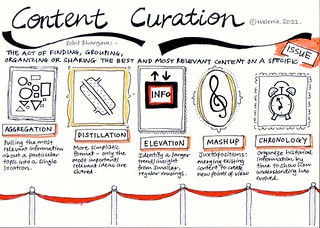
The third step is to curate the lessons. As the diagram here suggests, curation involves different ways of selecting and displaying content; high-grading the important lessons and giving them prominence, grouping similar lessons together, removing duplicates, and so on. This makes it easier for people to find the most relevant and most important lessons.  However the user still needs to look through the lessons one by one, and may find contradictions. And curation does not involve changes to the content, merely ways of organising and promoting the content.

The final step is to synthesise the lessons. This involves taking the knowledge from the lessons, and combining it into  guidance. Imagine you have 50 lessons on project scoping - you extract the key content from the lessons and build guidelines on project scoping. Then, as new project scoping lessons are identified, the guidelines can be continuously updated and improved. The user then only needs to look at the guidelines, which will contain the synthesised knowledge.

Imagine an engineer looking for best practice for safety procedures for installing gas turbines:
  • In the default state, she would need to search across many document systems and folders;
  • After step 1 she could at least search for documents tagged "gas turbine" and "safety";
  • After step 2 she would know there was a collection of safety documents, and may find several documents she can refer to. She will need to read each one to see which is obsolete and which is useful;
  • After step 3 she might find a curated set of safety documents, with the most recent or useful one(s) highlighted, with obsolete documents tagged as such;
  • After step 4 she may find a wiki page or procedure entitled "best practice safety procedure, gas turbine installation". After she performs the job, she can share her own lessons in case this procedure needs to be further improved. 

The current organisational application of these steps in the management of documented knowledge is shown below (replicated from this blog post - follow the link for more detail).


Steps 1 and 2 represent the dark blue and red sections, step 3 represents the purple section, and step 4 the light blue (upper) section. The three columns represent increasing levels of maturity of the KM program; from early stages to fully embedded.

The plot shows three main things:

  • As KM progresses, it becomes far less common to see documented knowledge scattered across many document stores, as people begin to take steps 1 and 2 (tagging and collection).
  • As KM progresses it becomes far more common to see documented knowledge being curated and/or synthesised, as organisations take step 3 and step 4.
  • Curation and Synthesis are still, unfortunately, minority activities. The majority of organisations responding to the surveys have not passed step 2, even when KM is fully embedded.


Tuesday, 3 September 2013

Connect and Collect, two crucial dimensions of Knowledge Management

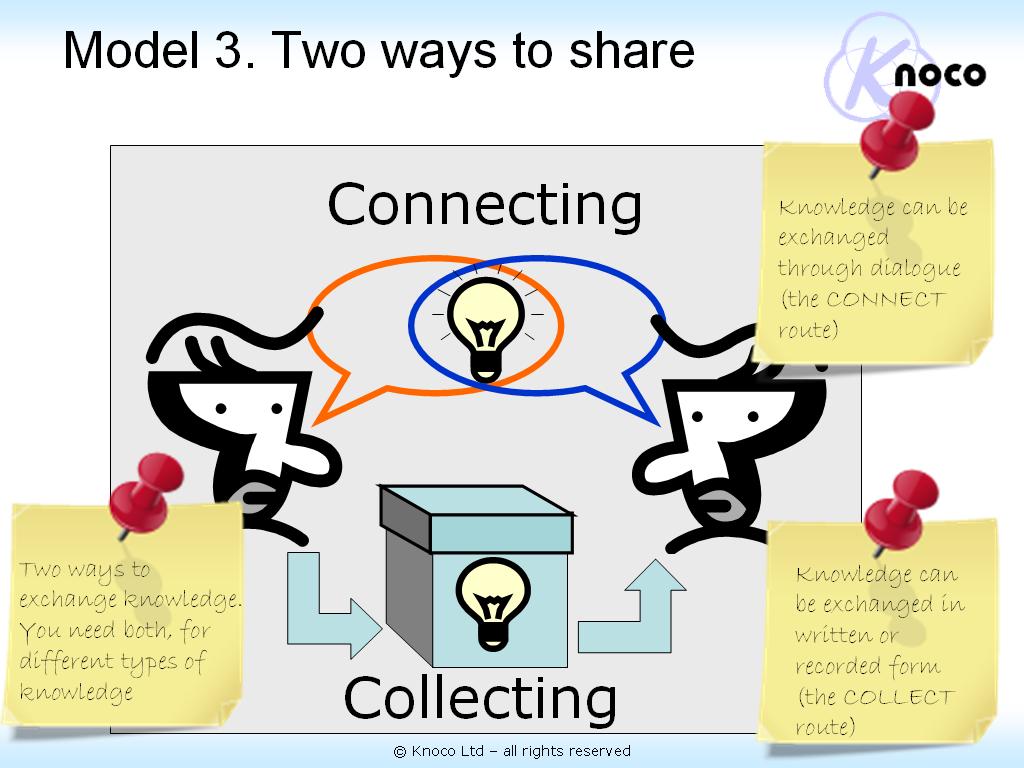
One of the earliest models in the history of Knowledge Management, and one that sometimes seems to get forgotten, is that there are two key dimensions in Knowledge Management, representing two routes between the knowledge suppler, and the knowledge user.

These are the Connect route, and the Collect route.

The Connect route supports knowledge transfer through connecting people.

  • In the Connect route, Knowledge is transferred through conversation - either face to face or electronically mediated. 
  • It can be supported by processes such as Peer Assist, Knowledge handover, knowledge exchange, knowledge markets, knowledge cafes, action learning, after action review, mentoring, coaching, and communities of practice.  
  • It can be supported by technologies such as collaboration tools, people-finders, community forums, webex, telephone and skype. 
  • The knowledge never needs to be written down; it can be - but it does not need to be, and knowledge can be transferred in tacit form.
  • The Connect route is necessary for complex knowledge, advanced knowledge, deep skills, and highly contextual knowledge. 
  • The Connect route is a highly effective way to transfer knowledge, but very inefficient, as the conversation must be repeated for each knowledge user.

The Collect route supports knowledge transfer through collecting knowledge into documents.

  • In the Collect route, Knowledge is transferred through documentation ("Knowledge capture"), through organisation and synthesis of that documentation, and through connecting the user with the documents, through search or through push.
  • It can be supported by processes such as Retrospect, Lesson Learning, Interview, creation of Knowledge Assets, and Knowledge Synthesis. 
  • It can be supported by technologies such as portals, lessons management systems, search, semantic search, blogs and wikis. 
  • The knowledge is written down or recorded, and transferred in explicit form.
  • The Collect route is ideal for relatively simple non-contextual knowledge which needs to reach a large audience, for knowledge that needs shelf life, for knowledge where no immediate user is available, and for knowledge which needs compiling and processing (such as lessons). 
  • The Connect route is an ineffective way to transfer knowledge, as we can only write a fraction of what we know, but very efficient, as once that fraction is captured it can be reused a thousand times.
Connect and Collect are not alternative strategies. They are two components of a single framework and a single strategy, which work in parallel. 

Your organisation will contain critical knowledge of very many kinds; some of which will need to be transferred through collection and some through connection. So make sure you address both dimensions
.

Wednesday, 3 September 2014


The two-chambered heart of KM


I found myself recently referring to Communication as "the heart of KM", but on reflection I decided that the heart of knowledge management has two chambers - a left and a right ventricle if you will - and that both are needed in order to pump knowledge around the organisation.

The two chambers are our old friends Connection and Collection, or the Connect and Collect routes for knowledge transmission.

Connection

Connection refers to connecting people so that they can share knowledge between them; through discussion and conversation. 


Collection 

Collection supports knowledge transfer through collecting knowledge into documents.
  • In the Collect route, Knowledge is transferred through documentation ("Knowledge capture"), through organisation and synthesis of that documentation, and through connecting the user with the documents, through search or through push.
  • It can be supported by processes such as Retrospect, Lesson Learning, Interview, creation of Knowledge Assets, and Knowledge Synthesis. 
  • It can be supported by technologies such as portals, lessons management systems, search, semantic search, blogs and wikis. 

You Need both routes!

The two different routes address different sorts of knowledge, both of which exist in your organisation. 


  • The Collect route is ideal for relatively simple non-contextual knowledge which needs to reach a large audience, for knowledge that needs shelf life, for knowledge where no immediate user is available, and for knowledge which needs compiling and processing (such as lessons). 
  • The Connect route is necessary for complex knowledge, advanced knowledge, deep skills, and highly contextual knowledge. 
  • Collection without connection results in bland knowledge bases which answer basic questions, but often lack nuance and context.
  • Connection without collection preserves no corporate memory, and runs the risk of overloading the experts with basic questions, and of loss of knowledge as the experts retire.
Keep the two chambers of Connection and Collection at the heart of your Knowledge Management strategy  if you want to succeed!

Monday, 8 January 2018

How Siemens build Knowledge Assets

Knowledge adds value when it is current, useful, validated, acccessible, combines knowledge from many sources, and is packaged in a usable format. Here's how Siemens does its knowledge synthesis and packaging. 


Siemens define a knowledge asset as being Validated Explicit knowledge on a value-adding Business processes.  I like this definition, as it implies that knowledge becomes an asset when it is validated, and when it helps the business.


However creation of such an asset requires a creation process involving the main knowledge holders from across the organisation. From this source, here's a diagram showing how Siemens goes through the synthesis and validation process.

You can see from the diagram that a knowledge asset takes about 3 months to build, and involves three workshops involving the relevant subject matter experts, plus a final review workshop.


  • A strawman of the asset is prepared before the first workshop, at which the SMEs agree the content structure, the scope, and the key knowledge to be included (in the form of processes, products and roles).

  • At the second workshop, the SMEs start to populate the content with processes, work products, and best practices - namely, searching around for good Explicit examples. They may provide practice guides, methodology, business frameworks, example work products, case studies, templates, architectures and role descriptions.

  • At the third workshop, the tacit knowledge is added in the form of tips and guidance, checklists etc.


The validated knowledge assets are stored separately from non-validated project documents, therefore making a clear distinction between project information and cross-project knowledge.

Once the knowledge asset is in place it is continually improved through work experience.

Friday, 14 September 2018

Connect and Collect - the two parallel pathways in KM

I mentioned Connect and Collect in yesterday's blog as being two routes for knowledge flow, so I thought I would expand on these two in today's post.


One of the earliest models in the history of Knowledge Management, and one that sometimes seems to get forgotten, is that there are two key dimensions in Knowledge Management, representing two routes between the knowledge suppler, and the knowledge user.

These are the Connect route, and the Collect route.

The Connect route supports knowledge transfer through connecting people.

  • In the Connect route, Knowledge is transferred through conversation - either face to face or electronically mediated. 
  • It can be supported by processes such as Peer Assist, Knowledge handover, knowledge exchange, knowledge markets, knowledge cafes, action learning, after action review, mentoring, coaching, and communities of practice.  
  • It can be supported by technologies such as collaboration tools, people-finders, community forums, webex, telephone and skype. 
  • The knowledge never needs to be written down; it can be - but it does not need to be, and knowledge can be transferred in tacit form.
  • The Connect route is necessary for complex knowledge, advanced knowledge, deep skills, and highly contextual knowledge. 
  • The Connect route is a highly effective way to transfer knowledge, but very inefficient, as the conversation must be repeated for each knowledge user.

The Collect route supports knowledge transfer through collecting knowledge into documents.

  • In the Collect route, Knowledge is transferred through documentation ("Knowledge capture"), through organisation and synthesis of that documentation, and through connecting the user with the documents, through search or through push.
  • It can be supported by processes such as Retrospect, Lesson Learning, Interview, creation of Knowledge Assets, and Knowledge Synthesis. 
  • It can be supported by technologies such as portals, lessons management systems, search, semantic search, blogs and wikis. 
  • The knowledge is written down or recorded, and transferred in explicit form.
  • The Collect route is ideal for relatively simple non-contextual knowledge which needs to reach a large audience, for knowledge that needs shelf life, for knowledge where no immediate user is available, and for knowledge which needs compiling and processing (such as lessons). 
  • The Connect route is an ineffective way to transfer knowledge, as we can only write a fraction of what we know, but very efficient, as once that fraction is captured it can be reused a thousand times.
Connect and Collect are not alternative strategies. They are two components of a single framework and a single strategy, which work in parallel. 

Your organisation will contain critical knowledge of very many kinds; some of which will need to be transferred through collection and some through connection. So make sure you address both dimensions
.

Monday, 19 July 2021

The Knowledge Manager as Supply Chain manager - an analogy

If Knowledge Management is like a supply chain for knowledge, then the Knowledge Manager is the Supply Chain manager.


Image from wikipedia japan

I have blogged many times about the analogy between Knowledge Management and a supply chain for knowledge. Like all analogies, this is limited (the view of the supply chain, which implies a supplier and a user, can be balanced by a view of knowledge co-creation and emergence, for example), but can also be a very useful lens through which to examine KM.

 A corollary of this idea is that the Knowledge Manager for the organisation or division takes the role of the Supply Chain manager for knowledge.  The knowledge manager does not create the knowledge nor use it, but is accountable for its creation and supply to the user.

We can explore this idea by looking at the job description of a supply chain manager, and seeing how this translates into KM terms. The supply chain job description below is taken from here and here.


Supply chain manager job description

Knowledge manager job description

Supply Chain Managers plan, develop, optimize, organize, direct, manage, evaluate, and are accountable and/or responsible for some or all of the supply chains processes of organizations. Knowledge Managers plan, develop, optimize, organize, direct, manage, evaluate, and are accountable and/or responsible for some or all of the knowledge management processes of organizations.
Diagram supply chain models to help facilitate discussions with customers.Diagram knowledge management models to help facilitate discussions with knowledge users.
Select transportation routes to maximize economy by combining shipments or consolidating warehousing and distribution.Select knowledge transfer approaches to maximize efficiency and effectiveness
Assess appropriate material handling equipment needs and staffing levels to load, unload, move, or store materials. Assess appropriate KM staffing levels for knowledge creation, transfer, storage, synthesis and re-use.
Confer with supply chain planners to forecast demand or create supply plans that ensure availability of materials or products. Confer with the business to forecast the demand for knowledge; create strategies and plans that ensure availability of knowledge as and when needed.
Define performance metrics for measurement, comparison, or evaluation of supply chain factors, such as product cost or quality. Define performance metrics for measurement, comparison, or evaluation of KM factors, such as knowledge availability or quality.
Monitor supplier performance to assess ability to meet quality and delivery requirements. Monitor knowledge supplier performance (eg the the knowledge supply from projects or from research) to assess ability to meet quality and delivery requirements.
Analyze information about supplier performance or procurement program success. Analyze information about knowledge supplier performance or knowledge creation / acquisition program success.
Meet with suppliers to discuss performance metrics, to provide performance feedback, or to discuss production forecasts or changes.Meet with knowledge suppliers to discuss performance metrics, to provide performance feedback, or to discuss new knowledge needs.
Design or implement plant warehousing strategies for production materials or finished products Design or implement storage and synthesis strategies for documented knowledge
Analyze inventories to determine how to increase inventory turns, reduce waste, or optimize customer service. Analyze knowledge stores to determine how to increase re-use, reduce waste, or optimize customer service.
Review or update supply chain practices in accordance with new or changing environmental policies, standards, regulations, or laws.Review or update KM practices in accordance with new or changing standards and requirements.
Implement new or improved supply chain processes.Implement new or improved KM processes.


But what's different?

The main difference between the role of the supply chain manager and the role of the Knowledge Manager is that the supply chain manager can assume that there is a customer for their services. They can assume that there are manufacturing workers who are ready and waiting for the supply of parts and materials.

The  Knowledge Manager cannot assume this.

The Knowledge Manager also has to work as a Demand Chain Manager; stimulating the demand for knowledge, and introducing the process and systems by which knowledge is sought, as well as those by which it is supplied.

Also, as stated above, there are elements of KM which are more collaborative and less of a flow process.

But where knowledge flows from supplier to user, then the knowledge manager can see herself acting as a supply chain manager, with some of the accountabilities listed above.


Tuesday, 24 September 2019

The two chambers of the KM heart

The heart of KM keeps knowledge flowing, and that heart has two chambers. 


Image from wikipedia
You can think of the organisation as a body, and knowledge flowing round the organisation like blood flows round a body.  But what is at the heart of KM? Is it knowledge sharing? Is it communities of practice? Is it knowledge creation?

The answer is that if there is a heart, it is not a single thing, but two chambers working together.  The two chambers are our old friends Connection and Collection; the Connect and Collect routes for knowledge transmission through Conversation and Content respectively. 


Connection


Connection refers to connecting people so that they can share knowledge between them; through discussion and conversation. 


Collection 


Collection supports knowledge transfer through collecting documented knowledge, synthesising it, sharing it and making it findable.
  • In the Collect route, Knowledge is transferred through documentation ("Knowledge capture"), through organisation and synthesis of that documentation, and through connecting the user with the documents, through search or through push.
  • It can be supported by processes such as Retrospect, Lesson Learning, Interview, creation of Knowledge Assets, and Knowledge Synthesis. 
  • It can be supported by technologies such as portals, lessons management systems, search, semantic search, blogs and wikis. 


You Need both routes!


In the past, Connect and Collect have been positioned as opposites, for example in the rival Personalisation vs Codification strategies described by HBR.

However they are not opposites; they are two sides of the same heart.  The two different approaches address different sorts of knowledge, both of which exist in your organisation. 
  • The Collect route is ideal for relatively simple non-contextual knowledge which needs to reach a large audience, for knowledge that needs shelf life, for knowledge where no immediate user is available, and for knowledge which needs compiling and processing (such as lessons). 
  • The Connect route is necessary for complex knowledge, advanced knowledge, deep skills, and highly contextual knowledge. 
  • Collection without connection results in bland knowledge bases which answer basic questions, but often lack nuance and context.
  • Connection without collection preserves no corporate memory, and runs the risk of overloading the experts with basic questions, and of loss of knowledge as the experts retire.
In reality, the two chambers of the heart work together. 

People can unite around collections of knowledge, connected people can collect what they collectively know. Conversation is where content is born, and content is something to talk about. In combination, both Connect and Collect drive the engine that makes knowledge flow. 

Keep the two chambers of Connection and Collection at the heart of your Knowledge Management strategy  if you want to succeed!


Monday, 5 September 2022

What the C in the SECI model really refers to

Most of us are familiar with the SECI model from Nonaka and Takeuchi, but sometimes forget that C stands for Combination, not Collection.


Image from wikimedia commons
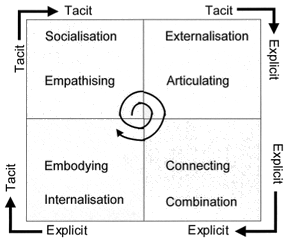
The Nonaka and Takeuchi SECI model for knowledge development is well known in the KM world, with its 4 components of  Socialisation, Externalisation, Combination and Internalisation.  

Nowadays many people assume that Externalisation means Documentation (which is not strictly true - it is more likely to represent the articulation of knowledge which was previously unspoken), but what about the C box? What do we assume this means?


According to the Wikipedia site linked above. the C box involves

Explicit to explicit by Combination (organizing and integrating knowledge), combining different types of explicit knowledge, for example building prototypes. The creative use of computerized communication networks and large-scale databases can support this mode of knowledge conversion. Explicit knowledge is collected from inside or outside the organisation and then combined, edited or processed to form new knowledge. The new explicit knowledge is then disseminated among the members of the organization

The key word here is Combination. Explicit knowledge gets combined with other explicit knowledge, seeking out links and resolving contradiction, and culminating in better knowledge or even new knowledge.

According to Nonaka, the combination mode of knowledge conversion is ‘a process of assembling new and existing explicit knowledge held by individuals into a knowledge system’ - a systemic approach to new knowledge development involving the combination of what is known by individuals.

The C box does not stand for "collection".


Collecting databases of documents is not part of the SECI development model (although collection is often a precursor to combination). It actually involves synthesis - connecting, combining and synthesising knowledge into something new, integrated and better.

Combination might be the Wiki article that summarises and synthesises a whole series of reports, or it might be the improved procedure that comes from combining new Lessons Learned, or it might be the checklist created by a Community of Practice discussion.

If all you are doing is collecting documents, then your knowledge flow and knowledge development has got stuck at this stage. A realisation of the importance of Combination and Synthesis often develops late in the KM journey, but it doesn't have to. Combination should be part of your KM framework from the start. 


The Combination of knowledge is a powerful part of the model, and is often overlooked when an organisation focuses only on collecting and tagging documents into a repository.

Blog Archive