Thursday, 29 September 2011
Free KM newsletter - sept 11
Our Autumn 2011 Knowledge Management newsletter is available for free download here
Our focus this quarter is on Collaboration, as well as announcing the start of Knoco Chile, Knoco E Australia, and our relationship with Vedalis


Wednesday, 28 September 2011
The Heroic Failure award
 Thanks Vince for notifying me of this article from the Wall Street Journal entitled Better Ideas Through Failure
Here we read about Mr. Myhren of Grey Grey Group, New York, who recently started handing out the "Heroic Failure" award because he was worried that fast growth at the agency, was making employees "a little more conservative, maybe a little slower." The award is for "The award is for ideas that are "edgier or riskier, or new and totally unproven,"
We also read about Michael Alter's "Best New Mistake" awards at SurePayroll, a payroll-services company in Glenview, Ill. Only people who are trying to do a good job, make a mistake and learn from it are eligible for the $400 annual cash award. Mr. Alter describes the fallout as "paying tuition. As opposed to saying, 'You screwed up,' or, 'You messed up,' we say, 'Let's talk about what we learned.' That drives a lot of innovation," he says.
We also read that "Failure, and how companies deal with failure, is a very big part of innovation," says Judy Estrin of Menlo Park, Calif., a founder of seven high-tech companies and author of a book on innovation. Failures caused by sloppiness or laziness are bad. But "if employees try something that was worth trying and fail, and if they are open about it, and if they learn from that failure, that is a good thing."
The interesting thing here is that all these people are not rewarding mistakes, they are rewarding risk-taking and learning. It is not failure that is being celebrated, but the courage to learn from failure.
Tuesday, 27 September 2011
Four levels of collaboration - the role of "the others"

I am starting to see four levels here.
The first and most basic level is where collaboration involves using the work products of others. These work products could be in a shared library for example, and the others have no involvement other than creating the work products in the first place. They may not even know their work products have been reused. This collaboration is so basic, you might argue that it's not collaboration at all.
The second level is where the business needs to access opinion from others. The opinion collection might be in the form of a survey, or open-ended feedback, or in the form of some sort of online ideas jam or brain storming session. Once the others have provided their opinions, ideas or feedback, they have no further involvement in creating the outcome (the new strategy, the new approach, whatever it might be that needed to be informed by those opinions). Although they have an interest in the outcome, and would like to see their opinions acted on, they don't have any further involvement until the outcome is ready.
The third level is where the business needs to access advice, knowledge and experience from others. Collecting this knowledge might happen through a community of practice, or through a peer assist, or through a virtual peer assist. The others provide advice, provide guidance, are involved in questioning the business unit that originated the collaboration, and have an advisory role in creating the outcome. However the outcome is not primarily for them, it is for the originating business unit. So althrough they are involved in creation, they don't have equal ownership of the outcome.
The fourth level is where the business needs actively to work with people from elsewhere as part of a short lived co-located team, or a longer lived virtual team. It needs the skills and input and judgment and effort from the others, and the outcome is co-created with the others. All parties have equal ownership and equal involvement in the outcome.
Monday, 26 September 2011
KM, the regular health-check
 There is a lot of value in a KM audit, so long as you do it regularly.
Our favoured approach to run the audit on an annual basis. It works like this
- The KM team works with the knowledge owner, or process owner, to audit their own knowledge area.
- Based on the results of the audit, they identify actions for the following year
- The next year, the audit should show improvement
- The KM team can use the audit results, and the change in results over the year, to construct a KM dashboard for reporting to senior management. If KM is working, all audit scores should show an increase over the previous year.
Thursday, 22 September 2011
The KIN 10th anniversary, in 2 minutes
Courtesy of Gary Colet, here's a wall-picture summary of the Knowledge and Innovation Network's 10th anniversary event (last week), delivered in 2 minutes. This was a very visual and beautiful way of summarising the event
Wednesday, 21 September 2011
Building trust in large communities of practice
It is a well-established dictum that "trust is required for knowledge sharing and re-use". In other words, people will share what they know, and act of the knowledge of others, if they know them, if they have a social relationship with them, and if they trust them.
There is another rule of thumb - that it is difficult to form trusting social relationships in groups of more than 150 (Dunbar's number). This seems to be the average size of tribes, military fighting units, and (according to some sources) web 2.0 circles. Within a group of 150, strong social ties of relationship and trust can form.
However that seems to break down when it comes to large online communities of practice within an organisation. Shell CoPs can exceed 2000 members. The US Army "PlatoonLeader.mil" community covers 12000 Platoon leaders. Other companies have communities which are just as large. Dunbar's number would suggest that these communities far exceed the limits of social cohesion, and therefore should not work as knowledge sharing mechanism. Who would trust 12000 people that they have never met?
Yet these communities DO work.
People DO trust them.
People open up to a surprising extent, and share all sorts of things in these large communities, expecially the military communities. Somehow it has proven possible to generate trust in a social institution, rather than in social ties with individuals.
No I don't know how this works, and it would be really interesting to conduct some research in this area. I speculate that there are a few factors at work here.
Firstly the community leaders and facilitators must engender trust. They must be trustworthy themselves, and must be trusted to ensure that the community of practice remains "a safe place to be vulnerable".
Secondly the community of practice must build a brand and a reputation as being "trustworthy". This is built over years, and built through "delivery of value" to members. The community leader will be instrumental in coordinating brand-building.
Thirdly the users must get a rapid, quality response. If they are brave enough to open up to the community of practice - to expose their ignorance and ask for advice and help, for example - then the advice must be quick, and the help must be helpful.
There may be other factors at work, but these must be within the top 5.
Tuesday, 20 September 2011
The first Nuclear KM team?

Last week I was at the 10th
anniversary of the admirable and highly successful Knowledge and Innovation
Network, and one of the exercises was for each of the companies present to
create a KM timeline, of their involvement with KIN, and with KM. I went to get
a cup of team, and when I returned I was very flattered to see the namecheck
shown here (Thanks Ian Neville!).
Of course, it was not just me; my Knoco
colleagues, particularly Tom Young, were also involved, but I wonder if it
really was the first Nuclear KM team ever? Does anyone know of one that pre-dates
2003?
Monday, 19 September 2011
Collaboration processes - a first pass guide
We read a lot about collaboration, and there are very many guides to the use of collaboration technology.
However there does not seem to be so much available concerning the use of collaborative process, or collaborative structure. Recently, in work for a client, I have been looking for a guidance structure for collaborative process, and came up with the matrix on this page.

Does it work? Your comments welcome - this is pretty much a first pass. An explanation follows.
Firstly, I am defining collaboration here as "working together on a common issue, across organisational and/or geographical boundaries". So "working together in a co-located team" is treated here as teamwork, not collaboration.
Secondly I am looking only at process/structure, not at technology. There may be many technology solutions that could support any one process or structure.
Thirdly I am looking at multiway collaboration, and so am excluding one-way publishing in all its forms, including blogging.
The two questions which define the matrix are
1) what are you trying to achieve through collaboration?
- working together to deliver a common product or objective?
- seeking knowledge and advice from others to guide your own objective?
- seeking opinion and data from others, to inform your own objective
The first question really talks about ownership of the output, and the degree of involvement of the collaborators in the solution.
The outcomes are as follows
- What we call "knowledge exchange" - a diverse group working face to face to create a common product
- Virtual work groups and virtual teams - the virtual equivalent of ftf workgroups and teams.
- Peer Assist (real or virtual)
- Communities of Practice
- Knowledge Cafe
- "Crowdsourcing" techniques such as surveying, polling and online brainstorms
Thursday, 15 September 2011
Top 7 tips for knowledge management success
 I know I have made all these points before, so some may be a bit deja vu for regular readers, but here in one place are Knoco's top 7 tips for making Knowledge Management implementation work. You probably have more tips to share - please contribute these via the comments section.
1. KM needs to be business-driven. It is vital that KM efforts are clearly linked to business outcome, with a clear business objective. I have a quote from a survey from the early 00s, that reads as follows
“Most successful knowledge management applications addressed a ‘life or death’ business situation. Successful cases answered two questions at the outset - What business objective am I trying to achieve? How can I apply existing knowledge?”
Here's another quote - "We have been looking at the key processes of the business, testing them for their "knowledge intensity" to see if we would create some significant new change in the performance of that particular process if we managed knowledge in a more profound way. The concept has not been difficult to sell to the top executive team." See how this approach starts with the key business processes?
Similarly Tom Davenport and co-authors, in the paper "Building successful Knowledge Management projects", conclude that "Link to economic performance or industry value" is the number one success factor for successful KM. Mars, for example, is implementing KM at a rate of two business issues per year. Work out your business focus areas, and work on delivering value in those areas.
2. KM needs to be introduced as a management framework. A Framework is a a small defined set of technologies and processes, embedded into business activity, and a small defined set of roles embedded into the organisational structure, all under an umbrella of Governance. Like other management systems, effective KM is a framework of roles, processes, technologies and governance which has been embedded into the business. Just as Financial Management is not a single tool - budgets for example, or invoicing - and is not a toolbox ("you can try writing budgets if you like - here's a guide"), but is a complete framework embedded into the business process, so Knowledge Management needs a framework. If there are holes in the framework, it will not deliver value.
A common mistake is to introduce one element of the Framework - a technology for example - and expect knowledge to start to flow. It won't. It might trickle, but it won't flow.
3. KM needs to address Pull as well as Push. I have blogged about this many times - Push creates supply, Pull creates demand and the two need to be in balance. Too many organisations focus on knowledge sharing, not on knowledge seeking and re-use. Pull, in the early stages, is more powerful than push. Creating demand creates a market.
4. KM is a change process. It is not a gradual change either - it is a step-change. It is a remodelling of the organisation; a make-over, a new way of thinking. It needs to be treated as a change process and measured as a change process. Don't go into KM thinking that it is about a new IT tool, or just "trying out communities" - you won't get far if you don't start to address the hearts and minds. This also means that KM implementation must be structured like a change program (including a piloting component), and must have a strong team of change agents to implement the change.
5. KM Must be embedded in the business. If its not embedded, you risk "tipping back" to a pre-KM state. Many of the high profile failures of KM are due to a failure to embed. You can;t rely on KM being driven by the efforts of a central team. A central team are needed, but their role is an assurance and support role. The drive must come from the business.
6. KM needs not just high level support, but high level expectation. People do what they believe is expected of them. People are generally good workers, they want to do a good job, and if something is expected of them as part of the job, they generally do it. Expectation can be explicit or implicit - written or unwritten. Expectation comes from leadership, and from peers, and these two sources of expectation need to be aligned to be effective (there is no point in the boss saying "I expect you to have a work life balance" if all your peers are working to 10pm and expect you to be part of the team). So knowledge management needs to become an expectation, from management as well as from peers. Senior management in the organisation needs to make KM expectations clear by explicitly stating what needs to be done in Knowledge Management, and by whom. They need to write these expectations down, and keep reinforcing them by what they say. They also need to make sure these expectations do not get weakened by, or conflict with, other company structures and expectations.
7. KM needs to be delivered where the high value decisions are made. This might be at operator level (the operator of a plant, the driller of a deepwater well, the pilot of a passenger aircraft) or it might be at senior management level. Knowledge supports decisions, and decisions are made at all levels. In fact the most valuable and risky decisions are made at senior level. The default approach to supporting these senior management decisions is to hire a big-5 consultant firm to supply the knowledge, but there is no reason why KM can't help as well. Delivering a high level KM pilot at senior level has three benefits.
- It delivers massive value to the business
- It engages senior managers in KM, and helps them understand the value KM can bring
- It gets senior managers on-side, by solving their problems for them (see the thorn in the lions paw).
Wednesday, 14 September 2011
Learning about the referee
 Every week, a sports team conducts its own learning sessions.
Firstly, they learn from their performance the previous weekend. They analyse the results of their plays, how well they work together, where their strengths and weaknesses are, and what they need to learn all.
Secondly they learn about the team that they will be meeting the next weekend. They look at their plays, they look at their defensive weaknesses, and they start to develop a strategy for winning.
In rugby union, there is a third area of learning, and that is to learn about the referee.
Rugby union has many subtle laws which are open to interpretation. How hard to use your arms when tackling, where to stand when rucking, how quickly to let go of the ball when tackled, how to bind when scrummaging - all of these laws can be interpreted different ways by different referees. And if you break a law, your opponents can take a penalty kick which could lose you three points. Therefore it is vitally important to learn about the individual referees, to know what they are keen on penalising, and to know whether blind spots are.
The same is surely true in business. It's all very well being an excellent project team, but sometimes the key point is not whether you can deliver your project in time, but whether it will pass the scrutiny of the local regulators. There is as much to be learned about regulatory compliance and legal compliance as there is about project delivery.
And yet, in all of the years in which I have been doing lessons learned from major projects, there has been almost no representation in the retrospect meetings from the company legal department. We have the project manager, the project engineeers, the HSE folks, procurement, quality and finance; but very selcdom any lawyers. That makes me wonder how much learning we have missed in the field of compliance with regulations.
Maybe in business we need to pay more attention to learning about the referee.
Tuesday, 13 September 2011
Online forums - discussion or serial monologue?
I thought I would test this hypothesis by looking through the online forums on Linked in.
The graph below shows the results of a quick survey of 30 threads within one forum. Columns are marked with a Q if the thread was started with a Question, S if it was started with a Statement such as a link to a blog post. The blue length of the column represents the posts within the thread that were statements; the red length represents questions.

We can see several interesting things.
Firstly most of the threads that start with a statement, have no replies at all. No discussion.
Secondly, there are very few questions among the replies, either to the questions or to the statements. In totla, fewer than 10% of the replying posts are questions. I think that supports the idea that what we are looking at here is not dialogue as such, where questions and answers are more evenly balanced, but a set of stated views.
There is one discussion I would like to highlight however - it has the largest number of replies and the most comprehensive discussion, and you can find it here
Part of the reason that this thread is so long, is the involvement of the person who originated the thread (take a bow Gerald), and his activities in responding and reframing the discussion, and the social interactions he generated. He has taken the role of discussion facilitator, and as a result has a far longer and richer result.
Out of the 98 posts within this thread, 63 are declarative statements, 13 are responses and reframing, 14 are social (expressions of thanks and appreciation), and 8 are questions.
For me this thread, although still more Q&A than dialogue, expresses much of the richness you would like to cultivate within a community of practice.
Monday, 12 September 2011
Roles - the KM blindspot?
 Here at Knoco we are firm believers that a full KM framework requires defined roles and accountabilities, but it seems not everyone sees it this way.
I was with a client last week, and he drew out a folder of "KM Assessment models" and "KM maturity models" he had accumulated from a number of sources. The thing that struck me most forcibly was how few of them made any mention at all of KM roles and accountabilities.
Maybe that is some sort of blindspot? Maybe there is some thinking that says "KM should be part of everyone's role - part of a general culture shift - we don't need any special roles and accountabilities"? Maybe there is even a feeling that to have KM roles is to abdicate the need for others to work with knowledge?
We have seen far too many KM initiatives fail for lack of accountabilities to subscribe to these feelings and thinkings. One of the common reasons for failure is to remove the few people with accountability, and expect KM to run itself.
Think of the importance of roles in other management systems.
Take safety management - everyone needs to be safe, but would safety management work if you removed the HSE roles, the safety wardens, the "head of safety"?
Take financial management - everyone needs to be take care of company finances, but would financial management work if you removed the accountable budget holder role, the CFO, the accounts department, the invoicing clerk?
As Tom Davenport said - "The next time someone starts spouting the "(KM is) everybody's job" rigmarole to me, I'm going to retort, "So I guess since it's everybody's job to monitor costs and enhance revenues, you've also eliminated the finance and accounting departments?"
So don't develop a blindspot to the importance of KM roles. Without them, your KM framework will be incomplete, and your KM initiative will be at risk.
For more on KM roles, read here.
Friday, 9 September 2011
KM - counting the apples or improving the farm?
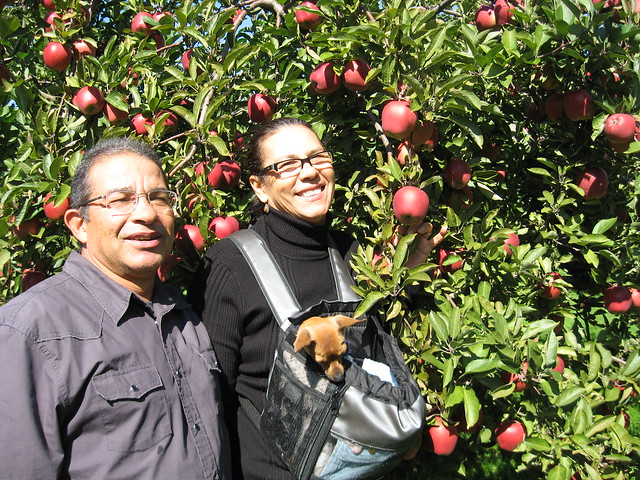 There are two types of Knowledge Management Assessment you may need when starting up a KM program. They go by different names for different people - a survey, a scan, an audit.
 The first, which we in Knoco call a Knowledge Management Audit, reviews the knowledge topics or knowledge areas within this organisation, and looks at the status of each one in terms of Knowledge Management. Is the knowledge widespread, or local? Is it held by one person, or by a community? Is it purely tactit, or is it fully documented? Does the organisation have the knowledge they need, or do they need to learn more?
The second, which we in Knoco call a Knowledge Management Assessment, looks at the status of the Knowledge Management framework. Are communities of practice in place? Is the technology infrastructure deployed? Are there roles and accountabilities for KM? Is there a closed learning loop? Are there KM expectations or policies? Is there a process for "learning before, during and after"? Is Knowledge Management Governance in place?
If you were looking at improving your farming methods in an apple orchard, the first would be counting the apples, the second would be reviewing your farming approach.
Both are needed.
If you don't review your farming approach, then you might know how many apples you have, but you don't know how to increase the yield.
If you don't count the apples, you can't track or demonstrate the increase in yield, and you don't know which trees need the most attention.
If I were to focus on one, however, I would focus on the assessment. If I had to choose just one, I would rather improve the farming method and let the apples take care of themselves.
Wednesday, 7 September 2011
Push and Pull in Communities of Practice
 This is a comparison of two communities of practice.
In one of them, the content is 80% or more "knowledge push". Most of this content either comes from the administrator or from the manager, and it consists of thought pieces or of snippets of news or links to articles. Usage is low and only 3% of the target staff have contributed. This community is pretty dead, really.
In the second (a community of practice I subscribe to for research purposes, even though it's on a topic I don't work on) usage is high, contribution is high, and a check of the messages from the past month or two shows that 93% of the content is "knowledge pull." The content is from people in the business with a problem to solve or a question to answer or a need to fill. This is a very live and active community.
Why the difference?
The difference comes from the value proposition for being a community of practice member. Community membership needs to generate more value than it costs, and the value in community membership is the ability to use the community as a knowledge resource.
See the BT Stadium video below for an analogy for internation in a community. The person standing in the middle of the stadium is using the community as a resource, by asking questions and getting answers ("What's this called"? "What do you think of that"? "Does anyone want this?" "Does anybody feel like this?"). The community enables Knowledge Pull.
Now imagine that stadium video where the person is standing silent in the middle, getting bombarded by knowledge being thrown at them ("Look at this". "Read that". "Listen to me")
Which community would you rather belong to? Pull or Push?
Tuesday, 6 September 2011
Survey on CoP resources

Several things surprised me.
Firstly, there were very few answers, and in many groups, no answers at all. Either people are shy about sharing real data online, or there are actually few practising community of practice leaders in the Linked-In KM groups. Many thanks to those of you who did reply though, your data are much appreciated.
Secondly the data, published here, seems at first sight to make no sense. Although you would expect the larger communities of practice to have a larger administration workload, there is no relationship in the data presented here. There are communities of practice of 45 members that have the same admin FTE resource as communities of 1000 members.
However diving deeper into the data, there are some points which are perhaps unusual.
- Point A seems to represent starter communities, or core teams, with the intention to grow to 500 members or more. These communities of practice are not fully formed.
- Point B represents communities of practice that meet only face to face, for cultural reasons.
- Point C is an academic research network, and it's not clear to me whether this is a community of practice or a some other form of collaborative endeavour.
- Point D also may be a research network.
Once we remove these points, then there looks to be more of a relationship, and the red line in the diagram shows the general trend (not that there needs to be a linear trend) of about 1.5 FTE support per 1000 members.
I think the final thing which this reminded me of, was that "Community" is a very elastic term which means many things to many people, so perhaps I should expect a lot of scatter in the data!
What about your community of practice? How many members does it have, and what FTE coordination resource does it need? Please let me know in the Comments section below
Monday, 5 September 2011
A new look at mentoring in knowledge transfer
 Mentoring and coaching are tried and tested ways of transferring knowledge between an older experienced person, and a younger less experienced person. However this relationship often breaks down. In a recent study for a client we found that knowledge transfer through mentoring was running at about 20% of the efficiency that was needed.
 When the relationship broke down, the two sides blamed each other (“he won’t tell me anything”. "he never asks me anything" (remember this?)), but in reality there were very few incentives to build the trusting relationship required for effective coaching.
Part of the problem with the traditional view of mentoring is that accountability for knowledge transfer lies with the coach or mentor. It is written into their job description, they are coached in the process of mentoring, and they take a leading role. The status of "having knowledge" is compounded with the status of "driving the process". The mentee plays a passive role, and we end up with "Knowledge Push" if we aren't careful. We end up with Teaching; not necessarily with Learning. At the same time, the mentor is still busy doing what he or she sees as "real work", and when push comes to shove, real work takes precedence over mentoring. As far as the coach or mentor is concerned, there isn't much of an incentive to do the coaching. This is especially true of the experienced person is due to retire. Ineffective transfer of knowledge is "not my problem" as far as the retiree is concerned.
More recently we have been looking at changing this realtionship. If the mentee is given an active status, that of a "dedicated learner", and is trained in the skills and processes of knowledge elicitation and interviewing, there is a change in the dynamic. The mentee takes a more active, more leading role - almost like an investigative reporter, or an industrial spy. After all, ineffective transfer of knowledge IS "my problem" as far as the mentee is concerned. It becomes a Learning-driven process, not a teaching-driven process. That learning can be planned, through a learning plan, and monitored and measured. And as he or she learns, then instead of just taking notes in their personal note book, they start to build knowledge assets in the company knowledge base. So as well as transferring the tacit skills, a documented knowledge base can be created as well. Now we have knowledge driven by Pull, not Push, which as we know is far more effective.
Sunday, 4 September 2011
Knowledge/action quote
![44/365: Action Comics... ["Acciones Cómicas"]](http://farm4.static.flickr.com/3644/3642308193_10b228275f_z.jpg)
The great end of knowledge
is not knowledge, but action. -- Thomas Henry Huxley
Saturday, 3 September 2011
Talk is Work (quote)

In a knowledge-driven
economy, talk is real work.--
Thomas Davenport and Laurence Prusak
Thomas Davenport and Laurence Prusak
Thursday, 1 September 2011
Quantified KM success stories 21 - Peer Assist at De Beers
 This success story is extracted from a chapter of my book "Performance through Learning", and describes how a Peer Assist at De Beers delivered a value of tens of millions of Rands
.
"Central Mines was one of the areas identified before the workshop as a potential pilot area for De Beers. Dieter Haage, the general manager at one of the larger mines, Finsch mine, already saw the potential of Knowledge Management but at that point did not have a clear idea of how he would implement it. That was partly why the December workshop had been so powerful; it had provided the mines with a toolkit and an implementation plan.
"Bruce Emerton had been identified as the potential knowledge manager for Finsch, and Bruce had attended the workshop. Bruce identified a couple of options for the application of KM, one of which was to hold a Peer Assist on the subject of earth-moving equipment. Finsch was about to invest heavily in earth-moving equipment, and wanted to draw on the knowledge and experience of the other mines first, and evolve the relationship with the chosen supplier through sharing knowledge to improve the outcome for mutual benefit. In some ways the peer assist was held later than would have been the ideal point, but the level of sharing was still very high, and some crucial knowledge and insights were exchanged during the breakout groups within the peer assist. The facilitator calculated that there were over 240 man years of knowledge and experience present in the room, all of which could be brought to bear on Finsch’s issues.
"Bruce believes that this knowledge has helped deliver R80 million in added value for Finsch mine. Again, this was a crucial early win for De Beers, and particularly valuable in that it delivered a hard monetary benefit in an area of strategic focus, namely underground mining. A similar peer assist for Premier mine proved equally successful in providing the Premier team with collective insight into how to improve current and future operational performance".
Subscribe to:
Posts (Atom)

 Posts
Posts

