Monday, 29 January 2024

A KM conference for the diary - Dublin in June

 Check out the Dublin KM conference, planned for June this year

It looks really interesting, with a great collection of speakers. Definitely one for the diary


Friday, 10 November 2023

UNDP KM strategy

Linked below is an excellent video on the 2022 KM strategy from the UN Development program. 

Good to see the focus on culture and networks.


Friday, 3 November 2023

Knoco 2023 survey results are available

 The Knoco 2023 KM survey is now available, Follow the link below to order a free copy.

Knoco Ltd has conducted a global survey of Knowledge management every three years, starting in April 2014, with the latest in September 2023. Participation has been free, voluntary and confidential, and all participants received a copy of the Knowledge Management Survey report. 

Thank you to all who took part this year!

In total, nearly 1200 people have taken part in the 4 surveys; mostly individuals leading Knowledge Management activities or members of Knowledge Management teams. The survey looks at many elements of the way people are implementing KM in their organisations, such as the choice of technology, the size of teams, the annual budget, and the use of various KM approaches. 

The report contains not only the 2023 answers, but also the way these answers have changed over the course of the 4 surveys. See for example the plot below of answers to a question about the use and value of AI technology as part of KM (this particular plot only covers 3 surveys, as we did not ask about AI in 2014).


Here is the link again

https://www.knoco.com/knowledge-management-survey.htm 


Sunday, 29 October 2023

Lesson Learning in NATO (video)

 Here's a great video from NATO about their lesson learned capability

Source here


Tuesday, 26 September 2023

RIP Larry Prusak

 Sad news today that Larry Prusak, one of the founder figures of Knowledge Management, has died.


In memoriam, here are some of Larry's words of wisdom.


"Those companies that don’t adapt to understanding knowledge as a force of production more important than land labour and capital, will slowly die, and will never know what killed them".


"The modern organisation evolved in the 19th century to deal with land, labour and capital, not with knowledge, which was assumed to reside only in the heads of the owners and managers. This led us to the modern organisation built on command and control mechanisms, run as hierarchical bureaucracies. This won’t do when knowledge is the major source of value, as it is for most large organisations today."

"One of the great conundrums in KM is Compliance; how do you get people to do this? The smarter firms realise that it is situational. People aren't lazy or stupid or don't care; you should look at the way people work; if they don't use a system, then why not? Its almost always an issue of bounded rationality; we don't have the energy, money , time or space to do it". 

"Incentives work. Remember when asking people to share knowledge; we live in a bounded universe. You have limited energy, limited money and limited time. Why do X instead of Y without marginal utilisation or incentives".

“If you have one dollar to invest in knowledge management, put one cent into information management and 99 cents into human interaction.”

"Everywhere I speak people conflate information and knowledge — and this situation is greatly abetted by IT vendors and consultants for obviously commercial reasons. I would estimate that tens of billions of dollars have been wasted by organizations trying to work with knowledge by buying IT tools. Since none of this is taught in Business schools or perhaps ANY schools it isn’t too surprising that most people can’t define knowledge as distinct from information".

"There's a struggle going on between those companies that have an overly technical focus on KM, and those that think it's all just talking and cultural issues. It's a real battle".

More on Larry at Stan Garfield's site. 


Thursday, 14 September 2023

Only a few days left for you to join the global KM survey

There's still a few days left for you to take part in the 2023 Knoco global survey of KM. 

Thank you if you have already taken part. If you haven't, we would love it if you could join too! Please follow the link to take part, and please forward this post to your KM friends in other organisations

What is this survey?
This is a survey of what organisations around the world are doing under the heading of "Knowledge Management". 
This is the 4th survey in a series; the previous surveys were held in 2014, 2017 and 2020. The questions in each of the surveys are mostly identical, allowing us to track changes in the responses over time. 
Even if you have taken part in previous surveys, please consider taking the survey again so we can see what has changed.

Who should take part?
Anyone can take part, who can answer questions on behalf of a current KM program within an organisation. You will need to know this program well. Perhaps you lead KM in the organisation, perhaps you are on the KM team or perhaps you consult to the KM team. If you do not know a current KM program in detail, it's best if you sit this out. 

What does the survey cover?
The survey is quite comprehensive. It covers the maturity, aims and scope of the KM program, the budget and value delivery, the KM team size and skills, the processes, technologies and governance in use, plus optional sections on communities of practice, lessons learning, knowledge retention and AI. 

How long will it take?
We will be honest with you - this survey is a big survey and takes about an hour to complete. We know this is a significant investment of your time, but this ensures the richness of the data gathered. We hope you will feel this is time well invested.

What do I get  in return?
We will send you a copy of the survey report as soon as it is complete. This will not only contain the results of the 2023 survey, but also a comparison with the results of previous years, to show trends in the responses over time.

Will I be anonymous?
Your  name and email address, and the name of the organisation you are answering on behalf of, will not appear in the report,. nor will they be shared with any third parties. 

How do I take the survey?
The link is here, and the survey is open until 20 September.

Thank you in advance!


Monday, 4 September 2023

Don't forget to take part in the Knoco 2023 KM survey

Don't forget to take part in the 2023 Knoco global survey of KM. 

We currently have 85 responses, but would love it if you could join too! Please follow the link to take part, and please forward this post to your KM friends in other organisations

What is this survey?
This is a survey of what organisations around the world are doing under the heading of "Knowledge Management". 
This is the 4th survey in a series; the previous surveys were held in 2014, 2017 and 2020. The questions in each of the surveys are mostly identical, allowing us to track changes in the responses over time. 
Even if you have taken part in previous surveys, please consider taking the survey again so we can see what has changed.

Who should take part?
Anyone can take part, who can answer questions on behalf of a current KM program within an organisation. You will need to know this program well. Perhaps you lead KM in the organisation, perhaps you are on the KM team or perhaps you consult to the KM team. If you do not know a current KM program in detail, it's best if you sit this out. 

What does the survey cover?
The survey is quite comprehensive. It covers the maturity, aims and scope of the KM program, the budget and value delivery, the KM team size and skills, the processes, technologies and governance in use, plus optional sections on communities of practice, lessons learning, knowledge retention and AI. 

How long will it take?
We will be honest with you - this survey is a big survey and takes about an hour to complete. We know this is a significant investment of your time, but this ensures the richness of the data gathered. We hope you will feel this is time well invested.

What do I get  in return?
We will send you a copy of the survey report as soon as it is complete. This will not only contain the results of the 2023 survey, but also a comparison with the results of previous years, to show trends in the responses over time.

Will I be anonymous?
Your  name and email address, and the name of the organisation you are answering on behalf of, will not appear in the report,. nor will they be shared with any third parties. 

How do I take the survey?
The link is here, and the survey is open until 20 September.

Thank you in advance!


Monday, 21 August 2023

Please take part in the global KM survey

 You are invited to take part in the 2023 Knoco global survey of KM. 

What is this survey?
This is a survey of what organisations around the world are doing under the heading of "Knowledge Management". 
This is the 4th survey in a series; the previous surveys were held in 2014, 2017 and 2020. The questions in each of the surveys are mostly identical, allowing us to track changes in the field of KM over time. 
Even if you have taken part in previous surveys, please consider taking the survey again so we can see what has changed.

Who should take part?
Anyone can take part, who can answer questions on behalf of a current KM program within an organisation. You will need to know this program well. Perhaps you lead KM in the organisation, perhaps you are on the KM team or perhaps you consult to the KM team. If you do not know a current KM program in detail, it's best if you sit this out. 

What does the survey cover?
The survey is quite comprehensive. It covers the maturity, aims and scope of the KM program, the budget and value delivery, the KM team size and skills, the processes, technologies and governance in use, plus optional sections on communities of practice, lessons learning, knowledge retention and AI. 

How long will it take?
we will be honest with you - this survey is a big survey and takes about an hour to complete. We know this is a significant investment of your time, but this ensures the richness of the data gathered. We hope you will feel this is time well invested.

What do I get  in return?
We will send you a copy of the survey report as soon as it is complete. This will not only contain the results of the 2023 survey, but also a comparison with the results of previous years, to show trends in the responses over time.

Will I be anonymous?
Your  name and email address, and the name of the organisation you are answering on behalf of, will not appear in the report,. nor will they be shared with any third parties. 

How do I take the survey?
The link is here, and the survey is open until 20 September.

Thank you in advance!


Monday, 14 August 2023

Should you be able to time-write knowledge management activity?

A common question from clients in professional services, legal or consulting firms, which usually operate a strict time-writing regime, is "How do we Time-write KM activity"?

Image from wikimedia commons
Creative commons licence
Author LetsgomusicStyle

In an industry where billable hour is king, how do you time write, and therefore bill, time spent in Knowledge Management activities such as Peer Assist, KM planning or Retrospects?  Is the activity billed to the relevant client? Or do you introduce Knowledge Management as a separate charge code, and therefore treat it as an overhead, which you pass on to all clients by increasing your fee level? Or do you cover the costs of that overhead by the leverage that KM offers; enabling more junior staff to deliver highly billed work?

Approaches seem to vary, with some companies allowing neither billing to clients nor a separate timecode, therefore relegating KM to a "personal time" activity.

Personally, I think KM should be billed to clients. 

Knowledge Management should only be introduced if it is going to benefit clients, and indeed the whole purpose of Knowledge Management within a professional services firm is to "bring the whole knowledge of the firm to bear on each client's problems". Therefore KM is part of providing a better service (in fact you could see KM as a component of good business practice).  If you are providing goods to a client, then the costs of the supply chain for those goods are passed on to the client, and if you are providing knowledge to a client, then KM is the supply chain for that knowledge. 

By this logic, KM should be paid for by the client. The time spent in Peer Assists, After Action reviews and even Retrospects should be billed to the client, by the logic of "we provide an excellent service to you through KM, so KM is billed as part of that excellent service". Of course, by the same logic, if KM is not delivering an excellent service, then you should stop doing KM. Time writing in this way keeps the focus on KM as a means to support the clients.

Certainly the KM activities that provide direct and immediate benefit to the client; the Peer Assists, the KM planning, and the After Action reviews are easiest to argue as being billable.  Retrospects, which do not benefit the current client but which benefit other clients in future, are harder to argue for. You could argue that because the results of the Retrospect are not shared with the client, you cannot charge the activity to the client, and therefore you could bring in a separate time writing code as part of overheads. However most firms try to keep overheads down, which disincentivises taking time for learning.

Giving KM a separate time writing code altogether, and not billing any of it to the client, implies that KM is an add-on, and an overhead, which is why I don't like this approach. KM should be seen as an investment, both for the client and for the firm, and not as an overhead cost.  

Not allowing people to timewrite KM at all will kill KM, unless you can find a sneaky way around the system. Last week I was discussing just such a sneaky way, with a KMer from a company with no KM charge code, and where nobody would spend any time on Retrospects or Lessons Learned. However one thing they do, on every client project, is to assign a junior as part of the juniors' Development Activity.

Here they have the opportunity for KM by Stealth - to use the Junior as the corporate learning resource.

The junior can keep a "learning blog" or "lessons blog" on which they can identify and publish all lessons and good practices recognised on that project. This is analogous to the "commanders blogs" used in the Army, which prove an excellent source of learning. The blog allows the junior to reflect and learn, and through that public reflection allows the firm to learn as well. The community of learners can take a role similar to the "lessons learned integrators" but without the supporting lessons learned system.

Of course KM by stealth is not a long term solution, and should only be used to demonstrate the value of KM with sufficient clarity that it becomes fully adopted, which means it then becomes a valid time writing activity and a cost/investment that can be passed to clients.

However you charge KM - to the client, to a separate code or as part of Development Activity - you need to find a way to make it fit with corporate incentives, otherwise your organisation will fail to learn, and thereby learn to fail. 


Thursday, 10 August 2023

What's the size of your "knowledge footprint"?

How far does your knowledge spread in your organisation?

Image from wikimedia commons
We are used to the idea of the Carbon Footprint - the amount of carbon dioxide released into the atmosphere as a result of your activities - but what about your Knowledge Footprint? This is the amount of your knowledge released into the organisation (or the world, if you prefer) as a result of your activities.

What is the size of your knowledge footprint?

We could measure that by seeing how far your knowledge spreads; whether you contribute in Community of Practice discussions, for example; whether you contribute to lessons learned, whether you add your contribution to Wikis and knowledge assets, whether you blog, or publish. All of these are examples of broadening your knowledge footprint, and contributing your knowledge to the wider organisation.

In contrast, a small knowledge footprint would be if you shared your knowledge only with the team you work with, or only in individual reports in a library which nobody might read. As an example, a study of "Which World Bank Reports Are Widely Read" found that over 31% of the reports they publish are never downloaded. The knowledge in these reports effectively has a zero footprint.  Just publishing knowledge does not mean a large footprint, the knowledge has to be read and reused.

Some companies incentivise having a large knowledge footprint.
  • In Deloitte, the performance appraisals will address what employee has done to contribute value to the firm beyond standard billable hours, including the creation of knowledge  
  • A similar approach is applied in McKinsey where one of the ways in which an employee can advance is by gaining recognition outside their own office through knowledge sharing. The knowledge behaviours people exhibit directly affects their promotion. 
  • The Fluor KM “Pacesetter” Program uses peer recognition to reward employees who are actively engaged in knowledge sharing behaviours. 
  • Boeing offer "Knowledge sharing awards" for people whose knowledge has been reused elsewhere for business advantage.
In Knowledge management, unlike in carbon dioxide release, a large footprint is generally a good thing.

How big is your knowledge footprint?

Monday, 31 July 2023

The decision log as a KM tool

A decision log can be a useful tool in learning, and as part of a KM system, provided to you log the right things.


Dia 91: Decisiones Many projects and many non-project bodies maintain a decision log, to keep track of and record the major decisions which have been made. This allows them to revisit the decisions later, and to understand the basis behind them in the light of later knowledge. This sort of review enables them to make better decisions in future. 
Some public bodies require these logs be kept. The Sussex Police, for example, require a decision log for major , saying that "the primary objective of the policy file or decision log is to record investigative direction, instruction, parameters and priorities for major crime investigations and other complex investigations whilst complying with the requirements of the Criminal Procedure and Investigations Act (CPIA) 1996".

Similarly the UK government HSE site requires a decision log for major investigations saying that "A key decision log (KDL) is a contemporaneous record of the key decisions that affect the course of an investigation and the reasons for those decisions.

But how helpful are these logs for learning purposes? 

That very much depends on the template of the log and therefore the items recorded. Some logs are very simple, and end up being diaries of what happened rather than reasons for decisions. The &nbsp Washington DNR site has a good decision log template including a column for decision rationale and one for the alternatives considered, but even that one does not have a column to record assumptions, and often one of the major causes of learning is that our assumptions were incorrect.

I think it helps to start from the review end, and work backwards. Once we understand how a decision log can be reviewed,  we can understand what should be logged.

The critical decision method is an established way to review, and draw knowledge and learning from, decisions in hindsight. As explained here, it involves 4 steps:
  1. Creating a timeline of the incident under review;
  2. Identifying the main decisions and decision points;
  3. Analysing why these decisions were made at the time, and also alternatives that were considered; and
  4. Asking "what-if" questions and other hypotheticals, to explore the decision process more deeply.
This study by Harenčárová, published in Human Affairs 25 in 2015, used the critical decision method to explore decisions made by paramedics, and created a template for retrospectively logging the decisions during the third step, using the following categories:
  • Cues (what was seen at the time)
  • Situation Assessment
  • Decision
  • Why? (Decision rationale)
  • What for? (intended outcome).
I think we can include "Assumptions" under "Situation assessment", in which case this becomes a pretty good template. Harenčárová goes on to further analysis, identifying the thinking strategies and heuristics the paramedics were using.

The critical decision method is great, allows for some really deep analysis, but faces the challenges that it is frequently applied long after the event, when memories have faced and the human brain has already post-rationalised many of the decisions. That's where the decision log would be very useful - allowing people to revisit the event based on notes taken at the time - which is of course difficult when the decisions were made under time pressure or in matters of life and death.

In engineering, the Toyota A3 report acts as a decision log for product design, and is a simple and visual way to keep track of engineering decisions, recording
  • The problem
  • the details of the current situation
  • root cause analysis
  • the "target state" 
  • the alternative countermeasures to address root causes
  • the chosen implementation plan with accountable actions and costs
  •  a follow-up plan, including preparation of a follow-up report 
These reports are used to communicate decisions in review meetings to build a knowledge base about good practices in product development, and to develop a final Basis of Design document.  The great thing about the A3 report is that it is completed in real time, and the rationale for all decisions is clearly made. That's why A3 reports are such a useful KM component.

If a decision log is to be useful as a part of KM, then it needs to cover some of the same ground as the A3 report and Harenčárová's log, and to record.
  • The problem that needed to be addressed (in terms of the information and cues which were available at the time)
  • An assessment of the situation, including what was assumed
  • The decision that was made
  • The alternatives that were rejected
  • Why the decision was made, i.e. the deciding factors that resulted in choosing that particular option
  • The intended outcome of the decision
On a large project, or one that is exploring new ground, or one that has big impact, then consider the use of the decision log as a KM tool.

However decide how you will review that log later, so you make sure you include all necessary columns in the log template. 

Monday, 24 July 2023

KM's crucial question - "What would you do differently next time?"

To learn from the past, we need to reflect on the past, and questions are crucial for prompting reflection. Here's one question that makes all the difference.


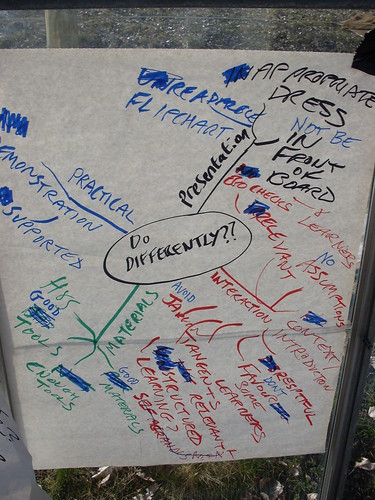
Do differently? - edited...When you observe the conversations and presentations at conferences and in organisations, they are very often stories about the past.
"We did this, we did that, this happened, we met these obstacles and through perseverance we achieved success"
It is possible to learn from these stories in a general sense, but often these stories are narrative and not reflective, they are history and not analysis, and it is from the reflection and the analysis that knowledge arises.

The question "If you were to do this again, what would you do differently next time?" is an excellent question to provoke reflection. It is a question that we use all the time in After Action Review and Retrospect, but it is one that you otherwise rarely hear at work, and almost never hear raised at conferences.

Many times people at work, or people at a conference, would ask each other “what did you do, how did you do X, how did you respond to Y”, and what they would get in reply would be, effectively, history. The replies would help you understand what the team did, but not understand whether this is a good thing to do, and bad thing to do or a random thing to do.

But if someone is asked “what would you do differently”, you can't answer with history; you have to answer with analysis and with insights.

The progression from Observations ("What we did and what happened") to Insights ("This is why things happened he way they did") to Lessons ("This is what I would do next time") is a process of analysis, and needs to be driven by questions - either questions from a facilitator or a third party, or by self-questioning.

History is not knowledge. It is analysis of history - reflection on history – that creates knowledge. We need to ask, not just “what did you do”, but also “with reflection, what would you do differently” if we are to get a true knowledge.


Monday, 17 July 2023

The KM strategy map - a visual link between KM and strategy

KM can be a crucial underpinning for business strategy. Here is a great way of showing how this can be delivered.


I am a firm believer in business led Knowledge Management Strategy.  Sometimes however we seem to lose sight of the KM/strategy link, and KM can then become relegated to a service function - something nice to have, but not strategic.

The KM strategy map is a way of  linking KM back to the business strategy, and showing that it has a crucial strategic role to play.


  First a bit of background to the strategy map itself.

A strategy map is an established way of mapping out the strategy of a company in a visual way, The approach was invented by Robert S Kaplan, and is well described in this 2004 HBR article and in his book Strategy Maps. A strategy map can be linked to Balanced Scorecard, and can be used to explain why a company is choosing the initiatives that it has.

The example above - a strategy map of Volvo Dealership -  is taken from one of Kaplans articles, and can also be found here. This map starts at the top with the vision, and works down, via elements of the strategy (in the example shown, growth and efficiency), then looks at the financial, customer, process and learning elements or objectives that support it.

Adding the Knowledge Management layer

As we know, Knowledge Management should be driven by the corporate vision and strategy, and should support the key activities that are needed to deliver that strategy. When Kaplan and Norton developed the ideas around strategy maps, KM was in its infancy and the "learning" elements were pretty generic (and to be honest, judging from examples, the learning elements are still pretty generic). 

What KM can do is make these less generic, more specific, and show how the elements of KM can directly support the business strategy.


As an example, I have added a Knowledge Management layer to the HBR "Volvo dealership" map. 

Please note this KM layer was not created in consultation with Volvo, nor does it reflect (other than by coincidence) what Volvo are doing in KM. Instead it is the sort of elements, and the sort of KM solutions, that you might be able to add at the bottom of a strategy map, that "flow upwards" to the corporate processes, strategy components, and vision. 

Sales and Marketing, for example, can be supported by more than generic "active participation, quality focused co-workers" etc; it could be supported by a Sales and Marketing CoP, actively developing and sharing ideas, solutions, good practices, with a knowledge base of past successful marketing materials and lessons. Similarly continued education of Volvo dealers can be supported by an online knowledge base, eLearning, and a dealers' community of practice. Risk handling could be supported by an effective lesson learning system.

Each KM intervention supports a process, which supports a customer and financial objective.

There are two advantages of this form of strategic map with a Knowledge Management layer;
  1. it helps the KM team to focus on those interventions that most directly support business strategy, and 
  2. it makes it clear to the business, and to Top Management,  how KM will help in delivering that strategy.

The KM strategy map can be a powerful tool in steering your KM program, and communicating to the leadership of the organisation the value you deliver.

Tuesday, 11 July 2023

How knowledge drives performance

There is a very close link between knowledge and performance, which is at the heart of any KM framework.


Knowledge results in performance. The more knowledge we have, the more capability we have, and the better we can perform. The more we learn from performance, the more knowledge we have. This puts us in a reinforcement cycle – a continuous improvement loop – continuously improving knowledge, continuously improving performance.

Conversely, if knowledge is missing, we do not know what to do, and make mistakes or slow down in order to learn, and performance suffers. 

We are all well aware of this link as it applies to us as individuals. The more we learn about something, the better we get, whether this is learning to speak Mandarin, or learning to ride a bicycle. The knowledge builds up in our heads and in our legs and fingertips, and forms an internal resource we can draw on.

It's much harder to make this link for a team, or for an organization. 

How do we make sure the organization learns from performance and from experience? How do we collect or store that knowledge for future access, especially when the learning takes place in many teams, many sites or many countries? How do we access the store of knowledge when it is needed, given that much of it may still be in peoples' heads?

This link, between knowledge and performance, is fundamental to the concept of knowledge management.  Knowledge management, at its simplest, is ensuring this loop is closed, and applied in a systematic and managed way, so that the organisation can continuously learn and continually improve performance.  In order to create this link and close the circle, the knowledge manager should

  1. Know what sort of organisational performance needs to be improved or sustained (and in some organisations this may not be easy - the performance requirements of public sector organisations, for example, may not always be easy to define);
  2. Know what knowledge is critical to that performance;
  3. Develop a system whereby that knowledge is managed, developed and made available;
  4. Develop a culture where people will seek for that knowledge, and re-use and apply it;
  5. Develop work habits and skills that ensure performance is analysed, and that new knowledge is gained from that performance (using processes such as lesson learning or After Action reviews);
  6. Set up a workflow to ensure that the body of knowledge is updated with this new knowledge; and
  7. Be able to measure both the flow of knowledge through this loop, and also the impact this has on performance.


That's KM at its simplest; a closed cycle of continuous learning and continuous performance improvement.

The complexities come in getting this loop up and running, in a sustainable way, in the crazy complex pressurised world of organisational activity.

But that's what they pay us Knowledge Managers for, right?  Dealing with those complexities. Designing the framework that closes the loop. Delivering the value;

ensuring that the best of existing knowledge drives the best possible performance, and that even better performance results in new knowledge.

Tuesday, 4 July 2023

Communities of practice and the "long tail of knowledge"

Part of the value of communities of practice is proividing access to the Long Tail of experience


There is a tendency in many companies to see Knowledge as being the province of the Experts.

As a result, they set up expert centres to look after the knowledge, and expert networks to share knowledge between experts around the organisation.

However one of the big culture shifts within Knowledge Management is the recognition that Knowledge is the province of all Knowledge Workers, not just the experts. Expert networks will access only a small part of the knowledge of the organisation, the remainder  (the "Long Tail") will be held by the non-expert Knowledge Workers.

Take the example shown in the graph here. The graph represents 50 workers within an organisation, with varying levels of experience from 30 years to 1 year. Initially the company decides that they will share knowledge by setting up a small network between the four experts - those with 15 or more years of experience (the red bars). Between them, these experts have 88 years of experience.

After a while, the company decides to replace the expert network with a full community of practice, where all 50 of the knowledge workers take an active role. The total years of experience within the community is now 274 - more than three times the experience than that held by the experts alone.

The value of this added experience comes when it is applied to knowledge in the work context. Knowledge is contextual - the application of knowledge changes on where it is applied, and when, and to what. The larger community has seen many more contexts, and the person who gives the advice is not necessarily the person with the longest experience, but the person with the most relevant context. Maybe that person has only been in the company a year or two, but if they have had relevant experience within that short time (particularly experience which is unusual or niche), they can answer questions, offer advice, and add real value based on their unique experience.

This is the concept of the long tail of knowledge.

The "long tail" is a term that has has gained popularity in recent times as describing the retailing strategy of selling a large number of unique items with relatively small quantities sold of each – usually in addition to selling fewer popular items in large quantities. The long tail of knowledge is a knowledge sharing strategy of offering a huge amount of knowledge transfer opportunities, with relatively small numbers of each particular question/answer exchange. It allows niche knowledge to be sought and found, provided the community of practice is large enough and broad enough.

Large online communities of practice allow access to the Long Tail.
Small expert groups access only the short head.

Tuesday, 27 June 2023

A different way to look at the Knowledge/Information divide

The relationship between knowledge and information has always been problematical. Here is a potential new way to look at it.


The Data/Information/Knowledge/Wisdom pyramid is a very common diagram in the KM world, but despite its ubiquity and simplicity it has many problems:
Why don't we set the DIKW pyramid aside, and also set aside the assumption that information and knowledge are somehow two mutually exclusive classes of the same sort of thing, and play with the idea that maybe information and knowledge are different sorts of thing, and not mutually exclusive. 

We can then draw a diagram such as the one below, dividing the world into Knowledge/Not Knowledge and Information/Not Information
At the top of this diagram are things that are Knowledge, and on the right are things that are Information. This gives us 4 quadrants.

  • Top left is Knowledge that is not Information. Here is Tacit knowledge; the things you know without realising. Also Implicit Knowledge (if you use that term) - the things you know and can express but have not yet expressed, or recorded, or documented.
  • Top right is Knowledge that is also Information. This is documented or codified knowledge - documents that transfer knowledge; that teach, instruct, advise, educate, and otherwise give people the ability to act. They contain the things you would say if you were to express your tacit knowledge. Here are your recipes, your tips and hints, your guidance notes, training material, best practices, standard operating procedures and checklists. 
  • Bottom right is Information that is not Knowledge. Here are records and documents that do not teach, instruct, advise, or educate. Here are minutes of meetings, or invoices, or contracts. 
  • Bottom left is everything else. Data sits in this box, but so do clouds and kittens and rocks.

Does this diagram work?

To test whether it works, try an analogy. Instead of Knowledge, write Music. You then have the 4 quadrants of "Music but not Information" which includes performed music, or music you hear in your head, "Music and Information" which includes sheet music as well as the files in your iPod, "Information but not music" which includes records and other sorts of files, and "Everything else".

There is a philosophical argument that Music is not Music until it is performed or played, and that in recorded form it is information containing a sort of "potential music"  (much as a battery contains potential energy), but this is unhelpful as it is, for sure, a specific type of information dedicated to the transmission of music. 

There is an identical philosophical argument that Knowledge is not Knowledge until it is held by a human, and that in recorded form it is information containing a sort of "potential knowledge"  (much as a battery contains potential energy), but this is unhelpful as it is, for sure, a specific type of information dedicated to the transmission of Knowledge.

Is this diagram helpful?

The diagram is helpful when it comes to mapping out the limits of Knowledge Management and Information Management, as shown in the diagram below.

Knowledge Management covers the top two boxes of the diagram, ensuring that the content of the knowledge and the conversations around this content are clear, accurate, comprehensive, valid, and helpful, and that this knowledge is accessible to those who need it, in the form they need it, and at the place and time they need it. 

Information Management covers the two right hand boxes, ensuring that the Information is structured, stored, owned, tagged, findable and retrievable.

In the top right hand box, documented knowledge is managed by both disciplines. Knowledge Management addresses the contents of the documents, while Information Management covers the containers - the documents and files themselves. Information Management and Knowledge Management are not mutually exclusive disciplines, they are overlapping disciplines.

I think that last point is the most valuable outcome of looking at information and knowledge in this different way; the point that Information Management and Knowledge Management are complementary and overlapping, that they overlap in the realm where knowledge is also information and information is also knowledge (even though you might argue it is Potential Knowledge), and that they manage this area in different ways.

With this view point we can avoid some of the dualistic and mechanistic thinking of the past, and start to understand how these two disciplines interact.


Monday, 19 June 2023

How and why to embed KM processes into an organisation

How can we embed Knowledge Management into the organisational process suite?


Complex BPMN 2 process in ARIS Express One of the aims of Knowledge Management Implementation is to develop and embed a Knowledge Management Framework, including building KM activities into business process. I thought I would expand a little on how to do this.

Most large organisations have pretty well-defined business processes. These may include
  • Marketing process
  • Sales process
  • New Product Development process
  • Manufacturing process
  • Packaging/distribution process
  • Project management process
  • Service-call resolution process
  • Staff development process
and so on. These processes consist of a series of steps or activities, often shown diagrammatically as a flow chart, like the example shown. Generally an organisation will expect its staff to follow the process steps. So if KM is embedded as a set of activities, then the organisation will expect these to be followed. KM therefore becomes a programmed expectation.

Embedding KM into these processes means putting Knowledge Management-specific activities into that flowchart.
  • You can start, by identifying where, within the business process, there is the greatest need for the team to acquire knowledge, and adding a "Knowledge Acquisition" step, such as Peer Assist, Lessons Review, Knowledge Site Visit, Collaborative work session, or a Knowledge Management Plan. There may be several such steps needed within the business process.
  • You can look at where,  within the business process, there is the greatest need for the team to create new knowledge, and add a "Knowledge Creation" step, such as Deep Dive, Think Tank, or Business Driven Action Learning.
  • Then you can look at where, within the business process, there is the greatest need for  the team to discuss and identify new knowledge acquired (for example through lesson learning. These will be steps which follow points where the greatest knowledge has been created, or the greatest learning acquired, and where you need to add a "Knowledge Capture" step. Some of these will capture knowledge for re-use by the same team, and may include small scale After Action Reviews. Some will capture knowledge and lessons for other teams, and may include Retrospect or the A3 process. Some may  include hand-over of knowledge to later stages in the project or product life-cycle, and may include Baton Passing or Knowledge handover. There may be several such steps needed within the business process.
  • You can also look at the staff development/staff lifecycle process, and identify steps where the individual staff member may need to gain or share knowledge. These could include, in the early stages of a career, the assignment of a mentor, or joining a relevant community of practice, or in the later stages, a knowledge retention program, or assignment as a subject matter expert or domain expert.
That is your starting point - looking at the flow of knowledge into and out of the process. You may eventually add other steps where needed.

The important thing is to 1) find knowledge management processes which work in your context, and 2) make sure those KM process appear, as little boxes, within the existing business process flow charts that your organisation already uses.

That way, KM will be applied as part of normal business.

Wednesday, 14 June 2023

How to balance a global approach to KM with different divisional needs

How can you implement a consistent approach to Knowledge Management, in a globally diverse company?


How much of  a Knowledge Management framework needs to be consistent around the globe, and how much can you vary on a local, or divisional, basis?

The answer is that you select certain global commonalities, but allow local expression of these. And the local expressions could be localised by geography or by corporate division.

There are several elements which need to be common, and applied globally.
  • Knowledge Management needs a common vision and a common definition (see blog post on example visions). That means that KM, across the whole global organisation, is trying to do the same thing.
  • Knowledge Management should employ a consistent approach to Communities of Practice. CoPs are  likely to be one of the elements that cross the corporate geographical and divisional boundaries, so a common and integrated CoP approach is important.
  • Knowledge Management should use a common global technology wherever possible. One set of Community software, one Yellow Pages, one search engine, one Portal, one Lessons Management System, one email system, and so on. However different functions and different divisions may need additional technology that meets their specific needs. 
  • Knowledge Management should be approached in the same way by Leadership. This will be expressed in a common KM Policy, and reflected in leadership expectations.
  • Knowledge management should apply a standard taxonomy and naming convention. Your product components, for example, should be referred to with the same names by product development, manufacturing, sales and service. This will allow KM to cover the whole product lifecycle. 

The elements which need to differ from division to division, are as follows.

  • Embedding KM processes into business process. Each division will work with a different process. (Ideally processes should be harmonised globally within each division - if not, then this can be one of the early tasks that KM helps with). Therefore KM will need to be embedded differently, in different steps in the process, and sometimes using different processes. The Sales process and the Project Management processes, for example, may be sufficiently different that each uses a partially different set of KM processes, embedding these processes in different places, even when the principles of "Learn before, during and after" should still apply. Projects may "Learn before" by doing KM planning at the project start, while Production may do KM planning on an annual basis. Projects may "Learn After" through holding Retrospects, Sales through using Knowledge Exchange. The principles are the same, the local expressions of those principles are tailored to the business process.
  • Embedding roles into the organigram. Each division will have a different organigram, so KM roles (which will be needed in all divisions - roles for knowledge creation and use, roles for knowledge ownership, roles for KM support) will be placed in different spots on the organigram. If the Projects division has a Project Management Office, for example, this could be the ideal home for the KM support roles for projects - the facilitators, the trainers, the lessons management team. If the Marketing division has regional hubs, this could be the ideal place for the KM support roles for marketing. And so on. 
  • Different specialist technology. Depending on the nature of the knowledge being applied, and the number of knowledge suppliers and users, different functions or divisions may need different KM technologies. Within R&D, for example, knowledge is evolving rapidly, and is held by a small number of people. They may find it useful to set up a wiki where they can collaborate on keeping knowledge constantly updated. on the other hand, the customer service department works with knowledge needed by thousands or millions of customers world-wide, and needs a knowledge base of reliable content where the customer agents (or even the customers themselves) can rapidly find answers to their questions. There are several vendors supplying this sort of technology. 
  • Different operational contexts. You see this most clearly where a company is providing products to major clients who have differing requirements, or where company lawyers are working in different countries with different regulatory systems. Here the knowledge itself will be local, varying with client or with country, but the KM system should still be global. Lawyers in one country, or engineers working with one client, may still be able to learn from knowledge gained in other contexts, which they can then modify to meet their own needs. 

So the implementation of Knowledge Management is set on global principles, and adapted to local settings. Getting this all set up and running comes from defining the Knowledge Management Framework and the Knowledge Management organisation

Monday, 29 May 2023

How to raise the profile of KM through stories; Knowvember at Fluor corp.

Fluor, the construction company, use the month of Knowvember" as an opportunity to publicise KM internally.


Fluor are an international engineering and construction company who have been applying a Knowledge management approach, based primarily on Communities of Practice, for well over 20 years. And with a long-running program such as this, it is easy for people to start to forget about KM, or take it for granted. Fluor have a powerful approach for keeping KM live in the corporate consciousness, described in a 2011 blog from Jeff Hester entitled "Successful KM storytelling".

Welcome to Knowvember.

Knowvember is an annual collection and celebration of KM success stories. It is a time when the Fluor offices sprout posters describing KM successes, chosen from submissions over the previous year. 

Each story has been collected - either informally and formally - from the various communities of practice and describes an example where knowledge was sought and shared, and where value was delivered to the organisation or to a client as a result. The stories come with pictures and quotes.

Then every year during the month of Knowvember the KM team reviews the stories shared over the past 12 months, and select a list of finalists. These are presented to a panel of C-level executives that select the winning stories. Jeff describes how "in 2010 we collected roughly 300 stories, culled this down to 20 finalists, from which the executives selected six winners. If your success story is selected as a winner, you get to select a local charitable organization to which a $500 donation is made in your name."

Although these stories are collected and publicised through the year, the annual one-month focus brings KM to the fore. As Jeff says

"During the final judging for the annual contest, the exposure these stories and the people involved get at a very high level of the organization serves two purposes: 
  • it provides recognition to folks who are often from far flung offices, and 
  • it reminds our executives of some very concrete ways KM strengthens and improves our company. 
And we’ve found that these stories provide the most tangible measure of the value of knowledge management — much more than the number of clicks and downloads".

Try a similar communication campaign at your organisation, focused on value stories. I could help keep alive and fresh the perception of KM as a value-delivery tool.

Monday, 22 May 2023

Why "learn before, during and after" is such a good KM model

"Learning before, during and after" is one of the oldest models in KM, and still one of the most useful.


Learning before, during and after was one of the early bywords for Knowledge Management at BP in the 90s - a simple and memorable mantra that project staff can grasp easily and quickly. It forms the basis for an operating philosophy for KM, and describes how Knowledge Management activities can be embedded  within the cycle of business activity.
The management of knowledge, like any management discipline, needs to be systematic rather than ad hoc, and needs to be tied into the business cycle. In any project-focused business, where business activities (projects) have a beginning and an end, knowledge can be addressed at three points.

  1. The project team can learn at the start of the project, so that the project begins from a state of complete knowledge (‘learning before’). This is where processes such as Knowledge handover and Peer Assist can be applied. 
  2. They can learn during the project, so that plans can be changed and adapted as new knowledge becomes available (‘learning during’), for example through the use of After Action Review.
  3. Finally, they can learn at the end of the project, so that knowledge is captured for future use (‘learning after’) and entered into the Lesson-Learned workflow.

These activities of "Learning before," "Learning during" and "Learning after" can become an expectation, or even a mandatory activity, for projects.  This model of ‘learn before, during and after’ was developed in BP during the 1990s, and was also developed independently in several other organizations. Shell refers to this as “Ask, Learn, Share”.

However, there is more to the model than the ‘learning before, during and after’ cycle. The knowledge generated from the project needs to be collated, synthesised, and stored as Knowledge Assets (guidance documents such as SoPs, or Wiki-based guidance) in order that knowledge deposited in the “knowledge bank” at the end of the project becomes more useful when accessed at the start of the next project. Communities of Practice need to be established to manage and share the tacit Knowledge Assets.

This five component framework (learning before, learning during, learning after, synthesis of knowledge into Knowledge Assets, and building Communities of Practice) is a robust model which creates value wherever it is applied.

Blog Archive