Showing posts with label re-use. Show all posts

Friday, 21 September 2018

Why knowledge re-use is such a barrier in KM

Unless knowledge is re-used, KM adds no value. Why is this final step so hard, and what can we do about it?



Roger
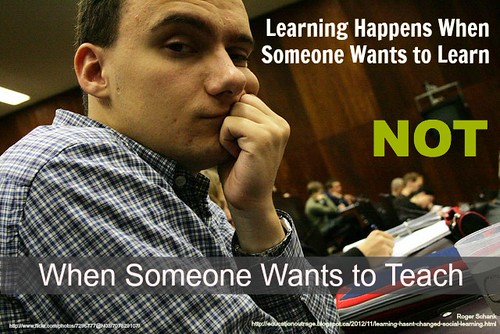
Roger by ZapTheDingbat, on Flickr
I was having a great conversation with a Knowledge Manager recently, who was grappling with the final, and most difficult, step in the Knowledge Transfer process, the step of knowledge re-use (what Nonaka and Takeuchi call the Internalisation step).

She had a great system of collecting knowledge, and a great system for synthesising knowledge, and when she showed the knowledge to the users they said "Wow, great, that's very useful", but when she asked them later whether they had actually used the knowledge, they said No.

We had a look at the reasons behind this. There were several blockers -

  • The knowledge was not to hand when they needed it - they needed to go look for it
  • They had no time to go looking for the knowledge
  • They may not trust the provenance of the knowledge
  • The knowledge did not solve an immediate pain, but was more of a long term benefit (see blog post on why some ideas spread and others don't). 
  • They could get away with doing things the way they had always done, even though the new way was better.
If we want knowledge workers to re-use knowledge, then 
  1. The knowledge should be available to them (or better - presented to them) at the point and time of need
  2. Ideally the knowledge should be built into process and procedure, and this procedural guidance should be available at the point and time of need
  3. There should be a culture of checking the procedures, just as an airline pilot goes through their checklist before take-off
  4. The knowledge should be usable
  5. They should be able to see a clear link between their experience and learning (and the learning of others like them) and the creation of the new knowledge.  
  6. They need to be assured, and need to believe, that the new knowledge or the updated procedure is the best available. 
  7. They should be clear that their peers, managers and stakeholders expect them to to use the knowledge
  8. there may need to be coaching or encouragement in he use of the new knowledge. The new knowledge should be built into training plans
  9. Then the knowledge worker's manager may need to check whether the new knowledge was used
  10. Failure of a task through not following the current procedures (and therefore the most up to date knowledge) should be treated as a serious breach.

Knowledge re-use is far harder than just giving people access to a site or a document. It's tricky, it's hard work, and it is the step where many KM programs fall.


Monday, 17 August 2015

Why I don't like "steal with pride"

You often come across the phrase "Steal with Pride" in a Knowledge Management context.  It means "don't be ashamed to take ideas from others" but it is a phrase that can easily backfire if you are not careful.


The phrase is used to overcome people's reluctance to learn, and their suspicion (from school days) that "copying answers from someone else is cheating".

To the extent that the phrase overcomes this cultural barrier it is useful, but the word that is most loaded and can easily backfire on you is "steal"

Re-use of knowledge should not be theft, and labelling it as theft is dangerous. Knowledge in an organisation should be donated willingly, shared openly, and re-used with acknowledgement and credit.

It is the acknowledgement and credit that makes the difference between knowledge re-use and knowledge theft. Knowledge theft is when someone else takes your material, or your idea, or your knowledge, or your practice, and passes it off as their own.  People hate that - they hate seeing their knowledge or their material being stolen and someone else getting all the credit.  As Terry Pratchett says in "Unseen Academicals", its a short step from Adopt, Adapt, Improve to Steal, Use, and Look Innocent.

Knowledge sharing and reuse is great, provided due credit and acknowledgement is given.

This is not theft, this is intellectual recycling. In all the knowledge assets and knowledge bases and lessons learned systems we are involved with, we make sure that the name of the orginator stays with the knowledge, and that they get credit for sharing.  Their knowledge remains theirs, even when re-used by others.


Reuse with pride; yes.

Reuse with acknowledgement, re-use with credit, re-use with thanks.

But don't steal.

Tuesday, 9 December 2014

KM Attitude, Habit, Framework - a story

I blogged recently about what Knowledge Management looks like when embedded, and suggested it was an Attitude, a Habit and a Framework. Here is a short real-life story that shows what I mean. 

The story is told by a drilling engineer, involved in planning and drilling oil wells on an offshore platform. Here he is describing how he shared knowledge with other parts of the organisation. The knowledge exchanged during this story has now been adopted as standard practice, and has delivered savings adding up to many millions of dollars to the organisation.

We can see the elements of Attitude, Habit and Framework illustrated in the story column, as described in the Interpretation column. 

Story
Interpretation
"On our platform, we typically use (and here he goes into details of a particular engineering solution), because this eliminates a whole step in the process which typically saves us 3 to 5 days".This sentence is an introduction and explains that the team had valuable knowledge to share. Saving 3 to 5 days time may be worth more than $1 million.
"One day while I was writing the final well report, I was reviewing this process and I realised that this was the first time we had used this combination"
Habit. Part of the habitual process used by this organisation is to review operations, in this case as part of an end--of-well-report, which includes a review of lessons.
Attitude. Recognising the fact that the team had learned something new, the engineer immediately assumes that this knowledge will be useful to others.
 "I thought that I should put this on the KM system, because it might have interest to other business units".
Framework. This organisation operates a complete framework, including a Lessons Management system for sharing good practice and lessons, and also assigning roles and accountabilities. The engineer knew that he was accountable for recording the new knowledge.
"The day after I placed this learning on the system, someone from (a business unit in another continent) wrote me an email asking for procedures and reference runs, and I sent it all off the next day".
Framework. The Lessons Management system contained the facility for notifying other teams working in a similar context. Within a day, this new knowledge had travelled around the globe.
Attitude. The other team immediately realised that knowledge from elsewhere may well be extremely valuable, and so got in touch to request more details. 
"Two days  later (another business unit) sent me an enquiry saying they were also interested in such applications, and I was more than happy to help".
Attitude. The engineer recognised the value of knowledge exchange, and so was "more than happy to help".

Monday, 10 February 2014


Everything is a remix


The big learning from music is that Everything is a Remix - see below


That could be the mantra for Knowledge Management as well.

There is no need to reinvent everything. Re-use it instead.

If you can remix existing knowledge, then do it. If Led Zeppelin weren't bothered by "Not Invented Here", then why should we be?

Most knowledge is a re-mix of something old, something new, something borrowed (thanks Quandora for this quote)

Don't build from scratch - embrace the remix.

Friday, 27 September 2013

The knowledge supply chain; lessons as "the car parts of knowledge"

This post is a combination of three ideas, to see if they come up with something new.
Idea number 1 - the idea of an organisation as a knowledge factory, sparked by Lord Browne's quote - "anyone in the organization who is not directly accountable for making a profit should be involved in creating and distributing knowledge that the company can use to make a profit" 
Idea number 2 - the idea that corporate process is a compilation or synthesis of all the lessons learned over time 
Idea number 3 - the idea that we can treat knowledge management as a supply chain, designed to get the right knowledge to the right people at the time they need to make decisions.

So the combination idea looks like this (based on an image from here).


This is a supply chain where components are manufactured, and assembled into products (like a car plant, or a construction site).

In our analogy, we have lessons from experience being assembled into continuously improving corporate processes, rather like car parts are assembled into cars.  The links within this chain are as follows

  1. The raw materials for the supply chain are the experiences of the individuals in the workplace, who are trying to apply the processes in different contexts, in a changing world.
  2. The supplier of the raw materials therefore are the individuals themselves.
  3. Experiences are manufactured into lessons through processes of analysis and discussion - team meetings such as Retrospects, and After Action Reviews. Through discussion and analysis, individual unconscious knowledge is made conscious, and the experiences of many individuals are combined into the lessons of the team or the lessons from an event. These lessons are the components - the car parts within the supply chain. 
  4. Now we get into the Distribution part of the supply chain. We need to get those parts to the assembly plant. This is a part where many Lessons learned systems break down, They leave those parts (lessons) in the warehouse (database), and expect people to come and find them (remember that scene from raiders of the Lost Ark?). We need instead to have active lessons management, to push the lessons to those who need them.
  5. Those who need them are (primarily) the people in charge of corporate process, who need to keep those processes fresh and updated as new learning comes in. The Process owners, or SMEs.
  6. However that is not the end of the story. The assembled knowledge needs to get to the consumer - though the equivalent of car showrooms (community portals), or supermarkets (Intranets) or street markets (wikis).
  7. The consumer is the knowledge worker. They apply the new knowledge, and in doing so, gain new experience. 
And so the cycle begins again.


Wednesday, 25 September 2013


Why so much Learning After, so little Learning Before?


Learning Happens One of the standard models for Knowledge Management is the idea of "Learning Before, During and After".

Ideally these three activities should be embedded in project process, so that a project
  1. Starts by reviewing and accessing all the knowledge it needs,
  2. Learns as it goes, improving its processes during the course of the project, and
  3. Identifies, analyses, documents and shares the new knowledge it has gained, for the sake of future projects. 
For the project itself, the most powerful of the three is "Learning Before". If a project can maximise it's knowledge up front, especially if the team can discover the things it doesn't know that it doesn't know, then success is much more likely.

And yet, when you look at internal company project frameworks, or even at  generic frameworks such as Prince 2 or ISO, there is almost always no trigger or requirement for Learning Before.

Prince 2 has a required, and well documented, step at the end, for creating lessons (although this could be much improved!), but has no step at the project start-up, requiring a search for, and review of, existing knowledge. 

This astounds me. Why even bother to collect lessons at the end of a project, if nobody reviews them at the start of the next project!

I think the answer is that it is psychologically easier to share than it is to learn.  A project team can feel proud and recognised (even a little smug at times) for sharing lessons, while asking for lessons can feel like an admission of incompetence ("can anyone help me with this?"). 

Learning After is Teaching - Learning Before is Learning, which is Much Harder.

You get around some of these barriers by introducing non-judgemental techniques such as Peer Assist and Knowledge Management plans, which take the exposure out of asking for help, or seeking for knowledge. And you also address it by developing a culture of Asking, rather than a culture of Sharing.

However I suspect that if 80% of companies require their projects to do some sort of Learning After, probably less than 10% require them to do Learning Before. 

Wednesday, 11 September 2013


Knowledge re-use - the final and most difficult step


Roger I was having a great conversation with a Knowledge Manager today, who was grappling with the final, and most difficult, step in the Knowledge Transfer process, the step of knowledge re-use (what Nonaka and Takeuchi call the Internalisation step).

She had a great system of collecting knowledge, and a great system for synthesising knowledge, and when she showed the knowledge to the users they said "Wow, great, that's very useful", but when she asked them later whether they had actually used the knowledge, they said No.

We had a look at the reasons behind this. There were several blockers -

  • the knowledge was not to hand when they needed it
  • they had no time to go looking for the knowledge
  • they may not trust the provenance of the knowledge
  • the knowledge did not solve an immediate pain, but was more of a long term benefit (see blog post on why some ideas spread and others don't). 
  • they could get away with doing things the way they had always done, even though the new way was better.
If we want knowledge workers to re-use knowledge, then 
  1. the knowledge should be available to them (or better - presented to them) at the point and time of need. 
  2. The knowledge should be usable, and 
  3. they should be able to see a clear link between their experience and learning (and the learning of others like them) and the creation of the new knowledge.  
  4. They need to be assured, and need to believe, that the new knowledge is the best available. 
  5. They should be clear that their peers, managers and stakeholders expect them to to use the knowledge, and 
  6. there may need to be coaching or encouragement in he use of the new knowledge. 
  7. Then the knowledge worker's manager may need to check whether the new knowledge was used.

Knowledge re-use is far harder than just giving people access to a site or a document. It's tricky, it's hard work, and it is the step where many KM programs fall.


Blog Archive