Showing posts sorted by date for query confirmation bias. Sort by relevance Show all posts

Monday, 23 May 2022

Is that really tacit knowledge, or could it be cognitive bias?

Is that really Tacit Knowledge in your head, or is it just the Stories you like to tell yourself?


IMAGINATION by archanN on wikimedia commons
All Knowledge Managers know about the difference between tacit knowledge and explicit knowledge (or at least they think they do!), and they know the difference between the undocumented knowledge you hold in your head, and documented knowledge which can be stored.   We often assume that the "head knowledge" (whether tacit or explicit) is the Holy Grail of KM; richer, more nuanced, more contextual and more actionable than the documented knowledge.

However the more I read about (and experience) cognitive bias and the failures of memory, the more suspicious I become of what we hold in our heads.

These biases and failures are tendencies 1) to think in certain ways that can lead to systematic deviations from good judgement, and 2) to remember (and forget) selectively and not always in accordance with reality. We all create, to a greater or lesser extent, our own internal "subjective reality" from our selective and flawed perception and memory. Some of this might be real knowledge, some might not.

Cognitive and memory biases include:

  • Confirmation bias, which leads us to take on new "knowledge" only when it confirms what we already think;
  • Gamblers fallacy, which leads us to think that the most recently gained knowledge is more important;
  • Post-investment rationalisation, which leads us to think that any costly decisions we made in the past must have been correct ("we spent a lot to learn that, so the knowledge must be correct");
  • Observational selection bias, which leads us to think that things we notice are more common that they are (like when you buy a yellow car, and suddenly notice how common yellow cars are);
  • Attention bias, where there are some things we just don't notice (see the Gorilla Illusions);
  • Memory transience, which is the way we forget details very quickly, and then "fill in the gaps" based on what we think should have happened;
  • Misattribution, where we remember things that are wrong;
  • Suggestibility, which is where we create false memories.

So some of those things in your head that you "Know" may not be knowledge at all. Some may be opinions which you have reinforced selectively, or memories you have re-adjusted to fit what you would have liked to happen, or suggestions from elsewhere that feel like memories. Some of them may be more like a story you tell yourself, and less like actual knowledge.

Do these biases really affect tacit knowledge? 

Yes they really do, and they can affect the decisions we make on the basis of that knowledge.  Chapter 10 of the 2015 World development Report, for example, looks at cognitive biases among development professionals, and makes for interesting reading.

While you would expect experts in the World Bank to hold a reliable store of tacit knowledge about investment to alleviate poverty, in fact these experts are as prone to cognitive bias as the rest of us. Particularly telling, for me, was the graph that compared what the experts predicted poor people would think, against the actual views of the poor themselves. 

The report identifies and examines 4 "decision traps" that affect the development professionals and influence the judgements that they make:

  • the use of shortcuts (heuristics) in the face of complexity; 
  • confirmation bias and motivated reasoning; 
  • sunk cost bias; and 
  • the effects of context and the social environment on group decision making.

And if the professionals of the World Bank are subject to such traps and biases, then there is no guarantee that the rest of us are any different.

So what is the implication?

The implication of this study, and many others, is that one person's "tacit knowledge" may be unreliable, or at best a mish-mash of knowledge, opinion, bias and falsehood. There is a risk that knowledge from one person's is unreliable, unless tested somehow. As Knowledge Managers, there are a number of things we can do to counter this risk.

  1. We can test Individual Knowledge against the knowledge of the Community of Practice. The World Bank chapter suggests the following: "group deliberation among people who disagree but who have a common interest in the truth can harness confirmation bias to create an efficient division of cognitive labor. In these settings, people are motivated to produce the best argument for their own positions, as well as to critically evaluate the views of others. There is substantial laboratory evidence that groups make more consistent and rational decisions than individuals and are less likely to be influenced by biases, cognitive limitations, and social considerations. When asked to solve complex reasoning tasks, groups succeed 80 percent of the time, compared to 10 percent when individuals are asked to solve those tasks on their own. By contrast, efforts to debias people on an individual basis run up against several obstacles, and when individuals are asked to read studies whose conclusions go against their own views, they find so many flaws and counterarguments that their initial attitudes are sometimes strengthened, not weakened". Therefore community processes such as Knowledge ExchangePeer Assist and general community discussion can be ideal ways to counter individual biases.
  2. We can routinely test community knowledge against reality. Routine application of reflection processes such as After Action review and Retrospect require an organisation to continually ask the questions "What was expected to happen" vs "What actually happened".  With good enough facilitation, and then careful management of the lessons, reality can be a constant self-correction mechanism against group and individual bias.
  3. We can test the knowledge against other viewpoints. Peer Assist, for example, can be an excellent corrective to group-think in project teams, bringing in others with potentially very different views. 
  4. We can combine individual memories to create a team memory. Team reflection such as Retrospect is more powerful than individual reflection, as the team notices and remembers more things than any individual can.
  5. We can codify knowledge. Lean as codified knowledge is, it at least acts as an aide memoire, and counteracts the effects of memory transience, misattribution and suggestibility. 
But maybe the primary thing we can do is to stop seeing individual tacit knowledge as being safe and reliable, and instead start to concentrate on the shared knowledge held within communities of practice.  

Think of knowledge as Collective rather than Individual, and you will be on the right track.

Monday, 22 November 2021

Why knowledge is social, not personal, and the implication of this view for KM.

There is a school of thought that knowledge lies only in the minds of individuals. I think this is misleading, and that reality is both more complex than this, and more interesting.


A search of the internet will find  a commonly held view in KM circles that Knowledge only exists in the brains of individuals.  

"Knowledge is in the mind" people might say, "and all else is information".  Thomas Wilson argues this point in his provocative paper "the nonsense of Knowledge Management", which was written as a polemic against the way Information Management was rebadged Knowledge Management by software vendors and consultants (a process described by Wilson as "search and replace marketing").

This viewpoint suggests that any way that an individual can find to express knowledge (spoken words, written words, recorded demonstrations) just turns it into information, and that any management applied to this process can only be information management.

Certainly the view of knowledge as a human attribute is very useful as a way of distinguishing knowledge management from information management. However I feel that this view focuses too much on the individual, and that in reality knowledge is not an individual attribute, but something shared and social.  (Please note that in this blog, I use the word "social" to mean related to interactions and relationships between people, rather than as a type of media).

The social nature of knowledge

To introduce this topic, I can do no better than to repeat the words of the great Larry Prusak, spoken at RostatomKM 2016

A key point that we (and by we, I mean the collectivity of practitioners and researchers) have learned is that Knowledge is profoundly social. It is not a factor of the individual but a factor of groups of people. Individuals may have separate memories, but do not have separate Knowledge. 

Larry's point is that Knowledge is a collective thing. The "tacit knowledge" we hold in our heads is either invented by ourselves or comes from the collective, and what we invent for ourselves is at best provisional knowledge, and at worst delusion. It can include

  • opinions
  • hypotheses
  • prejudices
  • cognitive biases
  • fantasies
  • falsehoods.

What turns these opinions etc. into knowledge is social confirmation and acceptance.

You think you might know something, but it could so easily be confirmation bias, and you don't know this until you start to test it with others. 

We see this clearly in the development of scientific knowledge. As part of the scientific method individual scientists develop and test hypotheses, but before these hypotheses are accepted as knowledge, they go through a process of peer review and socialisation. As the UK Parliament site explains

Peer Review is the means by which scientific experts in the field review the output from this process for validity, significance, originality and scientific clarity. Peer review is not, as some outside of science might think, designed to be a fraud detection system. Therefore in our view Peer Review and the subsequent publishing of research is only part, albeit an important one, of how new discoveries become accepted into our collective scientific knowledge.

That last sentence is important - "collective scientific knowledge". There is no such thing as "individual scientific knowledge", and you could argue, as Larry Prusak does, that there is no "individual knowledge" either.

Plato defined knowledge as "justified true belief", which means there needs to be a justification mechanism which can judge "truth". Self-justification by the knower makes no distinction between truth and opinion, and between knowledge and bias. It is the social group that justifies knowledge.

Note however that just because a social group confirms something, does not yet make it knowledge. There are many people in the USA for example who "know" that the world is run by a cabal of devil-worshiping paedophiles, or who "know" that Covid vaccination programs are a tool for government control. Most of us recognise this knowledge as false delusion, but these people "know" they are correct because their views are confirmed by others on the internet. Therefore social justification is not enough to make something knowledge - that justification needs to be continually tested (something that is very difficult to do when confirmation bias is involved). 

The implications for Knowledge Management


This alternative viewpoint - that knowledge is social and is held by groups of people rather than by individuals - still distinguishes knowledge from information, but takes us away from the individual human as the unit of analysis for Knowledge management. Here is Larry Prusak again;
There is much greater emphasis on Networks, Communities and Practices, and I state today that this is the correct unit of analysis if you want to work with knowledge in organisations: Networks, Communities and Practices.

This has five main implications:

  • You need to define your Knowledge Management Framework so that the primary "knowledge unit" is the practice area, and the networks and communities of practice are the mechanisms by which knowledge is shared and managed. This is the approach we take at Knoco when building Knowledge Management Frameworks, and we know that it works.
  • Much of the knowledge work you do will not be concerned with individuals or with documents, but with the interactions between people working in social groups. It is within these interactions (Peer Assists, Retrospects, Knowledge Exchange) that knowledge is built, tested and justified.
  • Documented knowledge should be owned and managed by the communities and networks. They should manage the wiki sites where knowledge is compiled and kept up to date (I mention wiki sites because wikis are, by design, created by ad managed by communities and networks.
  • The collective knowledge should always be open to challenge and testing, in case the community has fallen into a trap of confirmation bias.
  • You will find that the main culture change is getting people to see knowledge as something collective, to be built and maintained socially, rather than their own personal property to be protected and hoarded. 

Try this alternative social-centric viewpoint - I think you will find it very powerful.


Monday, 9 September 2019

Watch confirmation bias in action

Confirmation Bias is one of the most pernicious cognitive biases, and is a major challenge to Knowledge Management. See it in action below.

Confirmation bias is a powerful cognitive bias, which means that people

  1. Tend to select evidence that supports what they already believe, and 
  2.  Set up tests that confirm their believe, rather than test it.
You can see how this would be a thorn in the side of KM. How do you know whether what you are dealing with is Real Knowledge, or Fake Knowledge - an opinion which has been reinforced through selective evidence and only confirmatory testing?

Below is a short video of a team exercise to expose confirmation bias, which is also an excellent example of confirmation bias in operation. I explore further later down the page. 


In the 5 rounds of the game, the facilitator provided a set of names that fit a rule, and the participants suggested other names, and then estimated their confidence that they knew what the rule was.


Round Names Provided Names Added (all deemed correct) Confidence level
1 John Adams, Thomas Jefferson, George Washington Alexander Hamilton, James Madison, Andrew Jackson, John Hancock 76%
2 Abraham Lincoln Ben Franklin, U Grant, T roosevelt, JFK 53%
3 Martin Luther King Columbus, Jesus, Nelson Mandela, Rosa Parks 56%
4 Ghandi Mother Teresa, Julius Caesar, Mohammed (PBUH), Saddam Hussein 64%
5 Philip Seymour Hoffman Golda Meir, Fidel Castro, Michael Jackson, Amy Winehouse 76%

For example, in round 1 the three names provided will be familiar to Americans as "Founding fathers", or signatories to the Declaration of Independence. All the names suggested/added by the participants were also founding fathers, and the group was 76% sure that the rule was "Founding Fathers"

As the facilitator added more names, it became clear that these were not all founding fathers. 
  • Maybe (round 2) they were "Famous American political figures (male)" 
  • Maybe (rounds 3 and 4) they were "Famous political/religious figures (male or female)"
  • Maybe (round 5) they were "Famous dead people"
However - notice one important thing

All (or almost all) the suggested names were confirmatory. They conformed to the rule that the participants thought was in operation.

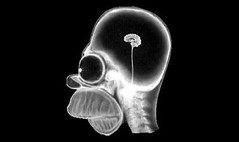
In no case did anyone suggest a name that tested the rule, only names that fitted the rule. Each suggested name, each test of the rule, was already inside the set they had already defined.  Nobody said "Donald Trump" (to test whether the person had to be dead), or "My granny" (to test whether the person had to be human), or "Homer Simpson" (to test whether the person had to be real), or "Ming Ming the Panda" (to test whether the person had to be human).

The only example of a test I can see in this list, rather than a confirmation, is when someone suggested Rosa Parks, even though all other names to date had been male. This was a true test.

People prefer to confirm, rather than to test. 

Also note how confident the group were with their first guess at the rule, back at the time when the sample set was smallest and when they were most wrong. Then as new names were added, their confidence fell, then rose again. But maybe they are still wrong - maybe if we added Donald Trump, Homer Simpson and Ming Ming the Panda, these would be correct as well. Maybe the rule is "sentient beings, alive or dead."

The lessons for Knowledge Management are these;

  • If everything seems to conform with what you "know" - beware confirmation bias; especially when your sample set is small.
  • Just because you are confident of what you know does not mean you are right. 
  • If you want to test whether your knowledge is correct, don't seek for confirmatory examples, seek for counter-confirmatory examples. Test, don't just confirm,
  • The first valid counter-confirmatory example must result in a re-think of what you know.
  • All of this is difficult; as humans we are programmed to seek confirmation, not to test theories. 

Beware of confirmation bias - its more pernicious than you think 


Friday, 6 September 2019

Why leaving knowledge in people's heads is not a great strategy

The default approach to managing knowledge which many companies use, is to keep knowledge in people’s heads, and to move the knowledge where it is needed by moving the people, not by transferring the knowledge. 


In this old model, knowledge is owned and held by the experts and the experienced people. Knowledge is imported to projects by assigning experienced people as members of the project team.
Knowledge is transferred from site to site by transferring staff, and by using company experts who fly around the world from project to project, solving problems. Knowledge is stored for the long term in the heads of the experts.

This is a very traditional model, but it has many major failings, and cannot be considered to be effective knowledge management.  Imagine if you managed your finances in this way! Imagine if the only way to fund a project was to transfer a rich person onto the project team, or to fly individual millionaires around the world to inject funds into the projects they liked!


The major drawbacks of this default ‘knowledge in the heads’ approach are as follows:
  • Experienced people can only be on one project at a time, whereas knowledge management can spread that experience to many projects. 
  • Knowledge cannot be transferred until people are available for transfer. 
  • Experts who fly in and fly out often do not gain a good appreciation of how things are done, and where the good practices lie. In particular, teams in projects may hide their failings from the company experts, in order to be seen in a good light. 
  • The burn-out potential for these experts is very high. 
  • Knowledge can become almost ‘fossilised’ in the heads of the experts, who can end up applying the solutions of yesterday to the problems of today 
  • When the expert leaves, retires, has a heart attack, or is recruited by the competition, the knowledge goes with them. 
Unfortunately, for the experts and the experienced people, this can be an attractive model, and was stereotypical behaviour for specialist engineers for many years. It can be very exciting travelling the world, with everyone wanting your assistance. It is like early Hollywood movie scenes with the US Cavalry riding over the horizon to save the wagon train at the last minute. Knowledge management, however, would make sure that the wagon train did not get into trouble in the first place. As one experienced engineer said recently, ‘If you could fly off to some problem project, save the day and be a hero, or sit behind your desk and capture knowledge, what would you do?’

However if that engineer's knowledge had been more widely available, perhaps the project would not have become a problem in the first place.

Don't keep the knowledge in a few heads, spread it through the organisation instead.  Build communities of practice to store and share the knowledge. Document what you can in accessible, findable and digestible content. Change the role of the expert, from being the knowledge hodler, to becoming the facilitator and steward of the knowledge framework on their particular topic - ensuring that the organisation is knowledgeable, rather than being knowledgeable themselves.

If you are serious about knowledge, then don't leave it only in the heads of experts. 

Tuesday, 30 July 2019

Does KM need an official Devil's Advocate role?

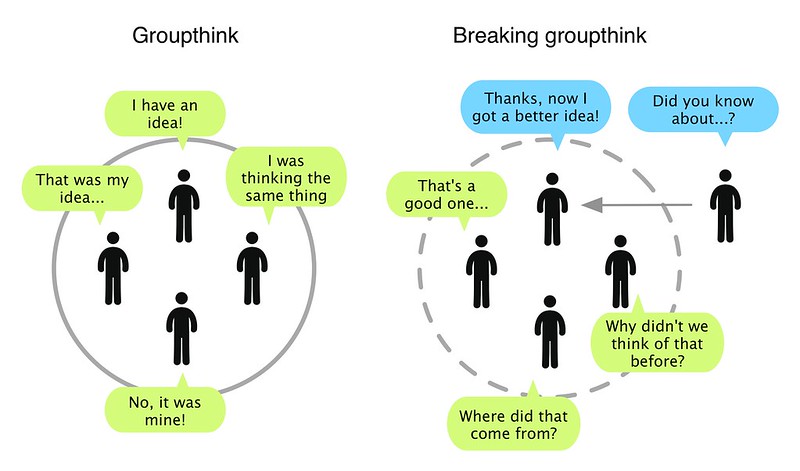
KM is beset by cognitive biases such as Groupthink. Maybe the Devil's Advocate role is needed to help combat this?


The biggest impediments to learning in an organisation are mental impediments, driven by cognitive biases.  These include the confirmation bias (where we only accept evidence that confirms what we think), and GroupThink; aka conformity bias (where the desire for harmony or conformity leads group members to minimize conflict and reach a consensus decision without critical evaluation of alternative viewpoints).

If you combine these two, you end up with a powerful immovable force, whereby a group becomes entrenched in their thinking.  People inside the knowledge bubble are convinced they are correct, and immune to learning or to new knowledge that contradicts what they think. They cannot learn. They are stuck.  This results in a Knowledge Bubble -  the classic example being the Bush Administration who, convinced that Saddam Hussein was the primary threat, refused to countenance warnings about Osama Bin laden.

But if Group-think is such a potent threat to learning, and thus to KM, whose job is it to prick the Knowledge Bubbles?

This interesting post from Tech Crunch called "The VP of Devil's Advocacy" might just have the answer.

One solution (and here the Tech Cruch quotes from the movie World War Z) is
"The tenth man. If nine of us look at the same information and arrive at the exact same conclusion, it’s the duty of the tenth man to disagree. No matter how improbable it may seem, the tenth man has to start thinking with the assumption that the other nine are wrong".
The original scene is below.


This is an illustration from Hollywood, but it is based on a real group - the Devils Advocates Office in Israeli intelligence - described here as follows
The devils advocates office ensures intelligence assessments are creative and do not fall prey to group think. The office regularly criticises products coming from the analysis and production divisions, and writes opinion papers that counter these department's assessments. The staff in the devils advocate office is made up of extremely experienced and talented officers who are known to have a creative "out of the box" way of thinking".
The Devils Advocates Office is an excellent and systematic defence against the perils of group-think.

An alternative approach, taken by many project management organisations, is what they call "The Black Hat review" - a destructive review questioning the assumptions underlying a proposal or a planned project. Often the Project Management Office takes this Black Hat role, which can counter the wishful thinking that besets many projects.


In sports, Bill Simmons calls this role "The VP of common sense"

I'm becoming more and more convinced that every professional sports team needs to hire a Vice President of Common Sense, someone who cracks the inner circle of the decision-making process along with the GM, assistant GM, head scout, head coach, owner and whomever else. One catch: the VP of CS doesn't attend meetings, scout prospects, watch any film or listen to any inside information or opinions; he lives the life of a common fan. They just bring him in when they're ready to make a big decision, lay everything out and wait for his unbiased reaction.

When you think about some of the crazy decisions taken by companies, and the even crazier ones taken by governments, it makes you think that this sort of systematic challenge should be institutionalised more often.

Perhaps more organisations should have a VP of Devils Advocacy, a Chief Black Hat, or a VP of common sense, to act as "The Tenth Man"

Someone whose role and accountability is to be the Chief Pricker of the Knowledge Bubbles.

Tuesday, 20 November 2018

What you need to know about social tools and KM

Here is a very interesting article from HBR entitled "What managers need to know about social tools" - thanks to Anshuman Rath for bringing it to my attention.  It's well worth a complete read.


Image by Codynguyen1116
on wikimedia commons
The article by Paul Leonardi and Tsedal Neeley, from the Nov/Dec issue of HBR last year, looks at the way companies have often introduced social tools - often because “Other companies are, so we should too” or “That’s what you have to do if you want to attract young talent”  - and describe some of the surprising outcomes.

Here are some of the points the article makes, with excerpts in quotes:

  • Use of these tools make it easier to find knowledge, through making it easier to find knowledgeable people.
"The employees who had used the tool became 31% more likely to find coworkers with expertise relevant to meeting job goals. Those employees also became 88% more likely to accurately identify who could put them in contact with the right experts"

  • Millenials are not keen adopters of enterprise social tools.
"Millennials have a difficult time with the notion that “social” tools can be used for “work” purposes (and are)wary of conflating those two worlds; they want to be viewed and treated as grown-ups now. “Friending” the boss is reminiscent of “friending” a parent back in high school—it’s unsettling. And the word “social” signals “informal” and “personal.” As a 23-year-old marketing analyst at a large telecommunications company told us, “You’re on there to connect with your friends. It’s weird to think that your manager would want you to connect with coworkers or that they’d want to connect with you on social media [at work]. I don’t like that.”

  • How people present themselves on internal networks is important to developing trust.
"How coworkers responded to people’s queries or joked around suggested how accessible they were; it helped colleagues gauge what we call “passable trust” (whether somebody is trustworthy enough to share information with). That’s important, because asking people to help solve a problem is an implicit admission that you can’t do it alone".

  • People learn by lurking (as well as by asking).
"Employees gather direct knowledge when they observe others’ communications about solving problems. Take Reagan, an IT technician at a large atmospheric research lab. She happened to see on her department’s social site that a colleague, Jamie, had sent a message to another technician, Brett, about how to fix a semantic key encryption issue. Reagan said, “I’m so happy I saw that message. Jamie explained it so well that I was able to learn how to do it.”

  • The way social tools add value to the organisation and to the individual is to facilitate knowledge seeking, knowledge awareness, knowledge sharing and problem solving. The authors give many examples mostly of problem-solving, and about finding either knowledge or knowledgeable people. One example saved a million dollars, and i will add that to my collection of quantified value stories tomorrow.

  • The value comes from practice communities. The authors do not make this point explicitly, so perhaps I am suffering from confirmation bias here, but they talk about the "spread of knowledge" that they observed as being within various groups covering practice areas such as marketing, sales, and legal.

The authors finish with a section on how to introduce the tools, namely by making the purpose clear (and the purpose may be social, or it may be related to knowledge seeking and sharing), driving awareness of the tools, defining the rules of conduct, and leading by example.

The article reminds us again that social tools can add huge value to an organisation, but need careful attention and application. Just because Facebook and Twitter are busy in the non-work world, does not mean similar tools operate the same way at work.

Monday, 2 October 2017

Fact-checking in Knowledge Management

Fact-checking is an unfortunate part of political life, but what is its role in Knowledge Management?

Image from wikimedia commons and IFLA
Fact checking - the act of checking factual assertions in non-fictional text in order to determine the veracity and correctness of the factual statements in the text - is here to stay in the world of news media. Every political statement, especially those from politicians known to "bend the truth", is subjected to independent checks, sometimes by the newspapers and broadcasters themselves, and sometimes by independent bodies.

Sometimes the disputes over the veracity of statements turns into a dispute between fact-checkers, as in this story from Forbes magazine;

"I was sitting in the Hong Kong airport and watching Chris Matthews interview Republican presidential candidate and U.S. Rep. Michelle Bachmann, of Minnesota, about a number of topics. Bachmann had been in the news that week because she had claimed that, "now we have the federal government … taking over ownership or control of 51 percent of the American economy." Matthews couldn't resist jumping on the statement, noting that MSNBC’s fact checkers couldn't come up with anything close to that number. Bachmann flippantly replied something like, and I’m paraphrasing, “Well, Chris, you have your fact checkers and I have mine. I think I’ll go with mine.”

Facts are important if people are to make correct decisions, whether this is in politics or in organisations, and it is organisations where Knowledge Management comes in. If organisational knowledge is to be used to support effective decisions making, then that knowledge needs to be based on factual evidence.

Facts and KM

Although we might cynically anticipate the need to check facts in politics, where politicians have long bent facts to their own ends, things are different in organisations. The issue we need to deal with is not political bias, but cognitive bias. All of us are human, and all of us are prone to effects such as confirmation bias (which leads us to select observations that reinforce what we already think) and attention bias (where we often fail to notice things we are not looking for).

These biases mean that what we record in our knowledge bases and knowledge assets can be as much opinion as fact, or even prejudice and misconceptions.

So how do we deal in facts, when applying Knowledge Management within an organisation?


  • Firstly when creating knowledge assets, we address the issue of validation. Generally the community validates, either through discussion and dialogue, or through co-creation of material and co-editing of wikis or collaborative documents. As Peter Kemper said in my Lessons Learned Handbook, "A Wiki should be self correcting. The moment I write something wrong, people all over the company will notice and become alarmed".
  • Secondly in our customer-facing knowledge bases, the contact agents will constantly testing every article to see if it answers the customers problem, and will flag, review or correct content which they find to be wrong. The watchword is "Re-use is Review" - knowledge is tested in re-use and corrected where wrong. 
  • In community of practice discussions, we again allow the community to self-validate. If someone posts an incorrect answer into a discussion forum, members of a mature and trusting community will quickly offer corrections. If there is diagreement, the community can talk this through. 
  • Then in After Action reviews and Lessons Learned meetings, we discuss what actually happened, and aim firstly for ground truth, and secondly for root cause analysis. Where people express opinion, we ask for the stories on which the opinions are based, and we look for the factual core of the story, before we look for interpretation.
  • The lesson learning system is also where the knowledge assets are tested and reviewed in use. Many times, the action associated with a lesson will be to correct, edit or update the relevant knowledge asset. 

So we rely on analysing evidence at the source of knowledge creation, and on validation and self-correcting mechanisms within the wikis and knowledge bases.

Validation and fact-checking is important in Knowledge Management, because knowledge management which is not founded on fact, but on opinion, is not knowledge management at all.


Monday, 20 March 2017

Tacit Knowledge and cognitive bias

Is that really Tacit Knowledge in your head, or is it just the Stories you like to tell yourself?


IMAGINATION by archanN on wikimedia commons
All Knowledge Managers know about the difference between tacit knowledge and explicit knowledge, and the difference between the undocumented knowledge you hold in your head, and documented knowledge which can be shared.  We often assume that the "head knowledge" (whether tacit or explicit) is the Holy Grail of KM; richer, more nuanced, more contextual and more actionable than the documented knowledge.

However the more I read about (and experience) cognitive bias and the failures of memory, the more suspicious I become of what we hold in our heads.

These biases and failures are tendencies to think in certain ways that can lead to systematic deviations from good judgement, and to remember (and forget) selectively and not always in accordance with reality. We all create, to a greater or lesser extent, our own internal "subjective social reality" from our selective and flawed perception and memory.

Cognitive and memory biases include

  • Confirmation bias, which leads us to take on new "knowledge" only when it confirms what we already think
  • Gamblers fallacy, which leads us to think that the most recent events are the more important 
  • Post-investment rationalisation, which leads us to think that any costly decisions we made in the past must have been correct
  • Sunk-cost fallacy, which makes us more willing to pour money into failed big projects than into failed small projects
  • Observational selection bias, which leads us to think that things we notice are more common that they are (like when you buy a yellow car, and suddenly notice how common yellow cars are)
  • Attention bias, where there are some things we just don't notice (see the Gorilla Illusions)
  • Memory transience, which is the way we forget details very quickly, and then "fill them in" based on what we think should have happened
  • Misattribution, where we remember things that are wrong
  • Suggestibility, which is where we create false memories

So some of those things in your head that you "Know" may not be knowledge at all. Some may be opinions which you have reinforced selectively, or memories you have re-adjusted to fit what you would have liked to happen, or suggestions from elsewhere that feel like memories. Some of them may be more like a story you tell yourself, and less like knowledge.

Do these biases really affect tacit knowledge? 

Yes they really do, and they can affect the decisions we make on the basis of that knowledge.  Chapter 10 of the 2015 World development Report, for example, looks at cognitive biases among development professionals, and makes for interesting reading.

While you would expect experts in the World Bank to hold a reliable store of tacit knowledge about investment to alleviate poverty, in fact these experts are as prone to cognitive bias as the rest of us. Particularly telling, for me, was the graph that compared what the experts predicted poor people would think, against the actual views of the poor themselves. 

The report identifies and examines 4 "decision traps" that affect the development professionals and influence the judgements that they make:

  • the use of shortcuts (heuristics) in the face of complexity; 
  • confirmation bias and motivated reasoning; 
  • sunk cost bias; and 
  • the effects of context and the social environment on group decision making.

And if the professionals of the World Bank are subject to such traps and biases, then there is no guarantee that the rest of us are any different.

So what is the implication?

The implication of this study, and many others, is that one person's "tacit knowledge" may be unreliable, or at best a mish-mash of knowledge, opinion, bias and falsehood. As Knowledge Managers, there are a number of things we can do to counter this risk.

  1. We can test Individual Knowledge against the knowledge of the Community of Practice. The World Bank chapter suggests that "group deliberation among people who disagree but who have a common interest in the truth can harness confirmation bias to create “an efficient division of cognitive labor”. In these settings, people are motivated to produce the best argument for their own positions, as well as to critically evaluate the views of others. There is substantial laboratory evidence that groups make more consistent and rational decisions than individuals and are less “likely to be influenced by biases, cognitive limitations, and social considerations”. When asked to solve complex reasoning tasks, groups succeed 80 percent of the time, compared to 10 percent when individuals are asked to solve those tasks on their own. By contrast, efforts to debias people on an individual basis run up against several obstacles (and) when individuals are asked to read studies whose conclusions go against their own views, they find so many flaws and counterarguments that their initial attitudes are sometimes strengthened, not weakened". Therefore community processes such as Knowledge Exchange and Peer Assist can be ideal ways to counter individual biases.
  2. We can routinely test community knowledge against reality. Routine application of reflection processes such as After Action review and Retrospect require an organisation to continually ask the questions "What was expected to happen" vs "What actually happened".  With good enough facilitation, and then careful management of the lessons, reality can be a constant self-correction mechanism against group and individual bias.
  3. We can bring in other viewpoints. Peer Assist, for example, can be an excellent corrective to group-think in project teams, bringing in others with potentially very different views. 
  4. We can combine individual memory to create team memory. Term reflection such as Retrospect is more powerful than individual reflection, as the team notices and remembers more things than any individual can.
  5. We can codify knowledge. Poor as codified knowledge is, it acts as an aide memoire, and counteracts the effects of transience, misattribution and suggestibility. 
But maybe the primary thing we can do is to stop seeing individual tacit knowledge as being safe and reliable, and instead start to concentrate on the shared knowledge held within communities of practice.  

Think of knowledge as Collective rather than Individual, and you will be on teh right track.

Wednesday, 21 December 2016

How KM deals with "We don't like to write things down"

A few times I have worked with organisations who say "We don't like to write things down in this organisation". So how do you address this in your KM program?

Image from "The writers advice" blog
This happened to me again a couple of weeks ago. "People here are not keen on writing" I heard - "documenting knowledge is the wrong approach" - "we need more conversations between people" - "the best place to store knowledge is in the heads of the experts". 

All these people I was speaking with had a good point. Documents are far less rich as a source of knowledge than experts, and reading is a far less efficient way of gaining knowledge than dialogue. I estimated in a previous blog post than transferring knowledge through writing is 14 times less effective than transferring through conversation.

So why is any knowledge documentation needed? Could I not say to this organisation "Yes, don't bother writing anything down - just build the conversations through which knowledge is transferred"?

The truth is that documentation and conversation (or content and conversation) are not an either/or choice; more of a both/and, and there are some cases where documentation is safer in the long run than storing knowledge in memories. Memories have the following flaws;
  • Memories fade over time, even though we think they don't. The "illusion of memory" is a real thing, which needs to be taken into account in KM - you cannot trust a "fact" that has been stored in human memory alone for more than a few months.
  • There are false memories. People remember things clearly, which never happened; for example the story of the journalist who publicly accused George Bush of making a statement which in fact he had not done.  This is "misremembering".
  • There are other human cognitive biases that distort memory. The confirmation bias is very strong, for example, leading people to select examples which support the opinions they already have. All of us are subject to this bias, even our best experts. 
  • Groups of people can form knowledge bubbles; a strong form of confirmation bias where facts and knowledge counter to views held by the group are just filtered out. Witness Brexit, for example.
  • Memories are held in heads, heads are attached to legs, and legs will eventually walk out of the building, never to return.

So on the one hand there is human memory which - as rich and nuanced as it is - contains much that is opinion, bias, prejudice, or just plain false. 

On the other hand we have documented knowledge - sparse, lacking in detail, cumbersome to create and digest, but immutable. 

How do you choose which route to take? And how do you get an organisation that doesn't like writing, to start recording knowledge?

I answer the first question in this blog post, where I suggest that the times to leave knowledge in the heads of people are

  • if there is limited demand for it;
  • if the expert is guaranteed not to forget (ie the knowledge is in constant use)
  • if the expert is guaranteed to stick around 
  • if the practitioners - expert and novice - are connected
  • if there is enough openness and challenge in the organisation that the knowledge bubbles will not form.
In all other cases, the knowledge should be written down. But if the organisation really does not like to write, how do you capture the knowledge? 

You have to find out why they don't like to write, and then find some way to address this barrier. 

  • If there is a cultural barrier, such as fear of exposure, perhaps you can keep the written knowledge confidential among the practitioners)
  • If there is a lack of writing skills, perhaps you can use knowledge champions or lessons facilitators to do the documenting
  • If there is a lack of language skills, maybe you ask people to capture knowledge in their native language, and translate it later
  • If they don't feel they have the time to write down knowledge, then it is a question of asking management to raise the priority of knowledge work.

If you are going to build a robust KM program, then you need to get people writing, as well as just remembering.

Tuesday, 7 January 2014


Risks and advantages of Just In Time Knowledge


Just In Time, 5/365 by Finstr
Just In Time, 5/365, a photo by Finstr on Flickr.
An interesting blog post here (thanks Barbara Fillip for the notification) got me thinking about the advantages and disadvantages of Just In Time Knowledge.

I am a believer in Just In Time Knowledge.

I believe that people are not receptive to knowledge, until they actually need it.

I believe that knowledge transfer works far more effectively through Pull (where people seek for knowledge when they need it) than Push (where people send out knowledge in the hope that someone might need it).

However the article (which is talking about Just In Time Information, rather than Knowledge, but the principles are the same) points out a risk. The risk is that when we are most in need of a decision, we are least discerning about the quality of the knowledge we receive, and the risk is that we pick up on what is new and what is different and what is current, and miss out on what is old and what is established.

You can see this most clearly when it comes to seeking knowledge from Communities of Practice. If the CoP has no "long term memory" (in the form of community knowledge bases, or community "established wisdom"), then the answers to any query come from the short-term knowledge of the CoP. They come from what is at the top of people's awareness, namely the things that have happened the most recently.

As the article says, "The worst time to look for information is when we need it to make a decision. When we do that we’re more likely to see what’s unique and miss the historical context. We’re also more likely to be biased by what is available".

The human brain, as we have pointed out many times on this blog, is not the ideal storage medium for knowledge. Challenges such as the illusion of memory, the illusion of confidence, the illusion of knowledge, the confirmation bias, the triumph of optimism over experience, all make the unsupported human memory unreliable.

Once we lose the long term written memory, and start relying on short term memory, we enter the world of Repeat Mistakes, where changes made to fix things, are unmade in future as the long term memory fades, as old staff move on, and as new people come in with bright ideas and no historical context.  So people change things, only to find that old problems re-emerge.

So what does this mean for Just In Time knowledge?

It means that the principle of driving Knowledge Sharing by Pull is fine, but that Organisations and Communities of Practice need to focus on long-term organisational memory as well as short-term organisational memory.

It means that Communities of Practice can hold knowledge not just in their collective brains and consciousness, but in their collective history and collective Experience Base.

It means that we need to address both Connect and Collect - Connecting People and Collecting Knowledge - in order to give secure decision support to the Just In Time requests.

Blog Archive