An interesting Forrester blog highlights some of the risks of process automation
image from wikimedia commons
We live in a world where automation is beginning to impact knowledge work, in the same way that it impacted manual work in the last century. On the one hand this is great news for organisations, as it can potentially revolutionize the productivity of the knowledge worker. On the other hand it brings risk.
One attractive opportunity is process automation, where a process that a human used to operate can become automated. The rules, heuristics and knowledge applied by the human can be extracted, using various knowledge management techniques, and turned into an algorithm which a computer or robot can use.
So a job like drafting a will, or cooking a meal, or monitoring a refinery, can be automated. Human knowledge is converted into algorithms, and the know-how that a human used to employ is passed to a machine which will reproduce the logic faithfully, tirelessly, without error, and for a fraction of the lifetime cost.
The problem of course is that know-how is not enough, and we also need know-why. The know-how is great in a predictable environment, but the know-why is needed once you move into uncharted territory.
That's one of the messages given in this Forrester blog entitled "Ghost In The Machine? No, It’s A Robot, And It Is Here To Help". The author, Daniel Morneau, is an advisor on the Technology council, and writes in the blog about robotic process automation, the benefits it will bring, and the governance it will need.
He also quotes one Industry leader who identifies a risk he had not anticipated:
"The hard lesson I learned is that once that knowledge is built into the bot and the employee goes out the door, it’s gone forever,” he said...“We captured the process in the code, right? I mean, the bot knows how to follow the process; we’ve just lost the business logic behind it”
When Moreau asked him what he would do differently, having learned this lesson, he replied
"I’d document the business logic where I can (and) I’d find a way to keep the best employees whose roles are being replaced so their deep understanding of the business logic can be available as we continue to support our businesses. I mean, the business function that that system is used for is not going away, and having employees who have a deep understanding of our business is the hardest thing to hire for".
So that's an interesting conclusion about the need for human knowledge of business logic.
We may increasingly outsource some of the know-how to the robots, but we still need to retain humans with the know-why.
I have been working in Knowledge Management for a long time now, and the history of KM includes examples of one technology after another claiming that it will replace KM or make it obsolete.
Yet KM is still here.
In the 1990s, it was Expert Systems that would make KM obsolete
Then in the late 90s, it was Groupware that would replace KM
Then Enterprise Search would be the saviour of KM
In the mid 200s, Social networking became the new trend that would supercede KM ("Social is the new KM")
And of course SharePoint - "all you need for KM"
Then came Enterprise 2.0, and Enterprise Social. They would become the new KM
In 2015 I met a purveyor of Semantic Search wearing a T-shirt reading "John Snow may not be dead, but knowledge management is". Made obsolete by his technology, obviously.
And now Big Data and AI and Chatbots and IBM Watson are set to "make KM obsolete".
Yet KM is still here.
All of these technologies have found their place within the KM toolbox over the years, and they have certainly made certain elements of KM work much faster and much more easily, while making little difference to other elements.
Yet KM as a discipline is still needed.
Enterprise search, for example, makes it far easier to find documented knowledge, but you still need KM to ensure the knowledge is documented in the first place. Enterprise Social Media makes it far easier to set up conversations within a community of practice, but you still need the community of practice in the first place, with its roles, processes, culture, and stores of shared knowledge. Semantic search makes it far easier to retrieve content in context, but content is only half of the content/conversation duo, and retrieval is only half of the supply/demand duo, and technology is only one of the four legs on the KM table, so there is far more to KM than just search.
All of these technologies make KM faster and easier, but none of them replace KM.
Even AI will not replace KM.
AI is a game-changer, for sure. It makes it possible to make new and rapid correlations from within massive datasets, but someone has to create the datasets, and clean them, and then train the AI, and then interpret the correlations and draw knowledge from what they observe (because we all know correlation is not causation). As I posted here, in the context of Big Medical Data at the European Bioinformatics Institute,
Big Data does not become Knowledge because of it's size - people have to add Knowledge to the data to make sense of it. The huge data resources of the EBI have to be combined with the specialist knowledge of the staff, and the application of the knowledge is the sense-making step
Also AI and Big Data still only work in the realm of documents, information and data, and in the processes of analysing and retrieving; they don't help with the transfer and creation of knowledge through conversation, or with tacit knowledge. So AI will be a massively powerful tool in the KM toolbox, but it won't replace the toolbox. We will need the roles and the processes and the governance to interplay with the technology. KM shifts up a gear, but still will be needed.
So call me an old grouch, but to date none of the new technologies touted as "the killer of KM" have made KM obsolete, and history suggests that neither will AI. And neither will the new technology that comes along in 5 years time. They will simplify, disrupt, and accelerate KM, but not replace it.
To the extent that people need to use knowledge to make decisions and judgments, then Knowledge Management will be augmented by technology, but not replaced.
How will the development of Artificial Intelligence affect the role of the Knowledge Manager?
There is a lot of discussion on Artificial Intelligence as part of Knowledge Management, and the use of powerful computing to replace the reliance on experts. As discussed here, the expert, in a rule-based scenario, is seldom better than a smart computer, and the computers are closing the gap that remains. Is there still a role for KM and the Knowledge manager as the computers get smarter?
Take the vision below, from an IBM Watson TV commercial.
Here the company expert, Jack, is on holiday and is replaced by Watson, who can give advice just as good as Jack's, and in some cases, in Jack's own words. Engineers using Watson can "access 30 years of experience in seconds" according to the commercial, which is exactly what we are seeking for in KM. Knowledge which used to live only in the expert engineer's head is now available to all at the point of need. Knowledge, through the application of AI, has become common property, easily accessed.
The benefits of this use of AI are considerable (please note that I am not, in this post, addressing the use of AI to search for correlations and patterns in big datasets; I am looking more at the retrieval of actionable advice).
As a result, the knowledge workers get quicker access to better knowledge, the organisation is protected against the loss of experts and the risk of problems onsite, and more can be done with fewer people.
It is probably inevitable that the number of knowledge workers will decrease as this sort of AI-related augmentation is used more and more. Think for example of the reduction in support-centre staff as the use of AI chatbots and technology such as Watson is used to answer customer queries, rather relying on human staff drawing on a Knowledge Base platform.
But what about the knowledge managers? Will they still have a job in the new world?
Yes, they definitely will.
AI like Watson in the video above interrogates structured and unstructured information, and rapidly retrieves an answer to a question, providingthat answer in the context of the enquirer. But someone has to make sure the knowledge is in the system already, and much of it is not. Even if it is in the system, the AI needs the language to be able to understand the question and to retrieve possible answers, and to have algorithms tuned well enough to judge the right answer. So the Knowledge Manager may have some or all of the following jobs to do:
Capture the tacit knowledge in the first place. In many organisations, much or most of the crucial knowledge is still in people's heads, and therefore completely inaccessible to AI. Some of it may never be captured. In the video above, how do you think Jack's knowledge became accessible to Watson? Not through trawling Jack's emails, but through a well-planned knowledge elicitation exercise, involving the skills of knowledge management.
Add the events which have not yet happened. This is another class of "knowledge not yet captured". In the example above, the records will be full of data and information related to the normal running of the plant, but will rarely have much on operations "outside the envelope" - when something has gone wrong. I remember a knowledge capture session I did once with a senior engineer, and he told me his favourite way to train new guys was to give them out-of-the-box examples to work with. "Imagine pump 3 has stopped, pipe 7 is running at 500 degrees, and there's smoke coming from the turbines. What do you do? Watson would not know what to do unless the knowledge manager puts examples like this into the dataset.
Clean the knowledge base. The biggest problem with AI is poor data, and AI starts with clean data. AI retriving knowledge starts with clean knowledge, and thats a job for the knowledge manager, as most knowledge bases I have seen are decidely unclean. For example a Watson-like AI acting as a chatbot answering customer queries needs a clean, reliable and constantly updated knowledge base just as much as contact centre agents do, and the knowledge manager makes sure that the knowledge base is managed well.
Build the ontology. Semantic search such as Watson's relies on a really good ontology, so Watson can make sense of the question, and can identify classes of answers from the existing documentation. Who will write the ontology? The knowledge manager will, with the help of the experts.
Oversee the training. AIs need to be trained, and this can be a big job. As this KM World article points out, "it is reported that it took a core team of 20 researchers to build Watson’s Jeopardy-beating machine (along with a strong support team to aid in those efforts). Likewise, the AlphaGo team spent 18 months researching the very complex game of Go (with 20 core researchers publishing their paper in Nature)".
Tune the algorithm. Not every AI has got the algorithm right, and a wrong algorithm can be a disaster. Microsoft shut down a bot called Tay after pranksters pushed it to make racist, sexist and pornographic remarks, for example. At the time of writing, AI needs a lot of guidance before it can work on its own.
Continually improve the knowledge supply chain. New knowledge comes in all the time. This needs to be added to the knowledge base. The performance of the company needs to be tracked, and you need to look at the lessons. Sometimes the AI needs tweaking. All of these things are jobs for the knowledge manager.
There are also circumstances where AI doesn't yet work well.
"Machine learning works best in an environment with rules and huge numbers of data points. That might work with cars driving through heavy traffic governed by laws, or with achieving the best price for selling a big block of shares.
It might not work well in deciding where to invest a hedge fund’s money, for example, or recommending products to customers without much previous data to go on. The minute things get fuzzy—either due to a lack of rules, an unclear evaluation of success or a lack of data—artificial intelligence performs poorly".
In a fuzzy and complex world, you are out of the realm where experts, expert systems and AI function well. Here you need the knowledge networks and the communities of practice, who can draw on their collective tacit experience. And helping build and sustain these networks is part of the role of the knowledge manager. AI can do nothing with tacit knowledge.
The number of knowledge managers in the AI world may well increase, not decrease.
Knowledge managers, and allied disciplines such as content managers and data scientists, will quite possibly be in greater demand if the use of AI increases as some commentators predict. For example, according to the bloomberg article quoted above
"These limitations (of AI) mean it’s not yet clear that the cost of automation will be offset by savings in human capital. Hiring a data scientist can cost more than $200,000, according to Bloomberg News. Flight-bookings company Amadeus has 40 of them. Siemens says it has more than 200 A.I. specialists running various projects. And even Silicon Valley has its grunt workers: Facebook is hiring 3,000 content moderators, on top of 4,500 existing ones. A.I. cheerleader Amazon has 341,000 employees—three times the number it had in 2012".
AI does not mean that knowledge management is dead, and the knowledge manager is out of a job. It adds a new and powerful technology to the knowledge managers arsenal, and changes the nature of some of the knowledge manager's tasks and adds new ones, while other tasks remain just as they were.
It looks like AI is not going to replace the knowledge managers, content managers and data scientists, at least not in the short term!
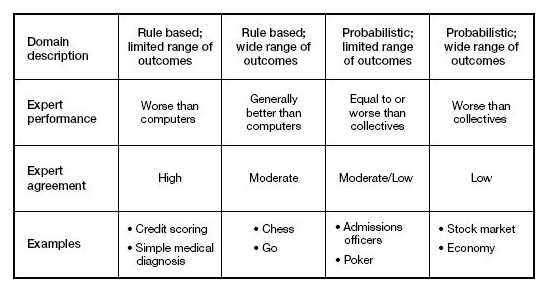
The premise of the blog post, based on the book Think Twice: Harnessing the Power of Counterintuition by Michael Mauboussin, was that "as networks harness the wisdom of crowds, the ability of experts to add value in their predictions is steadily declining. This is the expert squeeze".
The blog uses the diagram above to show that where prediction is needed, the Expert is often beaten by expert systems, and never better than a collective view.
Does this mean "the death of the expert"? In the new connected world, do the experts have a role, or are they squeezed out?
We have addressed this issue already on this blog (for example here and here) where we recognise that a Community of Practice will ideally always contain more knowledge and experience than any one expert. This results in a shift in the expert's role. From being the "font of all knowledge" they become the "stewards of knowledge". Stewardship is different from ownership - a steward maintains and nurtures something that is not theirs, for the benefit of others.
The exerts can take on a Knowledge Management role that involves becoming a Practice Owner or Practice Steward for their domain of practice, and playing a coaching an supporting role in the relevant Community of Practice. They also share their own knowledge through coaching, training, and contributions to the Community, and take technical roles on difficult and challenging pieces of work where they can apply, with wisdom, the knowledge of the community.
The point which the diagram above does not make, is that the Expert becomes a critical part of the collective. Without the experts taking part in the collective, the collective can become "the blind leading the blind". We have seen this in one large organisation, with huge communities in which the experts take no part as they are "too busy". Not only are questions in the communities not answered (or answered with platitudes), the experts deride the communities as having no relevance.
So let us recognise the new world, where the crowd can be smarter than any single expert. so long as the experts are given a new role within the crowd, and feel themselves to be stewards of the knowledge within the collective.
One of the most common and most famous "big data" stories is around Walmart and it's analysis of sales data. According to the New York Times in 2004 -
A week ahead of the storm's landfall, Linda M. Dillman, Wal-Mart's chief information officer, pressed her staff to come up with forecasts based on what had happened when Hurricane Charley struck several weeks earlier. Backed by the trillions of bytes' worth of shopper history that is stored in Wal-Mart's computer network, she felt that the company could "start predicting what's going to happen, instead of waiting for it to happen," as she put it.
The experts mined the data and found that the stores would indeed need certain products - and not just the usual flashlights. "We didn't know in the past that strawberry Pop-Tarts increase in sales, like seven times their normal sales rate, ahead of a hurricane," Ms. Dillman said in a recent interview. "And the pre-hurricane top-selling item was beer."
I would disagree with the New York Times. I think that what the data-mining experts found was Information in the form of a Correlation. The Knowledge would come in knowing what to do with that information (Knowledge, after all, being what enables correct action).
What would you do, dear reader, if you were a Walmart Executive who had been given this information on beer and pop tart sales? What action would you take?
The New York times suggests that the stores would be stocked with extra supplies of these items when hurricane warnings were first announced.
This article suggests that store managers were told to put their Pop-Tarts near the store entrances during hurricane season (Pop Tarts, for the non-US reader, are a brand of rectangular, pre-baked pastries made by the Kellogg Company. Pop-Tarts have a sugary filling sealed inside two layers of cardboard-like pasty, and are designed to be cooked within an electric pop-up toaster, therefore being an unlikely snack when power outages are forecast. Or perhaps you dip them in your beer).
You could even consider raising the margin on these items, following the principles of supply/demand pricing.
The problem with the three approaches above is that the public is very suspicious of anything that might be interpreted as Profiteering. If Walmart is perceived to be making additional profit through public concern about imminent hurricanes, then the publicity backlash could be damaging. The Information found as a correlation within the big dataset must be treated with care.
As Peter Drucker said, "Information only becomes knowledge in the hands of someone who knows what to do with it" and luckily Walmart has the knowledge they need to use this information wisely.
As a result WalMart is seen as a lifesaver, and it's disaster response procedure has been compared favourably with that of FEMA. They have won the hearts of the public, and of the administrators. Walmart are winning on three counts. They have plenty of data, they analyse this data to derive information, and they have knowledge (based on experience and codified in best practice) that allows them to take the correct actions. It is that knowledge that allows them to know what to do with the information they receive.
Knowledge, Information and Data; usually linked, often confused, not the same.
Part of the confusion, I have argued, comes from a deficiency in the English language, which uses the same word Knowledge for two different concepts; the accumulation of facts, and the accumulation of Know-how. Where other languages use different words for these concepts, we use the same word.
For me, it is Know-how that has the greater value, and it is KM focused on Know-how that delivers the greatest breakthroughs and the greatest impact to organisations. Know-how gives you the ability to act and to make correct decisions, while the accumulation of facts is closer to Information Management. The accumulation of facts without the know-how leaves you "better informed, but none the wiser".
Now "Big Data" enters the scene, and we see many people claiming that Big Data is part of Knowledge Management, because through Big Data we can gain added insight.
My argument is that Big Data is still data and needs data management rather than being included under knowledge management, and this is neatly illustrated in an article from this week's issue of New Scientist magazine entitled "Too Much Information" and bearing the interesting subtitle "What can you do with 9.8 million DVDs worth of data? Anything .... but you'll still need the know-how".
Big Data and Knowledge at the EBI
The article describes the data within the European Bioinformatics Institute, which houses sequences genome data from all over Europe totalling many petabytes. The sheer size of the database creates problems when it comes to storing, handling and transferring it, but the real issue comes when trying to make sense of it, and draw conclusions from it.
As New Scientist says
"The people who work at the EBI are the jewels of the institution. The work attracts a certain kind of person ... a breed of researchers who are very multidisciplinary and willing to focus on the broader impacts of their work in biology, computing and statistics....'A lot of this is very specific to malaria parasites' says (Olivio Miotto of the Centre for Genomics and Global Health). 'It requires a lot of knowledge about malaria as well as statistics' ".
This is a picture of people applying Knowledge (knowledge of malaria and of statistics) to Big Data in order to make sense of it, and to draw out potential actions.
Big Data does not become Knowledge because of it's size - people have to add Knowledge to the data to make sense of it. The huge data resources of the EBI have to be combined with the specialist knowledge of the staff, and the application of the knowledge is the sense-making step.
Data plus Knowledge = Action.
Data in itself does not lead to action, without the knowledge being applied. You manage the data itself through data management techniques, and you manage the knowledge itself through knowledge management techniques, and the two together give massively powerful actionable results. Big Data and KM should work hand in hand, but not be treated as the same thing.
A final word from New Scientist, my clarifications in brackets
"You (ie the knowledgeable scientist) have to work on the translation (of the data) to make it actionable - condensing terabytes into a single sentence.
This is great fun. It is where science is happening right now - you can really start to understand the genetic drivers behind both rare and complex diseases in a way that was unthinkable four or five years ago".
"This is the most comprehensive book I have ever read on the implementation of knowledge management. Whether you are just starting out or a seasoned professional, it is all here. Absolutely a first-rate reference." (Robert H Buckman, retired Chairman and CEO, Bulab Holdings, Inc)
I am a director for Knoco, the international firm of knowledge management consultants, offering a range of knowledge management services, including knowledge management strategy, knowledge management framework development, and knowledge management implementation services.
I also have an interest in Lessons Learned



 Posts
Posts


